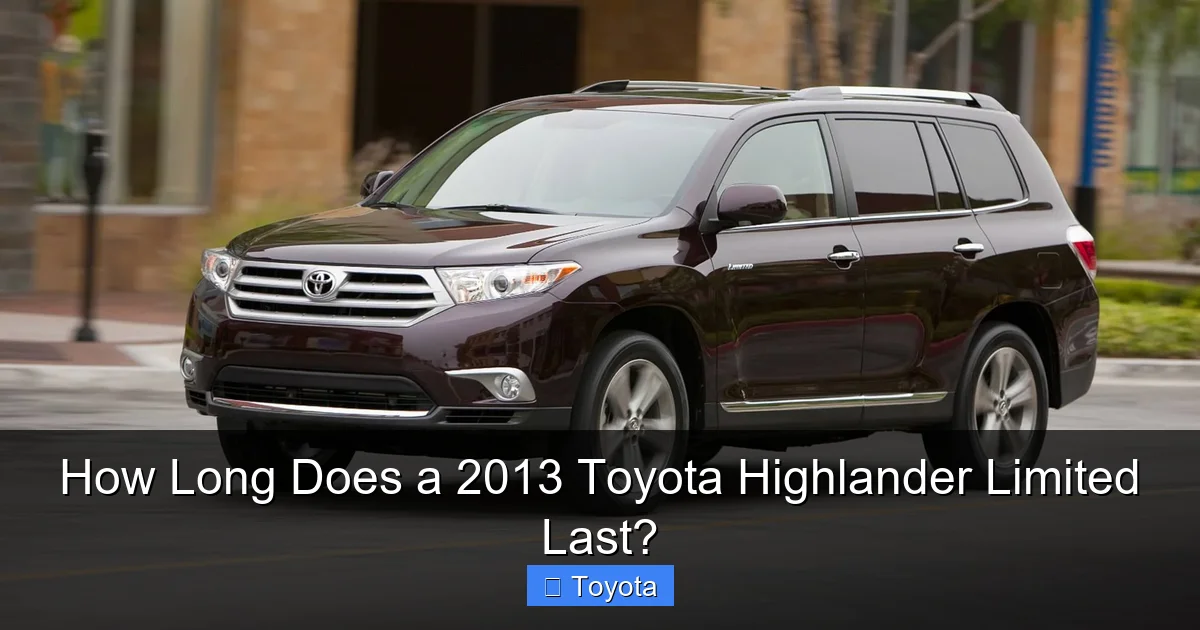
How Long Does a 2013 Toyota Highlander Limited Last?

Contents
- 1 Key Takeaways
- 2 📑 Table of Contents
- 3 Introduction: The Promise of a Toyota
- 4 Engine and Drivetrain: The Heart of the Beast
- 5 Frame and Body Durability: Standing the Test of Time
- 6 Interior and Electronics: Comfort vs. Longevity
- 7 Maintenance Best Practices: The Real Secret to 300,000 Miles
- 8 Resale Value and Ownership Costs: The Financial Longevity
- 9 Conclusion: It’s a Partnership
- 10 Frequently Asked Questions
Car Emergency Roadside Kit
Car Inverter

Car Ambient Light Kit

Car Wax Polish
The 2013 Toyota Highlander Limited is renowned for its robust build quality and reliable 3.5L V6 engine, often lasting well beyond 200,000 miles with diligent maintenance. Its unibody construction resists rust better than body-on-frame rivals, while the simple, proven drivetrain avoids complex failure points. Upholding Toyota’s legendary reliability, the limiting factors are typically wear items like brakes, tires, and suspension components, not major engine or transmission failures. Consistent fluid changes, timely belt replacements, and addressing minor issues promptly are the true secrets to maximizing its longevity.
Key Takeaways
- Proven Powertrain: The 3.5-liter V6 engine and 6-speed automatic transmission are known for exceptional durability, often surpassing 250,000 miles when maintained.
- Rust is the Primary Enemy: While construction is solid, road salt in northern climates can attack body panels and frame components; proactive rust prevention is critical.
- Maintenance is Non-Negotiable: Strict adherence to oil changes, fluid flushes, and inspection of wear items (belts, brakes, suspension) separates a 150k-mile SUV from a 300k-mile one.
- Electronics & Interior Outlast Mechanics: Infotainment or AC issues may arise, but they rarely render the vehicle undrivable, unlike catastrophic engine or transmission failure.
- Strong Resale Value: Well-maintained examples retain value exceptionally well due to their reputation for longevity and family-friendly practicality.
- Cost of Ownership Remains Low: Even at high mileage, repair costs for the 2013 Highlander are typically lower than many competitors due to part availability and mechanical simplicity.
- Model Year Specifics: The 2013 model is a mid-cycle refresh with refined reliability; it avoids many early-adopter issues of the 2008-2010 models.
📑 Table of Contents
- Introduction: The Promise of a Toyota
- Engine and Drivetrain: The Heart of the Beast
- Frame and Body Durability: Standing the Test of Time
- Interior and Electronics: Comfort vs. Longevity
- Maintenance Best Practices: The Real Secret to 300,000 Miles
- Resale Value and Ownership Costs: The Financial Longevity
- Conclusion: It’s a Partnership
Introduction: The Promise of a Toyota
When you hear the phrase “built to last,” Toyota is often the first name that comes to mind. For decades, the brand has cultivated a reputation for engineering vehicles that refuse to quit, and the third-generation Toyota Highlander (2008-2013) is a prime example. The 2013 model, in particular, represents a sweet spot—it benefits from years of refinement since the generation’s launch yet predates some of the more complex technology found in later models. The question isn’t just “how long does it last?” but “how long can *you* make it last?” The answer lies in a combination of inherent design strength and, more importantly, the commitment of its owner to proactive care.
This article dives deep into the longevity of the 2013 Toyota Highlander Limited. We’ll move beyond simple averages to explore the specific mechanical systems, common wear points, and the real-world maintenance routines that separate the stories of 300,000-mile heroes from the ones that falter at 150,000. Whether you’re considering buying a used Highlander or already own one and want a roadmap for the future, this comprehensive guide will provide the clarity you need.
Engine and Drivetrain: The Heart of the Beast
The Legendary 3.5L V6 (2GR-FE)
Under the hood of every 2013 Toyota Highlander Limited sits the 3.5-liter 2GR-FE V6 engine. This is not a new or exotic powerplant; it’s a workhorse found in countless Toyotas, from Camrys to RAV4s to 4Runners. Its widespread use is a massive advantage for longevity. The engineering is proven, the parts are abundant and affordable, and the community of mechanics who know it inside-out is vast. This engine, when serviced correctly, is not a question of “if” it will wear out, but “when”—and that “when” is typically measured in hundreds of thousands of miles.

Visual guide about How Long Does a 2013 Toyota Highlander Limited Last?
Image source: motortrend.com
The key to this engine’s durability is its design philosophy: overbuilt and under-stressed. It produces a healthy 270 horsepower but does so with a smooth, linear power delivery that doesn’t constantly scream at the redline. The dual overhead camshafts and variable valve timing (VVT-i) enhance efficiency and power without adding significant complexity. The Achilles’ heel, if it has one, is not the engine block itself but the ancillary components that support it.
- Timing Chain: Unlike many competitors that use a timing belt requiring replacement every 60,000-100,000 miles, the 2GR-FE uses a timing chain. It is designed to last the life of the engine. However, the chain tensioners and guides are wear items. At very high mileage (250,000+), some owners report chain noise, indicating a potential replacement is needed. This is a significant longevity advantage over belt-driven engines.
- Spark Plugs: These should be replaced every 120,000 miles per Toyota’s schedule. Neglecting this can lead to misfires and, over time, unnecessary strain on the catalytic converters.
- Oil Consumption: While generally reliable, some 2GR-FE engines, particularly earlier versions, are known to burn a small amount of oil between changes. The 2013 model improved upon this, but it’s still wise to check the oil level monthly. Running low on oil is the fastest way to catastrophically shorten an engine’s life. Keeping oil and filter changes every 5,000-7,500 miles with high-quality synthetic oil is the single most important thing you can do.
Real-world examples from enthusiast forums are telling. Numerous owners of 2013 Highlanders with 200,000, 250,000, and even 300,000 miles report no major engine work, only routine maintenance and minor repairs. One common theme: those who follow the maintenance manual religiously see the best outcomes.
The 6-Speed Automatic Transmission (U660E)
Paired with the V6 is Toyota’s U660E 6-speed automatic transmission. This transmission is also widely used and respected for its smooth operation and durability. It is not a CVT or a complex dual-clutch unit; it’s a conventional, robust automatic. The biggest threat to its longevity is not internal wear but neglect of the fluid that lubricates and cools it.
Toyota’s official maintenance schedule for the 2013 Highlander does not list a “lifetime” fluid for this transmission, despite some marketing claims for other models. The consensus among independent mechanics and high-mileage owners is that a transmission fluid and filter service every 60,000-80,000 miles is a wise, cost-effective insurance policy. Fresh fluid prevents the varnish and sludge buildup that can lead to harsh shifts, slipping, and eventual failure. A fluid change at 150,000 miles is better than never, but doing it at 60k is ideal.
Other transmission-related items to monitor:
- Transmission Mounts: These rubber components can deteriorate, causing vibrations during acceleration. They are inexpensive and easy to replace.
- Cooling System: The transmission fluid is cooled by a small radiator in the main coolant tank. Ensuring your engine’s cooling system is in perfect shape (thermostat, water pump, radiator) indirectly protects the transmission from overheating.
Major transmission failures in this generation are statistically rare. The more common issues are solenoid or sensor-related, which are far less invasive and expensive to fix than a rebuild. This is a system that will likely outlast the rest of the vehicle with basic care.
Frame and Body Durability: Standing the Test of Time
Unibody Construction and Rust Resistance
The 2013 Highlander uses a unibody construction, meaning the body and frame are integrated. This is standard for crossovers and offers better ride comfort and weight savings than traditional body-on-frame truck platforms. From a longevity perspective, the concern shifts to rust penetration. Toyota applies a decent factory coating, but it’s not a military-grade undercoating. In the “Salt Belt” states (the Northeast, Midwest, and parts of the Mountain West), road salt is the silent killer.

Visual guide about How Long Does a 2013 Toyota Highlander Limited Last?
Image source: s3.amazonaws.com
Inspection points are critical:
- Rockers and Wheel Arches: These are the first places to check. Look for bubbling paint or rust that has penetrated the metal.
- Frame Rails: Inspect the underside, especially where the rails are close to the ground.
- Strut Towers: Moisture can collect here and cause rust that compromises structural integrity.
Prevention is everything. A yearly undercarriage wash during winter months (especially after driving on salted roads) is a must. Applying a rust-inhibiting coating like fluid film or a professional electronic rust prevention system can add decades to the life of the body. A 2013 Highlander with a solid, rust-free frame in 2024 is a treasure and will last mechanically for as long as you want to keep it. One with significant structural rust is a safety hazard and a repair money pit.
Suspension and Steering Wear Points
These are the components that take the constant abuse of road imperfections. They are wear items, and their failure doesn’t mean the vehicle is “done,” but they significantly affect safety and comfort. Budgeting for these replacements is part of long-term ownership.
- Struts/Shocks: Factory struts on a 2013 model with 150,000+ miles are almost certainly worn. Worn struts lead to poor handling, uneven tire wear, and a harsh ride. Replacement is straightforward and moderately priced. For a detailed look at typical Toyota strut lifespan, see our guide on how long struts last on a Toyota.
- Control Arm Bushings: These rubber bushings can crack and deteriorate, leading to clunking noises and alignment issues. They are more labor-intensive to replace than struts but are a common repair on high-mileage models.
- Tie Rod Ends and Ball Joints: These steering and suspension joints wear out. Symptoms include uneven tire wear, loose steering feel, and clunks over bumps. Regular alignment checks can reveal worn components before they become dangerous.
The good news is that all these parts are mechanical, not electronic. They are available from OEM and premium aftermarket suppliers, and any competent mechanic can replace them. Unlike a failed engine computer, these repairs are predictable and manageable.
Interior and Electronics: Comfort vs. Longevity
What Wears Out First?
The engine and transmission may be nearing 300,000 miles, but the interior of a 2013 Highlander Limited might show its age much sooner. This is where “longevity” gets nuanced. The vehicle can still drive perfectly while the cabin becomes less pleasant. Common failure points include:

Visual guide about How Long Does a 2013 Toyota Highlander Limited Last?
Image source: i.ytimg.com
- Infotainment System: The factory touchscreen can become slow, unresponsive, or fail entirely. The backup camera may develop a fuzzy or black display. These are annoying but don’t affect driving. Many owners opt for aftermarket Android Auto/Apple CarPlay units, which is a cost-effective upgrade.
- Climate Control: The automatic climate control system has multiple blend door motors that can fail, leading to hot air from one side and cold from the other, or no AC at all. Diagnosis can be tricky, but parts are available.
- Power Seats and Windows: Motors and switches fail. Seat adjusters, especially on the driver’s side, are common wear items.
- Sunroof: The tracks and drains can clog or break, leading to leaks or the sunroof getting stuck.
These issues are cosmetic and comfort-related. They are rarely cheap to fix if you go through the dealer, but independent shops and used parts from salvage yards can keep costs down. They are, however, the most likely reason a high-mileage Highlander feels “old” and may affect resale value more than a worn engine would.
Maintenance Best Practices: The Real Secret to 300,000 Miles
Let’s be clear: the 2013 Highlander Limited will not magically last forever. Its longevity is a direct function of the maintenance it receives. Here is a prioritized checklist based on real-world high-mileage success stories.
The Non-Negotiable Foundation
- Oil Changes: Every 5,000 miles with full synthetic oil and a quality filter. Do not extend intervals. Check the oil level between changes.
- Coolant System: Replace engine coolant (not just top off) every 60,000 miles. A failed water pump or thermostat can cause overheating and engine destruction. Also, check the condition of the radiator and hoses.
- Transmission Fluid: As mentioned, a drain and fill (or full flush, depending on service history) every 60,000-80,000 miles. This is the #1 transmission longevity hack.
- Spark Plugs: Every 120,000 miles.
- Air Filter: Every 15,000-30,000 miles, depending on driving conditions. A clogged filter reduces efficiency and power.
The Critical “While You’re In There” List
When any mechanic is working on the engine bay or under the car, use that access to inspect and proactively replace related wear items. For example:
- During an oil change, inspect belts and hoses.
- During a coolant flush, inspect the serpentine belt tensioner and idler pulleys. A failing tensioner can snap the serpentine belt, leaving you stranded. For a deep dive on this specific component, read our article on how long a Toyota serpentine belt lasts.
- During a transmission service, inspect the transmission mount and driveshaft u-joints.
- During a brake job, inspect the caliper slide pins and hardware. Lubricate or replace as needed to prevent uneven wear and seizing.
Documentation is Everything
Keep a meticulous record of every service, no matter how small. A folder with receipts or a digital spreadsheet is invaluable. When you eventually sell the vehicle, a complete service history will command a premium price and prove the longevity is due to care, not luck. It also helps a new mechanic understand the vehicle’s history. For a 2013 model, knowing how to reset the maintenance light is useful, but the physical service record is what truly matters.
Resale Value and Ownership Costs: The Financial Longevity
Holding Its Value Remarkably Well
Depreciation is the largest cost of car ownership. The 2013 Highlander Limited, with a original MSRP around $40,000, has depreciated significantly but not catastrophically. As of 2024, a well-maintained example with 100,000-150,000 miles still commands $12,000-$18,000 depending on condition and region. This residual value is a direct testament to its perceived longevity and continued demand as a reliable 3-row family SUV. Compare this to many American or European crossovers from the same year, which may be worth substantially less due to reliability concerns.
The Limited trim adds features like leather, a sunroof, and premium audio, which help it retain value better than the base or LE models. However, these same features are the items that will need attention at high mileage (seat motors, sunroof, premium sound system components).
Projected Long-Term Costs
What does it cost to keep a 2013 Highlander running to 250,000 miles? Let’s break it down:
- Routine Maintenance (0-150k): Oil changes, filters, tires, brakes, coolant, transmission fluid. Budget $1,000-$1,500 per 30,000 miles if done at a reputable independent shop.
- Major Services (150k-250k): This is where the “wear item” list grows. Expect potential for struts, control arm bushings, timing chain guides/tensioner (if noisy), radiator, major coolant system hoses, and possibly a starter or alternator. A major “catch-up” service at 180k could run $2,500-$4,000, but it spreads the cost over another 70,000 miles.
- Surprise Repairs: Set aside a $1,000 annual buffer for unexpected failures like an AC compressor, power steering pump, or wheel bearing.
The math works in the Highlander’s favor. Even with $5,000 in repairs over a 100,000-mile span after 150k miles, your cost per mile is a mere $0.05. Compare that to a car payment on a new $40,000 SUV at $0.20+ per mile. The financial argument for driving a reliable, high-mileage Highlander is extremely strong.
Conclusion: It’s a Partnership
So, how long does a 2013 Toyota Highlander Limited last? The definitive answer is: as long as you decide to invest in it. The mechanical foundation is a 300,000-mile-plus design. The engine and transmission are bulletproof when fed clean fluids. The body will survive if protected from salt. The suspension and interior will wear, but these are rebuildable, replaceable systems.
The stories of Highlanders with 400,000 miles on the clock are not myths; they are case studies in obsessive maintenance. They are the owners who change their own oil, who pressure wash the undercarriage in February, who replace the transmission fluid at 60k without hesitation, and who fix a strange noise immediately before it becomes a major repair.
If you buy a 2013 Highlander Limited today and treat it with this level of respect, you will be rewarded with safe, comfortable, and incredibly reliable transportation for a decade or more. It will not be the newest, shiniest, or most tech-laden vehicle on the road, but it will be one of the most trustworthy. That is the true, enduring value of a Toyota. That is how long it lasts.
Frequently Asked Questions
How many miles can I realistically expect from a 2013 Toyota Highlander Limited before major engine or transmission work?
With perfect maintenance, 250,000 to 300,000+ miles is a realistic expectation for the original engine and transmission. The 3.5L V6 and 6-speed automatic are proven units. Major failures before 200,000 miles are uncommon and usually traceable to neglected oil or transmission fluid changes.
Are there any widespread, costly mechanical issues specific to the 2013 model year?
There are no model-year-specific catastrophic failures. The most common “costly” repairs are wear-and-tear items that affect all high-mileage SUVs: struts, control arm bushings, and timing chain components (guides/tensioners) making noise after 250k miles. Some owners report oil consumption higher than average; monitoring and topping up is key.
How big of a rust problem should I worry about, especially if I live in a northern state?
Rust is the single biggest threat to the longevity of the body and frame. Inspect the rocker panels, wheel arches, and frame rails thoroughly. A vehicle with significant structural rust is unsafe and should be avoided. A rust-free or minimally rusted example, with regular undercarriage washes and possible rust inhibitor application, can last indefinitely.
Does the 2013 Highlander have a timing belt or chain? When does it need replacement?
It has a timing chain, which is designed to last the life of the engine. There is no scheduled replacement interval. However, at extremely high mileage (250,000+), the chain tensioner and guides can wear, leading to a rattling noise. Replacing these components is a major but engine-saving repair if caught early.
What is the expected lifespan of the original battery and alternator?
A factory battery in a 2013 model is likely original and overdue for replacement. Batteries typically last 3-5 years. The alternator is very robust but can last 150,000-200,000 miles. Signs of alternator failure include dimming lights and a battery warning light. For more on alternator lifespan, see our general guide for how long a Toyota alternator lasts.
How does the 2013 Highlander’s longevity compare to the 2014+ models with the new 8-speed transmission?
The 2013’s 6-speed is simpler and arguably more proven for long-term reliability. The 8-speed automatic introduced in 2014 is generally smooth and efficient but has a more complex valve body and solenoid pack that can be costly to repair if issues arise. From a pure “mileage before major failure” perspective, the 2013’s powertrain has a slight edge in proven simplicity. However, all are very reliable when maintained.