How Long Do Subaru Wrx Last?

Contents
- 1 Key Takeaways
- 2 📑 Table of Contents
- 3 Understanding the Subaru WRX’s Design and Engineering
- 4 Average Lifespan: Real-World Mileage Expectations
- 5 Maintenance Tips to Maximize WRX Lifespan
- 6 Common Problems and How to Prevent Them
- 7 Driving Habits That Extend WRX Life
- 8 Model Year Considerations: Which WRX Lasts Longest?
- 9 Resale Value and Long-Term Ownership
- 10 Conclusion: How Long Do Subaru WRX Last?
- 11 Frequently Asked Questions

Car USB Charger

Car Battery Charger

Digital Tire Pressure Gauge

Car Cleaning Brush Set
The Subaru WRX is built for performance and durability, often lasting 150,000 to 200,000 miles or more with proper maintenance. While turbocharged engines demand extra care, many owners report reliable service well beyond 250,000 miles when following factory guidelines and addressing issues early.
So, you’re eyeing a Subaru WRX—or maybe you already own one. That rumbling boxer engine, the rally-bred all-wheel drive, the aggressive stance—it’s hard not to fall in love. But beyond the thrill of acceleration and corner-carving grip, there’s a practical question every enthusiast asks: How long do Subaru WRX last?
The short answer? A lot longer than you might think—especially if you treat it right. While the WRX isn’t your average commuter car, it’s not a disposable weekend toy either. Built on Subaru’s rugged platform and engineered for performance, the WRX has earned a reputation for toughness. But like any high-output machine, it demands respect—and regular care. Whether you’re driving a 2002 classic or a 2023 STI, understanding what affects longevity can mean the difference between a 100,000-mile project car and a 250,000-mile daily driver.
Key Takeaways
- Typical lifespan: Most Subaru WRX models last between 150,000 and 200,000 miles, with well-maintained examples reaching 250,000+ miles.
- Turbocharged engine care: The turbocharged 2.0L and 2.5L flat-four engines require timely oil changes, quality fuel, and proper warm-up/cool-down routines.
- Regular maintenance is critical: Following the factory maintenance schedule—especially for timing belts, fluids, and spark plugs—greatly extends engine life.
- Common weak points: Head gaskets, turbochargers, and suspension components may need attention in high-mileage WRXs, but are manageable with proactive care.
- Driving habits matter: Aggressive driving and frequent track use increase wear, while gentle break-in periods and smooth operation promote longevity.
- Model year matters: Newer WRX models (2015+) generally have improved reliability, but older models (2002–2014) can still last long with extra vigilance.
- Resale value holds up: Even high-mileage WRXs retain decent value due to strong enthusiast demand and proven performance heritage.
📑 Table of Contents
- Understanding the Subaru WRX’s Design and Engineering
- Average Lifespan: Real-World Mileage Expectations
- Maintenance Tips to Maximize WRX Lifespan
- Common Problems and How to Prevent Them
- Driving Habits That Extend WRX Life
- Model Year Considerations: Which WRX Lasts Longest?
- Resale Value and Long-Term Ownership
- Conclusion: How Long Do Subaru WRX Last?
Understanding the Subaru WRX’s Design and Engineering
The Subaru WRX has been a staple in the performance compact segment since its U.S. debut in 2002. At its core, it’s a turbocharged, all-wheel-drive sedan (and later, hatchback and sedan again) built on Subaru’s Global Platform. What sets it apart isn’t just power—it’s the combination of a horizontally opposed (boxer) engine, symmetrical AWD, and a sport-tuned suspension that delivers both grip and agility.
The Boxer Engine Advantage
Subaru’s signature boxer engine lies flat in the chassis, lowering the center of gravity and improving balance. This design reduces vibration and allows for smoother operation compared to traditional inline or V-shaped engines. The WRX uses either a 2.0-liter (EJ20) or 2.5-liter (EJ25) turbocharged flat-four, depending on the model year and market.
While boxer engines are known for durability, their low-slung design means oil drainage can be less efficient if the car isn’t driven regularly or warmed up properly. This makes oil changes and engine temperature management especially important for longevity.
Turbocharging and Performance Trade-Offs
The turbocharger is both the WRX’s greatest strength and its biggest maintenance concern. Forced induction delivers impressive power—often 260–310 horsepower depending on the trim—but it also increases stress on internal components. Turbos run hot, spin fast, and rely on clean oil for lubrication and cooling.
Without proper care, turbo failure can occur prematurely. However, modern turbos in WRX models (especially post-2015) are more robust than earlier versions. Subaru has refined materials and cooling systems, but the rule remains: treat the turbo with respect, and it’ll serve you well for hundreds of thousands of miles.
All-Wheel Drive and Drivetrain Durability
The symmetrical AWD system is one of Subaru’s hallmarks. In the WRX, it’s performance-oriented, with a viscous center differential and rear limited-slip differential (in some trims). This system enhances traction and handling, but it also means more moving parts under stress.
While AWD adds complexity, it’s generally reliable when maintained. Differential fluids, transfer case service, and clutch packs (in manual models) should be checked regularly. Neglecting these can lead to costly repairs, but following the maintenance schedule keeps the drivetrain running smoothly for years.
Average Lifespan: Real-World Mileage Expectations
So, how long do Subaru WRX last in real-world terms? The answer varies, but most owners can expect between 150,000 and 200,000 miles out of their WRX with proper care. Many go further—some even surpass 250,000 miles.

Visual guide about How Long Do Subaru Wrx Last?
Image source: jdmuscleusa.com
Case Studies: High-Mileage WRX Owners
Online forums like SubaruOutback.org and WRXForum.com are filled with stories of high-mileage WRXs. One owner reported driving a 2006 WRX to 278,000 miles before selling it, citing regular oil changes, timely timing belt replacements, and gentle driving habits. Another 2011 owner hit 230,000 miles with only minor repairs—mostly suspension and brake work.
These examples aren’t outliers. They reflect what’s possible when owners respect the car’s performance nature and stay on top of maintenance. Of course, not every WRX makes it that far. Neglect, poor driving habits, or lack of repairs can shorten lifespan significantly.
Factors That Influence Longevity
Several key factors determine how long your WRX will last:
- Maintenance history: Regular oil changes, fluid flushes, and scheduled services are non-negotiable.
- Driving style: Daily commuting with occasional spirited driving is easier on the car than constant track days or drag racing.
- Climate and environment: Salted roads in winter climates accelerate rust, while hot climates stress cooling systems.
- Model year and generation: Newer WRXs (2015+) benefit from improved engineering and materials.
- Modifications: Stock or mildly modified WRXs tend to last longer than heavily tuned or race-prepared versions.
When Do WRXs Typically Fail?
Most WRX failures occur due to neglect or abuse, not inherent design flaws. Common failure points include:
- Turbocharger failure (often from oil starvation or overheating)
- Head gasket leaks (especially in pre-2015 models)
- Timing belt failure (if not replaced on schedule)
- Suspension wear (struts, bushings, ball joints)
- Clutch wear (in manual transmissions)
But here’s the good news: most of these issues are preventable. With attention to detail, your WRX can easily outlast the average economy car.
Maintenance Tips to Maximize WRX Lifespan
If you want your WRX to last, maintenance isn’t optional—it’s essential. Think of it like training for a marathon: you can’t just run fast and expect to finish. You need preparation, recovery, and consistency.

Visual guide about How Long Do Subaru Wrx Last?
Image source: copilotsearch.com
Follow the Factory Maintenance Schedule
Subaru provides a detailed maintenance schedule in the owner’s manual. Stick to it. Key items include:
- Oil changes every 3,750–5,000 miles: Use full synthetic 5W-30 or 0W-20 (depending on model year) and high-quality filters.
- Timing belt replacement every 105,000 miles: This is critical. A failed timing belt can destroy the engine.
- Spark plug replacement every 30,000–60,000 miles: Iridium plugs last longer and maintain performance.
- Coolant flush every 30,000–60,000 miles: Prevents corrosion and overheating.
- Differential and transfer case fluid changes every 30,000 miles: Keeps AWD components lubricated.
Warm Up and Cool Down the Turbo
Turbocharged engines need time to warm up and cool down. Avoid revving the engine immediately after starting—let it idle for 30–60 seconds in cold weather. After hard driving, let the engine idle for 30–60 seconds before shutting off. This allows oil to circulate and cool the turbo bearings.
Some owners install aftermarket turbo timers or use remote starters with idle functions to automate this process. It’s a small habit that pays big dividends.
Use Quality Fuel and Oil
The WRX’s turbo engine prefers premium fuel (91 octane or higher). While it can run on regular, consistent use of lower-octane fuel can cause knocking and reduce performance. Stick with top-tier gasoline and reputable oil brands like Mobil 1, Castrol, or Subaru’s own oil.
Avoid cheap filters and fluids. A $10 oil filter might save money now but could lead to engine damage later. Invest in quality—it’s cheaper than a rebuild.
Inspect and Replace Wear Items Early
Don’t wait for parts to fail. Inspect suspension components, brakes, and drivetrain parts during oil changes. Replace worn struts, bushings, or CV joints before they cause secondary damage.
For example, a failing CV joint can damage the transmission output seal, leading to leaks and costly repairs. Catching it early saves time and money.
Address Leaks and Noises Immediately
Subarus are known for head gasket issues, especially in older models. If you notice coolant loss, white smoke, or oil mixing with coolant, get it checked immediately. Early repair prevents engine damage.
Similarly, unusual noises—whining turbos, grinding gears, or clunking suspension—should never be ignored. They’re often warnings of bigger problems.
Common Problems and How to Prevent Them
No car is perfect, and the WRX has its share of known issues. But most are manageable with awareness and proactive care.
Visual guide about How Long Do Subaru Wrx Last?
Image source: kelfordcams.com
Head Gasket Failures
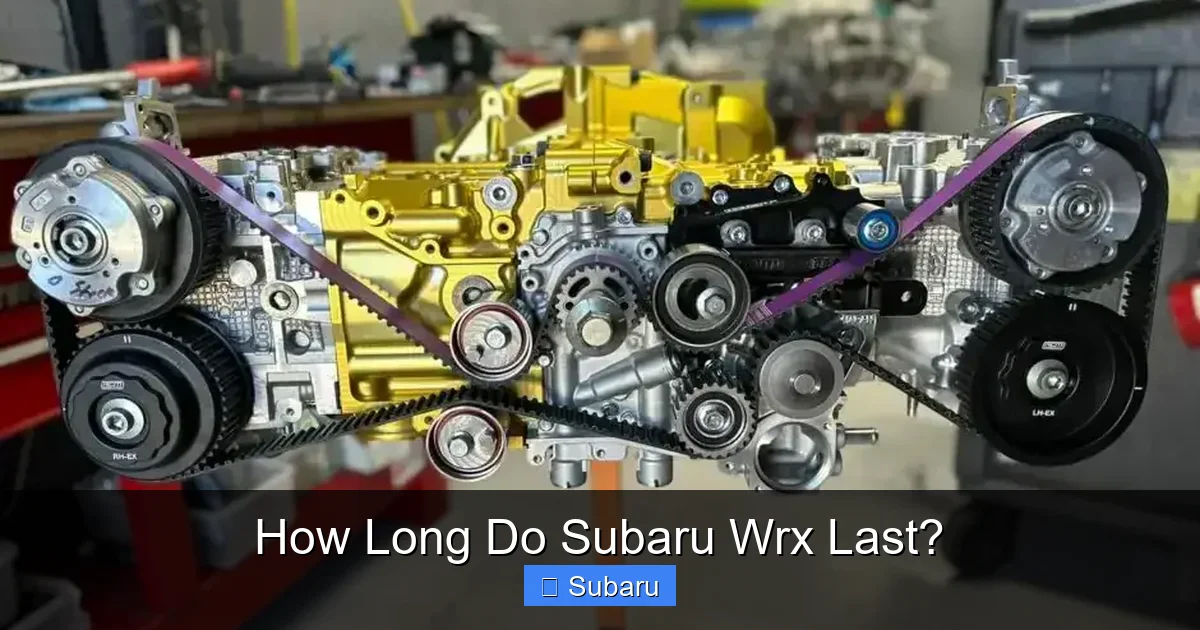
The EJ25 engine in pre-2015 WRXs is notorious for head gasket leaks. Caused by thermal stress and poor sealing design, it leads to coolant loss, overheating, and engine damage if ignored.
Prevention: Maintain proper coolant levels, avoid overheating, and consider upgrading to multi-layer steel (MLS) head gaskets if replacing them. Newer models (2015+) have improved designs and are less prone to this issue.
Turbocharger Wear and Failure
Turbo failure often results from oil starvation, overheating, or foreign object damage. Symptoms include loss of power, blue or black smoke, and loud whining noises.
Prevention: Use high-quality synthetic oil, change it regularly, and allow proper warm-up/cool-down. Avoid excessive boost without supporting mods (intercooler, fuel system).
Clutch and Transmission Wear
Manual WRXs are fun to drive but hard on clutches. Aggressive launches, riding the clutch, or towing can shorten lifespan.
Prevention: Drive smoothly, avoid “clutch slipping” during shifts, and replace the clutch every 60,000–100,000 miles depending on use. Consider a performance clutch if you track the car.
Suspension and Steering Wear
The WRX’s sport suspension wears faster than standard setups. Struts, control arms, and tie rods take a beating, especially on rough roads.
Prevention: Inspect suspension during oil changes. Replace worn parts promptly. Consider upgrading to polyurethane bushings for longer life.
Electrical and Sensor Issues
Modern WRXs have complex electronics. Faulty oxygen sensors, MAF sensors, or knock sensors can cause poor performance and reduced fuel economy.
Prevention: Use quality fuel, avoid water fording, and address check engine lights immediately. Regular diagnostics can catch issues early.
Driving Habits That Extend WRX Life
How you drive matters just as much as how you maintain your WRX. Performance cars reward skill—but punish abuse.
Break-In Period Matters
The first 1,000 miles are critical. Avoid redlining, hard launches, or sustained high RPMs. Vary engine speed during acceleration to seat piston rings properly. This sets the foundation for long-term reliability.
Avoid Excessive Boost and Mods
Stock WRXs are tuned for reliability. Adding big turbos, aggressive tunes, or nitrous without supporting upgrades increases stress on the engine and drivetrain.
If you modify, do it gradually and with supporting parts (cooling, fuel, internals). A well-tuned, mildly modified WRX can last longer than a stock one driven hard every day.
Use the Car Regularly
Letting a WRX sit for weeks or months can cause problems. Oil breaks down, seals dry out, and batteries die. Drive it at least once a week, even if just for a short trip.
If you must store it, use a battery tender, fuel stabilizer, and consider an oil change before long-term storage.
Track Days: Fun, But Be Smart
Track driving is exhilarating, but it’s hard on any car. If you take your WRX to the track, bring extra oil, check fluids before and after, and let the car cool down properly.
Consider upgrading to high-temp brake fluid, track-oriented pads, and a better cooling system if you track frequently. And always wear a helmet—your safety matters most.
Model Year Considerations: Which WRX Lasts Longest?
Not all WRXs are created equal. Different generations have different strengths and weaknesses.
2002–2007 (First Generation)
These early WRXs are iconic but require more attention. The EJ20 engine is strong but prone to head gasket and turbo issues. With proper care, they can last 200,000+ miles, but expect more repairs.
2008–2014 (Second Generation)
Improved build quality and the switch to the EJ25 engine brought more power and reliability. Still, head gaskets and turbo maintenance remain key. These models are popular with enthusiasts and hold value well.
2015–Present (Third Generation)
The current WRX (based on the FA20/FB20 engine family) is more refined. The 2.0L FA20DIT engine is turbocharged but more efficient and reliable than older EJ engines. Head gasket issues are rare, and electronics are more robust.
These models are the best bet for long-term ownership, especially if you plan to drive 200,000+ miles. They also have better fuel economy and modern safety features.
Resale Value and Long-Term Ownership
One of the WRX’s hidden strengths is its resale value. Even high-mileage examples sell well due to strong demand from enthusiasts. A well-maintained 150,000-mile WRX can fetch 50–60% of its original price, depending on condition and mods.
This makes the WRX a smart long-term investment. You get performance, practicality, and strong resale—rare in the compact car segment.
Conclusion: How Long Do Subaru WRX Last?
So, how long do Subaru WRX last? With proper care, most will easily reach 150,000 to 200,000 miles, and many go well beyond 250,000. The key is respecting the car’s performance nature—maintaining it diligently, driving it wisely, and addressing issues before they become disasters.
The WRX isn’t just a car. It’s a commitment. But for those willing to put in the effort, it rewards with thrilling drives, rally-bred capability, and a lifespan that rivals much more expensive machines. Whether you’re commuting, cruising backroads, or hitting the track, your WRX can be a loyal companion for decades—if you treat it right.
Frequently Asked Questions
How many miles can a Subaru WRX last?
Most Subaru WRX models last between 150,000 and 200,000 miles with proper maintenance. Well-cared-for examples often exceed 250,000 miles, especially newer models with improved reliability.
What is the most common problem with Subaru WRX?
Head gasket failures are the most common issue, especially in pre-2015 models with the EJ25 engine. Turbocharger wear and suspension component failure are also frequent concerns in high-mileage WRXs.
Do Subaru WRX need premium gas?
Yes, Subaru recommends premium fuel (91 octane or higher) for optimal performance and engine longevity. While it can run on regular, consistent use of lower-octane fuel may cause knocking and reduce power.
How often should I change the oil in my WRX?
Change the oil every 3,750 to 5,000 miles using full synthetic oil. Frequent changes are critical for turbocharged engines to prevent sludge and turbo damage.
Can a modified WRX last a long time?
Yes, but modifications increase stress on the engine and drivetrain. Mild mods with supporting upgrades (cooling, fuel, internals) can be reliable, but aggressive tuning without proper support shortens lifespan.
Is the Subaru WRX reliable long-term?
The WRX is reliable when maintained properly. It’s not as trouble-free as a basic commuter car, but with regular care, it’s one of the most durable performance compacts on the market.