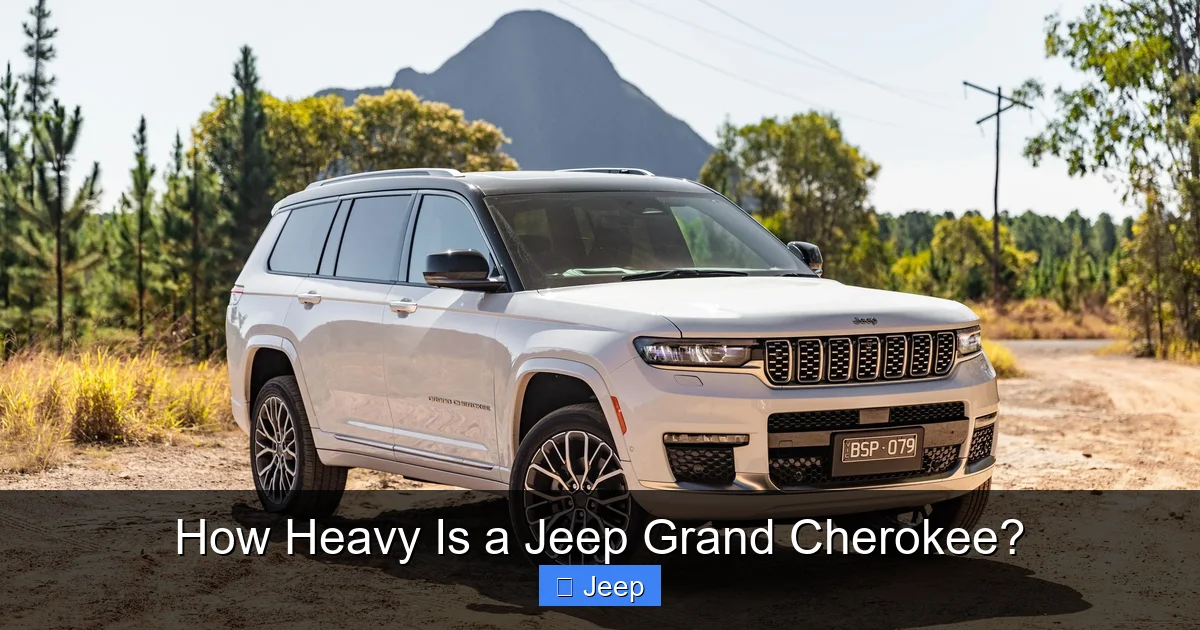
How Heavy Is a Jeep Grand Cherokee?

Contents
- 1 Key Takeaways
- 2 📑 Table of Contents
- 3 Why Weight Matters More Than You Think
- 4 Generation Breakdown: WK2 vs. WL
- 5 Trim Level Influence: From Laredo to Summit
- 6 Engine & Drivetrain: The Heart of the Matter
- 7 Practical Implications: What the Weight Means For You
- 8 Weight Comparisons: Putting It In Perspective
- 9 How to Find the Exact Weight of YOUR Grand Cherokee
- 10 Frequently Asked Questions

Interior Cleaner Spray

Bluetooth FM Transmitter

Digital Tire Pressure Gauge

Car Vacuum Cleaner (Portable)
The Jeep Grand Cherokee’s weight varies significantly depending on its model year, engine, and trim level. A modern Grand Cherokee typically weighs between 4,500 and 5,300 pounds, while older models can be lighter or heavier based on their configuration. Understanding this weight is crucial for towing capacity, fuel economy, and off-road capability.
So, you’re eyeing a Jeep Grand Cherokee. It’s a legendary nameplate for a reason—a blend of rugged capability, family-friendly space, and (in recent years) surprising luxury. But before you sign on the dotted line or hitch up your first trailer, there’s one fundamental question that often gets overlooked: How heavy is a Jeep Grand Cherokee? It’s not just a trivial number for trivia night. The weight of your specific Grand Cherokee is the silent architect behind its towing capacity, fuel economy, braking distance, and even how it feels on a winding backroad. Let’s pop the hood on this weighty topic and break it down, generation by generation, trim by trim.
Think of vehicle weight like the blueprint for a building. You wouldn’t construct a house without knowing the load-bearing capacity of its foundation, right? Similarly, you shouldn’t tow a boat or carry a full family and gear without knowing what your SUV actually weighs. A difference of 500 pounds between two seemingly similar Grand Cherokees can mean the difference between a comfortable highway merge and a strained engine, or between safely stopping and a white-knuckled moment. We’re going to unpack all of it.
Key Takeaways
- Weight varies by generation: The WK2 (2011-2021) and WL (2022+) generations have different baseline weights due to platform changes and added luxury features.
- Engine choice matters: A V6 model is lighter than a V8 or the powerful SRT and Trackhawk variants, which add significant mass.
- Trim level adds weight: Higher trims like Overland, Summit, and SRT include more sound deadening, luxury materials, and larger wheels/tires, increasing curb weight.
- Curb weight vs. Gross Weight: “Curb weight” is the vehicle’s ready-to-drive weight. “Gross Vehicle Weight Rating (GVWR)” is the maximum safe weight including passengers and cargo.
- Weight impacts performance: Heavier models have lower fuel economy but often better towing capacity and a more planted feel on highways.
- Off-road capability is nuanced: While extra weight can improve traction, it also increases strain on components and reduces break-over angle; wheel travel and gearing are more critical.
- Always check your specific VIN: For precise towing or payload calculations, the manufacturer’s specified weight for your exact vehicle is the only reliable source.
📑 Table of Contents
- Why Weight Matters More Than You Think
- Generation Breakdown: WK2 vs. WL
- Trim Level Influence: From Laredo to Summit
- Engine & Drivetrain: The Heart of the Matter
- Practical Implications: What the Weight Means For You
- Weight Comparisons: Putting It In Perspective
- How to Find the Exact Weight of YOUR Grand Cherokee
Why Weight Matters More Than You Think
Before we dive into the numbers, let’s connect the dots on why this number is so important. It’s the linchpin for several critical real-world performance metrics.
The Towing Equation
Your Grand Cherokee’s maximum towing capacity is directly tied to its Gross Vehicle Weight Rating (GVWR). The GVWR is the maximum total weight the vehicle is engineered to safely handle, including its own curb weight, passengers, cargo, and the tongue weight of a trailer. A heavier base vehicle (higher curb weight) means less of that GVWR is available for payload and trailer weight. If you’re looking at a heavy-duty V8 model for towing, its own extra weight partially offsets the engine’s additional power. You must know your starting point.
Fuel Economy’s Heavy Secret
Physics is a harsh taskmaster. It takes more energy—more fuel—to move more mass. This is why a sleek, lightweight sedan like a Toyota Camry can achieve 40+ MPG on the highway, while a full-size SUV like the Grand Cherokee struggles to hit 25 MPG. Every additional 100 pounds can reduce fuel economy by about 1-2%, all else being equal. So, choosing a heavy Summit trim over a lighter Laredo isn’t just a luxury choice; it’s a long-term commitment to more frequent gas station visits. Speaking of comparisons, you can see a stark contrast in how weight affects efficiency when you look at how heavy a Toyota Camry is versus our subject today.
Braking and Handling Dynamics
More mass means more momentum. A heavier vehicle requires a longer distance to come to a complete stop and is less agile in sudden evasive maneuvers. While the Grand Cherokee’s weight is distributed relatively well, the difference between a 4,500-lb and a 5,300-lb model on a slippery road is noticeable. It also affects tire wear and suspension component stress over time.
Generation Breakdown: WK2 vs. WL
The Jeep Grand Cherokee has evolved through two primary modern platforms. Understanding the baseline of each generation is key to estimating weight.

Visual guide about How Heavy Is a Jeep Grand Cherokee?
Image source: jeep.com.np
The WK2 Generation (2011-2021)
This was the long-reigning, third-generation platform. It started with a focus on on-road comfort and capability but ended with some of the most powerful and heaviest variants ever. The WK2’s unibody construction was a significant step forward in rigidity and refinement over its predecessors.
- Base V6 Models (Laredo, Limited): Typically ranged from 4,400 to 4,700 lbs. These were the “lightest” of the WK2 bunch, especially with the standard 3.6L V6 and without heavy off-road packages.
- V8 Models (Overland, Summit, SRT): The 5.7L HEMI V8 added considerable weight, both from the engine itself and the supporting cooling and drivetrain components. Expect 4,800 to 5,100 lbs for a loaded V8 Grand Cherokee.
- Performance Models (SRT, Trackhawk): Here’s where weight ballooned. The supercharged 6.2L V8 in the Trackhawk, along with heavy-duty brakes, cooling systems, and reinforced components, pushed these models to a staggering 5,400 to 5,700 lbs. They were essentially muscle cars in SUV clothing.
The WL Generation (2022-Present)
The current, fourth-generation Grand Cherokee (and the longer Grand Cherokee L) debuted on an all-new platform. Stellantis touted improvements in stiffness, safety, and technology. However, the addition of standard three-row seating (in the L), more sound deadening, and advanced safety tech meant the baseline weight increased.
- Standard 2-Row (WL) Models: Even the base Laredo 4×2 on the WL platform starts around 4,700-4,800 lbs due to the new architecture and standard features.
- Grand Cherokee L (3-Row): The longer wheelbase and extra seating naturally add mass. A base Laredo L is easily 5,000+ lbs, with higher trims like the Summit Reserve pushing 5,300 lbs or more.
- Hybrid 4xe Models: This is a fascinating case. The plug-in hybrid system adds the weight of the battery pack and electric motors (roughly 300-400 lbs) but replaces the traditional transmission with a lighter eTorque motor assembly. A Grand Cherokee 4xe typically weighs about 200-300 lbs MORE than its equivalent gas-only counterpart, landing it in the 5,100-5,400 lb range depending on trim.
If you’re considering a specific model year, it’s worth researching its exact specs. For instance, a well-maintained 2014 Jeep Grand Cherokee from the WK2 era will have a different weight profile than a 2023 model, which affects its value and capability.
Trim Level Influence: From Laredo to Summit
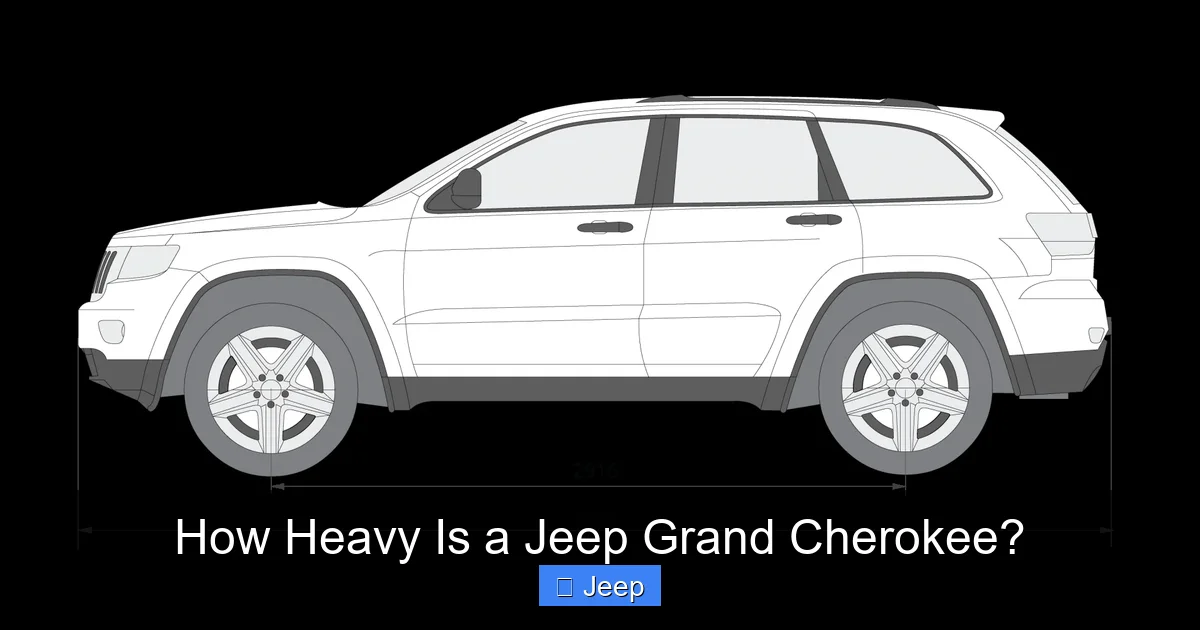
Within the same model year and engine choice, the trim level is the single biggest factor determining weight. Let’s use a recent model year as an example.
Visual guide about How Heavy Is a Jeep Grand Cherokee?
Image source: mspv.com
The “Lightweight” Contender: Laredo & Latitude
These base and entry-level trims are configured for value. They often have:
- Steel wheels (or smaller alloy wheels)
- Minimal sound insulation
- Cloth or basic leather seats
- Fewer advanced driver aids
- Standard suspension components
This makes them the lightest in the lineup. A 2023 Grand Cherokee Laredo 4×2 with the V6 might have a curb weight near 4,850 lbs.
The Middleweight: Limited & Trailhawk
Adding significant features adds significant pounds. The Limited trim brings premium leather, a more advanced infotainment system, and often larger wheels. The Trailhawk adds off-road armor (skid plates), a locking rear differential, all-terrain tires, and a more robust suspension—all of which contribute to a higher curb weight, often 200-300 lbs over the Laredo.
The Heavyweights: Overland, Summit, and SRT
These are the flagship trims, and they wear their weight as a badge of luxury and performance.
- Overland/Summit: Expect premium Nappa leather, massive touchscreens, a premium audio system with heavy subwoofers, more extensive sound deadening materials, and often larger 20″ or 21″ wheels with low-profile tires. A 2023 Grand Cherokee Summit Reserve 4×4 with the V8 easily clears 5,300 lbs.
- SRT & Trackhawk: As mentioned, these are in a league of their own. The SRT’s Brembo brakes, sport seats, and unique bodywork, plus the Trackhawk’s supercharger and drivetrain upgrades, make them the heaviest production Grand Cherokees ever built.
Engine & Drivetrain: The Heart of the Matter
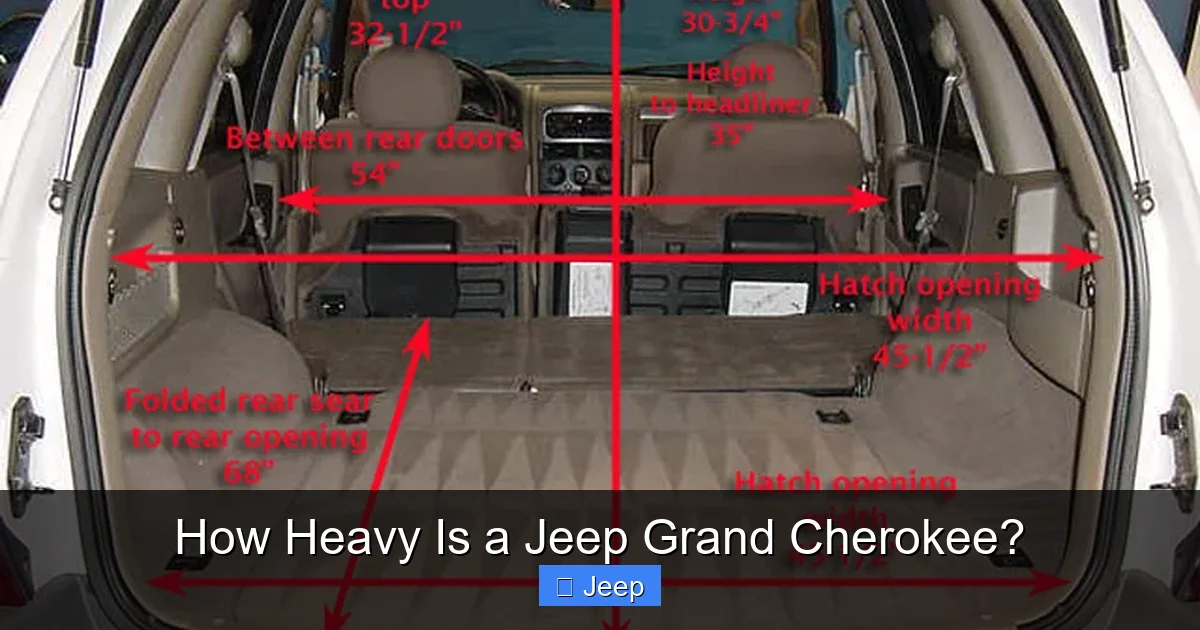
Your choice of powertrain is the next major weight determinant.
Visual guide about How Heavy Is a Jeep Grand Cherokee?
Image source: jeepspecs.com
The Standard-Bearer: 3.6L Pentastar V6
This is the workhorse engine for most Grand Cherokees. It’s a relatively lightweight aluminum-block V6, making it the optimal choice for those prioritizing payload and towing capacity relative to vehicle weight. Its curb weight contribution is the lowest among the gasoline options.
The Torque King: 5.7L HEMI V8
The iconic HEMI is a cast-iron block, which is inherently heavier than aluminum. The additional components for the Multi-Displacement System (MDS) cylinder deactivation and the stronger transmission it’s paired with (usually the 8-speed automatic) add substantial mass. You’re looking at a 150-250 lb penalty over the V6 in the same trim.
The Hybrid: 2.0L Turbo 4-Cylinder + Electric (4xe)
This powertrain is a study in contrasts. The 2.0L turbo engine is lighter than the V6, but the 17.3 kWh battery pack and dual electric motors add a lot of weight. The net result is a vehicle that’s heavier than the V6 but lighter than the V8 in the same trim. Its advantage is instant electric torque and superior fuel economy, which can offset the weight penalty in daily driving.
The AWD vs. 4WD Question
All-wheel drive (AWD) and four-wheel drive (4WD) systems add weight. A traditional 4WD system with a transfer case and heavy front axle is typically 50-100 lbs heavier than a front-wheel-drive baseline. However, the difference between a standard AWD system (like the Quadra-Trac I/II) and a more robust system (Quadra-Drive II) with a limited-slip rear differential is minimal in terms of raw weight but significant in capability.
Practical Implications: What the Weight Means For You
Let’s translate these numbers into your daily life.
Towing and Payload Capacity
This is the most critical application. Your owner’s manual will list both the Curb Weight and the GVWR. The difference between these two numbers is your maximum Payload Capacity (people, cargo, tongue weight). A heavier Grand Cherokee has a smaller payload margin. For example:
- A V6 Laredo (CW: ~4,600 lbs) with a GVWR of 6,500 lbs has a ~1,900 lb payload.
- A V8 Summit (CW: ~5,300 lbs) with a GVWR of 7,000 lbs has a ~1,700 lb payload.
Even though the V8 can tow more (7,200 lbs vs. 6,200 lbs for the V6), its payload capacity is actually lower because it starts heavier. You must calculate your *actual* loaded weight (family + gear + trailer tongue weight) against the GVWR. If you’re exploring lease options, this payload calculation is part of understanding how much is a Jeep Grand Cherokee lease for the specific configuration you need.
Fuel Economy Reality Check
The EPA ratings are estimates based on a specific test weight. Your real-world MPG will drop as your vehicle’s weight increases (from cargo, passengers, or a heavier trim). A 200-lb difference can mean 0.5-1 MPG less in combined driving. Over 12,000 miles a year, that’s an extra 20-40 gallons of gas. The hybrid 4xe model is the exception, using its electric motor to offset the weight penalty during low-speed commuting.
Off-Road Performance: A Double-Edged Sword
There’s a classic off-roading adage: “There’s no replacement for displacement (of weight).” A heavier vehicle can push a tire into the ground more effectively, sometimes improving traction on loose surfaces. However, this is a minor benefit compared to the drawbacks:
- Increased Strain: More weight means more stress on axles, CV joints, and suspension components when crawling over rocks.
- Reduced Break-Over Angle: This is the angle between your front and rear tires when cresting a hill. A longer wheelbase (like the Grand Cherokee L) helps, but overall weight doesn’t; a heavier vehicle is often a longer vehicle, which can reduce this critical angle.
- Water Fording: The weight itself doesn’t help, but the higher ride height of off-road trims (like Trailhawk) is what matters for water depth.
For serious off-roading, a lighter, shorter-wheelbase vehicle like a Wrangler is often more capable, which is why dedicated off-roaders might look at how much it is to lease a Jeep Wrangler instead. For the Grand Cherokee, its strength is high-speed desert running and forest service roads, not rock crawling.
Weight Comparisons: Putting It In Perspective
How does the Grand Cherokee stack up against its peers and its own history?
Vs. The Competition
A modern, well-equipped Grand Cherokee L Summit is in the same weight class as its primary rivals:
- Ford Explorer Platinum (V6): ~5,200 lbs
- Toyota Highlander Limited (V6): ~4,900 lbs
- Honda Pilot Elite (V6): ~4,600 lbs
The Grand Cherokee often trends slightly heavier than some Japanese rivals due to its more robust construction and available V8, but it’s competitive within its segment. Its weight advantage (or disadvantage) is in the details of its specific powertrain and feature set.
Evolution Over Time
The first-generation (ZJ, 1993-1998) Grand Cherokee was a revelation for its time, but it was relatively light. A base 1996 model with the 4.0L inline-six was under 4,000 lbs. The second generation (WJ, 1999-2004) grew in size and weight, with V8 models pushing 4,600-4,800 lbs. The modern WK2 and WL generations, packed with safety cages, airbags, sound deadening, and technology, are genuinely heavyweight contenders. A 2023 Grand Cherokee L V8 weighs nearly what a full-size **2002 Jeep Wrangler** (a much simpler, body-on-frame SUV) and a 1998 full-size pickup truck did.
How to Find the Exact Weight of YOUR Grand Cherokee
So you’ve narrowed it down to a specific used Grand Cherokee. How do you get its precise, real-world weight?
1. The Driver’s Side Door Jamb Sticker
This is your primary source. Open the driver’s door and look for the yellow and white certification label. It will list:
- GVWR (Gross Vehicle Weight Rating)
- GAWR (Gross Axle Weight Rating) Front/Rear
It will NOT list the exact curb weight, but the GVWR is the critical legal limit. The manufacturer’s published curb weight for that exact VIN is also often listed on a spec plate nearby or in the owner’s manual.
2. The Owner’s Manual
The manual will have a “Vehicle Specifications” section that lists curb weight for each model variant for that year. It might be broken down by engine and drivetrain.
3. A Professional Scale
This is the only way to get the *actual* weight of your specific vehicle as it sits, with all its fluids, a full tank of gas, and any permanent accessories. Drive onto a public truck scale (often at recycling centers or gravel pits). This is invaluable if you’ve added aftermarket bumpers, winches, or heavy-duty bumpers. It tells you your real-world starting point for payload calculations.
4. Online VIN Decoders & Manufacturer Build Sheets
Services like Jeep’s own build sheet tool (if you have the VIN) or paid decoder sites can often provide the exact factory specifications for your vehicle, including its shipping weight (very close to curb weight).
Frequently Asked Questions
What is the curb weight of a standard Jeep Grand Cherokee?
There is no single “standard” weight. For a current model year (WL) Grand Cherokee with the 3.6L V6 and 4×2 drivetrain, the curb weight typically starts around 4,700-4,800 pounds. Adding 4×4, a V8 engine, or a higher trim like Summit can increase this to 5,300 pounds or more.
Does the Grand Cherokee L weigh more than the two-row Grand Cherokee?
Yes, significantly. The Grand Cherokee L has a longer wheelbase to accommodate the third row. This adds structural material, more seats, and often more features. A comparable trim level (e.g., Laredo) of the Grand Cherokee L will weigh approximately 200-300 pounds more than the two-row version.
How much does the hybrid Grand Cherokee 4xe weigh?
The plug-in hybrid system adds the weight of the battery pack and electric motors. A Grand Cherokee 4xe typically weighs about 200-300 pounds more than the equivalent gas-powered V6 model. For example, a 2023 Grand Cherokee Laredo 4xe has a curb weight of approximately 5,100 pounds, compared to about 4,850 pounds for the V6 AWD Laredo.
Is the Grand Cherokee too heavy for a standard garage or car lift?
No. The maximum weight, even for a fully loaded SRT or Trackhawk, is under 6,000 pounds. Most residential two-car garages have floor ratings well above this, and standard automotive lifts (especially four-post lifts) are typically rated for 7,000-10,000 pounds per vehicle. Always verify your specific garage floor or lift’s rating, but the Grand Cherokee is well within common limits.
How does weight affect the Grand Cherokee’s off-road performance?
Weight has a mixed effect. Extra weight can improve traction on loose surfaces by pressing tires into the ground. However, it increases stress on axles and suspension during rock crawling and can reduce break-over angle if the vehicle is also longer. For most Grand Cherokee owners, its weight is managed well by its capable suspension and drivetrain (especially in Trailhawk trim), but a lighter, shorter-wheelbase vehicle like a Wrangler will ultimately have an advantage on the most technical terrain.
Where can I find the exact weight for my specific Grand Cherokee VIN?
Your best sources are: 1) The yellow tire information label on the driver’s side door jamb, which lists the GVWR; 2) The original window sticker (Monroney label) if available; 3) A build sheet from Jeep using your VIN; or 4) The specifications section of your owner’s manual. For the absolute real-world weight, take it to a public truck scale.