How Does Infiniti Awd Work

Contents
- 1 Key Takeaways
- 2 📑 Table of Contents
- 3 The Infiniti Philosophy: Intelligent, Rear-Biased AWD
- 4 The Core Components: What Makes the Magic Happen?
- 5 How It All Works Together: The Torque Transfer Dance
- 6 Maintenance is NOT Optional: The Critical Role of Oil and Fluid
- 7 Real-World Performance: What Does It All Mean for You?
- 8 Common Questions and Troubleshooting
- 9 Frequently Asked Questions

Side Mirror Rain Guard
Tire Shine Spray

Car LED Headlight Bulb

LED Indicator Light
Infiniti’s All-Wheel Drive (AWD) systems, primarily the advanced ATTESA (Advanced Total Traction Engineering System for All Terrain), are intelligent, rear-biased setups that proactively send power to the wheels with the most grip. They use a sophisticated array of sensors, a transfer case with computer-controlled clutch packs, and open differentials to manage torque in real-time, enhancing stability, traction, and driving confidence in varied conditions. Proper maintenance, especially using the correct fluids and oils for the transfer case and differentials, is absolutely critical to ensure this complex system operates smoothly and reliably for the life of the vehicle.
So, you’re looking at a shiny Infiniti, maybe a Q50 or an QX60, and you see that coveted “AWD” badge. You know it means better traction, but have you ever wondered what’s actually happening under that sleek body when the roads get slippery? It’s not just a simple, permanent connection to all four wheels. Infiniti’s All-Wheel Drive system is a masterpiece of intelligent engineering, a dance of mechanics and electronics designed to give you confidence in almost any situation. Let’s pop the hood, both literally and figuratively, and break down exactly how Infiniti AWD works. It’s more fascinating than you might think, and understanding it helps you appreciate why taking care of it—especially with the right oils and fluids—is so important.
Key Takeaways
- Infiniti AWD is primarily rear-biased: Under normal conditions, power flows to the rear wheels for sportier handling, with the system seamlessly transferring up to 50% of torque to the front wheels when rear slip is detected.
- The heart is the ATTESA transfer case: This intelligent unit uses wet clutch packs controlled by the vehicle’s computer to vary torque distribution between front and rear axles without driver input.
- It’s a predictive system: Using multiple sensors (wheel speed, throttle position, steering angle, yaw rate), the system anticipates loss of traction before it happens and adjusts power accordingly.
- Different models have different systems: While most use ATTESA E-TS (Electronic Torque Split), performance models like the Q50 Red Sport 400 use ATTESA E-TS Pro with an electronic limited-slip rear differential for even more aggressive torque vectoring.
- Oil/fluid maintenance is non-negotiable: The transfer case and differentials require specific, high-quality fluids. Using the wrong fluid or neglecting changes can cause clutch pack damage, slippage, and expensive failures.
- AWD does not mean “invincible” on ice: It improves acceleration and stability but does not shorten braking distances. Proper winter tires are still the single most important safety upgrade for snow and ice.
- Driving modes alter AWD behavior: Modes like “Snow” or “Sport” change throttle response, transmission shift points, and the AWD system’s torque split sensitivity to suit the driving environment.
📑 Table of Contents
- The Infiniti Philosophy: Intelligent, Rear-Biased AWD
- The Core Components: What Makes the Magic Happen?
- How It All Works Together: The Torque Transfer Dance
- Maintenance is NOT Optional: The Critical Role of Oil and Fluid
- Real-World Performance: What Does It All Mean for You?
- Common Questions and Troubleshooting
The Infiniti Philosophy: Intelligent, Rear-Biased AWD
Before we dive into gears and clutches, it’s key to understand Infiniti’s core philosophy. Unlike some AWD systems that are front-biased (like many mainstream crossovers) or full-time 50/50 splits (like some off-road rigs), Infiniti’s primary system, known as ATTESA (Advanced Total Traction Engineering System for All Terrain), is rear-biased. What does that mean?
In a straight line on dry pavement, the vast majority of the engine’s power is sent to the rear wheels. Why? Because this setup gives the car a more sporty, responsive feel—it handles like a rear-wheel-drive vehicle, which is the benchmark for driving dynamics. The front wheels are essentially along for the ride until they’re needed. This is a big part of why an Infiniti feels so engaging to drive compared to some of its luxury peers. The system’s job is to be almost invisible, smoothly and seamlessly sending power forward only when the rear wheels begin to lose grip. It’s all about maintaining that sporty character while adding a huge safety net.
From ATTESA to ATTESA E-TS Pro: A Quick Evolution
The basic ATTESA concept has been around for decades, evolving significantly. Early versions were more mechanical. Modern iterations, specifically ATTESA E-TS (Electronic Torque Split) and the even more advanced ATTESA E-TS Pro, are fully electronic and predictive. The “E-TS” part tells you it’s electronically controlled. The “Pro” variant, found in higher-performance models like the Q50 Red Sport 400 and some QX70s, adds an electronic limited-slip differential (eLSD) on the rear axle. This isn’t just about front-to-rear torque split; it can also actively manage power between the two rear wheels, pushing the car into corners with incredible precision. It’s a key reason why these Infinitis feel so agile.
The Core Components: What Makes the Magic Happen?
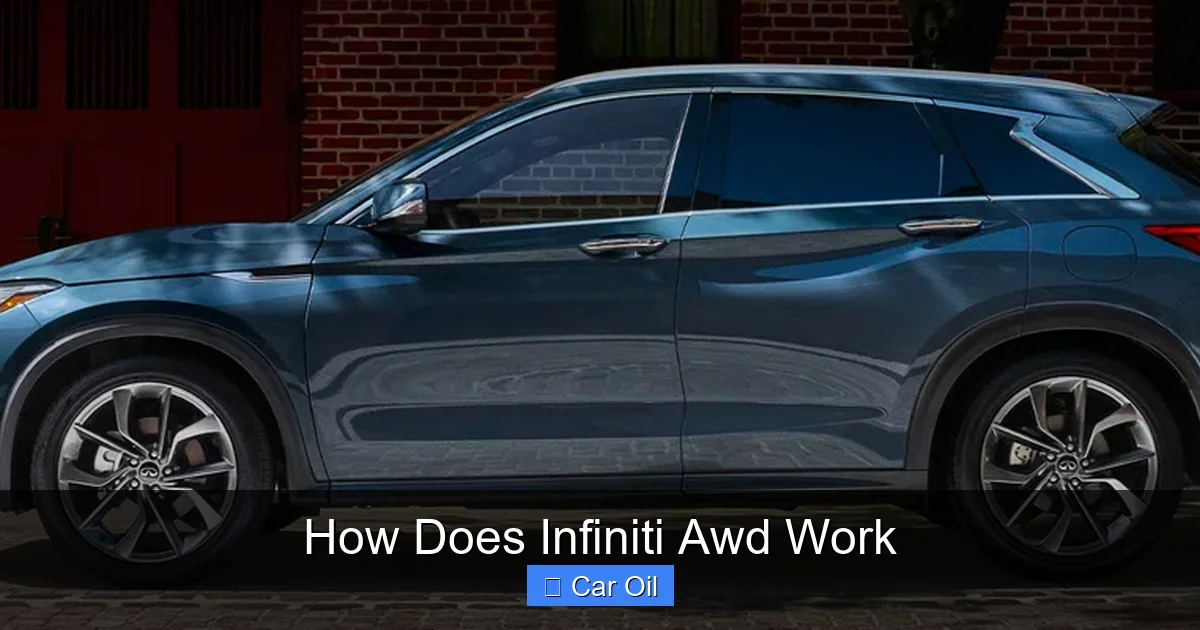
An Infiniti AWD system isn’t one single part; it’s a team of specialized components working together under the command of the vehicle’s computer, the ECU (Engine Control Unit) or, more specifically, the TCM (Transmission Control Module). Here are the key players:
Visual guide about How Does Infiniti Awd Work
Image source: lp-auto-assets.s3.amazonaws.com
1. The Transfer Case: The System’s Brain Center
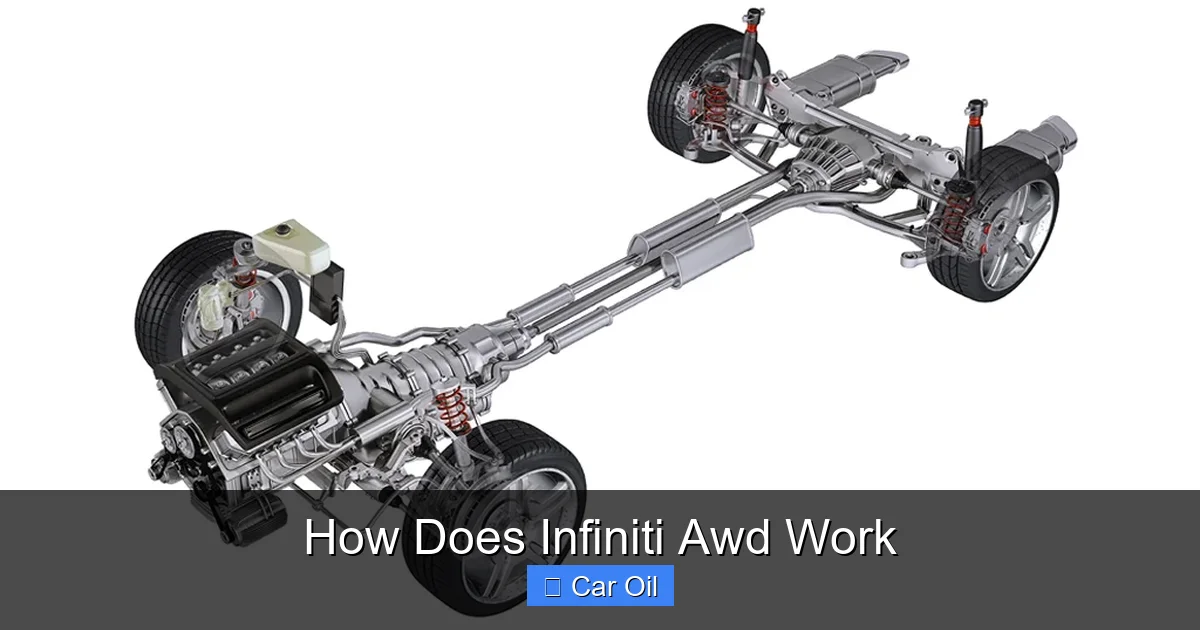
This is the most critical and complex part of Infiniti’s AWD setup. Mounted to the back of the transmission, it’s not a simple gearbox. Inside, you’ll find wet clutch packs and a planetary gear set. The clutch packs are like a high-performance, computer-controlled disc brake system, but instead of slowing something down, they engage to transfer torque. Hydraulic actuators, controlled by solenoids, apply pressure to these clutch packs. The more pressure, the more the front driveshaft is connected and the more torque is sent forward. When no pressure is applied, the front driveshaft is essentially freewheeling, and all power goes rearward. The planetary gears allow for a smooth, permanent connection to the front axle at a fixed ratio, ensuring the front wheels always spin at the correct speed relative to the rear when engaged.
2. The Rear and Front Differentials
Once power leaves the transfer case, it goes to the rear and front differentials. In most Infinitis, these are open differentials. Their job is simple: allow the wheels on the same axle to rotate at different speeds when cornering (the outside wheel travels farther than the inside). The open differential sends power to the wheel with the least resistance. This is a weakness—if one rear wheel is on ice, it will spin freely, and all rear power goes to it, leaving the other wheel (on pavement) with nothing. This is where the ATTESA system’s front bias comes in: if the rear open diff sends all power to a spinning wheel, the system detects the wheel speed difference and immediately engages the transfer case clutch packs to send torque to the front axle, where at least one wheel has grip. On models with ATTESA E-TS Pro, the rear electronic limited-slip differential actively brakes the spinning wheel and sends power to the one with traction, making the system even more effective.
3. The Sensor Network: The System’s Senses
The computer is blind without data. Infiniti AWD uses a sophisticated suite of sensors:
- Wheel Speed Sensors: Found at each wheel, they are the primary input. A large difference in speed between wheels indicates slip.
- Steering Angle Sensor: Tells the computer how far and which way you’re turning. This helps predict if the car is likely to understeer (plow forward) or oversteer (rear slides out).
- Yaw Rate Sensor: Measures the car’s actual rotation around its vertical axis. It compares the intended path (from steering angle) to the actual path. If the car isn’t turning as much as it should (understeer), the system may send more power rearward. If it’s turning too much (oversteer), it may send more power forward to stabilize it.
- Throttle Position Sensor: A heavy foot indicates a request for more power and potential for wheel spin, prompting the system to be more proactive.
- G-Sensor (Accelerometer): Measures lateral and longitudinal acceleration, helping the system understand the vehicle’s dynamics on hills and during cornering.
How It All Works Together: The Torque Transfer Dance
Now, let’s put it all in motion. Imagine you’re driving your Infiniti QX60 on a wet road and you accelerate briskly from a stoplight.
Visual guide about How Does Infiniti Awd Work
Image source: lp-auto-assets.s3.amazonaws.com
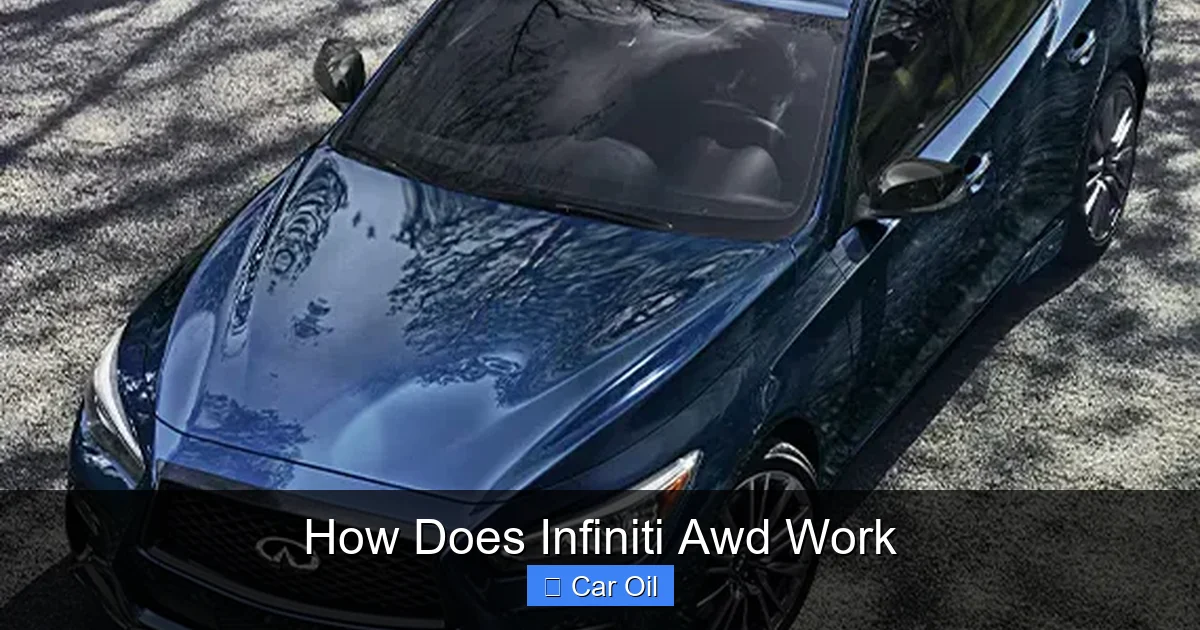
Step 1 (Normal Conditions): The transmission sends power to the rear driveshaft. The transfer case’s clutch packs are disengaged. All torque goes to the rear open differential, which splits it between the two rear wheels. The car feels like a RWD vehicle.
Step 2 (Slip Detected): Your right rear tire hits a patch of standing water. The wheel speed sensor for that wheel suddenly shows it spinning much faster than the left rear wheel. The computer instantly knows the right rear wheel has lost traction.
Step 3 (Immediate Response): The TCM commands the transfer case. Solenoids activate, hydraulic pressure builds, and the wet clutch packs begin to engage. This progressively connects the front driveshaft. Power that was being wasted at the spinning rear wheel is now redirected, first to the rear wheel with grip, and then, as clutch pressure increases, to the front axle.
Step 4 (Stabilization): The front differential (an open diff) receives this torque and sends it to the front wheel with the most grip. You feel a subtle, almost imperceptible tug as the car finds traction and pulls forward smoothly instead of spinning its rear wheel. The entire process happens in milliseconds, far faster than any human could react. In a model with ATTESA E-TS Pro, the rear eLSD might first apply brake pressure to the spinning right rear wheel, which not only slows it but also forces more torque to the left rear wheel via the open diff, all while the front axle is being engaged. It’s a multi-layered, incredibly fast fight against loss of control.
The Role of Driving Modes: Tailoring the System
Your Infiniti likely has drive mode selectors (Eco, Standard, Sport, Snow, etc.). These don’t just change throttle response and shift points; they also recalibrate the AWD system’s logic.
- Snow Mode: This is the most interventionist AWD setting. It starts with a more aggressive front torque bias (e.g., up to 50/50 from a standstill) to maximize traction from a stop. It also softens throttle response and holds gears longer to prevent wheel spin. It’s perfect for deep snow or icy starts.
- Sport Mode: This keeps the system more rear-biased for a sportier feel. The clutch packs are slower to engage, allowing for more rear-wheel-drive character during spirited driving. It might also make the ATTESA E-TS Pro’s rear eLSD more active for sharper cornering.
- Eco Mode: Prioritizes fuel efficiency. It will disengage the front axle as quickly as possible when not needed and may be more conservative with torque transfers to minimize parasitic drag from the transfer case.
Maintenance is NOT Optional: The Critical Role of Oil and Fluid
Here’s where we connect directly to our Car Oil category. Your Infiniti’s AWD system relies on specific fluids for its survival. The transfer case and both differentials are not “lubed for life.” They contain high-pressure, high-shear components—especially those clutch packs in the transfer case—that require specialized fluid.
Visual guide about How Does Infiniti Awd Work
Image source: salvagebid.com
- Transfer Case Fluid: This is the most important fluid for AWD function. It’s typically a specific NS-2 (Nissan/Infiniti Special) fluid or a high-quality GL-4/GL-5 gear oil meeting Nissan’s specification (like Matic J). It must have the correct friction characteristics for the wet clutch packs. Using generic gear oil or, worse, automatic transmission fluid (ATF) can cause the clutches to slip (burning them out) or chatter. This fluid degrades over time due to heat and shear forces. Neglecting the transfer case fluid service interval (often 60,000-90,000 miles, check your manual!) is a direct path to a $2,000+ transfer case rebuild or replacement. When you see a “Service AWD” light, this is often the culprit.
- Differential Fluid: The front and rear differentials also need their own gear oil. While they don’t have clutch packs, they house hypoid gears under extreme pressure. Using the wrong viscosity or type (e.g., a GL-5 oil with extreme pressure additives that can harm brass components in some older diffs) can lead to gear wear and failure. Your owner’s manual specifies the exact type, often a Nissan Matic gear oil.
- Engine Oil: This might seem unrelated, but it’s not. The engine’s power is the source of all torque. Poor-quality or degraded engine oil increases internal engine friction and heat, reducing overall efficiency and power delivery. A weak engine struggling with old oil puts more strain on the entire drivetrain, including the AWD system. Furthermore, many modern Infinitis have variable valve timing systems that rely on clean, stable oil pressure to function correctly. These systems affect engine output and torque curves, which the AWD computer is constantly monitoring. Clean, specification-correct engine oil (often 0W-20 or 5W-30 SN/SP resource-conserving) ensures the engine can deliver power predictably, allowing the AWD system to do its job accurately.
Practical Tip: Always, always use the fluids specified in your owner’s manual. For an Infiniti, that usually means genuine Nissan/Infiniti fluids or aftermarket fluids that explicitly state they meet the Nissan Matic J or NS-2 specification. When in doubt, ask a specialist. If you’re servicing your own vehicle and need to know capacities, resources like the article on how many quarts of oil a Nissan Rogue takes can offer a baseline reference, as the Rogue shares some drivetrain philosophy with Infiniti crossovers, but always cross-reference with your specific Infiniti model’s manual.
Real-World Performance: What Does It All Mean for You?
This engineering translates to tangible benefits on the road.
Traction and Acceleration:
The most obvious benefit. From a stop on wet pavement, or merging onto a highway in the rain, the Infiniti AWD system will feel more sure-footed and less likely to spin its wheels compared to a rear-wheel-drive car. It’s not magic—it won’t make a front-wheel-drive car faster—but it maximizes the use of the available traction.
Stability and Cornering:
This is where the rear-biased setup shines. In a corner, if you apply throttle and the rear begins to step out (oversteer), the system can send power to the front wheels to help pull the car straight, acting as a stability net. In understeer conditions (the car plowing wide), it can send more power rearward to help rotate the car. The ATTESA E-TS Pro with its rear eLSD takes this further, actively pushing the car into the apex by sending more power to the outer rear wheel.
All-Weather Confidence:
On snow-covered roads, engaging Snow Mode gives you a huge psychological and physical advantage. The more balanced torque split from a stop helps you crawl up icy driveways without sliding back. It doesn’t make you invincible—you still need to drive cautiously—but it dramatically reduces the chance of getting stuck or losing control in low-traction scenarios.
Important Caveats:
AWD is not a substitute for good tires. The best AWD system in the world cannot overcome a set of bald all-season tires on ice. AWD mainly helps with acceleration and stability; it does not significantly shorten braking distances. That’s all about tire rubber and brake hardware. Also, AWD systems add weight and mechanical drag, which can slightly reduce fuel economy compared to a 2WD counterpart. The trade-off for most is well worth it.
Common Questions and Troubleshooting
Owning an Infiniti AWD vehicle brings up some common questions and potential issues.
The “AWD” or “Service AWD” Warning Light:
If this illuminates on your dashboard, don’t ignore it. It means the computer has detected a fault in the AWD system. Common causes include:
- A faulty wheel speed sensor (most common).
- Low or degraded transfer case fluid.
- A problem with the transfer case clutch pack solenoid or hydraulic circuit.
- A mismatch in tire sizes (even a significantly worn tire on one corner can trigger it).
A diagnostic scan is needed to read the specific fault code. If the issue is fluid-related, a service may resolve it. For sensor or internal transfer case faults, repairs can be costly. If you encounter this light, especially after an oil change where the wrong fluid might have been used, it’s a serious sign to get it checked immediately. You can learn about reset procedures for similar systems in Nissan vehicles, like the steps in how to reset the AWD light on a Nissan Rogue, but note that resetting a light does not fix the underlying problem—it only clears the symptom until the fault is detected again.
Can I Turn Off AWD?
In most Infiniti models, you cannot manually disable the AWD system. It’s always active and ready. There is no “2WD” mode for fuel savings. The system automatically decouples the front axle when not needed to minimize parasitic loss. Some older or specific models might have an “AWD Lock” button for low-speed, maximum-traction situations (like getting unstuck in deep snow), which holds a fixed 50/50 torque split up to a certain speed (usually 18-25 mph). You should know how to use and disengage this feature properly; instructions for similar Nissan systems can be found in guides like how to turn off AWD lock on a Nissan Rogue. Generally, once you exceed the lock speed, it reverts to normal automatic mode.
Tire Rotation and Matching:
Because the AWD system is so sensitive to wheel speed differences, it is absolutely critical that all four tires are the same size, model, and have approximately equal tread depth. A significant difference (like one new tire and three worn ones) can cause the system to constantly think a wheel is slipping, leading to unnecessary clutch pack wear and potentially triggering the warning light. Always follow a strict rotation schedule (often every 5,000-7,500 miles) and replace all four tires at once if they are worn out.
Frequently Asked Questions
Does Infiniti AWD use more fuel than 2WD?
Yes, but the penalty is usually modest (1-3 MPG). The system adds weight and mechanical drag. However, the computer disengages the front axle when not needed to minimize this. The trade-off for enhanced traction and safety is considered worthwhile by most owners.
Can I use Infiniti AWD for off-roading?
Infiniti AWD systems are designed for on-road performance and all-weather traction, not serious off-roading. They lack a low-range transfer case, locking differentials, and underbody protection. For gravel roads or light snow, they’re excellent. For rock crawling or deep mud, look to a dedicated SUV with a 4WD system.
What happens if I neglect transfer case fluid changes?
The fluid breaks down, loses its friction properties, and becomes contaminated with clutch material. This causes the wet clutch packs to slip and overheat, leading to chatter, shuddering during turns, and eventual catastrophic failure of the transfer case. It’s an expensive and avoidable repair.
Is Infiniti AWD the same as Nissan’s?
Yes, fundamentally. Infiniti is Nissan’s luxury division. The ATTESA system is a Nissan technology. Infiniti models often use more advanced, performance-tuned versions (like E-TS Pro) and are calibrated for a more refined, sportier feel, but the core mechanical and electronic architecture is shared.
Why does my Infiniti shudder when turning?
A shudder or binding feeling during tight, slow turns (like in a parking lot) is a classic symptom of an AWD system that cannot fully decouple the front axle. The most common cause is degraded or incorrect transfer case fluid, which prevents the clutch packs from disengaging smoothly. A fluid change often resolves this.
Should I use winter tires with Infiniti AWD?
Absolutely, and it’s the single best safety upgrade you can make. AWD helps you accelerate and stay stable, but winter tires are essential for confident braking and cornering on ice and snow. All-season tires harden in cold weather and lose significant grip. For true winter capability, mount a set of dedicated winter tires on separate wheels.