
How Do You Turn Off the Check Engine Light on a Toyota Tacoma?

Turning off the check engine light on your Toyota Tacoma is a simple process, but it’s crucial to understand why it came on first. The light is a warning from your truck’s computer that something needs attention. You can reset it using an OBD2 scanner or, as a temporary measure, by disconnecting the battery. However, if the underlying problem isn’t fixed, the light will return. Always diagnose the issue before clearing the code to ensure your Tacoma remains safe and reliable.
Key Takeaways
- The check engine light is a diagnostic tool, not a “do not drive” signal: It alerts you to a problem, which can range from a loose gas cap to a serious engine issue. Your first step should always be to read the trouble code.
- Resetting the light without fixing the problem is temporary: The light will come back on if the issue persists. A proper diagnosis and repair are the only permanent solutions.
- An OBD2 scanner is the safest, most effective reset method: It clears the stored codes and verifies the repair. Basic scanners are affordable and easy to use for most Tacoma owners.
- The “disconnect the battery” method is a last resort: It will reset the light but also clears other vehicle computer data (like radio presets and transmission adaptations), and may not work on newer models.
- Some issues require immediate professional attention: If the light is flashing or accompanied by severe performance problems, stop driving and have the truck towed to prevent catastrophic damage.
- Regular maintenance prevents many check engine lights: Following your Tacoma’s service schedule, including things like resetting the maintenance required light, keeps your truck running smoothly and helps avoid many common triggers.
- A loose or faulty gas cap is the #1 most common cause: Before assuming the worst, check that your fuel cap is tightened properly until it clicks.
📑 Table of Contents
- Understanding Your Tacoma’s Check Engine Light
- The Golden Rule: Diagnose Before You Reset
- Method 1: The Proper Way – Using an OBD2 Scanner
- Method 2: The Temporary Workaround – Disconnecting the Battery
- Common Causes for a Check Engine Light on a Tacoma
- When to Seek Professional Help
- Preventive Maintenance to Avoid Future Lights
- Conclusion: Knowledge is Power (and a Healthy Engine)
Understanding Your Tacoma’s Check Engine Light
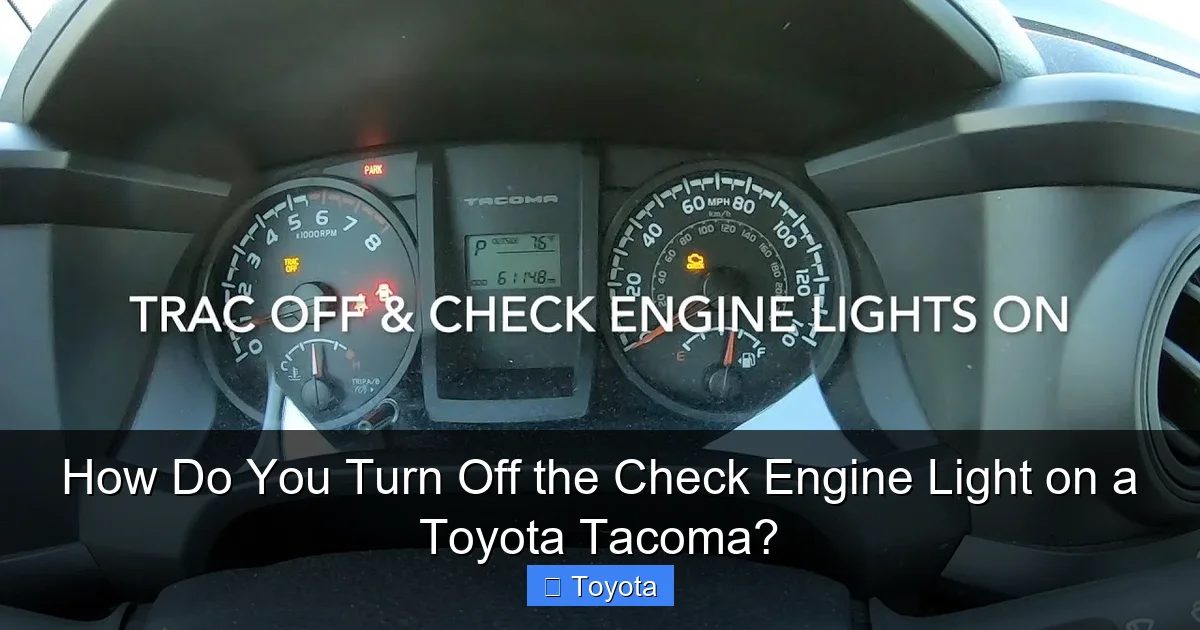
That small, illuminated engine icon on your Toyota Tacoma’s dashboard isn’t just there to annoy you. It’s a critical communication tool from your truck’s On-Board Diagnostics (OBD) system. When it glows steadily, it’s saying, “Hey, something’s not quite right with my emissions or engine management system. You should check me out.” If it’s flashing, it’s screaming, “EMERGENCY! STOP DRIVING! I’m about to cause serious damage!” Understanding this difference is the first and most important step in dealing with it.
The system is incredibly sensitive. It monitors dozens of sensors and components hundreds of times per second. When a sensor reading falls outside the pre-programmed acceptable range, the computer stores a “trouble code” and illuminates the light. This light is officially called the Malfunction Indicator Lamp (MIL), but we all know it as the check engine light. Its primary job is to protect your catalytic converter and ensure your Tacoma meets emissions standards, but it also protects your engine from harm.
Steady vs. Flashing Light: What’s the Difference?
This distinction is non-negotiable for your truck’s health. A steady, amber/yellow light indicates a non-emergency fault. You can usually drive cautiously for a short distance to get it diagnosed, but you shouldn’t ignore it for weeks. Common steady light causes include a loose gas cap, a faulty oxygen sensor, or a minor evaporative emission (EVAP) system leak.
A flashing or red light signals a severe misfire. Unburned fuel is flooding the catalytic converter, which can destroy it in minutes. This is often caused by a bad spark plug, ignition coil, or fuel injector. If your light is flashing, pull over safely, shut off the engine, and arrange for a tow. Do not continue driving.
The Golden Rule: Diagnose Before You Reset
This is the cardinal rule of check engine light management. Simply turning off the light without addressing the root cause is like ignoring a fever by taking a cold shower—it provides momentary relief but does nothing to cure the illness. The code will return, often within a few drive cycles (typically 2-3 starts and drives).

Visual guide about How Do You Turn Off the Check Engine Light on a Toyota Tacoma?
Image source: toyotacheckenginelight.com
To diagnose, you need to retrieve the stored Diagnostic Trouble Codes (DTCs). This is done via the OBD2 port, a standardized 16-pin connector usually located under your Tacoma’s dashboard, just below the steering column. You’ll need a tool to read it:
- Basic OBD2 Code Reader ($20-$50): Perfect for most owners. It plugs in, reads the code (like P0171, P0420), and often has a simple “Erase Codes” function.
- Advanced Scanner/App ($100+): Provides more detailed data, live sensor readings, and manufacturer-specific codes. Some work with your smartphone via Bluetooth.
- Free Service at Auto Parts Stores: Companies like Auto Zone, O’Reilly, and Advance Auto will scan your Tacoma for free. They can’t clear the code for you, but they’ll print the definition. This is a great first step.
Once you have the code, you can research it. A code like “P0455 – Evaporative Emission System Leak Detected (large leak)” points you toward checking the gas cap and vapor lines. A code like “P0302 – Cylinder 2 Misfire Detected” tells you to focus on that specific cylinder’s spark plug, coil, or injector. Fix the problem, then clear the code.
Method 1: The Proper Way – Using an OBD2 Scanner
This is the professional, recommended method. It respects the vehicle’s computer system and ensures a clean reset after a repair.
Visual guide about How Do You Turn Off the Check Engine Light on a Toyota Tacoma?
Image source: i.ytimg.com
Step-by-Step Guide
1. Locate the OBD2 Port: Look under your Tacoma’s dashboard on the driver’s side. It’s usually within easy reach of the steering wheel. It may have a plastic cover that flips open.
2. Connect the Scanner: Turn your ignition to the “ON” position (do not start the engine). Plug the OBD2 connector firmly into the port.
3. Turn On the Scanner: Follow the device’s prompts. You’ll typically select your vehicle make (Toyota) and model year.
4. Read Codes: Navigate to the “Read Codes” or “Diagnose” function. The scanner will communicate with the truck’s computer and display any stored codes. Write these down. If multiple codes exist, note all of them. They often point to a common system.
5. Perform the Repair: This is the most critical part. Use the code(s) as your roadmap. Replace the faulty oxygen sensor, tighten or replace the gas cap, fix the vacuum leak, etc.
6. Clear the Codes: After the repair is complete, return to the scanner’s menu and select “Clear Codes” or “Erase DTCs.” Confirm the action. The check engine light should go off immediately.
7. Test Drive: Drive your Tacoma normally for 15-20 minutes under various conditions (city, highway). The light should remain off. If it returns, the repair may not have been successful, or a new, different problem has developed.
Method 2: The Temporary Workaround – Disconnecting the Battery
This old-school method can reset the light, but it’s a blunt instrument with significant downsides. It should only be used if you cannot access a scanner and have already diagnosed and fixed the problem, or as a last-ditch effort to see if a minor, transient issue clears itself.

Visual guide about How Do You Turn Off the Check Engine Light on a Toyota Tacoma?
Image source: dealerimages.dealereprocess.com
How to Do It (and the Consequences)
1. Safety First: Ensure the Tacoma is parked, the engine is off, and the keys are out of the ignition. Wear safety glasses and gloves.
2. Locate the Battery: In most Tacomas, it’s under the hood, on the driver’s side. If you have a newer model with a battery in the cab (under the rear seat or in the trunk), consult your owner’s manual first.
3. Disconnect the Negative Terminal: Using a 10mm wrench, loosen the nut on the NEGATIVE (-) battery cable (it’s usually black). Twist the cable off and tuck it away from the terminal so it cannot accidentally touch metal.
4. Wait: Leave it disconnected for at least 10-15 minutes. This allows the capacitors in the vehicle’s computers (ECU, PCM, BCM) to fully discharge, clearing the memory.
5. Reconnect: Reattach the negative cable and tighten the nut securely.
What Else Gets Reset? This is the major drawback. Disconnecting the battery will also reset:
- Your radio presets and clock.
- Power window and sunroof initializations (they may need to be re-taught).
- Automatic transmission shift points (it will re-learn your driving style).
- Climate control settings.
- Steering angle sensor calibration (the VSC/TRAC lights may flash for a drive cycle).
For a 2016+ Tacoma, this method may not clear the check engine light due to enhanced security systems that retain memory. Your best bet is still an OBD2 scanner. If the light comes back immediately after reconnecting, the fault is still active and needs diagnosis.
Common Causes for a Check Engine Light on a Tacoma
Knowing the frequent culprits can help you prioritize your diagnosis. Here are the top offenders across various Tacoma model years, especially the popular 3.5L V6 and 2.7L 4-cylinder engines.
Fuel System & Emissions
- Loose, Damaged, or Missing Gas Cap: The #1 cause. A poor seal allows fuel vapors to escape, triggering EVAP system codes like P0455, P0456.
- Faulty Oxygen (O2) Sensors: These monitor exhaust gases. A failing upstream (before catalytic converter) sensor hurts fuel economy and performance. Codes: P0130-P0134 (Bank 1), P0150-P0154 (Bank 2).
- Catalytic Converter Efficiency: A failing cat will trigger P0420 or P0430. This is often a result of a long-ignored misfire or rich fuel condition.
- Mass Air Flow (MAF) Sensor: Contamination can cause rough idle, poor acceleration, and codes P0100-P0103.
Ignition & Engine Mechanical
- Spark Plugs & Ignition Coils: Worn plugs or failed coils cause misfires (P0300-P0306). The 3.5L V6 uses one coil per cylinder (coil-on-plug), making coil failures common.
- Variable Valve Timing (VVT) System: Issues with the VVT-i solenoid or oil flow can trigger codes like P0010, P0011, P0012.
- Exhaust Gas Recirculation (EGR) System: A clogged EGR valve or failed EGR temperature sensor can cause rough idle and codes P0400-P0405.
Other Electrical & Sensor Issues
- Thermostat (especially on newer Tacomas): A failing electronic thermostat can cause codes P0128 (coolant thermostat temperature) or P0125 (insufficient coolant temp for closed loop).
- Camshaft or Crankshaft Position Sensors: Critical for engine timing. Failure can cause a no-start condition or codes P0340, P0335.
- Evaporative (EVAP) Purge or Vent Solenoids: These control fuel vapor flow. A stuck solenoid triggers codes like P0441, P0442.
When to Seek Professional Help
While many Tacoma owners are perfectly capable of handling a gas cap or spark plug replacement, some situations absolutely require a trained technician with advanced tools.
Red Flags That Mean “Stop and Call a Pro”
- The light is FLASHING. As stated, this is an emergency.
- The truck is running poorly: Severe misfiring (shaking, loss of power), stalling, or backfiring.
- Multiple, complex codes: If your scanner shows 5+ codes across different systems (engine, transmission, ABS), it could indicate a wiring harness issue, a failed main computer (PCM), or a severe underlying problem that’s cascading.
- Codes pointing to the transmission: If you see codes starting with P07xx or P08xx, or if the check engine light is on along with a separate transmission warning light, stop driving. These can indicate solenoid or internal mechanical failures.
- You’ve attempted a repair and the code returns immediately. This suggests the repair was incorrect, the part was defective, or there’s a related issue you haven’t found.
- You lack the tools, space, or confidence. There’s no shame in taking it to a trusted independent mechanic or the dealer. A proper diagnosis fee is worth the peace of mind and prevention of costly damage.
A professional will use a high-end scan tool to view live data streams, perform tests (like a smoke test for EVAP leaks), and have access to Technical Service Bulletins (TSBs) from Toyota that address known, common problems specific to your Tacoma’s model year and engine. For example, certain years have known issues with AC compressor clutch failures that can trigger check engine lights, which a mechanic would know to check.
Preventive Maintenance to Avoid Future Lights
The best way to “turn off” a check engine light is to make sure it never comes on in the first place. Sticking to your Tacoma’s maintenance schedule is the single most effective strategy.
- Use Quality Fuel: Avoid cheap, low-quality gasoline. Top-tier detergents help keep fuel injectors and intake valves clean.
- Replace Engine Air Filter Regularly: A clogged filter strains the engine and can affect MAF sensor readings. Check it every 15,000 miles.
- Address Small Problems Immediately: That rough idle or slight decrease in fuel economy? Get it checked. Small issues become big, expensive ones if ignored.
- Don’t Ignore Other Warning Lights: An illuminated oil pressure light or battery light can quickly lead to engine damage that will trigger a check engine code. Pay attention to all your gauges and warnings.
- Keep the Gas Cap Secure: Get in the habit of tightening it until you hear at least three clicks. If the cap’s seal is cracked or damaged, replace it. It’s a $20 part that saves hours of diagnostics.
- Follow Your Service Schedule: This includes more than just oil changes. Spark plugs (every 120,000 miles on many Tacomas), ignition coils, oxygen sensors, and coolant have service intervals. Adhering to them prevents failures. You can also stay on top of routine service by properly resetting the maintenance required light after each service.
Conclusion: Knowledge is Power (and a Healthy Engine)
So, how do you turn off the check engine light on a Toyota Tacoma? The short answer is: with an OBD2 scanner, after you’ve fixed the problem the code represents. The long answer is what we’ve explored here—a process of calm diagnosis, informed repair, and proper reset. Your Tacoma’s check engine light is not your enemy; it’s your truck’s voice. It’s trying to tell you something important. By listening to that voice, reading its message (the trouble code), and taking appropriate action, you protect your investment, ensure your safety, and maintain the legendary reliability that makes the Tacoma a icon.
Resist the urge to simply disconnect the battery and forget about it. That approach is a gamble with your truck’s health. Instead, embrace the diagnostic process. Grab a code reader, find the definition, and become your Tacoma’s best advocate. Whether it’s a $25 gas cap or a $1,200 catalytic converter, addressing the root cause is always the smarter, safer, and more economical path. A healthy Tacoma with a dark dashboard is a happy Tacoma, ready for the next adventure.
Frequently Asked Questions
Can I just pull the fuse for the check engine light to turn it off?
No. The check engine light is controlled by the Powertrain Control Module (PCM). Pulling a fuse may reset some systems but will not clear the stored diagnostic trouble codes. The light will simply come back on when the PCM powers up and sees the fault is still present. You must clear the codes via the OBD2 port.
How many miles can I drive with a steady check engine light on?
There’s no set number. It depends entirely on the severity of the fault. If it’s a loose gas cap, you can drive indefinitely until you tighten it. If it’s a faulty oxygen sensor, you can drive for weeks or months, but with reduced fuel economy and potential pollution. If it’s an early-stage catalytic converter issue, driving could eventually cause it to fail completely. When in doubt, get it diagnosed promptly.
Will an oil change turn off the check engine light?
Not directly. A check engine light is for engine management and emissions system faults, not for oil life. However, a severely neglected oil change that leads to low oil pressure or engine damage could trigger a code. The light that reminds you of an oil change is the separate “MAINTENANCE REQUIRED” or “OIL” light, which you reset after an oil change.
Why is my check engine light on but my Tacoma seems to run fine?
This is very common. Modern vehicles are designed to compensate for minor failures. A slightly lazy oxygen sensor or a small EVAP leak may not cause noticeable drivability issues but will still trigger the light because it affects emissions. Don’t ignore it just because it drives fine—the problem can worsen over time and lead to more expensive repairs or failed emissions testing.
How much does it cost to diagnose a check engine light?
Many auto parts stores (like Auto Zone) offer free code scanning. A mechanic or dealer will typically charge a diagnostic fee (often $80-$150) which is usually applied to the repair cost if you proceed with them. This fee covers their time, expertise, and advanced scan tool usage to pinpoint the exact problem.
After fixing the problem, how long does it take for the light to go off?
If you clear the code with a scanner, the light should go off immediately. If you fix the problem but don’t clear the code, the light will stay on until the computer completes a specific number of “drive cycles” (usually 2-3) where the faulty component tests within normal parameters. This can take a day or two of normal driving. Using a scanner to clear it after the repair is the fastest way.
