
How Do You Reset the Tire Pressure Light on a 2015 Toyota Sienna?

Resetting the tire pressure light (TPMS) on a 2015 Toyota Sienna is a simple DIY task you can do in minutes. First, always ensure all tires are properly inflated to the manufacturer’s recommended PSI, found on the driver’s door jamb sticker. If the light persists after correct inflation, use the vehicle’s built-in reset procedure via the steering wheel controls or the “SET/2” button. Understanding when a reset is appropriate versus when a professional diagnosis is needed is key to safe driving.
Key Takeaways
- Understanding How Do You Reset the Tire Pressure Light on a 2015 Toyota Sienna?: Provides essential knowledge
📑 Table of Contents
- Understanding Your 2015 Toyota Sienna’s Tire Pressure Monitoring System (TPMS)
- Critical First Step: Diagnose Before You Reset
- Method 1: The Standard Button Reset (Most Common)
- Method 2: The Menu-Driven Reset (For Some Trims/Displays)
- Troubleshooting: When the Light Won’t Stay Off
- Maintenance Tips to Prevent Future TPMS Issues
- The Bottom Line: Safety Over Convenience
Understanding Your 2015 Toyota Sienna’s Tire Pressure Monitoring System (TPMS)
That little yellow tire-shaped icon glowing on your dashboard is more than just an annoyance—it’s your 2015 Toyota Sienna’s Tire Pressure Monitoring System (TPMS) trying to tell you something important. Before we dive into the “how,” let’s quickly understand the “why.” The TPMS is a critical safety feature mandated by law. It continuously monitors the air pressure inside your Sienna’s four road tires. When the pressure in one or more tires drops significantly below the recommended level, the system triggers a warning light to alert you.
For the 2015 model year, the Sienna uses an indirect or direct system? The 2015 Sienna uses a direct TPMS. This means each wheel has its own electronic sensor, powered by a small internal battery, that transmits real-time pressure and temperature data to your vehicle’s computer. This is more accurate than older indirect systems that used the ABS wheel speed sensors to guess pressure changes. Because it’s a direct system, the sensors themselves can fail, or the system needs to be manually told when you’ve rotated tires or replaced a sensor. That’s where the reset procedure comes in.
Why the TPMS Light Comes On: More Than Just Low Air
While low tire pressure is the most common cause, it’s not the only one. Here’s a full list of reasons your 2015 Sienna’s TPMS light might illuminate:
- Low Tire Pressure: The obvious one. A slow leak from a nail, a damaged valve stem, or simply cold weather causing pressure to drop (pressure decreases about 1 PSI for every 10°F drop in temperature).
- Overinflated Tires: Yes, too much air can also trigger the warning. Always inflate to the exact PSI on your door jamb sticker, not the max on the tire sidewall.
- Faulty TPMS Sensor: Sensors have batteries that last 7-10 years. A dead battery or a physically damaged sensor (from curb impact, corrosion) will cause a constant light.
- Unmatched Sensors: If you replaced a sensor with a non-OEM or incorrectly programmed one, the system may not recognize it.
- Recent Tire Service: After a tire rotation, repair, or replacement, the system needs to be reset to learn the new sensor positions. Forgetting this is a very common reason for the light to stay on after service.
- Damaged Valve Stem: The valve stem is part of the sensor assembly. A leaky or broken stem requires sensor replacement.
- System Malfunction: Rarely, the vehicle’s TPMS control module can have an electronic fault.
Pro Tip: If the TPMS light flashes for 60-90 seconds upon starting your Sienna and then stays solid, it usually indicates a system fault (like a dead sensor battery), not just low pressure. A solid light that comes on after you’re driving typically means low pressure.
Critical First Step: Diagnose Before You Reset
This is the most important rule. Resetting the light without fixing the underlying problem is like turning off your smoke alarm while a fire is still burning. It’s dangerous and will lead to poor fuel economy, uneven tire wear, and compromised handling and braking—especially in a heavy minivan like the Sienna that often carries families and cargo.
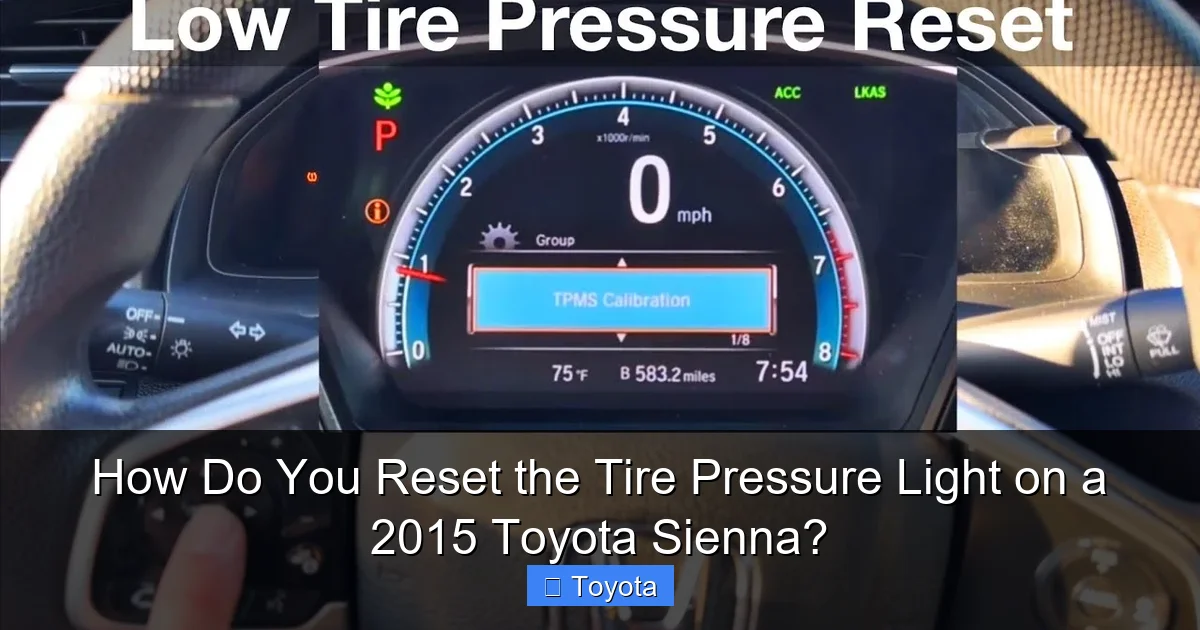
Visual guide about How Do You Reset the Tire Pressure Light on a 2015 Toyota Sienna?
Image source: i.ytimg.com
How to Properly Check and Inflate Your Sienna’s Tires
1. Find Your Pressure Spec: Open the driver’s door. Look for the yellow and white sticker on the door jamb (the pillar you latch the door to). It lists the exact PSI for front and rear tires. For a 2015 Sienna, it’s commonly 35 PSI for all four tires when carrying a full load, but always use the sticker on your specific vehicle.
2. Check When Cold: “Cold” means the car hasn’t been driven for at least three hours or has been driven less than 1-2 miles. Driving heats the tires and air inside, giving a falsely high reading.
3. Use a Reliable Gauge: Digital stick-type gauges are inexpensive and accurate. Don’t trust the gauge at a gas station—they are often abused and inaccurate.
4. Inflate to Spec: Remove the valve cap, press your gauge on, note the reading. Add air in short bursts from a compressor (at home or at a service station), re-checking frequently. It’s easy to over-inflate. When you hit the exact number on your door jamb sticker, replace the valve cap securely.
5. Don’t Forget the Spare: While your spare tire doesn’t have a TPMS sensor, you should still check its pressure periodically (it often has a different, higher PSI requirement, like 60 PSI).
After inflating all four tires to the correct cold pressure, drive your Sienna for a few minutes. In many cases, the light will turn off on its own as the system re-reads the corrected pressures. If it stays on after 5-10 minutes of driving, then it’s time to perform the manual reset procedure.
Method 1: The Standard Button Reset (Most Common)
This is the primary method for a 2015 Sienna. It uses the “SET/2” button, which is actually part of the multi-information display (MID) controls on the steering wheel. This method is for when you’ve corrected the pressure and need the system to recognize the current state.
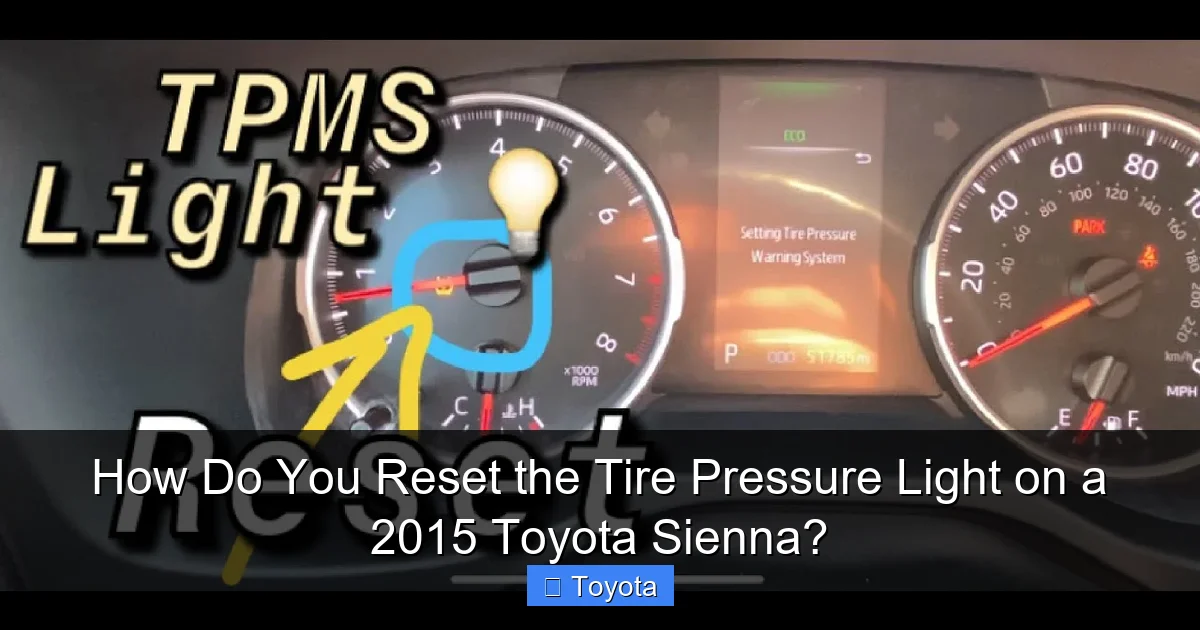
Visual guide about How Do You Reset the Tire Pressure Light on a 2015 Toyota Sienna?
Image source: i.ytimg.com
Step-by-Step Button Reset Procedure
- Step 1: Ensure the ignition is ON (engine can be off or running). Turn the key to the “ON” position or press the Start/Stop button twice without touching the brake pedal.
- Step 2: Locate the “SET/2” button. On the 2015 Sienna, this is on the right spoke of the steering wheel, often near the “+” and “-” cruise control buttons. It may have a small icon that looks like a car with an exclamation point or simply say “SET.”
- Step 3: Press and hold the “SET/2” button. You must hold it for about 3-5 seconds. You’ll know it’s working when the TPMS indicator light on your dashboard blinks three times.
- Step 4: Release the button. The light should then turn off. If it doesn’t turn off immediately, drive the vehicle at a steady speed above 25 mph for several minutes. The system will re-check the pressures and should extinguish the light.
Important Note: If the “SET/2” button does not seem to work, or if your steering wheel controls look different (some Limited or Platinum trims may have a slightly different layout), you may need to use the menu-based method below. Always consult your owner’s manual for the exact diagram of your steering wheel.
Method 2: The Menu-Driven Reset (For Some Trims/Displays)
Some 2015 Sienna models, particularly those with the larger multi-information display, may require you to navigate through a menu to reset the TPMS. This method is also useful if the simple button press doesn’t work.
Navigating the Multi-Information Display (MID)
- Step 1: With the ignition ON, use the “Mode” or “Display” button (often the “Up/Down” arrow on the left steering wheel spoke) to cycle through the display screens until you find the “TPMS” or “Tire Pressure” screen. It might show a graphic of your car with pressure readings or a message like “Tire Pressure Low.”
- Step 2: Once on the TPMS screen, look for a “Set” or “Reset” prompt. This may require you to press and hold the “Enter” button (the center button on some steering wheels) or the “SET” button again while on this specific screen.
- Step 3: Follow any on-screen prompts. The display may ask you to confirm or show a countdown. The TPMS light should blink to confirm the reset is in progress.
- Step 4: After confirming, exit the menu. The light should go out after a short drive.
Key Difference: The button method (Method 1) is a global reset command. The menu method (Method 2) sometimes allows you to see which tire is low before resetting, and on some systems, it’s the only way to initiate the reset sequence. If you’re unsure, try Method 1 first. If the light returns or doesn’t blink, explore the display menus.
Troubleshooting: When the Light Won’t Stay Off
You’ve inflated the tires perfectly. You’ve followed the reset procedure precisely. But that stubborn TPMS light is back on, or it never turned off at all. Now what? This is the point where a simple reset transitions into diagnosis.
Common Reset Failures and Their Solutions
- The Light Returns Immediately: This almost always means a physical problem with a tire or sensor. You have a slow leak. Inspect the tire for nails, screws, or sidewall damage. Check the valve stem for cracks or leaks (spray soapy water on it; bubbles indicate a leak). A sensor battery may also be dead.
- The Light Flashes, Then Stays Solid: This is a classic TPMS system fault code. Your Sienna’s computer is telling you it can’t communicate with one or more sensors. This usually means a dead sensor battery (sensors are not serviceable; the whole unit must be replaced) or a damaged sensor. You’ll need a professional with a TPMS scan tool to identify which sensor has failed.
- Reset Button Does Nothing (No Blinking Light): Ensure you’re holding the button long enough (5+ seconds). Check that your battery is strong; a weak car battery can sometimes prevent the TPMS module from activating. Also, if any tire is still significantly low, the system may ignore the reset command until pressure is corrected.
- Light is On, But All Pressures Read Normal: This can happen after a tire rotation if the system wasn’t reset. It can also indicate a faulty sensor that is sending erroneous data. A TPMS tool can “relearn” the sensor positions or identify a bad sensor.
When to Call a Professional: If you’ve verified correct, cold tire pressures on all four tires and the light still won’t reset after multiple attempts, it’s time to visit a tire shop or your Toyota dealer. They have the specialized scan tools to read TPMS codes, test sensor signals, and replace/ reprogram sensors if needed. Replacing a TPMS sensor on a Sienna typically costs $80-$150 per sensor for parts and labor.
Maintenance Tips to Prevent Future TPMS Issues
An ounce of prevention is worth a pound of cure. By incorporating these habits into your routine, you can minimize TPMS annoyances and keep your Sienna safe and efficient.
Proactive Care for Your Tires and TPMS
- Check Pressures Monthly: Don’t wait for the light. Make it a habit to check all four tires (when cold) once a month with your own gauge. This catches slow leaks early.
- Account for Temperature: Be vigilant during seasonal transitions, especially fall to winter. A 30°F drop can lower pressure by 3 PSI, enough to trigger the light. Add air as needed in the early morning.
- Use Valve Stem Caps: Always keep the little plastic caps on your valve stems. They keep dirt and moisture out, preventing corrosion and slow leaks at the core.
- Be Careful at the Shop: When getting tires rotated, repaired, or replaced, explicitly remind the technician to “reset the TPMS” after the work is done. It’s an easy step for them to forget.
- Know Your Sensor’s Age: The original TPMS sensors in your 2015 Sienna are now 9+ years old. Their internal batteries are nearing or at the end of their typical lifespan. If you start getting recurring TPMS warnings with no tire issues, start budgeting for sensor replacement.
- Consider Aftermarket Sensor Quality: If you replace a sensor, opt for a high-quality OEM or OEM-equivalent part. Cheap aftermarket sensors can have unreliable batteries or poor signal strength.
- Don’t Ignore the Spare: While it won’t trigger the light, a dead or flat spare leaves you stranded. Check its pressure when you check your other tires.
For owners of other Toyota models, resetting maintenance lights follows a similar philosophy of understanding your vehicle’s specific system. For example, the process to reset the maintenance light on a Toyota Highlander involves the odometer button, while resetting the oil light on a 2011 Highlander uses the steering wheel controls. It’s always best to consult your specific model’s manual.
The Bottom Line: Safety Over Convenience
Your 2015 Toyota Sienna is designed to be a safe and reliable family hauler. The TPMS is a vital part of that safety equation. Properly inflated tires provide optimal traction, braking, handling, and fuel economy. They also wear evenly, saving you money on premature replacements.
The reset procedure is merely a communication tool. You’re telling the car’s computer, “I have addressed the issue you warned me about.” It is not a fix in itself. The real fix is maintaining correct tire pressure. By making regular pressure checks a habit and understanding the reset process, you take control of this important maintenance item. If the light persists despite your best efforts, don’t hesitate to seek professional help. A correct diagnosis will ensure your Sienna is as safe and efficient as it was designed to be, protecting you and your passengers on every journey.
And remember, while the process is similar across many vehicles, each can have its nuances. If you ever find yourself with a different Toyota or another brand, the principles are the same: diagnose, correct, then reset. For instance, the steps to reset the tire pressure light on a Subaru Outback also involve a button hold, but the location and timing might differ slightly. Always start with your own owner’s manual.
Frequently Asked Questions
Can I reset the TPMS light without inflating the tires?
No. You should never reset the light without first confirming all tires are inflated to the correct PSI on the door jamb sticker. Resetting with low pressure is unsafe and will cause the light to return quickly.
Why does my TPMS light come on in cold weather?
Air contracts as temperature drops. A 10°F drop can lower tire pressure by about 1 PSI. If your tires were exactly at spec in warm weather, a cold snap can drop them below the trigger point, activating the light. Inflate them when cold to the door jamb spec and reset.
Do I need to reset the TPMS after rotating my tires?
Yes, absolutely. The system learns the position of each sensor. Rotating the tires moves the sensors to new wheel locations. If you don’t reset/relearn the positions, the system will incorrectly report a low pressure on the wrong tire, and the light will stay on.
How much does it cost to replace a faulty TPMS sensor on a Sienna?
A direct TPMS sensor for a 2015 Sienna typically costs between $50 and $100 for the part. With professional installation and programming (if required), total cost per sensor usually ranges from $80 to $150. Some shops may offer a package if you replace all four at once.
My TPMS light is flashing. Is that different from a solid light?
Yes. A flashing TPMS light (usually for 60-90 seconds at startup) indicates a system malfunction, most commonly a dead sensor battery or a communication failure. A solid light typically indicates low pressure in one or more tires. A flashing light requires professional diagnosis with a scan tool.
Will disconnecting the battery reset the TPMS?
No. The TPMS is a separate module with its own memory. Disconnecting the car’s battery will reset the radio and engine computer, but it will not clear a TPMS warning. You must use the specific “SET/2” button or menu procedure to reset the tire pressure system.
