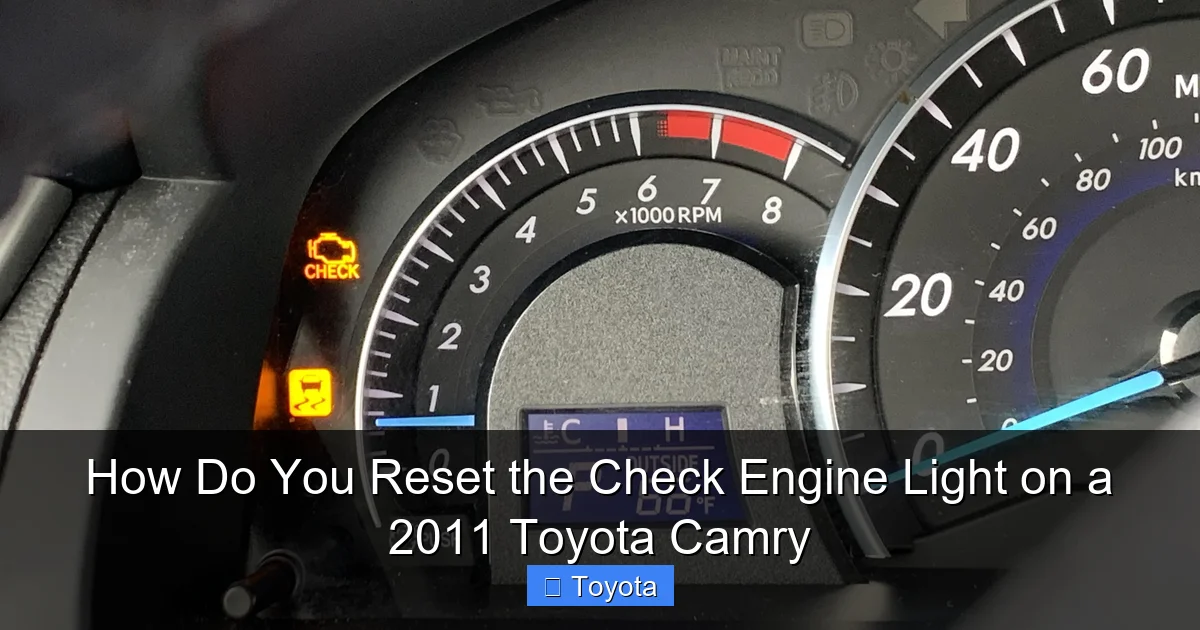
How Do You Reset the Check Engine Light on a 2011 Toyota Camry

Contents
- 1 Key Takeaways
- 2 📑 Table of Contents
- 3 Understanding Your 2011 Camry’s Check Engine Light: It’s a Messenger, Not the Problem
- 4 Method 1: The Universal Reset – Disconnecting the Battery
- 5 Method 2: The Professional Way – Using an OBD2 Scanner
- 6 When You Should NOT Reset the Check Engine Light
- 7 Special Considerations for Your 2011 Camry
- 8 Post-Reset: What to Do After the Light Goes Out
- 9 Conclusion: A Reset is a Final Step, Not a Shortcut
- 10 Frequently Asked Questions
Car Emergency Roadside Kit

Steering Wheel Cover

Car Shampoo Concentrate

Waterless Car Wash Spray
Resetting the check engine light on a 2011 Toyota Camry is a simple process, but it’s critical to diagnose and fix the underlying issue first. You can clear the light by disconnecting the battery, using an OBD2 scanner, or completing a successful driving cycle after repairs. Never ignore a persistent light, as it indicates a problem that could cause engine damage. Always read the stored trouble codes before resetting to understand what triggered the warning.
That little, glowing engine-shaped icon on your dashboard. It’s one of the most notorious and anxiety-inducing sights for any car owner. For the driver of a 2011 Toyota Camry—a vehicle known for its legendary reliability—seeing the check engine light can feel like a betrayal. Your first instinct is to make it go away. But before you go searching for how to reset check engine light on 2011 Toyota Camry, you need to understand what that light truly means and the proper, safe way to handle it. This guide will walk you through everything, from the “why” to the “how,” ensuring you protect your reliable Camry instead of potentially harming it.
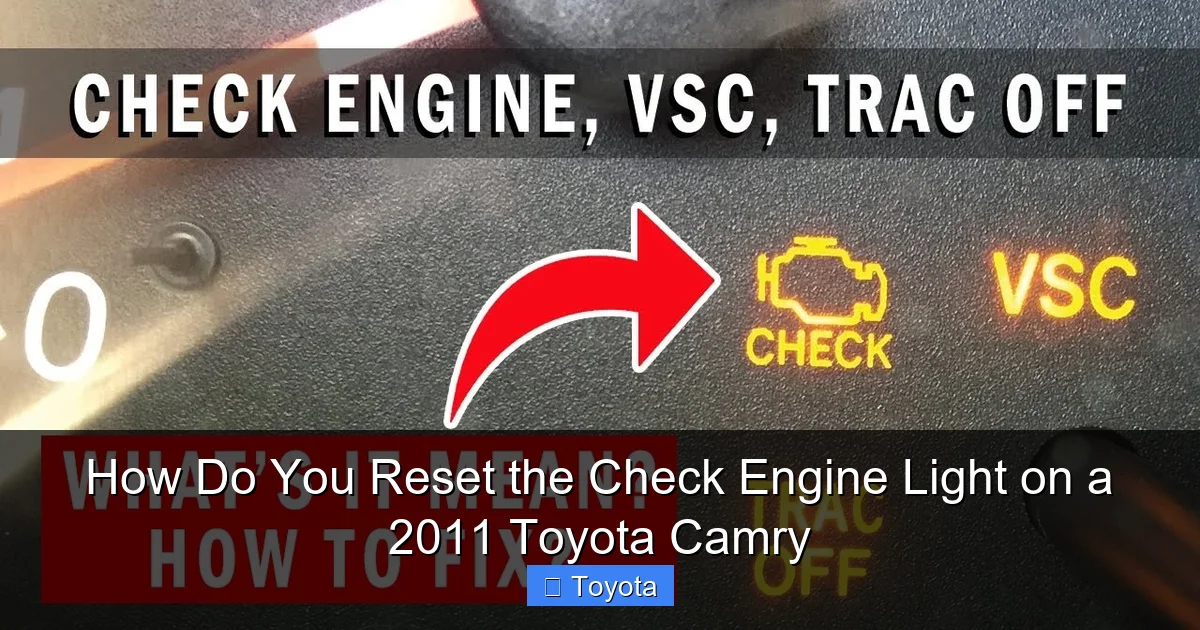
The check engine light, or malfunction indicator lamp (MIL), is your car’s way of saying, “Hey, something in my emissions or engine management system isn’t working right.” The On-Board Diagnostics II (OBD2) system, standard in all 1996+ vehicles like your Camry, constantly monitors dozens of sensors and components. When it detects a value outside the normal range, it logs a Diagnostic Trouble Code (DTC) and illuminates the light. Resetting the light does not fix the problem. It merely erases the computer’s memory of the fault. If the underlying issue remains, the light will inevitably return, often within a few drive cycles. Therefore, resetting should only be the final step after a successful repair.
Key Takeaways
- Diagnose Before You Reset: Always use an OBD2 scanner to read trouble codes before clearing the light. Resetting without fixing the problem will cause the light to return.
- Battery Disconnect is a Universal Method: Removing the negative battery terminal for a few minutes will clear the computer’s memory and turn off the light, but it also resets other systems like radio presets.
- An OBD2 Scanner is the Professional Tool: This is the fastest, most reliable way to reset the light and verify the repair. It’s a must-have for any DIY car owner.
- A Driving Cycle Can Auto-Clear: After a repair, the car’s computer may turn off the light on its own once it confirms the issue is resolved during a specific drive pattern.
- The Light’s Behavior Matters: A steady light means a non-emergency issue. A flashing light indicates a severe problem (like a misfire) that can damage your catalytic converter—stop driving immediately.
- Not All Lights Reset the Same Way: Dashboard warnings like the maintenance required light or airbag light have completely different reset procedures. For instance, resetting the airbag light on a Toyota Camry requires a different process.
- Persistent Light Means Unresolved Issue: If the check engine light returns immediately after a reset, the repair was incomplete or a new problem exists. Seek professional diagnostics.
📑 Table of Contents
- Understanding Your 2011 Camry’s Check Engine Light: It’s a Messenger, Not the Problem
- Method 1: The Universal Reset – Disconnecting the Battery
- Method 2: The Professional Way – Using an OBD2 Scanner
- When You Should NOT Reset the Check Engine Light
- Special Considerations for Your 2011 Camry
- Post-Reset: What to Do After the Light Goes Out
- Conclusion: A Reset is a Final Step, Not a Shortcut
Understanding Your 2011 Camry’s Check Engine Light: It’s a Messenger, Not the Problem
Before we dive into reset methods, we must establish a crucial hierarchy of action. The check engine light is a symptom, not the disease. Treating the symptom without curing the disease is ineffective and dangerous. Your approach should always be:
- Scan and Read: Retrieve the stored trouble codes.
- Diagnose: Research the code’s meaning and perform the necessary tests to find the faulty component.
- Repair: Fix or replace the broken part.
- Verify: Ensure the repair is complete and the issue is resolved.
- Reset: Clear the light and confirm it stays off.
Skipping steps 1-4 is why many people find their check engine light back on within a day or two. They’ve only treated the messenger, not the message.
Steady vs. Flashing Light: A Critical Difference
The behavior of your Camry’s check engine light provides immediate, vital information.
- Steady Yellow/Orange Light: This indicates a non-emergency fault in the emissions system. Common culprits include a loose gas cap (the #1 cause!), a faulty oxygen sensor, or a minor EVAP leak. You can usually drive the car for a while, but you should schedule a diagnosis soon. Prolonged driving with certain codes can reduce fuel economy and eventually cause more damage.
- Flashing or Blinking Light: This is a SEVERE EMERGENCY. It means the engine is misfiring badly enough to potentially overheat and destroy the catalytic converter—an expensive repair. Common causes are bad spark plugs, ignition coils, or fuel injectors. If your light is flashing, pull over safely and shut off the engine immediately. Have the car towed to a mechanic. Do not attempt to reset a flashing light; the problem must be fixed first.
Method 1: The Universal Reset – Disconnecting the Battery
This is the oldest trick in the book and works on virtually any vehicle with a conventional 12-volt battery, including your 2011 Camry. It’s effective because it cuts power to the Engine Control Module (ECM), clearing its stored memory, including trouble codes and long-term fuel trim adaptations.
Visual guide about How Do You Reset the Check Engine Light on a 2011 Toyota Camry
Image source: i.ytimg.com
Step-by-Step Battery Disconnect Procedure
- Safety First: Park your Camry on a level surface, engage the parking brake, and turn off the engine. Open the hood.
- Locate the Battery: The battery in a 2011 Camry is typically in the engine bay on the driver’s side.
- Identify Terminals: The negative terminal is marked with a minus (-) sign and is usually connected to a black wire. The positive terminal has a plus (+) sign and a red wire.
- Loosen the Negative Terminal: Using a 10mm socket or wrench, loosen the nut on the negative (-) cable clamp. Do not touch the positive terminal with your tools.
- Disconnect and Secure: Once loose, carefully lift the negative cable clamp off the terminal post. Tuck the cable away from the battery so it cannot accidentally touch the post. You can secure it with a zip-tie or plastic tie.
- Wait: Leave the battery disconnected for at least 10-15 minutes. This ensures all residual power (from capacitors) in the ECM is drained. Some sources recommend 30 minutes for a full clear.
- Reconnect: Reattach the negative cable clamp to the terminal post and tighten the nut securely. Do not overtighten.
- Start the Car: Close the hood, start the engine, and let it idle for a minute. The check engine light should be off. You may notice the engine idle is slightly rough for the first 30 seconds; this is normal as the ECM relearns fuel trims.
Important Caveats of the Battery Method
While effective, this method has significant downsides. Disconnecting the battery will reset all your vehicle’s settings. This includes:
- Radio presets and clock time.
- Power window/mirror “memory” settings.
- Automatic transmission shift points (the car may shift differently for the first 10-20 drive cycles as it relearns your driving style).
- Steering angle sensor calibration (the steering wheel may not be perfectly straight after a reset; a specific calibration drive is needed).
- On some models, it may trigger a “Check VSC” or “Check ABS” light, which often requires a separate drive cycle to clear.
Because of these side effects, the battery disconnect is best reserved for situations where you don’t have a scanner and are certain the repair is complete (e.g., after replacing a gas cap or an oxygen sensor). For a more precise reset, an OBD2 scanner is superior.
Method 2: The Professional Way – Using an OBD2 Scanner
This is the recommended, modern method. An OBD2 scanner (also called a code reader or scan tool) plugs into your Camry’s Data Link Connector (DLC), located under the dashboard on the driver’s side (steering column area). It communicates directly with the ECM.
Visual guide about How Do You Reset the Check Engine Light on a 2011 Toyota Camry
Image source: img.toyotask.com
Types of Scanners and What You Need
You have several options, from basic to advanced:
- Basic Code Reader ($30-$60): Reads and clears generic OBD2 codes. Perfect for the DIYer. Brands like Autel, Launch, and Innova offer reliable models. Ensure it says it supports “OBD2 EOBD” and “all makes/models.”
- Enhanced Scan Tool ($100-$300+): Reads manufacturer-specific codes (P1xxx codes for Toyota) and accesses more systems (ABS, SRS, HVAC). Useful for complex issues.
- Smartphone Adapters ($15-$40): Devices like the OBDLink MX+ or Vgate iCar Pro plug into the DLC and connect to a free app (like Torque Pro) on your phone. They offer great value and data logging.
Step-by-Step Scanner Reset Procedure
- Locate the DLC: Find the trapezoidal 16-pin connector under your Camry’s dash.
- Connect the Scanner: Plug the scanner’s cable firmly into the DLC.
- Turn on the Ignition: Turn the key to the “ON” or “Run” position (do not start the engine). The scanner should power on.
- Read Codes: Navigate the menu to “Read Codes” or “Trouble Codes.” Note all codes displayed (e.g., P0171, P0420). Write them down. This is your diagnostic roadmap.
- Diagnose and Repair: Use the code(s) to guide your diagnosis. Fix the issue. (Example: Code P0455 is a large EVAP leak – often a loose or faulty gas cap).
- Clear Codes: After the repair, with the ignition still “ON,” go to the “Clear Codes” or “Erase Codes” function on your scanner. Confirm the action.
- Verify: The check engine light should extinguish immediately. Turn the ignition off and on again to be sure. Some scanners have a “I/M Monitor Readiness” test. After clearing, all monitors will show “Not Complete.” You must drive the car to reset them.
The “Drive Cycle” – Letting the Computer Self-Verify
Clearing codes resets the light, but the ECM also uses a series of self-tests called “monitors.” For the light to stay off permanently, these monitors must all complete and show “Ready” or “Complete.” A generic drive cycle for a 2011 Camry typically includes:
- A cold start (engine off for 4+ hours).
- Drive at steady speeds (40-60 mph) for 10-15 minutes.
- Include some gentle acceleration and deceleration.
- A complete warm-up cycle.
- A slow-down from 40 mph to a stop without braking hard.
- A 2-minute idle period.
After this cycle, re-check your scanner’s monitor status. If all are “Complete” and the light remains off, your repair was successful. If a monitor won’t set or the light returns, the fault persists.
When You Should NOT Reset the Check Engine Light
There are clear scenarios where pressing that “clear” button or disconnecting the battery is the absolute wrong move.

Visual guide about How Do You Reset the Check Engine Light on a 2011 Toyota Camry
Image source: seventrumpet.com
Signs of a Serious Problem
Do not reset if you notice any of these alongside the check engine light:
- Flashing light (as mentioned, this is a dire emergency).
- Severe loss of power, shaking, or unusual noises.
- Overheating (temperature gauge in the red).
- Smoke from the exhaust or engine bay.
- Sweet smell (coolant leak) or rotten egg smell (catalyst issue).
- Reduced fuel economy that is dramatic and sudden.
In these cases, the problem is active and likely causing damage. Resetting the light would just mask the danger, leading to a catastrophic and costly failure. Tow the vehicle to a trusted mechanic.
If You Haven’t Repaired Anything
If you simply cleared the light to make a warning disappear for a vehicle inspection or sale without addressing the fault, you are committing fraud in many jurisdictions and risking the safety of the next driver. More importantly, you are gambling with your own engine’s health. A minor issue like a failing oxygen sensor will, over time, cause your catalytic converter to fail – a repair that can cost $1,500 or more. The $100 diagnostic fee is cheap insurance compared to that.
Special Considerations for Your 2011 Camry
Your fifth-generation Camry (XV40) is a sophisticated machine. While the reset procedures are universal, some model-specific nuances exist.
The Gas Cap: The Usual Suspect
The most common cause of a check engine light in any Camry, especially a 2011, is a loose, damaged, or missing fuel filler cap. The EVAP system is sealed, and a poor seal is detected as a large leak (codes P0455, P0456). Always start here. Turn the cap until you hear at least three clicks. Ensure it’s seated properly. If the cap’s seal is cracked or missing, replace it (a genuine Toyota cap is ~$25). Tighten it, then drive for a day. The light may clear itself. If not, a simple code clear will do it after confirming the cap is good.
Common Camry-Specific Trouble Codes
While many codes are generic, some are frequently reported for this model year and engine (2.5L 4-cylinder or 3.5L V6):
- P0420/P0430: Catalyst System Efficiency Below Threshold. Often caused by failing O2 sensors before the catalyst, but can mean the catalyst itself is worn out. Expensive.
- P0171/P0174: System Too Lean (Bank 1/2). Means too much air or not enough fuel. Could be a vacuum leak, dirty MAF sensor, or weak fuel pump.
- P0300-P0306: Random/Multiple Cylinder Misfire Detected. The serious one. Check spark plugs, ignition coils, and fuel injectors.
- P0441/P0442/P0446: EVAP System issues (purge valve, vent solenoid, leaks).
Knowing these common codes helps you prioritize diagnostics. Remember, a code points to a system, not a specific part. P0420 means “the computer thinks the catalyst isn’t cleaning exhaust as well as it should.” You must diagnose why (bad O2 sensor vs. bad catalyst).
Resetting Other Dashboard Lights
It’s easy to confuse the check engine light with other service indicators. The maintenance required light on your Camry is a simple mileage-based reminder for oil changes and other scheduled service. It is reset via a different procedure (usually involving the odometer button and ignition). Never try to reset the check engine light using the maintenance light method; it won’t work. Similarly, the airbag light (SRS) has a completely different, often scanner-required, reset process after a fault or airbag deployment. Always identify the correct light symbol on your dash.
Post-Reset: What to Do After the Light Goes Out
You’ve scanned, repaired, and cleared the code. The light is off. Your job isn’t done yet.
Drive and Monitor
For the next 50-100 miles, drive normally but stay alert. Pay attention to:
- Does the check engine light come back on?
- How does the engine run? Any roughness, hesitation, or strange sounds?
- Is fuel economy normal?
- Any new smells or leaks?
If the light returns immediately or within a few drive cycles, the repair was not successful. The code will likely be the same one. You need to re-diagnose. If a new code appears, you may have introduced a new problem during the repair.
Prepare for Emissions Testing
In most states, you cannot pass an emissions/smog test with a check engine light on. Even if the light is off, the tester will check if all OBD2 monitors are “Ready.” After a code clear, all monitors reset to “Not Complete.” You must complete the drive cycle (as described earlier) to set them. This can take 1-3 days of normal driving. Don’t take your car for a smog test right after a reset; you will fail. Use your scanner to verify monitor status first.
Conclusion: A Reset is a Final Step, Not a Shortcut
Resetting the check engine light on your 2011 Toyota Camry is a straightforward task, but its simplicity is precisely why it’s often misused. Think of it like this: the check engine light is your car’s fever. You wouldn’t just take a fever reducer and feel better without treating the infection causing the fever. Similarly, you must diagnose and repair the root cause—be it a loose gas cap, a failing sensor, or a misfiring cylinder—before using the battery disconnect method or an OBD2 scanner to clear the code.
Your Camry’s reliability is built on proper maintenance and timely attention to warnings. By following the diagnostic-first approach outlined here, you protect your engine, save money on future repairs, ensure your car passes inspections, and drive with genuine peace of mind. Invest in a decent OBD2 scanner; it’s the most valuable tool in your glovebox after the owner’s manual. And remember, when in doubt, a professional diagnostic is always the wisest choice for a car that’s meant to last for years to come. For owners of other Toyota models, the general principles are the same, though specific reset procedures for lights like the maintenance light on a Toyota Yaris or check engine light on a Toyota Highlander can vary slightly in their execution. Always consult the correct guide for your specific model.
Frequently Asked Questions
Can I just disconnect the battery to reset the check engine light on my 2011 Camry?
Yes, disconnecting the negative battery terminal for 10-15 minutes will clear the light. However, this also resets all your vehicle’s memory settings (radio, clock, transmission adaptations) and should only be done after you have diagnosed and fixed the original problem. If you haven’t repaired the issue, the light will return.
Will the check engine light reset itself after I fix the problem?
Sometimes, yes. If the issue was minor and self-correcting (like a loose gas cap that you tightened), the ECM may turn off the light on its own after a successful driving cycle. However, for most active faults, you will need to manually clear the stored code with an OBD2 scanner to extinguish the light.
Do I absolutely need an OBD2 scanner to reset the light?
No, the battery disconnect method works without a scanner. But a scanner is highly recommended because it allows you to read and record the trouble codes first, which is essential for proper diagnosis. A scanner also provides a cleaner reset without losing all your car’s other settings and lets you verify that all system monitors have reset properly.
How much does it cost to have a shop reset my check engine light?
If you just want the light reset with no diagnosis, many shops will do it for $50-$100. However, this is not advisable. Reputable shops will insist on diagnosing the cause first, as resetting an unresolved issue is unethical and a disservice to the customer. The diagnostic fee (typically $80-$150) is the valuable part, as it tells you what needs to be fixed.
I reset the light, but it came back on the next day with the same code. What does that mean?
This means the underlying problem was not correctly repaired. The ECM ran its test on the affected system, detected the same fault, and turned the light back on. You need to revisit your diagnosis. For example, if you got a code for an oxygen sensor, you may have replaced the wrong sensor or have an underlying issue (like an exhaust leak) that is causing the new sensor to fail.
Is it safe to drive my Camry with the check engine light on?
It depends. If the light is steady and the car is running normally (no strange noises, smells, or performance issues), you can drive it for a short period to get it diagnosed. However, you should not delay. If the light is flashing, or if you notice severe performance problems, stop driving immediately and have the car towed. Driving with a flashing light can destroy the catalytic converter in minutes.