
How Do I Turn Off the Check Engine Light on a 2004 Toyota 4runner?

Do not simply turn off the check engine light without first diagnosing and repairing the underlying issue. The light is a warning that something is wrong with your 4Runner’s emissions or engine system. The proper procedure involves using an OBD2 scanner to read and clear the diagnostic trouble code (DTC) after the repair is complete. If the problem persists, the light will return, and driving with a serious fault can cause severe engine damage.
That little amber icon on your 4Runner’s dashboard—the one that looks like an engine with a line through it—has a way of ruining your day. It’s the check engine light, and its sudden illumination can spark a wave of questions and a pit in your stomach. “Is it serious? Can I still drive it? How do I make it go away?” If you’re the owner of a 2004 Toyota 4Runner, you’re in the right place. This guide will walk you through exactly what that light means, what you must do before even thinking about turning it off, and the correct, safe procedures to reset it once the problem is fixed. We’ll cut through the mystery and give you the knowledge to handle this common situation with confidence.
First, let’s get one critical truth straight: the check engine light is not a “service required” reminder like the maintenance light. It is your 4Runner’s way of screaming, “Hey, something is broken or not working right in my engine or emissions system!” Ignoring it or simply turning it off without fixing the root cause is like tearing the battery wire out of a smoke detector instead of putting out the fire. It might stop the noise, but you’re in real danger. Our goal here is not just to make a light go out; it’s to ensure your 4Runner is running safely, efficiently, and reliably for years to come.
Key Takeaways
- The check engine light is a warning, not a service reminder. It indicates a problem that must be diagnosed and repaired before resetting the light.
- You must read the diagnostic trouble code (DTC) first. Use an OBD2 scanner to identify the specific issue before attempting any reset.
- Disconnecting the battery is a last-resort method. It may clear codes but can also cause other systems to lose memory and may not work on all vehicles.
- After clearing the code, you must complete a drive cycle. The vehicle’s computer needs to monitor all sensors under various conditions to confirm the repair.
- If the light returns immediately or flashes, stop driving. A flashing light indicates a severe problem (like a misfire) that can destroy your catalytic converter.
- Some issues require professional diagnosis. Complex problems like EVAP system leaks or internal engine faults need advanced tools and expertise.
- Resetting the light does not fix the car. It only turns off the dashboard indicator. The actual mechanical or electrical repair is separate and essential.
📑 Table of Contents
- Understanding the Check Engine Light: It’s Not a Guest, It’s a Warning
- Essential Preparation: You Can’t Reset What You Don’t Understand
- How to Turn Off the Check Engine Light: The Correct Methods
- After the Reset: What to Expect and How to Monitor
- When to Absolutely Seek Professional Help
- Common Myths and Costly Mistakes to Avoid
- Conclusion: Knowledge is Power (and Saves Money)
Understanding the Check Engine Light: It’s Not a Guest, It’s a Warning
Your 2004 4Runner is a rolling network of computers and sensors. The main computer, called the Engine Control Module (ECM) or Powertrain Control Module (PCM), constantly monitors dozens of parameters—oxygen levels, engine timing, fuel trim, and more. When a sensor sends a reading that is out of the expected range, or if a component fails, the ECM stores a Diagnostic Trouble Code (DTC) and illuminates the check engine light to get your attention.
The Difference Between a Steady Light and a Flashing Light
This is the most important distinction. A steady, solid check engine light typically indicates a non-emergency fault. It might be something like a loose gas cap (which triggers an EVAP system code), a failing oxygen sensor, or a minor misfire. You can usually drive cautiously for a short distance to get it diagnosed. However, a flashing or blinking check engine light is a dire emergency. It means the ECM has detected a severe, active misfire—a cylinder is not firing at all. Driving with a misfire dumps raw, unburned fuel into your exhaust system, which will overheat and destroy the incredibly expensive catalytic converter within minutes. If your light is flashing, pull over safely and shut off the engine immediately. Have the vehicle towed to a mechanic.
What “Check Engine” Actually Means
The term is a bit of a misnomer. It doesn’t always point directly to the engine. The system monitors anything that affects emissions. Common culprits on a 2004 4Runner include:
- Faulty Oxygen (O2) Sensors: These tell the computer how much oxygen is in the exhaust. They wear out and cause poor fuel economy.
- Loose or Faulty Gas Cap: A cap that doesn’t seal properly causes the EVAP (evaporative emissions) system to fail its leak test. This is the easiest fix—just tighten or replace the cap.
- Mass Air Flow (MAF) Sensor Issues: This sensor measures incoming air. If it’s dirty or failed, the engine can’t calculate fuel properly.
- Catalytic Converter Problems: A failing cat will trigger specific codes and often comes with rotten egg smells or poor performance.
- Ignition System Misfires: Worn spark plugs, bad ignition coils, or damaged spark plug wires can cause cylinders to misfire.
Before you can even think about resetting the light, you need to know which of these (or something else) is the problem. That requires reading the code.
Essential Preparation: You Can’t Reset What You Don’t Understand
Rushing to clear the light is the #1 mistake. You must first retrieve the stored code(s). This is your diagnostic roadmap. Without it, you’re guessing. The 2004 4Runner uses the universal OBD2 (On-Board Diagnostics II) system, mandated for all cars sold in the US since 1996. This standardization is your best friend.
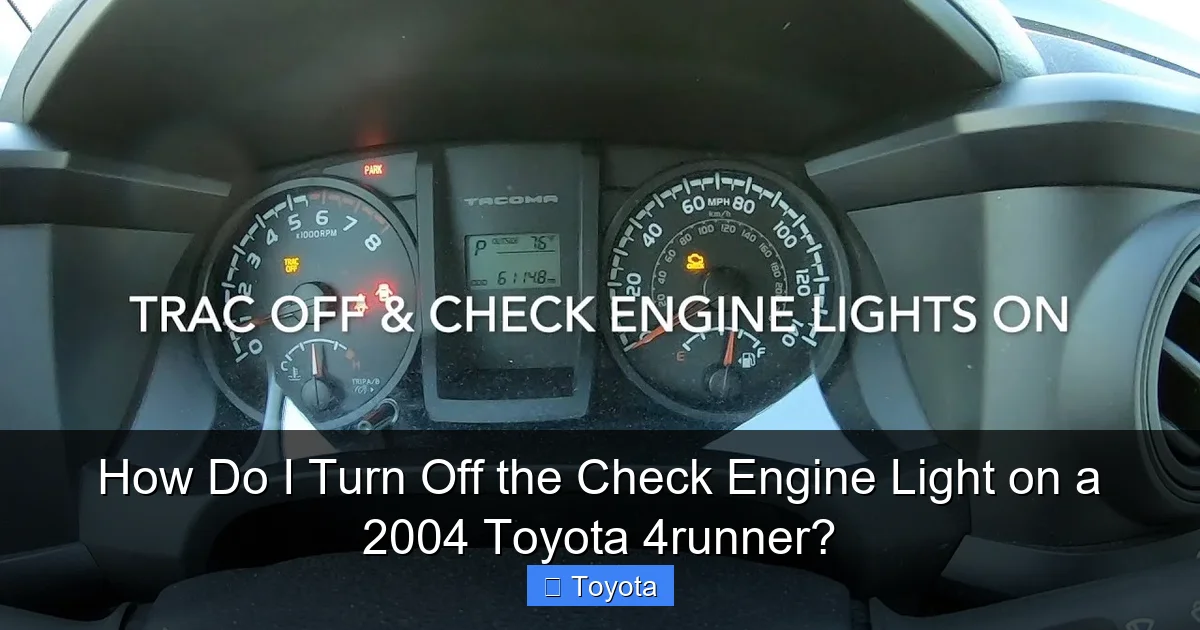
Visual guide about How Do I Turn Off the Check Engine Light on a 2004 Toyota 4runner?
Image source: i.ytimg.com
Tool #1: The OBD2 Scanner/Code Reader
You need a tool to communicate with your 4Runner’s computer. You have options:
- Basic Code Reader ($20-$50): These inexpensive devices plug into the OBD2 port (under the dashboard, near the steering column) and simply read and clear codes. They are perfect for this task. Brands like ANCEL, Autel, and Innova make reliable basic models.
- Advanced Scan Tool ($100+): These offer live data streaming, graphing, and manufacturer-specific codes. Great for deeper diagnostics but overkill for just resetting a light.
- Smartphone Adapter ($15-$30): Devices like the OBDLink LX or BAFX Products plug into the OBD2 port and connect to your phone via Bluetooth or Wi-Fi. You use a free app (like Torque or OBD Fusion) to read and clear codes. Very convenient and cost-effective.
Do not buy a “universal” code reader that claims to work on all makes without an OBD2 connector. Ensure it explicitly states compatibility with 1996+ OBD2 vehicles.
Tool #2: Your Smartphone, a Notebook, and Google
Once you have a 5-character code (like P0420 or P0301), you need to understand it. A code reader will give you a brief definition, but for real insight, search “P0420 Toyota 4Runner” online. Forums like Toyota4Runner.com are goldmines for model-specific experiences. Write down the code and any freeze frame data (the conditions when the fault occurred) before clearing it.
The Critical First Step: Diagnosis
Plug your scanner into the OBD2 port with the ignition in the “ON” position (engine off). Follow the device’s instructions to “Read Codes.” You may get one code or several. Do not clear them yet. Research each code. For example:
- P0440-P0447: EVAP system leak. Start by checking and tightening the gas cap. If that doesn’t work, it could be a faulty purge valve or a leak in the charcoal canister.
- P0171/P0174: System too lean/rich. Could be a vacuum leak, dirty MAF sensor, or bad fuel pump.
- P0300-P0304: Random/Multiple Cylinder Misfire or specific cylinder (e.g., P0302 = cylinder 2). Check spark plugs, ignition coils, and wires.
Fix the problem first. Replace the faulty part, repair the leak, clean the sensor. Only after the repair is complete should you proceed to reset the light. If you clear the code without fixing it, the light will return within a few drive cycles as the computer redetects the fault. This is why simply disconnecting the battery is often a temporary and ineffective solution.
How to Turn Off the Check Engine Light: The Correct Methods
Now that you’ve diagnosed and repaired the issue, it’s time to clear the code and turn off that annoying light. Here are your methods, in order of preference.
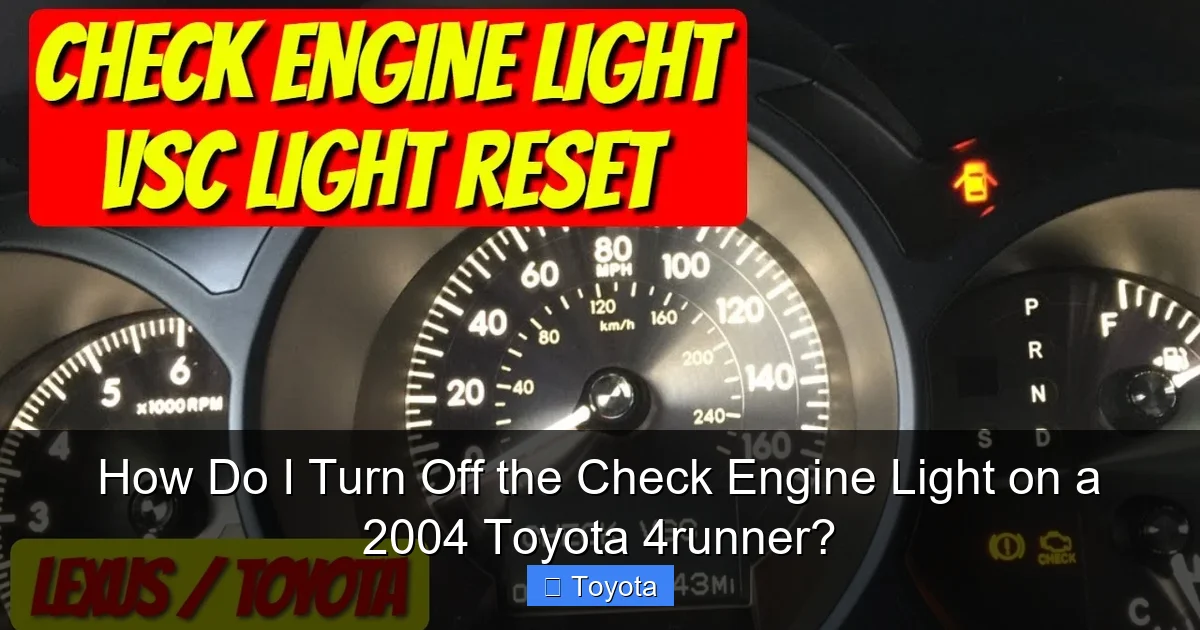
Visual guide about How Do I Turn Off the Check Engine Light on a 2004 Toyota 4runner?
Image source: i.ytimg.com
Method 1: The Proper Way – Using an OBD2 Scanner to Clear Codes
This is the standard, manufacturer-approved method. It communicates directly with the ECM and tells it to erase all stored diagnostic data.
- Ensure the repair is complete. All connectors are tight, parts are installed correctly.
- Reconnect your OBD2 scanner to the port under the dash.
- Turn the ignition to the “ON” position (do not start the engine).
- Navigate the scanner’s menu to find “Erase Codes,” “Clear DTCs,” or “Reset MIL.” The MIL is the Malfunction Indicator Lamp (the check engine light).
- Select the option and confirm. The scanner will communicate with the car and send the clear command.
- The light should go out immediately. You may hear a chime from the scanner or the car’s cluster.
Important: Clearing codes also erases all the computer’s learned data—fuel trim adjustments, idle adaptation, and other performance parameters. The ECM will need to relearn these over the next few drives, which is why you might experience slightly rough idle or hesitant acceleration for the first 20-50 miles. This is normal.
Method 2: The “Drive Cycle” – Letting the Computer Verify the Fix
After clearing the code, the ECM doesn’t consider the problem truly fixed until it runs its internal tests again and passes. This is called a “drive cycle” or “readiness monitor” status. Most states use this for emissions testing (smog check). If your monitors aren’t set to “Ready,” you’ll fail the test even if the light is off.
The drive cycle for a 2004 4Runner is specific. Generally, it involves:
- Starting from a cold soak (car sitting for several hours).
- Driving at steady speeds between 40-60 mph for 10-15 minutes.
- Including some gentle acceleration and deceleration.
- Coming to a complete stop and idling for a few minutes.
- A cool-down period.
The easiest way to know if you’ve completed it is to use your OBD2 scanner. Many have a “Readiness Monitor” or “I/M Status” function. It will show which tests (Catalyst, EVAP, O2 sensors, etc.) are complete and which are incomplete. You need all or most to be “Ready” for an emissions test. Simply driving normally for 50-100 miles usually completes the cycle. For a precise 4Runner drive cycle procedure, a factory service manual is best, but normal driving often suffices.
Method 3: The Last Resort – Disconnecting the Battery
Before we had OBD2 scanners, this was the only way. It’s messy and can cause other problems, but it works in a pinch.
- Open the hood and locate the battery.
- First, disconnect the negative (black) battery cable. Use a 10mm wrench. Always remove the negative cable first to prevent accidental shorts.
- Wait at least 10-15 minutes. This allows the ECM’s capacitors to fully discharge, erasing volatile memory.
- Reconnect the negative cable and tighten it securely.
Drawbacks of this method:
- It will also reset your radio presets, clock, and power seat/window memory.
- On some vehicles, it can trigger the theft system (immobilizer) or require a “relearn” procedure for the engine idle. The 4Runner’s system is generally robust, but it’s a possibility.
- It may not clear all codes on some models, especially manufacturer-specific ones stored in long-term memory.
- It does not guarantee the monitors will reset properly; you still need a drive cycle.
Bottom Line: Use this method only if you have absolutely no access to an OBD2 scanner and you are certain the repair is correct. For a few dollars, a basic code reader is a far better investment.
After the Reset: What to Expect and How to Monitor
The light is off. Great! But your job isn’t done. You need to verify the repair held.
Visual guide about How Do I Turn Off the Check Engine Light on a 2004 Toyota 4runner?
Image source: autovfix.com
The First Drive and Beyond
Start the engine. The light should remain off. Drive normally. For the first 20-50 miles, the ECM is in its “relearn” phase. Pay attention to:
- Idle quality: Is it smooth or slightly lumpy? A minor roughness is normal as the computer adjusts fuel trims.
- Throttle response: Does it feel hesitant? This should smooth out quickly.
- Any new noises, smells, or performance issues? If something feels wrong, stop and re-check your repair.
Checking Your Work with a Scanner
After your drive cycle, plug your scanner back in. Don’t just check if the light is off; check the status of the diagnostic monitors. Look for a menu option like “I/M Readiness” or “Check Emiss. Sys.” All the monitors should show “Complete” or “Ready.” If one or more are “Incomplete,” your drive cycle wasn’t sufficient. Keep driving normally; they will usually complete within 100-150 miles of mixed driving.
Most importantly: Re-read the codes. Go to the “Read Codes” function. If the original code is gone and no new codes have appeared, your repair was successful. If the same code returns, your repair did not fix the problem. If a new, different code appears, your repair may have caused a new issue (e.g., an O2 sensor code after replacing the exhaust).
Will the Light Come Back On?
If the repair was correct and all components are functioning within spec, the light should stay off permanently. However, if the issue was a component that was on the verge of failure (like an aging O2 sensor), it might trigger a new code later. The key is that you addressed the specific problem indicated by the code. If a new, unrelated code pops up, that’s a new problem to diagnose.
When to Absolutely Seek Professional Help
There are times when resetting the light yourself is not just unwise, it’s dangerous. Here are your red flags:
Symptom: The Check Engine Light is Flashing
As stated before, this is an emergency. A flashing light means a severe, active misfire. Continuing to drive will destroy your catalytic converter ($1,500+ replacement). Tow the vehicle.
Symptom: Multiple, Complex Codes
If your scanner reads codes like P0300 (random misfire) and P0171 (system too lean) and P0420 (catalyst efficiency), you’re dealing with an interconnected problem. A vacuum leak, for example, can cause both lean conditions and misfires. A professional has the experience to trace these interrelationships.
Symptom: You’ve Fixed the Obvious Part, But the Code Returns
You replaced the spark plug for a P0302 code, but the code comes back. The problem might be deeper—a leaking head gasket, a cracked cylinder head, or a faulty fuel injector. These require compression tests, leak-down tests, and advanced diagnostics.
Symptom: You Cannot Read the Code
If your scanner cannot communicate with the vehicle or shows “No Data,” there may be a power issue, a blown fuse for the OBD2 port, or a completely dead ECM. This requires a professional.
For complex issues, especially those involving the engine’s internal mechanics, there is no shame in calling a trusted mechanic. Their diagnostic fee is money well spent to avoid a catastrophic and far more expensive repair.
Common Myths and Costly Mistakes to Avoid
Let’s debunk some dangerous misinformation that circulates online.
Myth: “I can just pull the fuse for the check engine light.”
This does not work on modern vehicles. The light is controlled by the software in the ECM. Pulling fuses might reset other systems but will not clear the DTC. You’d just be disabling other important functions for no reason.
Myth: “If the light is off, the problem is gone.”
Not true. The ECM only illuminates the light when it detects a fault. If the fault is intermittent (e.g., a loose wire that only connects when you hit a bump), the light may turn itself off after a few drive cycles, but the problem still exists and will likely return. Always retrieve and address stored codes, even if the light is currently off.
Myth: “A cheap scanner from the auto parts store is enough for everything.”
While a basic reader is fine for reading and clearing generic OBD2 codes, it cannot access manufacturer-specific codes or perform advanced functions like bi-directional controls (activating solenoids to test them). For complex 4Runner-specific issues (like A/T or 4WD system codes), you often need a more advanced tool. A basic reader is for post-repair resets, not for full diagnostics.
Mistake: Ignoring Other Warning Lights
Your 4Runner has other critical lights: the VSC TRAC OFF light, the oil pressure light, the battery light. If these are on alongside the check engine light, you have multiple systems with problems. Resetting the check engine light does nothing for these. For instance, if your VSC TRAC light is on, it indicates a fault in the traction control system, which may share sensors with the engine management. It’s wise to address all warnings. You can find specific guides for other lights, like how to turn off the VSC TRAC light on a Toyota 4Runner, but the diagnostic principle is the same: diagnose first, reset last.
Mistake: Confusing the Check Engine Light with the Maintenance Required Light
This is a classic mix-up. The maintenance required light on your 4Runner is a simple mileage-based reminder for oil changes and other scheduled service. It is not a diagnostic trouble indicator. Its reset procedure is entirely different and does not involve an OBD2 scanner. If you’re trying to turn off a wrench icon or “MAINT REQD” message, you need the procedure for the maintenance light, not the check engine light. You can learn the correct method for your Toyota’s maintenance light in our dedicated guide.
Conclusion: Knowledge is Power (and Saves Money)
Turning off the check engine light on your 2004 Toyota 4Runner is the final, ceremonial step in a repair process. It is not the beginning. The correct sequence is: 1) Read the code, 2) Diagnose the cause, 3) Repair the faulty component, 4) Clear the code with a scanner, 5) Complete a drive cycle, 6) Verify the repair by re-scanning. By following this method, you ensure that the light going out means your 4Runner is truly healthy, not that you’ve silenced a warning siren.
Investing in a basic OBD2 scanner is one of the best $30 you’ll ever spend as a car owner. It empowers you to understand your vehicle, avoid being sold unnecessary services, and take control of its maintenance. Remember, your 4Runner is a capable, rugged machine. Treat its warnings with respect, address problems promptly, and it will reward you with many more years of reliable adventure. If at any point the problem feels beyond your comfort zone—especially with a flashing light or confusing multiple codes—don’t hesitate to consult a professional. Safe travels!
Frequently Asked Questions
Can I just disconnect the battery to turn off the check engine light on my 2004 4Runner?
Yes, disconnecting the negative battery cable for 10-15 minutes will often clear the code and turn off the light. However, this is a blunt tool that erases all computer memory, may cause other systems (like radio, clock) to reset, and does not guarantee the drive cycle monitors will set properly. Using an OBD2 scanner to clear codes is the preferred, more precise method.
How long do I need to drive after clearing the code for the light to stay off?
You need to complete a full “drive cycle” so the ECM can run all its self-tests and confirm the repair. For most 2004 4Runners, this means driving normally for 50-100 miles, including both city and highway speeds, a complete stop, and a cool-down period. Using an OBD2 scanner to check “I/M Readiness” status is the only way to be certain all monitors are set to “Ready.”
Will the check engine light come back on if I don’t fix the problem?
Absolutely. The light will return, typically within 10-50 miles of driving, as the ECM redetects the same fault. Clearing the code without repairing the root cause is a temporary waste of time. The code must be fixed for the light to stay off permanently.
What does it mean if the check engine light is flashing on my 4Runner?
A flashing check engine light indicates a severe, active engine misfire. This is a critical emergency. Driving with a misfire will dump unburned fuel into your exhaust, overheating and destroying the catalytic converter within minutes. If your light is flashing, pull over safely, shut off the engine, and have the vehicle towed to a mechanic immediately.
Do I need a special scanner for a 2004 Toyota 4Runner?
No. The 2004 4Runner uses universal OBD2 protocols. Any basic OBD2 code reader or Bluetooth adapter that supports the OBD2 standard will be able to read and clear generic powertrain codes. You do not need an expensive, dealer-level scan tool for this specific task.
My check engine light is off, but I have a stored code. Should I be worried?
Yes. A stored, inactive code (often called a “history code”) means a fault occurred in the past. While the light is off because the problem corrected itself or the ECM determined it was no longer active, the stored code is a clue. It points to a component that is failing or has failed intermittently (e.g., a loose gas cap, a faulty sensor that sometimes works). You should retrieve and research this code to prevent a future breakdown or a light that comes back on.
