How Do I Reset the Check Engine Light on a 2007 Toyota Camry

Contents
- 1 Key Takeaways
- 2 📑 Table of Contents
- 3 That Glowing Puzzle: Understanding Your Camry’s Check Engine Light
- 4 The Right Tool for the Job: Why an OBD-II Scanner is Your Best Friend
- 5 Method 1: The Professional Way – Resetting with an OBD-II Scanner
- 6 Method 2: The Manual Reset – Disconnecting the Battery
- 7 Method 3: The Natural Reset – Driving Cycle Completion
- 8 When You Should NOT Reset the Light (And What to Do Instead)
- 9 Common Pitfalls and Misconceptions
- 10 Conclusion: A Reset is a Final Step, Not a First
- 11 Frequently Asked Questions



Resetting the check engine light on your 2007 Toyota Camry is a simple process, but it’s crucial to understand what it means. The light is a warning from your car’s computer that something needs attention. Simply turning it off without fixing the underlying issue is ineffective and potentially dangerous. This guide will walk you through the correct steps to reset the light after the problem has been diagnosed and repaired, using common methods like an OBD-II scanner or a temporary battery disconnect.
Key Takeaways
- Diagnose First, Reset Second: Never reset the light without identifying and repairing the cause. Use an OBD-II scanner to read the trouble code.
- Method Matters: The most reliable reset method is using an OBD-II scanner. Disconnecting the battery is a temporary workaround but can cause other systems to lose memory.
- The Light Will Return: If the problem isn’t fixed, the check engine light will come back, often after just a few drive cycles.
- Safety First: A lit check engine light can indicate serious issues affecting emissions, fuel economy, or drivability. Driving with it on can worsen damage.
- Professional Help is Smart: If you’re uncomfortable diagnosing the code or the repair is complex, consult a qualified mechanic.
📑 Table of Contents
- That Glowing Puzzle: Understanding Your Camry’s Check Engine Light
- The Right Tool for the Job: Why an OBD-II Scanner is Your Best Friend
- Method 1: The Professional Way – Resetting with an OBD-II Scanner
- Method 2: The Manual Reset – Disconnecting the Battery
- Method 3: The Natural Reset – Driving Cycle Completion
- When You Should NOT Reset the Light (And What to Do Instead)
- Common Pitfalls and Misconceptions
- Conclusion: A Reset is a Final Step, Not a First
That Glowing Puzzle: Understanding Your Camry’s Check Engine Light
You’re driving your reliable 2007 Toyota Camry, and suddenly, a small yellow engine-shaped icon illuminates on your dashboard. That’s the check engine light, or Malfunction Indicator Lamp (MIL). Your first instinct might be to figure out how to turn it off. But before we dive into the “how,” we need to talk about the “why.” This light is your car’s way of saying, “Hey, something under the hood needs a closer look.” It’s part of your Camry’s On-Board Diagnostics II (OBD-II) system, a standardized computer network that monitors everything from engine performance to emissions controls.
Resetting the light is not a magical fix. It’s simply clearing a flag in the computer’s memory. If the original problem still exists, the computer will detect it again and turn the light right back on. Think of it like silencing a smoke alarm without checking for fire—it doesn’t solve the problem, it just silences the warning. Therefore, the absolute first step is always to diagnose the issue. You can do this by plugging an OBD-II scanner into the port under your dashboard (we’ll cover this in detail). The scanner will give you a code, like P0301, which tells you the system that detected the fault. Only after the repair is complete should you proceed to reset the light to confirm the fix and clear the code from memory.
The Right Tool for the Job: Why an OBD-II Scanner is Your Best Friend
Before you can reset the light, you need to know why it came on. The gateway to that information is the OBD-II port, a standardized 16-pin connector located under the dashboard, usually to the left of the steering column. Any OBD-II scanner (there are simple, inexpensive ones and advanced professional tools) can plug in here and communicate with your Camry’s Engine Control Unit (ECU).

Visual guide about How Do I Reset the Check Engine Light on a 2007 Toyota Camry
Image source: i.ytimg.com
Reading the Code is Non-Negotiable
When you connect the scanner and turn your ignition to “ON” (without starting the engine), the tool will prompt you to read codes. It will pull a diagnostic trouble code (DTC) from the ECU. This code is the starting point. For example, a P0171 code points to a “System Too Lean” fuel mixture, while a P0440 points to an Evaporative Emission Control System malfunction. You can look up these codes online or in a repair manual to understand the probable cause. Do not guess. A proper diagnosis saves you time, money, and prevents you from clearing a light for a serious problem like a failing catalytic converter or misfire that could damage your engine.
Choosing a Scanner
You don’t need a $500 professional scan tool. For a 2007 Camry, a basic Bluetooth or wired OBD-II adapter that pairs with a free smartphone app (like Torque or OBD Fusion) is perfectly adequate for reading and clearing codes. These are widely available for under $30. Just ensure it says it’s compatible with OBD-II vehicles from 1996 onward. If you prefer a standalone unit, a simple “code reader” from an auto parts store will also work for this specific task. For those interested in other models, the process for reading codes on a Toyota Corolla is virtually identical due to the universal OBD-II standard.
Method 1: The Professional Way – Resetting with an OBD-II Scanner
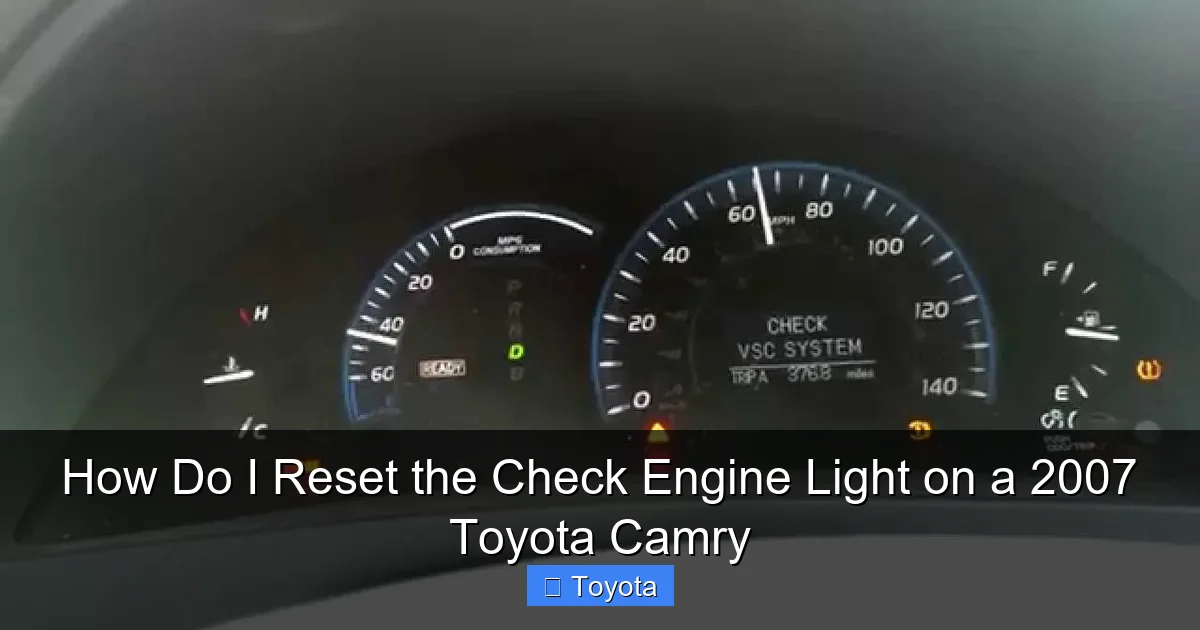
This is the cleanest, most reliable method and is what mechanics use. Once you’ve read and addressed the issue causing the code, here’s how to clear it:
Visual guide about How Do I Reset the Check Engine Light on a 2007 Toyota Camry
Image source: i.ytimg.com
- Step 1: Ensure the ignition is in the “ON” position (all dash lights on, engine off).
- Step 2: Plug your OBD-II scanner firmly into the port under your dashboard.
- Step 3: Turn on the scanner if it’s a standalone unit, or open your paired app on your phone.
- Step 4: Navigate the menu to find the “Clear Codes” or “Erase DTCs” function. The exact wording varies by device.
- Step 5: Select it. The scanner will communicate with the ECU and wipe the stored code(s).
- Step 6: You will usually see a confirmation message like “Codes Cleared” or “DTCs Erased.”
- Step 7: Disconnect the scanner. The check engine light should immediately go out.
Important: After clearing the code, start the engine. The light should remain off. If it comes back on after driving for a short distance, it means the fault has reappeared or the repair was not successful. The scanner may also show a “Pending Code” status for certain monitors that haven’t yet completed a full test cycle—this is normal and not an immediate cause for alarm.
Method 2: The Manual Reset – Disconnecting the Battery
This is the old-school method, often used when a scanner isn’t available. It works by cutting power to the ECU, forcing it to reset and clear its long-term memory, including stored codes. However, it has significant downsides and should be used with caution.
Visual guide about How Do I Reset the Check Engine Light on a 2007 Toyota Camry
Image source: i.ytimg.com
The Step-by-Step Process
- Open the hood and locate the battery.
- Using a 10mm socket or wrench, loosen the negative (black, marked with a “-” or “NEG”) battery terminal clamp.
- Carefully lift the clamp off the battery post and tuck the cable aside so it cannot touch the post.
- Wait at least 15 minutes. This is critical. It allows all residual power (in capacitors and modules) to drain completely. Simply loosening the clamp is not enough; the circuit must be fully broken.
- Reconnect the negative cable and tighten the clamp securely.
- Close the hood.
The Major Caveats of This Method
Disconnecting the battery will reset everything. This means you will lose:
- Your radio presets and security code (you may need the code to reactivate it).
- Clock settings.
- Power window and sunroof “learned” positions (they may need to be reprogrammed).
- Transmission shift points and fuel trim adaptation data. The car may run or shift slightly rough for the first 50-100 miles as the ECU relearns your driving habits and sensor baselines.
Because of these inconveniences and the fact it doesn’t address the root cause, this method is not recommended as a first resort. It’s a last-ditch effort if you have no scanner and are certain the repair is complete. For specific systems like the airbag, a simple battery disconnect is often not sufficient to clear the fault; a specialized scan tool is required, as detailed in our guide for resetting the airbag light on a Toyota Camry.
Method 3: The Natural Reset – Driving Cycle Completion
Sometimes, after you’ve fixed a problem (like tightening a loose gas cap), the check engine light will turn off on its own. How? The OBD-II system has multiple “monitors” that continuously test various systems. For the light to turn off automatically, the specific monitor that set the fault must run and pass successfully during a specific driving pattern, called a “drive cycle.”
For your 2007 Camry, a generic drive cycle to set all monitors might include:
- Starting the engine cold and letting it idle for 2-3 minutes.
- Driving at a steady 40-50 mph for 5-10 minutes.
- Allowing the vehicle to slow down without braking, to a stop, and idling again for a minute.
- Accelerating to 55 mph and cruising for several minutes.
- Letting it idle again, then turning the engine off.
This process can be unpredictable and time-consuming. You could drive for days and the light might stay on because the computer hasn’t run the specific test it needs. Therefore, manually clearing the code with a scanner after a repair is almost always faster and more reliable than waiting for a natural drive cycle.
When You Should NOT Reset the Light (And What to Do Instead)
This is the most important section. There are scenarios where resetting the light is the absolute wrong move. Your safety and your car’s health depend on recognizing these.
Signs of a Serious Problem
Do not reset the light if you notice any of the following symptoms alongside the illuminated MIL:
- Engine misfiring: A shaking, sputtering engine, loss of power, or a sound like a popcorn maker popping.
- Overheating: Temperature gauge in the red or steam/smell from the engine bay.
- Severe loss of power: The car feels like it’s in “limp mode,” struggling to accelerate.
- Strange noises: Ticking, knocking, or grinding sounds from the engine.
- Fluid leaks: Puddles of coolant, oil, or transmission fluid under the car.
- Flashing light: If the check engine light is blinking rapidly, stop driving immediately. A flashing MIL indicates a severe misfire that is likely dumping unburned fuel into your catalytic converter, which can destroy it in minutes. This requires urgent, professional diagnosis.
The Correct Action
If you have any doubt, the correct action is: 1) Read the code. 2) Research what that code means for your 2007 Camry’s 2.4L 4-cylinder or 3.5L V6 engine. 3) Perform basic inspections (check gas cap, air filter, visible hoses/wires). 4) If the issue is beyond your skill, take it to a trusted mechanic. Resetting a light for a faulty oxygen sensor or catalytic converter will not fix the problem; it will just delay the inevitable and more expensive repair. For other Toyota models, the diagnostic approach is similar. You can see how the process applies to a different vehicle like the Toyota Highlander, which shares many components and diagnostic procedures.
Common Pitfalls and Misconceptions
Let’s clear up some confusion that can lead to wasted time or money.
“I just tightened my gas cap, so the light should go off.”
A loose or faulty gas cap is a very common cause of a check engine light (often code P0455 or P0442). Tightening it until it clicks is the first step. However, the ECU may still have the code stored. After tightening, you can try clearing it with a scanner. If the cap was the issue, the light should stay off. If it comes back, the cap may be defective and need replacement, or there’s a leak elsewhere in the EVAP system.
“Disconnecting the battery resets the computer permanently.”
False. It only clears volatile memory. The ECU will immediately begin relearning and storing new data. Any pre-existing, unresolved mechanical or electrical fault will trigger the light again, usually within the first 10-50 miles of driving after the reset.
“My friend has a scanner, so I can just have him clear it.”
You can, but this is where communication is key. Have your friend read the code first and tell you what it is. Knowing the code (e.g., “P0303 – Cylinder 3 Misfire Detected”) is invaluable information for any mechanic you eventually take it to. It gives them a massive head start on diagnosis.
Conclusion: A Reset is a Final Step, Not a First
Resetting the check engine light on your 2007 Toyota Camry is a straightforward task, but its simplicity belies its importance. The core principle to remember is this: the light is a messenger, not the problem. Treating the symptom (the light) without addressing the disease (the underlying fault) is a recipe for breakdowns, expensive repairs, and unsafe driving conditions. Your process should always be: Diagnose with an OBD-II scanner → Identify the faulty component/system → Perform the necessary repair or replacement → Verify the repair (the light is off, and the code doesn’t return during a test drive) → Finally, clear the code to reset the system. By following this logical sequence, you maintain your Camry’s reliability, ensure your safety, and keep that glowing engine icon in its proper place: off your dashboard. If at any point the diagnosis or repair feels beyond your comfort zone, investing in a professional diagnosis is the smartest and safest choice for you and your vehicle.
Frequently Asked Questions
Can I reset the check engine light without fixing the problem?
Yes, you can physically clear the code, but it is strongly discouraged. The light will return as soon as the car’s computer detects the fault again, usually within a short drive. This wastes your time and ignores a potentially serious issue.
Is it safe to drive with a steady check engine light on?
It depends. If the car is running smoothly with no strange noises, smells, or performance issues, a short drive to get it diagnosed is usually okay. However, a steady light means an emissions-related problem that should be diagnosed promptly. A flashing light means stop driving immediately.
Will disconnecting the battery damage my car’s computer?
No, it will not damage the ECU. It will, however, cause it to lose all learned data and memory, leading to minor annoyances like lost radio presets and a temporary period of slightly rough running as the system relearns optimal settings.
How much does a basic OBD-II scanner cost?
A basic code reader that can read and clear generic OBD-II codes (like those for your 2007 Camry) typically costs between $20 and $50. More advanced scanners with manufacturer-specific codes and live data can cost more.
Why did my check engine light come back on after I reset it?
The most common reason is that the original problem was not properly diagnosed or repaired. The computer detected the same fault again. Other possibilities include a faulty new part, a loose electrical connection, or a different, new problem that set a separate code.
What’s the difference between the check engine light and the maintenance required light?
They are completely different. The check engine light (yellow/amber engine icon) indicates an emissions-related fault diagnosed by the OBD-II system. The maintenance required light (usually a wrench icon or “MAINT REQD”) is a simple mileage/timer reminder for scheduled service like oil changes. Resetting procedures for the maintenance light are different and often involve a button on the dash or a sequence with the odometer. You can find the specific steps for your Toyota in guides like how to reset the maintenance required light on a Toyota.