How Can I Get Better Gas Mileage in My Toyota Camry?

Contents
- 1 Key Takeaways
- 2 📑 Table of Contents
- 3 Understanding Your Toyota Camry’s MPG: The Baseline
- 4 Tire Pressure and Maintenance: The Rolling Resistance Factor
- 5 Engine Health and Routine Maintenance
- 6 Smart Driving Techniques for Maximum Efficiency
- 7 Fuel Type, Quality, and Additives: What Really Matters?
- 8 Weight, Aerodynamics, and Accessory Load
- 9 Conclusion: A Holistic Approach to Savings
- 10 Frequently Asked Questions


Improving your Toyota Camry’s gas mileage is achievable through a combination of proper maintenance, smarter driving habits, and mindful vehicle care. Simple steps like maintaining correct tire pressure, adhering to a regular service schedule, and avoiding aggressive acceleration can yield significant savings at the pump. This guide provides actionable, detailed strategies to help you maximize every gallon.
Key Takeaways
- Maintain Optimal Tire Pressure: Under-inflated tires increase rolling resistance, forcing your engine to work harder and consume more fuel. Check pressures monthly and inflate to the manufacturer’s spec listed on your door jamb sticker.
- Adopt Smooth Driving Habits: Avoid rapid acceleration and hard braking. Gradual speed changes and anticipating traffic flow can improve fuel economy by 15-30% in city driving.
- Stay on Top of Routine Maintenance: Regular oil changes with the correct grade, clean air filters, and healthy spark plugs ensure your engine runs efficiently. A neglected engine burns fuel less completely.
- Reduce Excess Weight and Drag: Remove unnecessary items from your trunk and cabin. Every 100 lbs. of extra weight can reduce MPG by about 1%. Also, remove roof racks when not in use to cut aerodynamic drag.
- Use Air Conditioning Wisely: At low speeds, open windows; at high speeds, use AC with windows closed to reduce drag. The AC compressor puts a significant load on the engine, hurting mileage.
- Choose the Right Fuel and Consider Additives: While your Camry is designed for regular unleaded, using top-tier certified fuel with proper detergents keeps injectors clean. Premium gas is not required unless specified for your specific model year.
- Plan Efficient Routes and Use Cruise Control: Combine trips to avoid cold starts. On highways, use cruise control to maintain a steady speed, as varying throttle input wastes fuel.
📑 Table of Contents
- Understanding Your Toyota Camry’s MPG: The Baseline
- Tire Pressure and Maintenance: The Rolling Resistance Factor
- Engine Health and Routine Maintenance
- Smart Driving Techniques for Maximum Efficiency
- Fuel Type, Quality, and Additives: What Really Matters?
- Weight, Aerodynamics, and Accessory Load
- Conclusion: A Holistic Approach to Savings
Understanding Your Toyota Camry’s MPG: The Baseline
Before you can improve something, you need to know where you stand. Your Toyota Camry’s Environmental Protection Agency (EPA) fuel economy ratings—found on your window sticker and in your owner’s manual—provide a laboratory-tested baseline. A typical modern Camry with a 2.5L 4-cylinder engine achieves an estimated 28 MPG in the city and 39 MPG on the highway. The more powerful V6 models will have lower ratings, often around 22-25 city / 32-34 highway. However, real-world driving rarely matches these perfect numbers.
Several factors cause this gap. Driving style is the biggest variable. City driving with frequent stops is far less efficient than steady highway cruising. Climate plays a role; extreme cold or heat forces the engine to work harder. Even the age and condition of your specific vehicle matter. A well-maintained 2018 Camry will likely get better mileage than a neglected 2012 model with worn components. Understanding this baseline helps you set realistic goals. If your combined average is 10-15% below the EPA estimate, there’s likely room for improvement through driver behavior and maintenance. If it’s 25% below, a mechanical issue is probable.
How Your Driving Style Eats Gas
Think of your right foot as the primary fuel economy control. Aggressive driving—speeding, rapid acceleration, and hard braking—is the single biggest enemy of MPG. The U.S. Department of Energy estimates that such habits can lower gas mileage by 15-30% at highway speeds and 10-40% in stop-and-go traffic. Why? It takes significantly more fuel to accelerate a 3,300-pound car from 0 to 60 quickly than to ease into it. Similarly, braking converts all that forward momentum into wasted heat. The key is to drive as if you have an egg under your foot: be smooth and progressive. Look far ahead at traffic signals and the behavior of cars several ahead. By slowing down gradually instead of racing to a stop, you save fuel and brake pads. This isn’t about driving painfully slow; it’s about being efficient and predictable.
Tire Pressure and Maintenance: The Rolling Resistance Factor
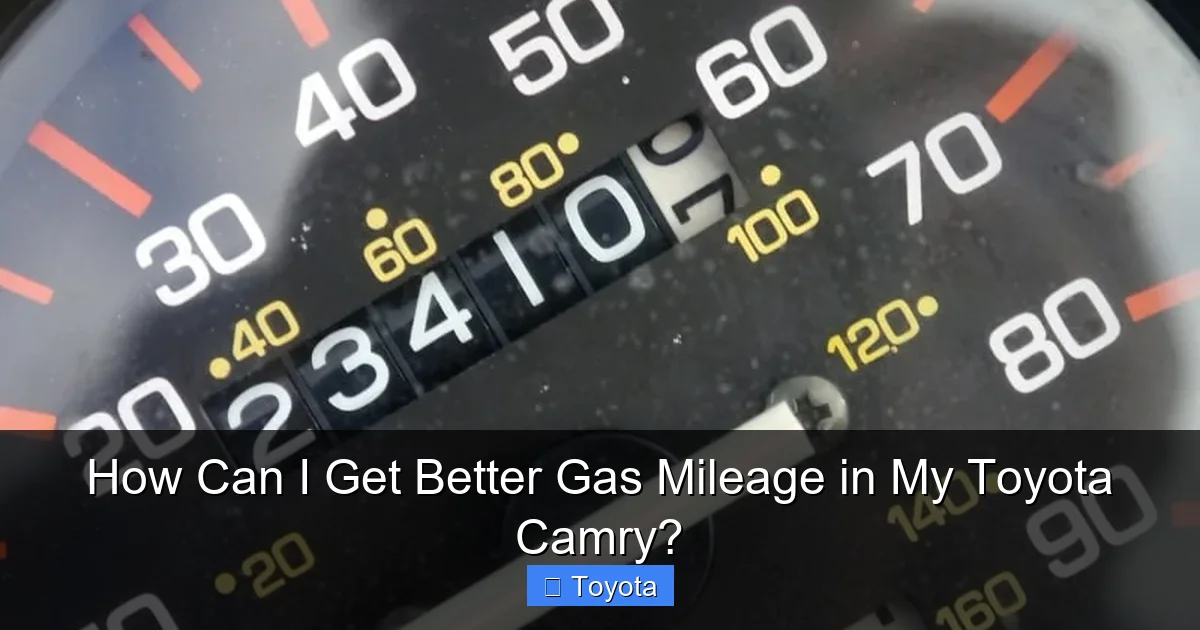
Tires are your car’s only contact with the road, and their condition has a direct, massive impact on fuel efficiency. The most critical and overlooked factor is tire pressure. For every 1 PSI (pound per square inch) that all four tires are under-inflated, your fuel mileage drops by about 0.2%. That might sound small, but if your tires are 5 PSI low—a common occurrence—you’re losing 1% of your MPG. For a Camry getting 30 MPG, that’s a loss of 0.3 MPG, meaning you’ll buy more gas more often over time.

Visual guide about How Can I Get Better Gas Mileage in My Toyota Camry?
Image source: insura4you.com
The correct pressure is not the number on the tire sidewall (that’s the max). It’s the specification from Toyota, found on a sticker inside the driver’s door jamb or in your owner’s manual. Check pressures when tires are cold (driven less than a mile) for an accurate reading. Invest in a good digital tire gauge. Beyond pressure, tire type and wear matter. Low-rolling-resistance (LRR) tires, often standard on new Camrys, are engineered to minimize the friction that saps fuel. When it’s time for replacements, consider models known for low rolling resistance. Worn, unevenly worn, or misaligned tires also create drag. Regular tire rotations (every 5,000-7,500 miles) and alignment checks ensure even wear and optimal rolling efficiency. Speaking of tires, choosing the right set can make a noticeable difference. Research from sources like the best tires for Toyota Tacoma gas mileage often highlights models with low rolling resistance compounds that are also suitable for Camry sedans, emphasizing how critical this component is for efficiency across the Toyota lineup.
The Importance of Wheel Alignment
Wheel alignment is more than just for tire wear. If your wheels are misaligned (toe-in or toe-out), the tires are effectively being dragged slightly sideways as you drive. This creates constant, unnecessary friction. Even a slight misalignment can increase rolling resistance enough to hurt your MPG. Have your alignment checked if you notice uneven tire wear, your car pulls to one side, or after hitting a pothole hard. An alignment is a relatively inexpensive service that protects both your tires and your fuel economy.
Engine Health and Routine Maintenance
A smoothly running engine is a fuel-efficient engine. Neglected maintenance forces the engine’s computer to compensate with richer fuel mixtures, wasting gas. Here are the most critical items:

Visual guide about How Can I Get Better Gas Mileage in My Toyota Camry?
Image source: motorbiscuit.com
- Engine Oil: Using the correct viscosity grade (e.g., 0W-20 for most modern Camrys) is vital. Thicker oil increases internal engine friction. Always use oil that meets Toyota’s specifications. Stick to the recommended change interval—old, dirty oil loses its lubricating properties and can increase drag.
- Air Filter: A clogged air filter restricts airflow to the engine, making it work harder to “breathe.” It’s a simple, cheap fix. Inspect it at every oil change; replace it every 15,000-30,000 miles depending on your driving environment (dusty areas need more frequent changes).
- Spark Plugs: Worn or fouled spark plugs cause incomplete combustion, wasting fuel and reducing power. Replace them at the interval specified in your manual, typically every 60,000-120,000 miles for modern iridium plugs.
- Fuel System: While not a regular maintenance item for most, fuel injectors can become clogged with deposits over time, leading to poor spray patterns and inefficient fuel atomization. Using quality fuel and occasional fuel system cleaner additives can help maintain injector cleanliness.
- Oxygen Sensors: These sensors tell your engine computer how much oxygen is in the exhaust, allowing it to adjust the fuel mixture precisely. A faulty O2 sensor can reduce MPG by 10% or more and trigger a check engine light.
Adhering to your Toyota’s maintenance schedule in the owner’s manual isn’t just for reliability; it’s a direct investment in fuel economy. A well-tuned engine operates at peak efficiency.
Smart Driving Techniques for Maximum Efficiency
You have the most control over your driving habits. Implementing these techniques can transform your daily commute’s fuel consumption.

Visual guide about How Can I Get Better Gas Mileage in My Toyota Camry?
Image source: debrouxautomotive.com
Master the Art of “Hypermiling” (Safely)
“Hypermiling” refers to extreme techniques to maximize MPG. You don’t need to go to extremes, but adopting its core principles is beneficial. The golden rule: maintain momentum. Every time you press the brake, you’re throwing away the energy you just spent fuel to create. Scan the road 15-20 seconds ahead. If you see a red light or slowing traffic far ahead, start easing off the gas early to coast and avoid coming to a complete stop if possible. On highways, use your cruise control. A steady speed is far more efficient than constant, minor throttle adjustments. Set it to the legal speed limit or slightly below—aerodynamic drag increases exponentially with speed. Driving 65 mph instead of 75 mph can save 10-15% in fuel.
Limit Idling and Cold Starts
Idling gets 0 MPG. If you’re stopped for more than 30-60 seconds (except in traffic), turn off the engine. Modern fuel-injected engines use negligible extra fuel on restart. Also, combine trips. Multiple short trips with cold starts use more fuel than one longer trip where the engine is fully warmed up. A cold engine runs rich (more fuel) until it reaches optimal operating temperature. If possible, make your longest errand first to ensure the engine is warm for subsequent stops.
Fuel Type, Quality, and Additives: What Really Matters?
Your Camry’s owner manual states the required fuel: typically “unleaded gasoline with a pump octane rating of 87.” Using a higher octane “premium” fuel (91 or higher) in an engine not designed for it provides no performance or efficiency benefit. The higher octane resists “knock” (premature combustion) under high compression, which your standard Camry engine doesn’t produce. It’s simply a waste of money. You can learn more about fuel grades for Toyota vehicles by reading our article on whether you can put premium gas in a Toyota Corolla, as the principles are identical for the Camry’s standard engines.
What does matter is fuel quality. All gasoline is not created equal. Top Tier certified fuels (a standard developed by automakers including Toyota) contain a higher level of detergent additives that help keep fuel injectors and intake valves clean. Clean fuel system components ensure optimal spray patterns and combustion. Whenever possible, fill up at major brands known for Top Tier fuel. Occasionally (every 5,000-10,000 miles), you can use a bottle of a proven fuel system cleaner additive. Look for products with P.I.E.A. or equivalent certification. These can help dissolve minor deposits and maintain efficiency.
Weight, Aerodynamics, and Accessory Load
Your Camry is designed to be aerodynamic. Anything that disrupts that smooth airflow or adds mass requires more energy (fuel) to move.
- Remove Roof Racks/Carriers: A roof rack, even when empty, creates significant aerodynamic drag, especially at highway speeds. If you don’t use it weekly, take it off. A roof box or cargo carrier multiplies this effect. The drag penalty can be 5-15% on the highway.
- Declutter the Interior and Trunk: Treat your car like a backpack—only carry what you need for the trip. Golf clubs, tools, old bags, and other “just-in-case” items add up. As mentioned, 100 lbs. of cargo can reduce MPG by 1-2%. For a family sedan, that’s a noticeable impact over time.
- Use Accessories Judiciously: The air conditioning compressor is driven by the engine belt, placing a 3-5 HP load on it. In city driving, this can reduce MPG by 10-20%. At highway speeds, the drag from open windows is worse than using AC with windows up. As a rule, use max AC sparingly. Also, minimize the use of other electrical accessories like seat heaters and defrosters when not needed, as the alternator places a small additional load on the engine.
Another often-overlooked factor is your fuel fill-up habit. The article on how many miles you can drive when the gas light comes on in a Camry highlights that consistently running your tank very low can cause the fuel pump to overheat (as it relies on fuel for cooling) and may draw sediment from the tank bottom into your fuel system. For both longevity and efficiency, try to refuel when you have about 1/4 tank remaining.
Conclusion: A Holistic Approach to Savings
Getting better gas mileage in your Toyota Camry isn’t about one magic fix. It’s the cumulative result of dozens of small, consistent actions. Start with the low-hanging fruit: check your tire pressure this week, drive more smoothly for your next tank, and schedule that overdue oil change. These steps require minimal cost but offer immediate returns. Then, move to the medium-effort items: remove that permanent roof rack, plan your trips, and ensure your air filter is clean. By adopting a mindset of efficiency—seeing your car as a system where every part and every habit affects the whole—you’ll not only save significant money on fuel but also reduce wear and tear, potentially extending your Camry’s life and delaying costly repairs. Remember, your Camry is already one of the most fuel-efficient sedans on the market. These tips simply help you reclaim the efficiency that Toyota’s engineers designed into the vehicle, ensuring you get the most out of every gallon.
Frequently Asked Questions
Will using premium gas improve my Toyota Camry’s gas mileage?
No, it will not. Your Camry’s engine is designed for regular 87-octane unleaded fuel. Using premium (91+ octane) provides no benefit in power or efficiency. Premium is only necessary for engines with high compression ratios or turbochargers that are prone to knock. Wasting money on premium is a common myth. Stick to the fuel type specified in your owner’s manual for optimal performance and economy.
How much does tire pressure really affect gas mileage?
It has a significant impact. For every 1 PSI that your tires are under-inflated, your fuel economy drops by approximately 0.2%. If all four tires are 5 PSI low (a very common situation), you’re losing about 1% of your MPG. Properly inflated tires also improve handling, tire wear, and safety. Check your pressures monthly with the recommended PSI from the door jamb sticker, not the tire sidewall.
Is it better to roll down windows or use air conditioning for gas mileage?
It depends on your speed. At low city speeds (below 40-50 mph), open windows cause less aerodynamic drag than running the AC compressor, so rolling down windows is more efficient. At higher highway speeds, the open windows create substantial drag that hurts mileage more than the engine load from the AC. The best practice is to use the AC with windows closed on the highway, and consider ventilating with windows at lower speeds.
Can a dirty air filter really hurt my fuel economy?
Yes, absolutely. A clogged air filter restricts the flow of air into your engine. The engine’s computer then compensates by using more fuel to maintain the correct air-fuel ratio. This can reduce MPG by up to 10%. Replacing a severely dirty air filter is one of the cheapest and easiest maintenance tasks you can do for your Camry’s efficiency. Check it at every oil change.
How much weight can I carry before it noticeably hurts my Camry’s MPG?
As a general rule, every extra 100 pounds of cargo in your vehicle reduces fuel economy by about 1-2%. While 100 lbs sounds like a lot, it’s easy to accumulate—two average suitcases, a few bags of groceries, and some sports equipment can add up quickly. The effect is most noticeable in city driving with frequent acceleration. Regularly clean out your trunk and back seat to remove unnecessary items.
Does using the “Eco” mode in my Camry actually save gas?
Yes, the Eco mode is designed to improve fuel efficiency. It recalibrates the throttle response to be less sensitive (making acceleration smoother and slower), may adjust the HVAC system for less aggressive cooling, and can prompt earlier transmission shifts. The savings are modest, typically in the range of 1-3 MPG in mixed driving, but it requires zero effort on your part. It’s a useful tool, especially in heavy traffic where aggressive pedal inputs are common.