
Does the 2017 Toyota Corolla Have a Timing Belt or Chain?

The 2017 Toyota Corolla uses a timing chain, not a timing belt. This is a significant advantage for owners, as timing chains are designed to last the lifetime of the engine with proper maintenance, eliminating the costly scheduled replacement intervals required for timing belts. This contributes to the Corolla’s renowned long-term reliability and lower cost of ownership. You primarily maintain it through regular oil changes with the correct oil viscosity, as clean oil is crucial for chain lubrication and tensioner function.
If you’re a 2017 Toyota Corolla owner or a savvy shopper researching a used model, one question is absolutely critical: does it have a timing belt or a timing chain? This isn’t just trivial mechanics trivia. The answer sits at the heart of your car’s long-term maintenance schedule, potential repair costs, and overall peace of mind. A timing component failure is one of the most destructive and expensive things that can happen to an internal combustion engine. Getting this right is a huge deal.
For the 2017 model year, the answer is clear and consistent across every single Corolla on the road: it has a timing chain. But why does that matter so much? What’s the real difference between a belt and a chain? And what does this mean for you as an owner, beyond just “it’s good”? Let’s pop the hood and dive deep into the mechanical heart of the world’s best-selling car.
Key Takeaways
- The 2017 Corolla has a timing chain: All 2017 Corolla models, regardless of trim (L, LE, SE, XLE), use the 2ZR-FE or 2ZR-FAE engine, both of which are equipped with a timing chain system.
- No scheduled replacement needed: Unlike timing belts, which typically require replacement every 60,000 to 100,000 miles at a cost of $500-$1,000+, the timing chain is engineered to last the engine’s life under normal operating conditions.
- Oil quality is paramount: The chain’s longevity is almost entirely dependent on consistent, high-quality oil changes. Using the wrong oil or extending drain intervals can lead to chain stretch and premature wear.
- Failure is rare but possible: While extremely uncommon, chain failure can occur due to extreme neglect (severe oil starvation), faulty tensioners, or manufacturing defects. It results in catastrophic engine damage.
- Signs of wear are subtle: Listen for a distinct rattling or slapping noise from the front of the engine, especially during cold starts. Poor performance, rough idle, or a check engine light with codes P0010-P0017 can also indicate timing issues.
- It boosts resale value: Knowing a used car has a timing chain instead of a belt is a major selling point for knowledgeable buyers, as it removes a large, future service item from the equation.
- This is a long-term Toyota trend: Toyota has largely phased out timing belts in its mainstream, non-performance engines for over a decade, favoring chains for durability and reduced maintenance.
📑 Table of Contents
- Timing Belts vs. Timing Chains: The Fundamental Difference
- The 2017 Toyota Corolla: Engine and Timing System Specs
- The Major Benefits of a Timing Chain in Your Corolla
- Maintaining Your Timing Chain for a Lifetime
- Debunking Myths: What a Timing Chain Is NOT
- Context: The 2017 Corolla in the Toyota Ecosystem
- Conclusion: A Major Point in the Corolla’s Favor
Timing Belts vs. Timing Chains: The Fundamental Difference
Before we celebrate the chain, we must understand the belt. Both a timing belt and a timing chain serve the same primary purpose: they synchronize the rotation of the crankshaft (which is connected to the pistons) and the camshaft(s) (which opens and closes the valves). This precise timing allows the air-fuel mixture to enter and exhaust gases to exit the cylinders at the exact right moment. If this synchronization is lost—if the “timing” is off—the valves can collide with the pistons, causing bent valves, damaged pistons, and a destroyed cylinder head. This is called “interference engine” damage, and it’s catastrophic.
How a Timing Belt Works
A timing belt is a toothed rubber belt, reinforced with fiberglass or Kevlar. It’s relatively quiet, lightweight, and inexpensive to manufacture. However, rubber degrades over time. It cracks, stretches, and can suffer from oil contamination. Therefore, it is a consumable service item. Automakers specify a strict replacement interval, usually based on mileage (e.g., 60,000, 90,000, or 100,000 miles) and/or time (e.g., 7-10 years), even if the belt looks fine. Replacing it is labor-intensive because it’s often buried deep in the engine, requiring the removal of many other components. The total cost, including parts and labor, can easily hit $600 to over $1,200 for some vehicles. It’s a planned, expensive service you cannot skip.
How a Timing Chain Works
A timing chain is, as the name suggests, a metal roller chain, much like a bicycle chain but far more robust. It rides on gear sprockets attached to the crankshaft and camshaft(s). It is lubricated by engine oil and kept under tension by a hydraulic or spring-loaded tensioner. The key advantages are durability and longevity. A properly maintained chain can easily last 200,000, 300,000 miles, or the entire life of the engine. It does not have a prescribed replacement interval in the owner’s manual. The trade-off is that it can be slightly noisier (though modern Toyota chains are very quiet) and, if it does fail, the resulting damage is equally catastrophic. However, failure due to normal wear is exceptionally rare in a well-maintained engine.
The 2017 Toyota Corolla: Engine and Timing System Specs
Every 2017 Toyota Corolla comes with one of two very similar 1.8-liter four-cylinder engines, part of Toyota’s venerable ZR engine family:
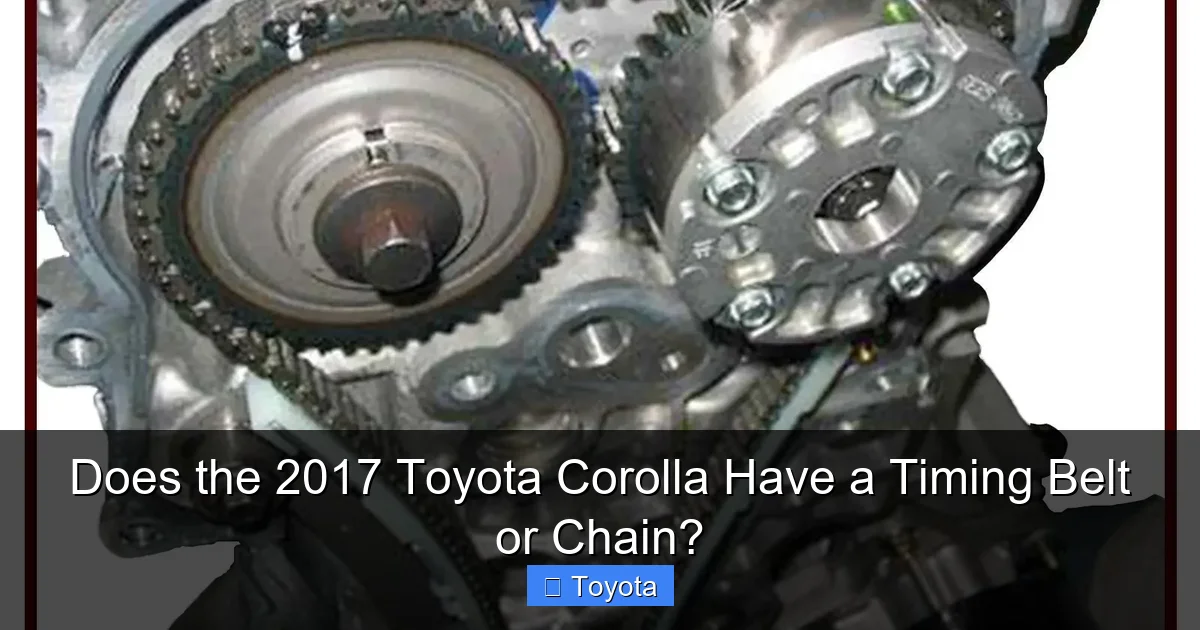
Visual guide about Does the 2017 Toyota Corolla Have a Timing Belt or Chain?
Image source: i2.wp.com
- 2ZR-FE: The standard engine in most trims (L, LE, XLE). It produces 132 horsepower and 128 lb-ft of torque.
- 2ZR-FAE: A slightly more efficient version with variable valve timing on both intake and exhaust cams (VVT-iW), found in some SE and LE models. It produces the same power but with marginally better fuel economy.
Both of these engines are overhead cam (OHC) designs with dual overhead cams (DOHC). This means there is a camshaft for the intake valves and one for the exhaust valves on each cylinder head. To drive both camshafts precisely from the single crankshaft, a robust timing chain is used. This chain is located at the front of the engine, behind the plastic timing chain cover. It is lubricated by a dedicated oil passage from the engine’s main oil system.
So, for the 2017 Corolla, you can rest easy. There is no timing belt hiding in your engine that will require a thousand-dollar service down the road. Your maintenance schedule will not include a “Timing Belt/Water Pump Replacement” service. This is a defining, positive characteristic of this generation of Corolla.
The Major Benefits of a Timing Chain in Your Corolla
Choosing a car with a timing chain over a belt isn’t just about avoiding one expensive bill; it’s about a fundamentally different ownership experience. Here’s what that chain means for you.
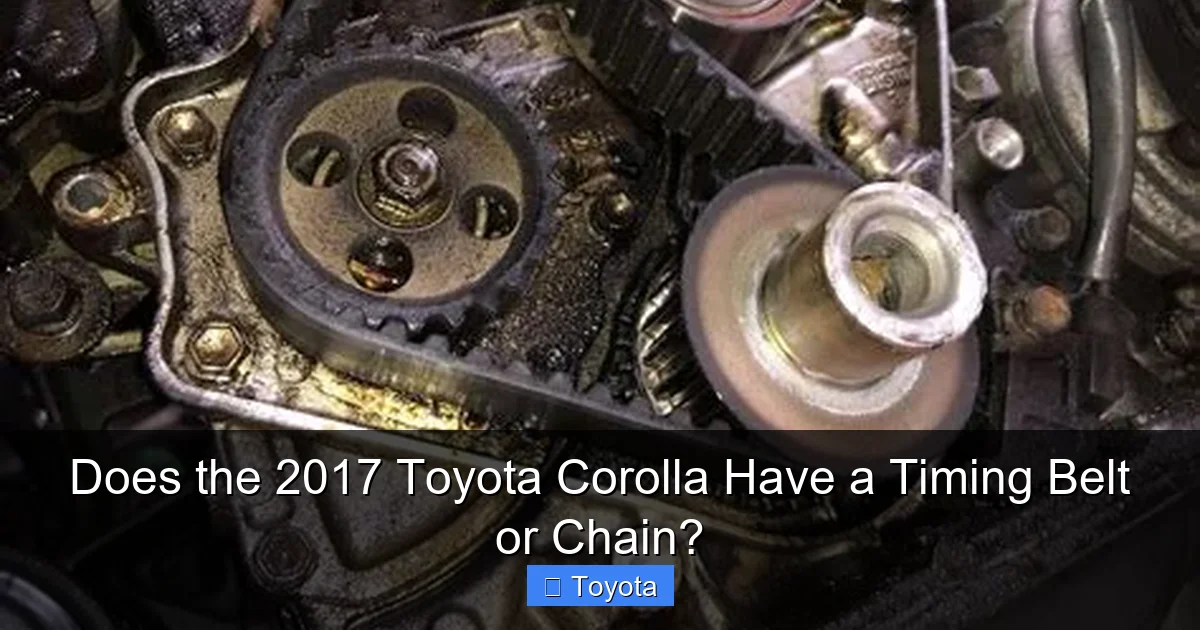
Visual guide about Does the 2017 Toyota Corolla Have a Timing Belt or Chain?
Image source: autozonic.com
1. Dramatically Lower Long-Term Ownership Costs
This is the most obvious and significant benefit. By eliminating the mandatory timing belt replacement, you remove one of the largest “scheduled maintenance” line items from your budget. Over 10 years and 150,000 miles, that could be $1,000-$2,000 saved compared to a competitor using a belt (some older Honda Civics, for instance). That money can be redirected towards other upkeep, savings, or fun. For a budget-conscious commuter car like the Corolla, this is a massive win for the total cost of ownership equation.
2. Peace of Mind and Reduced Complexity
There’s a mental load that comes with owning a car with a timing belt. You find yourself thinking, “Is it time yet? Do I have the money set aside? What if I forget?” That anxiety vanishes with a chain. You follow your regular oil change and general service schedule, and the timing system is simply not a worry item. This aligns perfectly with the Corolla’s “appliance-like” reliability reputation. You get in, it starts, it takes you where you need to go, and you don’t have to think about its fundamental mechanical health beyond the basics.
3. Proven Toyota Engineering and Reliability
This isn’t just any chain; it’s a Toyota-designed chain in a Toyota engine. The ZR engine family, with its chain drive, has a decades-long track record of outstanding reliability and low failure rates across millions of Corollas, Matrixes, and other models worldwide. Toyota’s engineering philosophy for its mass-market vehicles prioritizes durability and low maintenance. The timing chain is a prime example of this. When you combine this with Toyota’s legendary build quality, you get a powertrain that is notoriously difficult to break.
Maintaining Your Timing Chain for a Lifetime
“It lasts forever” is a common phrase, but it comes with a big, fat asterisk: if you maintain it properly. A timing chain is a precision component that relies on two things: constant, clean lubrication and proper tension. Your role in this is simple but non-negotiable.
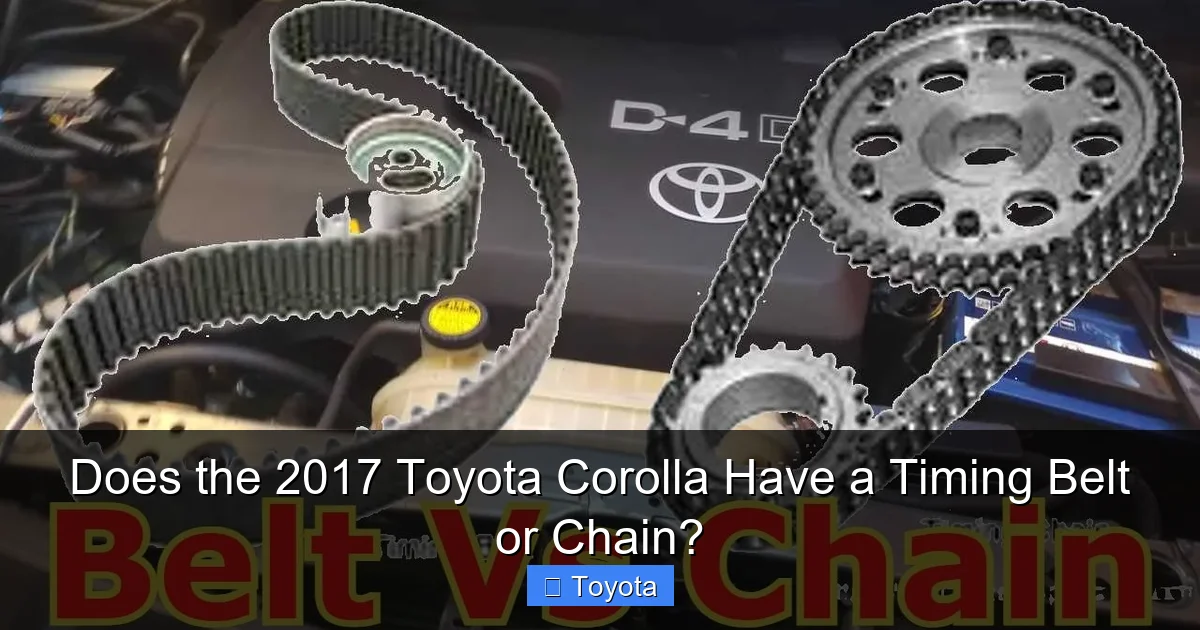
Visual guide about Does the 2017 Toyota Corolla Have a Timing Belt or Chain?
Image source: i.ytimg.com
The #1 Rule: Meticulous Oil Changes
Engine oil is the lifeblood of the timing chain. It lubricates the chain links, reduces wear on the sprockets, and, most critically, powers the hydraulic tensioner that keeps the chain from rattling and jumping. The single most important thing you can do is change your oil on schedule or sooner, using only the oil viscosity specified in your owner’s manual (typically 0W-20 synthetic for the 2017 Corolla).
- Why Synthetic Oil is Best: Synthetic oil maintains its viscosity and protective properties better over long drain intervals and in extreme temperatures. It also has better detergents to keep the tiny oil passages to the chain and tensioner clean. Just as using the correct fuel is important, using the correct oil is paramount for engine longevity.
- Never Extend Intervals: Even if your car has an oil life monitor, don’t be tempted to push it to 10,000 miles. For maximum chain health, especially in severe driving conditions (lots of short trips, extreme heat/cold, dusty environments), change the oil every 5,000-7,000 miles.
Listening and Observing: Early Warning Signs
While failure is rare, a chain can develop excessive “stretch” (wear between pins and bushings) or the tensioner can fail. Listen for these symptoms:
- A cold-start rattle: A distinct metallic rattling or slapping noise from the front top of the engine that lasts 1-3 seconds on startup, especially when the engine is cold. This is often the classic sign of a worn timing chain or weak tensioner. It should not be ignored.
- General rattling: A persistent rattling that changes with engine RPM, not just on startup.
- Check Engine Light: The engine control module (ECM) monitors camshaft position sensors. If the chain has stretched enough to alter cam timing (even slightly), it will set diagnostic trouble codes, often in the P0010-P0017 range (Camshaft Position Actuator Circuit). Resetting the light won’t fix the underlying problem; it will just come back.
- Poor performance, rough idle, or backfiring: These are signs of significant timing misalignment, which is a dire emergency.
If you hear a cold-start rattle, have a mechanic diagnose it immediately. The fix is not a simple belt job; it involves replacing the chain, tensioner, and likely the guides and sprockets—a major, expensive engine repair.
Debunking Myths: What a Timing Chain Is NOT
Because timing chains are so reliable, some myths have sprung up. Let’s clear them up.
Myth 1: “A Timing Chain Never Needs Replacing.”
Technically, it’s designed to last the engine’s life. But “life” is a long time, and components wear. Extremely high-mileage engines (300,000+ miles) or engines that have suffered from chronic oil neglect can develop enough chain stretch to require replacement. It’s not a scheduled item, but it can be a wear item on very high-mileage vehicles. The key is that it’s not an *expected* replacement at 100k miles like a belt.
Myth 2: “A Timing Chain is Completely Silent and Maintenance-Free.”
Modern chains are very quiet, but they are not silent. You should not hear a loud, prolonged rattle. Also, while the chain itself doesn’t need scheduled service, the components that guide and tension it—the plastic guides, the hydraulic tensioner—can wear out or fail over time. These are parts of the “timing chain system.” So, the system as a whole does benefit from being inspected during major services, especially on high-mileage cars.
Myth 3: “All Engines are Switching to Chains, So It’s No Big Deal.”
It’s true that the industry has largely moved to chains for economy and mid-size engines. However, many performance engines, some turbocharged engines, and some older designs still use belts for specific characteristics (like lighter weight or specific NVH tuning). So, when buying any car, you must verify the specific engine’s design. For the 2017 Corolla, it’s a definite and major benefit.
Context: The 2017 Corolla in the Toyota Ecosystem
Understanding that the 2017 Corolla has a chain helps place it within Toyota’s broader strategy. Toyota’s move to timing chains in its mainstream, non-hybrid gasoline engines began in the mid-2000s. The 1ZZ and 2ZZ engines (found in early 2000s Corollas) were some of the last widely used belts in that model line. By the time the current ZR engine family debuted in the late 2000s (for the 2009+ Corolla), the switch to chains was complete.
This contrasts with some of Toyota’s other lines. For example, many of its larger V6 and V8 engines, like those in the Tundra and Sequoia, used timing belts for years before switching to chains in more recent model years. The 2017 Corolla’s 1.8L four-cylinder is firmly in the “chain for life” camp. This consistency is a hallmark of Toyota’s approach to its bread-and-butter commuter cars: engineer it to be simple, durable, and cheap to own for a very long time.
When you look at a competitor like a Honda Civic from the same era, you’d find a mix. The base 2.0L i-VTEC engine in the 2017 Civic used a timing chain, while the older 1.8L engine in some markets still used a belt. This kind of model-by-model, engine-by-engine variation is exactly why you must check your specific vehicle’s engine code. For the Corolla, it’s beautifully simple: 2017 = chain.
Conclusion: A Major Point in the Corolla’s Favor
The question “Does the 2017 Toyota Corolla have a timing belt or chain?” has a definitive and owner-friendly answer: it has a timing chain. This is not a minor technicality; it’s a cornerstone of the vehicle’s value proposition. It directly translates to lower predictable costs, less scheduled maintenance complexity, and greater long-term reliability.
Your responsibility is simple and familiar: change the oil on time with the correct oil. Do that, and you have essentially removed the most terrifying and expensive potential failure point from your engine’s future. You can drive your Corolla with the confidence that its timing system, a critical component, is built to outlast the car itself under normal use. In the search for a worry-free, economical, and dependable used car, a 2017 Toyota Corolla with its proven timing chain engine checks a very important box. It’s one of the many reasons this simple, unassuming sedan continues to be a top recommendation for anyone wanting a car that just works, year after year.
Frequently Asked Questions
What happens if the timing chain fails in a 2017 Toyota Corolla?
Timing chain failure is extremely rare but catastrophic. The chain’s sole job is to keep the valves and pistons synchronized. If it breaks or jumps teeth, the pistons can collide with the open valves, causing bent valves, damaged pistons, and a ruined cylinder head. This is called an interference engine failure and requires a complete engine rebuild or replacement, costing thousands of dollars.
How can I tell if my 2017 Corolla’s timing chain is worn out?
The most common sign is a metallic rattling or slapping noise from the front top of the engine that lasts 1-3 seconds on cold starts. A persistent rattle at any RPM, a check engine light with camshaft-related codes (P0010-P0017), or a noticeable drop in performance can also indicate excessive chain stretch or a failing tensioner. Any of these symptoms require immediate professional diagnosis.
Is there a recommended mileage to replace the timing chain in a 2017 Corolla?
No. Toyota does not list a scheduled replacement interval for the timing chain in the 2017 Corolla’s maintenance schedule. It is designed to last the life of the engine under normal operating conditions. The focus should be on perfect oil change discipline to ensure its longevity.
What is the difference between a timing chain and a serpentine belt?
They are completely different. A timing chain is an internal engine component inside the engine cover that synchronizes the crankshaft and camshaft(s). A serpentine belt is an external rubber belt that drives engine accessories like the alternator, power steering pump, and air conditioning compressor. The serpentine belt on a 2017 Corolla does have a replacement interval (typically around 60,000-90,000 miles), but it is not a critical engine synchronization part.
How much does it cost to replace a timing chain if it fails?
Replacing a failed timing chain in an interference engine like the Corolla’s is a major repair. It involves disassembling the front of the engine, replacing the chain, tensioner, guides, and likely the water pump (which is driven by the chain), and repairing any valve/piston damage. The cost can range from $2,500 to $4,000 or more, often making a used engine replacement a more economical option.
Does having a timing chain affect the resale value of my 2017 Corolla?
Yes, positively. For a knowledgeable buyer, knowing a car has a timing chain instead of a belt is a significant advantage. It removes a major, future $1,000+ service item from their ownership cost projection. When comparing two similar used cars, the one with the timing chain will be more attractive and often command a slightly higher price or sell faster.
