Does Tesla Deliver Before the Estimated Date?

Contents
- 1 Key Takeaways
- 2 📑 Table of Contents
- 3 Understanding Tesla’s Unique Delivery Estimation System
- 4 Factors That Can Lead to an Early Tesla Delivery
- 5 The More Common Reality: Why Deliveries Are Often Late
- 6 Practical Tips to Improve Your Chances of an On-Time or Early Delivery
- 7 How Tesla’s Delivery Model Compares to Traditional Automakers (Jeep, Honda, Nissan, etc.)
- 8 What to Do If Your Tesla Delivery Is Significantly Delayed
- 9 The Bottom Line: Patience Is a Virtue (and Sometimes a Necessity)
- 10 Frequently Asked Questions

Dash Cam

Jumper Cables

Diesel Fuel Additive

Car Wash Mitt
Many Tesla buyers anxiously watch their estimated delivery date, hoping for an early surprise. While Tesla occasionally delivers vehicles ahead of schedule, it’s not the norm due to their build-to-order manufacturing model. This article breaks down exactly how Tesla sets these dates, the key factors that can speed up or slow down your delivery, and actionable tips if you’re eager to get your new electric vehicle sooner.
Key Takeaways
- Tesla’s build-to-order system is the primary reason early deliveries are rare: Unlike traditional dealerships with instant inventory, every Tesla is manufactured specifically for a customer’s order, making the process inherently linear and schedule-dependent.
- Production efficiency and logistics wins can create early delivery opportunities: If a factory produces vehicles faster than planned or logistics hubs move cars more quickly, some orders may slip through ahead of their projected window.
- Your location and configuration significantly impact the timeline: Choosing a popular, readily-available configuration (like a standard color) or living near a service center/logistics hub can sometimes shorten the wait.
- Ordering a “inventory” or “demo” vehicle is the surest way to get a Tesla immediately: These are pre-built cars that match someone else’s cancelled order or are used as test drives, and they are available for immediate pickup or quick delivery.
- Traditional automakers with dealer networks operate on a completely different model: Brands like Honda or Nissan often have vehicles sitting on dealer lots, allowing for same-day or next-day purchase, a stark contrast to Tesla’s direct-to-consumer, made-to-order approach.
[FEATURED_IMAGE_PLACEHOLDER]
📑 Table of Contents
- Understanding Tesla’s Unique Delivery Estimation System
- Factors That Can Lead to an Early Tesla Delivery
- The More Common Reality: Why Deliveries Are Often Late
- Practical Tips to Improve Your Chances of an On-Time or Early Delivery
- How Tesla’s Delivery Model Compares to Traditional Automakers (Jeep, Honda, Nissan, etc.)
- What to Do If Your Tesla Delivery Is Significantly Delayed
- The Bottom Line: Patience Is a Virtue (and Sometimes a Necessity)
Understanding Tesla’s Unique Delivery Estimation System
So, you’ve configured your dream Tesla, put down your deposit, and now you’re staring at that estimated delivery date on your account. It feels like a promise, but is it set in stone? The short answer is: rarely. Tesla delivering before the estimated date is a pleasant anomaly, not the expected outcome. To understand why, you need to grasp the fundamental difference between Tesla’s business model and that of virtually every other car manufacturer.
Tesla operates on a direct-sales, build-to-order model. There are no dealerships with sprawling lots full of every color and option combination. When you place an order, that VIN (Vehicle Identification Number) is essentially queued into a global production schedule. The factory in Fremont, Shanghai, or Berlin doesn’t start building your specific car until it’s your configuration’s turn on the line. The “estimated delivery date” is Tesla’s best projection of when that complex ballet of production, quality control, and logistics will culminate in your car arriving at a local delivery center or being loaded onto a carrier for home delivery.
The Production Pipeline: From Order to VIN Assignment
The journey begins long before you see a date. Once you order, your configuration enters a vast digital queue. Tesla’s production planning software attempts to optimize the assembly line by batching similar configurations—think all white Model 3s with a certain interior and wheel type might be grouped together to minimize factory changeovers. This batching is efficient for Tesla but means your specific order waits for its “batch” to be scheduled. The first tangible milestone is VIN assignment. This is a huge psychological step for buyers, as it means their car has a unique identity and is officially in the production stream. The estimated delivery date is usually solidified or refined around this VIN assignment phase.
This system is the core reason early delivery is uncommon. The estimate is calculated based on known production rates, current queue lengths for your configuration, and standard transit times from the factory to your region. It’s a forecast, not a guarantee. Any deviation—positive or negative—from the assumed production pace or logistics timeline will shift your date.
Factors That Can Lead to an Early Tesla Delivery
If the system is designed for predictability, how do early deliveries happen at all? They occur when reality outperforms the forecast. These instances are often celebrated in Tesla owner forums and social media, but they are the exception that proves the rule. Here are the most common catalysts for getting your Tesla early:
Visual guide about Does Tesla Deliver Before the Estimated Date?
Image source: cdn.teslanorth.com
1. Overperformance in Production
Tesla’s factories are marvels of vertical integration and ambition. Sometimes, a production line runs more efficiently than planned. Maybe a new robot or process tweak reduces the time per vehicle. Maybe there’s a push to hit a quarterly delivery target. In these periods, vehicles can flow off the line faster than the logistics network can handle, creating a temporary glut. Your order, sitting further down the queue, might get pulled into this faster-moving stream. This is more likely if you have a very common, high-volume configuration like a black or white Model Y with the standard interior.
2. Logistics and Transportation Wins
The journey from factory to your local delivery hub involves trains, car carriers, and trucks. A normally congested rail route might be clear. A carrier truck might have an unexpected empty slot. A regional delivery hub might process its incoming inventory faster than usual. These micro-optimizations in the supply chain can shave days or even weeks off the transit portion of your timeline. For example, if your car is built in Shanghai for the European market and a ship has an early departure, European customers might see their dates move up.
3. Cancellations and Re-prioritization
Orders get cancelled. People change their minds, face financial hurdles, or simply wait too long. When a cancellation occurs, that VIN and its partially built (or fully built) vehicle re-enters the system. Tesla’s logistics then have to decide what to do with it. Sometimes, they will slot it into the queue for a new order with an identical configuration. If your order matches that cancelled spec perfectly and is next in line, you could inherit a car that is already built or far along in production, drastically accelerating your timeline. This is the “inheritance” effect and is a known, if unpredictable, pathway to early delivery.
4. Proximity to a Delivery/Service Center
If you live very close to a major Tesla delivery hub or service center that also acts as a distribution point, your “transit time” is minimal. The estimated date often includes a buffer for long-distance shipping. If your car arrives at the regional hub and you’re on the immediate delivery list, you might get a call the same day or next day, effectively delivering before the *final* date on your original estimate, which was more conservative.
The More Common Reality: Why Deliveries Are Often Late
For every story of an early delivery, there are dozens of tales of delays. Understanding the causes of lateness is perhaps more useful for managing expectations. The same build-to-order system that makes early delivery hard makes it vulnerable to disruptions.
Visual guide about Does Tesla Deliver Before the Estimated Date?
Image source: cdn.motor1.com
Production Bottlenecks and Part Shortages
Tesla’s cars are packed with proprietary components and semiconductors. A shortage in a single chip needed for the new HW4 computer, a delay in a specific battery cell supply from Panasonic or CATL, or a hiccup in the supply of a unique interior trim piece can stall an entire batch of vehicles. Because the production line is optimized for specific batches, a shortage for one configuration can cause a cascade of delays for everyone waiting for that variant. This was widely seen during the global chip shortage and with the transition to 4680 battery cells.
Configuration Complexity and “Hold” Status
If you order a rare color (like Multi-Coat Red or Stealth Grey), a unique wheel design, or the Full Self-Driving (FSD) capability package, you are likely in a smaller, slower-moving batch. Tesla may put these configurations on a “hold” until they have enough orders to justify a production run. Your estimated date will slip until that batch is scheduled. The more unique your order, the more volatile your date.
Logistical Chaos and Regional Imbalances
Shipping is a nightmare to perfectly coordinate. A ship might miss its slot, a train might be delayed, or a trucking company might have a labor shortage. Furthermore, Tesla sometimes misjudges regional demand. They might send too many cars to one state and not enough to another. If your region is oversupplied, your car might be sitting at a hub waiting for a carrier to your specific area, while someone in an undersupplied region gets their car from the same batch much faster. Your zip code matters more than you’d think.
The “Final Stretch” Delay
Perhaps the most frustrating delay happens when your car is 98% done. It’s been built, it’s at the local delivery center, but it’s waiting for a final quality inspection, a window tint, a charging adapter, or simply to be detailed and put on the delivery lot. This final hold can add days or weeks to an otherwise on-schedule delivery. It feels close, but it’s not yet yours.
Practical Tips to Improve Your Chances of an On-Time or Early Delivery
While you can’t control Tesla’s factory output, you are not powerless. Your choices during the ordering process significantly influence the stability and potential speed of your delivery timeline.
Visual guide about Does Tesla Deliver Before the Estimated Date?
Image source: driveteslacanada.ca
Embrace Flexibility in Color and Wheels
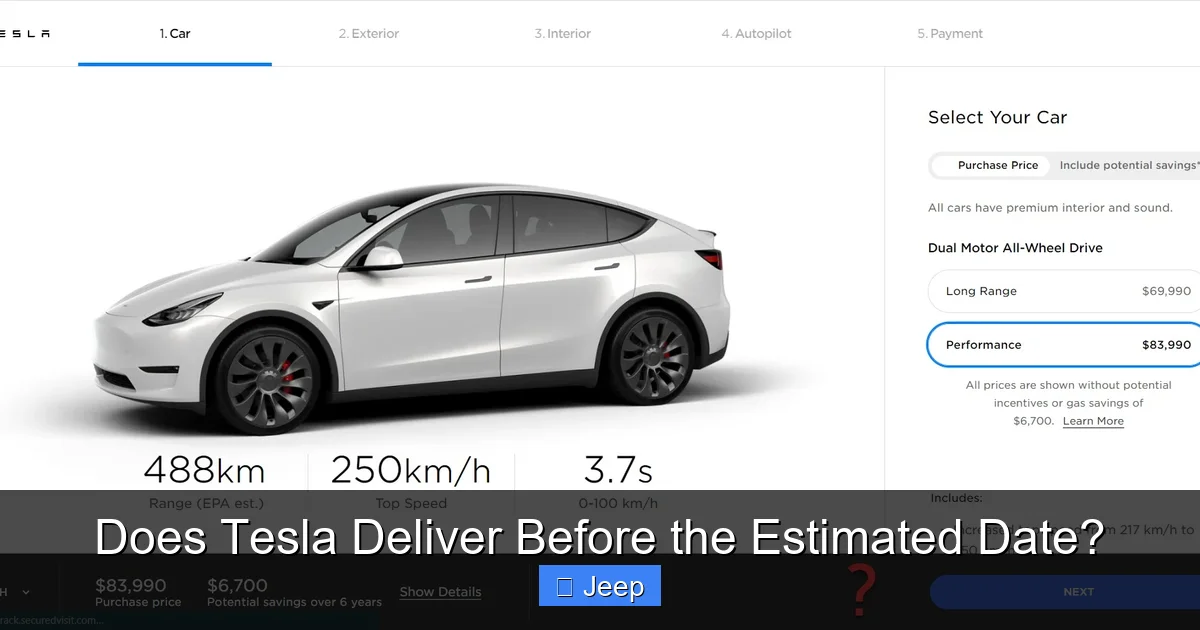
This is the number one piece of advice. If you choose white, black, silver, or grey (the most common exterior colors) and standard aero wheels, you are entering the highest-volume, fastest-moving production stream. These cars are produced constantly and in large batches. The estimated date for these configurations is more likely to be accurate or even move up. A rare pearl white or a custom 20″ turbine wheel puts you in a slower lane. Be willing to compromise on aesthetics for speed.
Consider “Inventory” or “Demo” Vehicles
This is your shortcut. Tesla’s website and some local delivery centers list “Inventory” vehicles. These are cars that were built for other orders that were cancelled, or are used as demo/loaner vehicles. They are already built, have a VIN, and are sitting at a hub or service center. You can often purchase and take delivery of these within days. The configuration might not be perfect, but it’s the closest you’ll get to “off the lot” in the Tesla world. Check the “Inventory” filter on the Tesla website regularly for your region.
Optimize Your Location and Delivery Method
When ordering, you select a delivery location. If you have flexibility, choosing a delivery center in a major metro area that is a primary logistics hub (like the San Francisco Bay Area for Fremont-built cars) can sometimes reduce transit time. Conversely, selecting a small, remote service center might add days as your car waits for a final leg carrier. Also, consider “home delivery” vs. “pickup.” Sometimes, home delivery adds a scheduling step with a third-party carrier, creating another potential delay point. Picking up at the delivery center might allow you to take the car the same day it arrives there.
Use a Referral and Stay Proactive (But Not Pushy)
While a referral code doesn’t directly speed up production, it can sometimes grant you access to a slightly better delivery estimate from a knowledgeable sales advisor, or alert you to inventory vehicles. More importantly, once you have a VIN and are in the “production” phase, you can use your Tesla account to track your car’s movement. When it arrives at the regional hub, a polite call to your local delivery team can sometimes get you on the list for an earlier delivery slot if they have capacity, rather than waiting for the automated notification.
Understand the Timing of Estimate Updates
Your estimated date will change. It’s normal. It often moves from a wide window (e.g., “July-August 2024”) to a narrower one (e.g., “Week of August 12”) to a specific date (e.g., “August 15, 2024”). Don’t panic when the initial wide window shrinks or expands slightly. The most meaningful update is the VIN assignment and the shift to a specific week. After that, the date is generally more firm, though still susceptible to final logistics delays.
How Tesla’s Delivery Model Compares to Traditional Automakers (Jeep, Honda, Nissan, etc.)
This is where the frustration for many new Tesla buyers crystallizes. They are used to the traditional dealership model. Let’s compare, using examples from brands like Honda and Nissan.
The “Dealer Inventory” Paradigm
When you buy a Honda Civic or a Nissan Rogue, you are largely buying from a pre-existing inventory. The dealer orders a mix of trims, colors, and features based on regional predictions. These cars sit on the lot. You can walk in, pick one off the shelf, and often drive it home the same day after paperwork. The “wait” is for special orders or highly popular new models. This model decouples manufacturing from individual customer orders. The manufacturer builds batches for the *dealer*, not for *you*. The dealer then sells from stock. This creates the possibility of immediate gratification that Tesla’s model simply cannot offer.
This fundamental difference explains why questions like “Does the 2016 Honda Civic Have Apple CarPlay?” are about feature availability on an existing product, while a Tesla buyer’s question is about when a custom-ordered product will be made. The Honda buyer selects from what’s there; the Tesla buyer waits for their selection to be created. You can read more about the specific feature sets of traditional vehicles in our detailed guides, such as our article on whether the 2016 Honda Civic includes Apple CarPlay, which highlights how fixed these features are at the point of manufacture.
The “Build-to-Order” Reality
Tesla’s model is more like ordering a custom suit versus buying one off the rack. The suit (your Tesla) is tailored (built) specifically for your measurements (configuration). This has advantages: you get exactly what you want, and the manufacturer has less capital tied up in unsold inventory. The disadvantage is wait time. Other brands are starting to dabble in direct sales (e.g., Porsche, BMW), but they still rely heavily on dealer stock. Even brands with online ordering typically funnel you to a dealer who then manages a traditional inventory-based order with the factory.
Post-Purchase Experience and Updates
Another stark contrast is the post-delivery experience. In a traditional car, your features and capabilities are frozen at the moment of purchase. A 2016 Honda Civic will never gain new infotainment features; its Apple CarPlay capability, if it has it, is what it is. Tesla, however, continuously pushes over-the-air (OTA) software updates that can add range, new games, entertainment features, and even improve performance. This means the car you take delivery of is not the final product it will be a year later. This dynamic is unique and partially compensates for the wait, as your vehicle improves over time. For a deep dive into how traditional automakers handle in-car technology, our piece on Apple CarPlay availability in the 2020 Honda Civic illustrates the static nature of infotainment in most other brands.
Charging Infrastructure and Delivery
For electric vehicles, the charging setup is part of the ownership ecosystem. Tesla’s delivery typically includes information on their Supercharger network and home charger recommendations, but installation is the owner’s responsibility. This is similar to other EVs. For instance, a Nissan Ariya owner might wonder about compatibility with Tesla’s vast Supercharger network—a topic we cover in our article Can the Nissan Ariya Use a Tesla Charger?. This highlights a key difference: Tesla’s charging network is integrated into the ownership experience from day one, while other EV buyers must navigate a patchwork of third-party networks, which can be a factor in their overall satisfaction but doesn’t directly impact the physical delivery date of the vehicle itself.
What to Do If Your Tesla Delivery Is Significantly Delayed
So, your specific date has come and gone, and your car is still in “Production” or “Awaiting Shipment.” What now? First, take a breath. Delays of weeks or even a few months are not uncommon in the current automotive landscape, especially for EVs. Here is a practical action plan.
Step 1: Check Your Tesla Account Relentlessly
Your account is your single source of truth. The status will change from “Production” to “In Transit” to “Ready for Delivery.” Note the “Estimated Delivery” range shown. Sometimes, a new, wider range appears, which is Tesla’s way of resetting expectations. The moment it shows “In Transit,” you can usually track the approximate location (e.g., “Departed Factory,” “Arrived at Port,” “In Transit to Regional Hub”).
Step 2: Contact Tesla Support, But Strategically
Don’t spam them daily. If your date has passed by more than two weeks with no status change or a regressive change (e.g., from a specific week back to a wide month range), a polite, factual inquiry is warranted. Use the support option in your Tesla app. Have your order number ready. Ask for a clarification on the new timeline and the reason for the delay (e.g., “Can you confirm if this is due to a production hold on my configuration or a logistics backlog?”). You often won’t get a specific reason, but you might get a slightly more refined estimate.
Step 3: Evaluate Your Configuration
Is your order highly customized? If so, the delay may be inherent to your choices. At this point, you have a decision to make: stick with your unique configuration and wait, or contact Tesla to see if you can switch to a more readily available combination (e.g., change a wheel style or interior color) to jump the queue. This is a major compromise but can be effective.
Step 4: Consider Your Options
If the delay is unacceptable (e.g., you need a car by a specific date for a move or job), you have few good choices. Cancelling your order means losing your deposit and starting over, likely facing even longer wait times as a new order. The only realistic alternative is to actively search the Tesla “Inventory” page daily for a vehicle that matches your needs as closely as possible. This is how many frustrated buyers eventually get a car, albeit not the exact one they originally ordered.
Step 5: Manage Your Expectations and Stress
The Tesla wait is a test of patience. Join online forums for your specific model. Seeing that others with similar configurations are in the same boat is strangely comforting. Remember, you are buying a product from a company that is scaling production of revolutionary technology. There will be bumps. The goal is to get a safe, exciting, and technologically advanced vehicle. Focusing on the eventual reward helps mitigate the frustration of a moving target delivery date.
The Bottom Line: Patience Is a Virtue (and Sometimes a Necessity)
Does Tesla deliver before the estimated date? Yes, it happens. But you should not bank on it. The probability is low, and banking on an early delivery can lead to significant logistical and emotional problems if you have moving schedules or lease expirations. The healthiest mindset is to treat the estimated delivery date as a rough, best-case-scenario target that will almost certainly change, and plan your life accordingly.
The system is designed for Tesla’s efficiency, not for customer convenience in the traditional sense. Your chances of an early, on-time, or only-slightly-late delivery are maximized by ordering the most common configuration available, living near a major logistics hub, and being ready to pounce on an inventory vehicle. For everyone else, the wait is part of the Tesla experience. It separates the truly committed from the casual browser. When that finally arrives, regardless of whether it was early, on time, or late, the novelty of that first drive in your silent, quick, and software-updating electric car tends to make all the waiting fade into a distant memory. Just remember to breathe, check your app, and maybe don’t sell your old car until the new one is physically in your driveway.
Frequently Asked Questions
How often does Tesla actually deliver before the estimated date?
It’s relatively uncommon, likely happening for a small minority of orders (estimates vary from 5-15%). It’s more frequent for high-volume, common configurations and during periods of exceptional factory output or logistical efficiency. For rare or complex orders, early delivery is a rare exception.
What is the most reliable way to get a Tesla quickly?
The absolute fastest method is to purchase an “Inventory” or “Demo” vehicle listed on Tesla’s website. These are pre-built cars with a VIN that can often be delivered within days to a couple of weeks. For a new custom order, choosing the most common color (white, black, silver) and wheel option gives you the best chance of a stable and potentially shorter timeline.
If my delivery date passes, should I be worried?
No, a passing date is extremely common and usually not a cause for alarm. Your estimated date is a projection. It’s normal for it to be updated, often slipping by a few weeks. Only be concerned if your status regresses (e.g., from “In Transit” back to “Production”) or if there is no update for several months after your original window closes.
Can I change my configuration to get my car sooner?
Yes, but it’s a major decision. Once your order has a VIN and is in production, changes are impossible. However, if your order is still in the early queue without a VIN, you can contact Tesla support to see if you can switch to a different color, wheel, or interior that has a shorter production queue. This can significantly accelerate your delivery but means compromising on your original choices.
How accurate are Tesla’s initial wide delivery windows (e.g., “July-September 2024”)?
The initial wide window is a very rough estimate based on overall demand and production capacity. Its primary purpose is to set initial expectations. It should be treated as almost meaningless. The meaningful date appears later when you get a VIN and a specific week or month. Even that can change, but it’s far more reliable than the first estimate.
Does paying for Full Self-Driving (FSD) affect my delivery date?
Historically, yes. FSD has sometimes been a separate software activation that didn’t hold up production, but in other periods, ordering FSD placed your car in a different, sometimes slower, queue for final software flashing at the end of the line. Currently, FSD is typically ordered as part of the vehicle configuration and should not independently cause a delay, but it’s always a factor to consider if you see a pattern of delays for FSD-equipped vehicles in your region.