Does Mazda Cx-30 Have Blind Spot Monitoring?

Contents
- 1 Key Takeaways
- 2 📑 Table of Contents
- 3 Introduction: Seeing the Unseen in Your Mazda CX-30
- 4 How Mazda’s Blind Spot Monitoring (BSM) Actually Works
- 5 BSM Availability Across 2024-2026 Mazda CX-30 Trims
- 6 Beyond the Alert: Related Systems That Work with BSM
- 7 Using BSM Effectively: Practical Tips and Common Misconceptions
- 8 Comparing Mazda CX-30 BSM to the Competition (Like Subaru Crosstrek)
- 9 What If My CX-30 Doesn’t Have Factory BSM? Aftermarket and Future Outlook
- 10 Conclusion: A Non-Negotiable Safety Feature
- 11 Frequently Asked Questions


Yes, the Mazda CX-30 comes equipped with Blind Spot Monitoring (BSM) as a standard or available feature depending on the trim level and model year. For the 2024 through 2026 model years, BSM is part of Mazda’s i-ACTIVSENSE safety suite, typically standard on higher trims like Premium, Preferred, and Premium Plus, and often available on the base Sport model. The system uses radar sensors to alert you of vehicles in your blind spots, significantly enhancing highway and lane-change safety.
Key Takeaways
- Standard on Most Trims: For 2024-2026, BSM is standard on CX-30 trims above the base model and frequently available as an option on the Sport trim.
- Part of i-ACTIVSENSE: It’s integrated with other safety features like Rear Cross-Traffic Alert (RCTA) and Lane Departure Warning for comprehensive awareness.
- Radar-Based System: Uses radar sensors in the rear bumper, not cameras, to detect vehicles in adjacent lanes, operating reliably in various weather conditions.
- Visual and Audible Alerts: Provides clear warnings via icons on the side mirrors and a beeping sound if you signal to change lanes with a vehicle present.
- Not a Substitute for Looking: The system is a powerful aid, but drivers must still perform traditional shoulder checks before lane changes.
- Can Be Temporarily Disabled: The system can be turned off via vehicle settings, useful for specific driving scenarios, but it’s recommended to keep it on.
- Aftermarket Options Exist: For older CX-30 models without factory BSM, aftermarket kits are available, though integration and reliability vary.
[FEATURED_IMAGE_PLACEHOLDER]
📑 Table of Contents
- Introduction: Seeing the Unseen in Your Mazda CX-30
- How Mazda’s Blind Spot Monitoring (BSM) Actually Works
- BSM Availability Across 2024-2026 Mazda CX-30 Trims
- Beyond the Alert: Related Systems That Work with BSM
- Using BSM Effectively: Practical Tips and Common Misconceptions
- Comparing Mazda CX-30 BSM to the Competition (Like Subaru Crosstrek)
- What If My CX-30 Doesn’t Have Factory BSM? Aftermarket and Future Outlook
- Conclusion: A Non-Negotiable Safety Feature
Introduction: Seeing the Unseen in Your Mazda CX-30
Let’s talk about one of the most common and anxious moments of modern driving: the lane change. You signal, glance over your shoulder, and—bam—there’s a car you didn’t see, hiding in that notorious “blind spot.” It’s a heart-stopper. This is where technology like Blind Spot Monitoring (BSM) becomes your silent co-pilot. For anyone researching the Mazda CX-30, a supremely popular and practical subcompact SUV, the question “Does the Mazda CX-30 have Blind Spot Monitoring?” is absolutely critical. The short answer is a resounding yes, but the details matter a great deal. In this deep dive, we’ll explore exactly how Mazda implements this life-saving tech in the CX-30 for the 2024 through 2026 model years, which trims get it, how it works in practice, and why it’s more than just a convenience—it’s a fundamental safety upgrade.
Mazda has long championed a “Jinba Ittai” philosophy—a Japanese term meaning “horse and rider as one”—which translates into creating vehicles that feel intuitively connected to the driver. Their i-ACTIVSENSE suite of safety and driver-assistance technologies is a direct extension of this. Blind Spot Monitoring isn’t an isolated gadget; it’s a networked system that communicates with other sensors and the vehicle’s computer to create a protective bubble around your CX-30. As we move into the 2026 model year, BSM has effectively become a staple of the CX-30’s value proposition, especially when stacked against rivals like the Subaru Crosstrek, which also offers similar systems. Understanding its availability and operation is key to making an informed purchase decision and using your vehicle to its fullest, safest potential.
How Mazda’s Blind Spot Monitoring (BSM) Actually Works
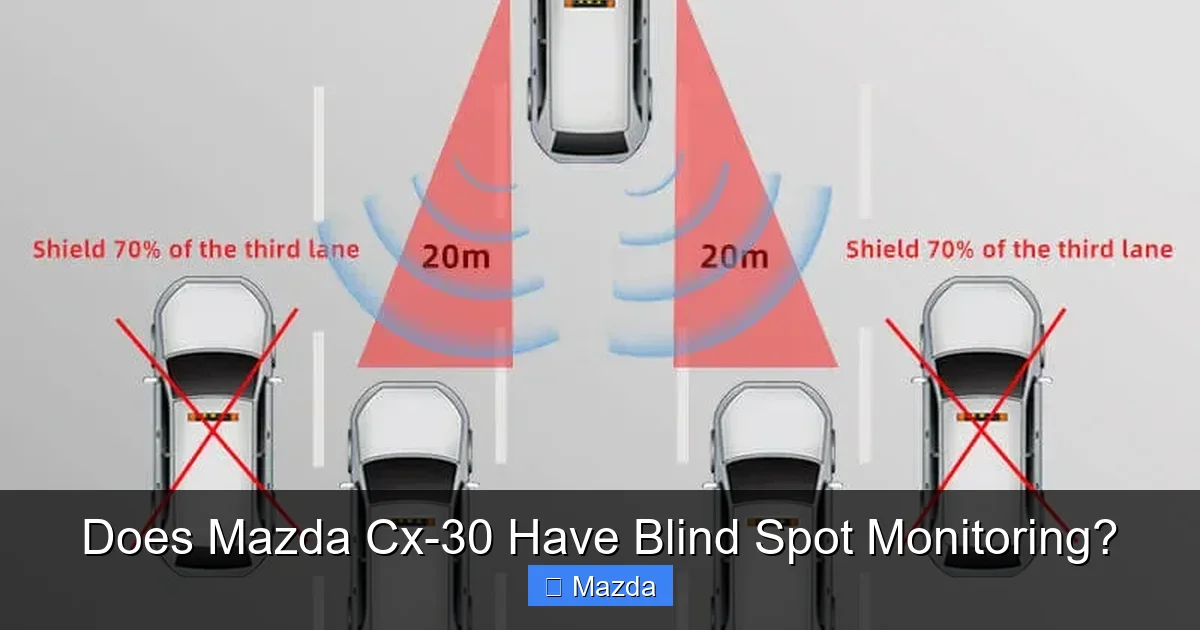
Before we get into the CX-30 specifics, let’s demystify the technology. Forget the notion that it’s a magic camera. Mazda’s BSM is a radar-based system. Hidden within the rear bumper, usually on both sides, are compact radar sensors. These sensors emit radio waves that bounce off objects—specifically, other vehicles. By measuring the time it takes for the waves to return, the system calculates the distance, speed, and direction of an approaching vehicle in the adjacent lane.
Visual guide about Does Mazda Cx-30 Have Blind Spot Monitoring?
Image source: i.ytimg.com
The Science of the Sensors
These aren’t just any sensors; they’re designed to be robust. Radar technology has a major advantage over camera-based systems: it’s far less affected by darkness, heavy rain, fog, or snow. While no system is perfect in a blizzard, Mazda’s radar will typically still “see” a car when your eyes might struggle. The sensors have a specific field of view, generally monitoring a zone starting roughly from your rear door pillar extending back about 10-15 feet and out into the adjacent lane. This is the classic blind spot zone that your side mirrors can’t cover.
From Detection to Driver Alert: The Communication Chain
Detection is only step one. The real magic is in the alert system. When a vehicle enters the monitored blind spot zone, two things happen simultaneously:
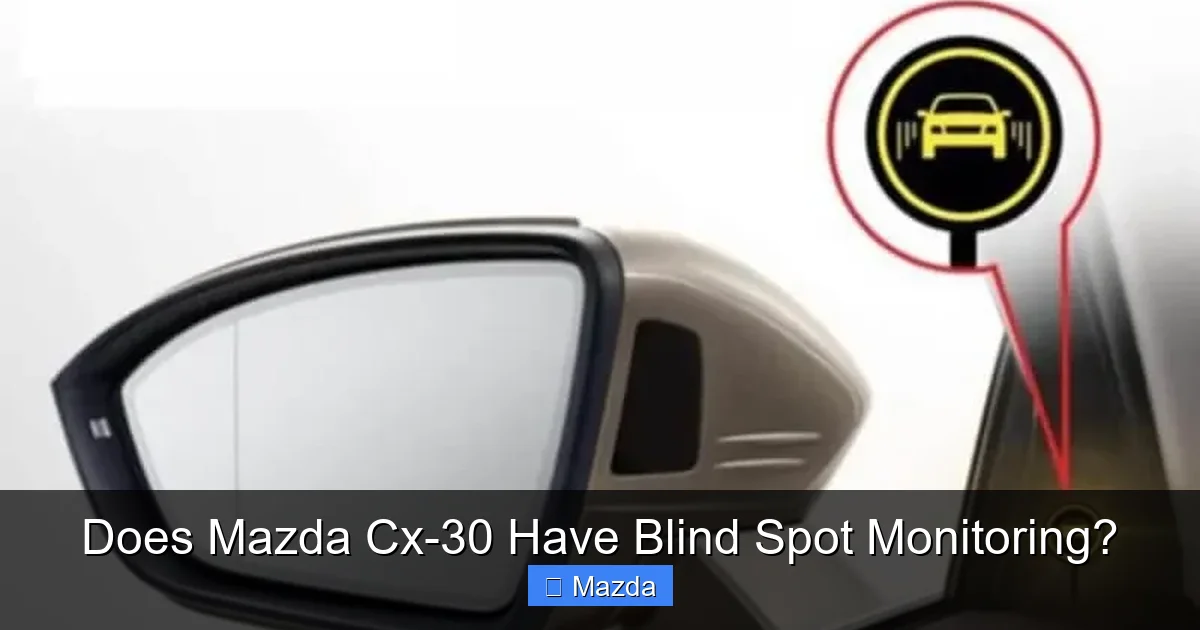
- Visual Alert: A small, amber (sometimes yellow) icon shaped like a car or a warning symbol illuminates on the corresponding side of the dashboard, near the A-pillar, or integrated into the outside mirror housing (depending on the CX-30’s model year and trim). This is your constant, at-a-glance reminder.
- Audible Alert (Conditional): If you activate your turn signal to move into that lane while the vehicle is still detected, the system emits a distinct, urgent beeping sound. This audible cue is critical because it interrupts your decision-making process at the exact moment you’re committing to a lane change.
This two-tiered approach is brilliant. The steady light tells you “something is there,” and the beep screams “DO NOT PROCEED.” It’s designed to be unambiguous and impossible to ignore once you’re familiar with it.
BSM Availability Across 2024-2026 Mazda CX-30 Trims
This is the most important practical section for a buyer. Mazda doesn’t always make every safety feature standard on every trim. For the CX-30, Blind Spot Monitoring is bundled within the larger i-ACTIVSENSE package. Here’s the breakdown for the current and projected 2026 model years.
Visual guide about Does Mazda Cx-30 Have Blind Spot Monitoring?
Image source: i.ytimg.com
The Standard Trims: Sport, Preferred, Premium, Premium Plus
For the 2024 and 2025 models, and expected to continue for 2026, the availability looks like this:
- Sport (Base): Historically, the Sport trim has been the value leader. BSM is not standard here. However, it is almost always available as part of an optional package, frequently bundled with other desirable features like Rear Cross-Traffic Alert (RCTA) and Smart City Brake Support. For a 2026 buyer, you must check the window sticker or configure online to see if the “i-ACTIVSENSE” or “Safety Package” is an option for the Sport.
- Preferred: This is where BSM typically becomes standard equipment. The Preferred trim represents the sweet spot for many buyers, and Mazda usually includes the core i-ACTIVSENSE suite here, which encompasses BSM, RCTA, and Lane Departure Warning System (LDWS).
- Premium & Premium Plus: On these higher trims, BSM is unequivocally standard. You get the full suite, often with additional features like a 360-degree parking camera, but the blind spot monitoring functionality is identical to the Preferred trim.
The All-Important Package Check
My strongest advice? Never assume. Always, always verify the exact equipment on the specific vehicle you’re looking at by checking the Monroney label (window sticker). The VIN can also be decoded online through Mazda’s official resources to see installed features. When shopping used, a 2022 or 2023 CX-30 might have BSM standard on more trims than a 2021 model, as Mazda consistently expands standard safety content. For the 2026 model, expect the trend of expanding standard features to continue, possibly making BSM standard even on the Sport trim, but confirm this at the time of purchase.
Beyond the Alert: Related Systems That Work with BSM
Thinking of BSM as a standalone tool is a mistake. Its true power is unlocked when you understand how it collaborates with other systems in your CX-30’s safety network.
Visual guide about Does Mazda Cx-30 Have Blind Spot Monitoring?
Image source: blindspotmonitor.com
Rear Cross-Traffic Alert (RCTA): Your Backup Buddy
RCTA is almost always paired with BSM in Mazda’s packaging. While BSM monitors the sides for vehicles in adjacent lanes while you’re driving forward, RCTA activates when you’re in reverse. Using the same rear-bumper radar sensors, it scans for vehicles crossing behind you—like in a parking lot when you’re backing out of a spot. If it detects traffic, you get a visual icon (often the same BSM light but on the opposite side) and a loud alert. This is a phenomenal combo for preventing back-over accidents.
Lane Departure Warning (LDW) and Lane Keep Assist (LKA)
LDW uses a forward-facing camera to monitor lane markings. If you drift out of your lane without signaling, you get a gentle vibration through the steering wheel or a visual/audible alert. In many CX-30 trims, this is paired with Lane Keep Assist, which can provide gentle steering input to help keep you centered. While these are forward-looking systems, they create a complete picture: BSM protects your sides during lane changes, LDW/LKA protects you from unintentional lane drift, and together they promote attentive, lane-disciplined driving.
Smart City Brake Support
This forward-collision mitigation system uses a camera and sometimes radar to detect vehicles or pedestrians ahead and can apply the brakes automatically if a collision is imminent and you haven’t reacted. It’s another layer in the safety net, operating at lower speeds typical of urban driving. When you have BSM, RCTA, LDW, and Smart Brake Support all active, your CX-30 is watching from almost every angle.
Using BSM Effectively: Practical Tips and Common Misconceptions
Having the technology is one thing; using it correctly is another. Here’s how to be a BSM power user.
Trust, But Verify: The Shoulder Check is Still King
This is the non-negotiable rule. Blind Spot Monitoring is an aid, not a replacement for your own observation. The system is incredibly reliable, but it has limitations. It may not detect motorcycles, bicycles, or very small vehicles as quickly. It can also be temporarily obscured by heavy accumulation of dirt, snow, or ice on the rear bumper where the sensors are located. The correct sequence is: 1) Check your mirrors. 2) Notice the BSM light. 3) Still perform a quick shoulder check to confirm the zone is clear and to scan for any small objects the radar might miss. 4) If clear and light is off, signal and complete your maneuver. This habit makes you a supremely safe driver, with or without technology.
Understanding the Alerts: Light vs. Beep
Train yourself to recognize the difference. A steady amber light on your A-pillar or mirror means “a vehicle is currently in your blind spot.” It’s a status indicator. The moment you touch your turn signal, that light should either turn off (if the vehicle has passed) or start flashing, accompanied by a rapid beeping. That beep is your “abort lane change” signal. Don’t ignore it. It’s not a suggestion; it’s a warning.
When to Temporarily Disable BSM
There are rare, specific scenarios where you might want to turn the system off. For example, if you’re performing a tight, multi-point turn on a narrow street and the system keeps alerting you for vehicles in a lane you have no intention of entering, it can be annoying. You can usually disable BSM via a button on the steering wheel or through the vehicle settings menu on the infotainment screen. But here’s the key: re-enable it as soon as you’re back on normal roads. Make it a habit to check that the BSM icon on your dash is illuminated (showing it’s active) every time you start driving.
Comparing Mazda CX-30 BSM to the Competition (Like Subaru Crosstrek)
How does Mazda’s system stack up? The Subaru Crosstrek is a direct competitor and offers “Blind Spot Detection” as part of its EyeSight suite. Both systems are radar-based and function very similarly. The primary differences are often in branding and user interface. Mazda’s alerts are integrated into the A-pillar, while Subaru often uses the side mirror housings. Both are excellent, reliable systems. In fact, if you’re cross-shopping, you’ll find the core functionality nearly identical. The deciding factor often comes down to which vehicle’s overall interface you prefer and which trim gives you the feature at a better price point. For a deep dive into Subaru’s offering, you can read our detailed comparison of Does The Subaru Crosstrek Have Blind Spot Monitoring.
What matters more than brand-to-brand nitpicking is this: any vehicle in this class equipped with a modern blind spot monitoring system is a safer vehicle. The technology has matured to the point where it’s highly effective and trustworthy. Whether you choose the Mazda CX-30, Subaru Crosstrek, or a Honda HR-V, prioritizing a model with BSM is a smart safety decision.
What If My CX-30 Doesn’t Have Factory BSM? Aftermarket and Future Outlook
For owners of a used base-model CX-30 without the feature, or for those simply curious, what are the options?
The Aftermarket Route: Proceed with Caution
Yes, you can add Blind Spot Monitoring aftermarket. Companies like VDO, Autel, and others sell kits. However, this is not a simple plug-and-play accessory. It involves:
- Drilling holes in your rear bumper to install radar sensors.
- Extensive wiring work to connect the sensors to a control module and power source.
- Integrating the alert system—either new mirror-integrated lights or dash-mounted lights.
- Potential compatibility issues with your vehicle’s CAN bus system.
Installation is complex and best left to professional car electronics specialists. The cost (parts + labor) can approach $1,000 or more. The system will also not be integrated as seamlessly as the factory unit. For these reasons, adding BSM aftermarket is generally not recommended unless you are deeply committed and have a reputable installer. It’s far better to purchase a CX-30 with the feature from the factory. If you’re considering a vehicle without it, first check if adding it is even possible for your specific model year by consulting specialists.
The 2026 and Beyond Outlook
The trajectory is clear: driver-assistance features are becoming standard. For the 2026 Mazda CX-30, it is highly probable that Blind Spot Monitoring will be standard on all trims, not just the upper ones. Mazda is consistently democratizing its safety tech. Furthermore, we may see the evolution toward more advanced systems. While current BSM is excellent, future iterations could include:
- Enhanced Visualization: A small digital display in the gauge cluster showing a simplified graphic of cars in your blind spots.
- Integration with Navigation: The system could use map data to anticipate blind spot risks near highway on-ramps or complex interchanges.
- Active Intervention: While current systems only alert, future versions could potentially apply gentle braking or steering resistance if you attempt a lane change with a vehicle present and no signal, moving from warning to prevention.
But for now, the radar-based alert system in today’s CX-30 is a mature, reliable, and incredibly valuable safety tool.
Conclusion: A Non-Negotiable Safety Feature
So, does the Mazda CX-30 have Blind Spot Monitoring? The definitive answer for the 2024-2026 model years is yes, it does. It’s a core component of the i-ACTIVSENSE safety suite, standard on Preferred, Premium, and Premium Plus trims, and available on the Sport. This radar-based system provides crucial, timely visual and audible alerts that dramatically reduce the risk of a side-impact collision during a lane change. It works in concert with Rear Cross-Traffic Alert and other systems to create a comprehensive awareness network around your vehicle.
When shopping for your CX-30, making BSM a priority is one of the smartest decisions you can make. The peace of mind it offers on busy highways and during stressful merges is tangible. If you’re looking at a base model without it, strongly consider adding the option package or seeking a slightly higher-trim used model that includes it. The technology has proven itself not as a gimmick, but as a fundamental layer of modern driving safety. Once you’ve experienced a BSM alert that prevented a potential mistake, you’ll never want to drive without it again. In the Mazda CX-30, you’re getting a system that is as intuitive and integrated as the driving experience itself—truly seeing the unseen.
Frequently Asked Questions
Is Blind Spot Monitoring standard on all 2024 Mazda CX-30 trims?
No, it is not standard on the base Sport trim for 2024. However, it is standard equipment on the Preferred, Premium, and Premium Plus trims. For the Sport, it’s typically available as part of an optional i-ACTIVSENSE package.
Can I turn off the Blind Spot Monitoring in my CX-30?
Yes, you can temporarily disable the BSM system. There is usually a button on the steering wheel (often marked with a car and radar waves) or an option in the vehicle settings menu on the infotainment screen. It’s recommended to keep it enabled for normal driving and only disable it for specific, temporary situations.
Does BSM work in bad weather like heavy rain or snow?
Yes, because it uses radar sensors, it performs much better in poor weather than camera-based systems. However, a heavy accumulation of snow, ice, or mud caked on the rear bumper around the sensor locations can block the radar waves and temporarily disable the system. The system may also give a “sensor blocked” warning in this case.
What’s the difference between Blind Spot Monitoring and Rear Cross-Traffic Alert?
Blind Spot Monitoring (BSM) monitors the adjacent lanes on either side of your vehicle while you are driving forward. Rear Cross-Traffic Alert (RCTA) uses the same rear sensors but activates when you are in reverse, warning you of traffic crossing behind you, such as in a parking lot. They are complementary systems often packaged together.
Will BSM detect motorcycles and bicycles?
The radar sensors are designed to detect vehicles, but they can sometimes have a harder time picking up smaller, narrower objects like motorcycles and bicycles, especially if they are at the far edge of the sensor’s range. This is why performing a traditional shoulder check is still an essential safety habit, even with BSM active.
Can I add Blind Spot Monitoring to a CX-30 that doesn’t have it?
Aftermarket kits exist, but installation is complex, requiring drilling into the rear bumper and extensive wiring. It is not a simple DIY project and can be expensive. The system’s integration and reliability may not match the factory-installed version. The best path is to purchase a CX-30 with the feature from the factory.