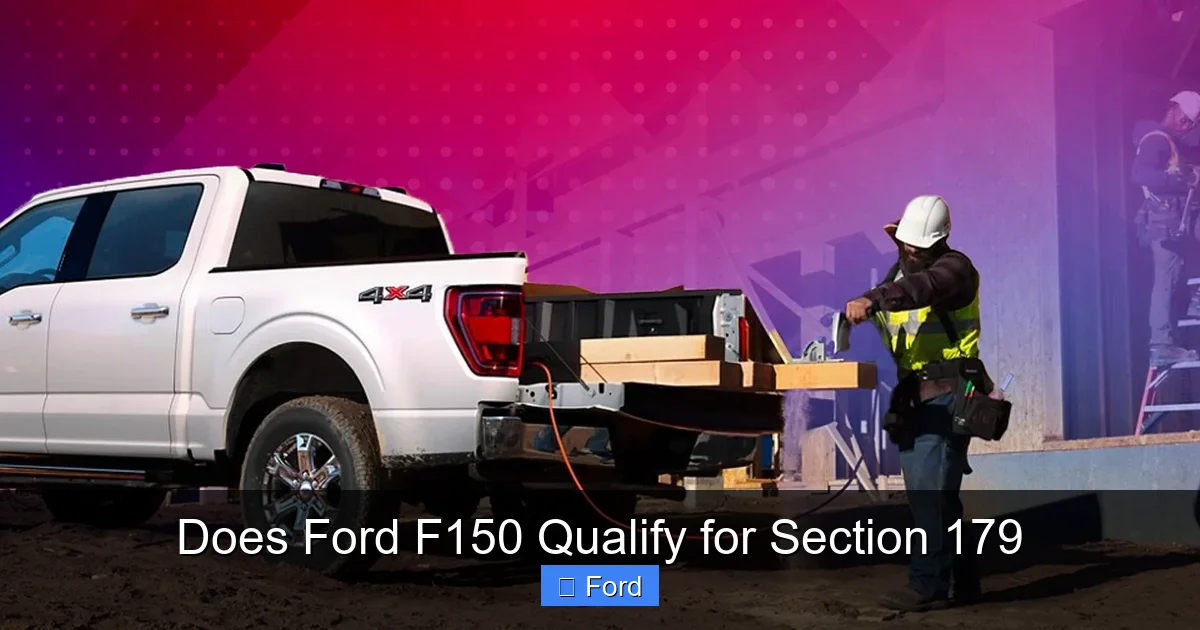
Does Ford F150 Qualify for Section 179

Contents
- 1 Key Takeaways
- 2 📑 Table of Contents
- 3 What is Section 179 and How Does It Work?
- 4 Ford F150: A Heavy-Duty Truck That Often Meets Section 179 Criteria
- 5 Step-by-Step Guide to Claiming Section 179 for Your Ford F150
- 6 Common Mistakes That Can Disqualify Your F150 from Section 179
- 7 Real-World Scenarios: How Different Businesses Use Ford F150 for Section 179
- 8 Conclusion: Making an Informed Decision for Your Business
- 9 Frequently Asked Questions


The Ford F150 often qualifies for Section 179 due to its GVWR over 6,000 lbs, but eligibility depends on specific model configurations and primary business use. Proper documentation and understanding IRS rules are essential to claim this deduction successfully.
Does Ford F150 Qualify for Section 179
If you’re a business owner in America, chances are you’ve considered a Ford F150. It’s the undisputed king of trucks, known for its durability, capability, and versatility. But beyond its work ethic, the F150 can also be a smart financial move thanks to Section 179 of the tax code. This provision allows businesses to deduct the cost of qualifying equipment, including vehicles, in the year they’re purchased. So, does the Ford F150 qualify for Section 179? In most cases, yes! But there are specific rules you must follow. In this comprehensive guide, we’ll explore everything from weight requirements to claiming the deduction. You’ll learn which F150 models qualify, how to document business use, and tips to avoid common pitfalls. By the end, you’ll be equipped to make an informed decision and potentially save thousands on your taxes. Let’s dive in.
The Ford F150 has been the best-selling vehicle in the United States for over four decades. Its appeal to businesses is undeniable—from construction crews to sales teams, the F150’s capability and reliability make it a top choice. With the advent of the aluminum-intensive design in 2015, Ford reduced weight but maintained strength, and GVWR remained high. The recent addition of the hybrid and electric F150 Lightning expands the lineup, but all maintain GVWR over 6,000 lbs, preserving Section 179 eligibility. So, if you’re considering an F150 for your business, understanding Section 179 can make it even more affordable.
Key Takeaways
- GVWR is Key: Most Ford F150 models have a GVWR exceeding 6,000 lbs, meeting the IRS requirement for Section 179.
- Business Use Majority: The truck must be used over 50% for business purposes to qualify for the deduction.
- Model-Specific: Not all F150 trims qualify; payload packages and engine options can affect GVWR.
- Deduction Limits Apply: Section 179 has annual limits; for 2024, it’s $1,220,000 with a vehicle cap of $28,900 for passenger vehicles, but trucks often exceed this.
- Keep Meticulous Records: Document business mileage, use logs, and expenses to support your claim.
- Consult Tax Professionals: Tax laws change; get advice tailored to your business and vehicle purchase.
📑 Table of Contents
- What is Section 179 and How Does It Work?
- Ford F150: A Heavy-Duty Truck That Often Meets Section 179 Criteria
- Step-by-Step Guide to Claiming Section 179 for Your Ford F150
- Common Mistakes That Can Disqualify Your F150 from Section 179
- Real-World Scenarios: How Different Businesses Use Ford F150 for Section 179
- Conclusion: Making an Informed Decision for Your Business
What is Section 179 and How Does It Work?
Section 179 is a tax deduction that allows businesses to immediately expense the cost of qualifying property, rather than depreciating it over time. Enacted to stimulate economic growth, it’s especially beneficial for small and medium-sized enterprises. For vehicles, the rules are a bit nuanced. The IRS classifies vehicles into two categories: passenger automobiles and “other” vehicles. Passenger vehicles have strict dollar limits on deductions—for 2024, it’s $28,900 for the first year. But vehicles with a Gross Vehicle Weight Rating (GVWR) over 6,000 pounds are considered “other” and aren’t subject to these low limits. This is where trucks like the Ford F150 shine. Since most F150s exceed 6,000 lbs GVWR, they often qualify for the full purchase price deduction under Section 179, up to the annual limit of $1,220,000 for all qualifying property in 2024. However, the deduction cannot exceed your business’s taxable income for the year.
The Basics of Section 179
Section 179 was introduced in the 1950s to encourage businesses to invest in equipment. It allows you to deduct the entire cost of qualifying assets in the year you put them into service. This is different from traditional depreciation, which spreads the cost over several years. For example, if you buy a Ford F150 for $50,000 and use it 100% for business, you could deduct the full $50,000 in 2024, reducing your taxable income by that amount. If you’re in a 25% tax bracket, that’s a $12,500 tax saving! But there are limits: the total Section 179 deduction for all property cannot exceed $1,220,000 in 2024, and it phases out if you buy more than $3,050,000 worth of qualifying property. Also, the deduction is limited to your business’s taxable income—so if you have a loss, you can’t use it that year, but you can carry it forward to future years.
How Section 179 Benefits Small Businesses
For small businesses, Section 179 is a cash flow hero. Instead of waiting years to recover costs through depreciation, you get an immediate tax break. This can make purchasing a necessary vehicle like an F150 feasible. Imagine a landscaping business that needs a reliable truck. Without Section 179, they might delay the purchase due to cash constraints. With Section 179, the tax savings effectively lower the net cost. For instance, a $45,000 F150 with a 30% tax bracket saves $13,500 in taxes, making the net cost $31,500. That’s a significant incentive. Moreover, Section 179 applies to both new and used equipment, as long as it’s new to your business. So, you can buy a used F150 and still qualify, provided it meets GVWR and use requirements.
Section 179 has been a part of the tax code since the 1950s, originally designed to encourage businesses to invest in new equipment during economic downturns. Over the years, Congress has adjusted the limits and rules. For 2024, the maximum Section 179 deduction is $1,220,000, with a phase-out threshold of $3,050,000. This means if you buy more than $3,050,000 worth of qualifying property in a year, the $1,220,000 limit is reduced dollar-for-dollar. For most small businesses buying one F150, this isn’t an issue. But if you’re a larger business buying multiple vehicles and equipment, you need to watch the phase-out. Also, the deduction is limited to your business’s taxable income from active trades or businesses. So, if your business has a loss, you can’t use Section 179 that year, but you can carry forward the unused deduction to future years, where it can offset income then.
Ford F150: A Heavy-Duty Truck That Often Meets Section 179 Criteria
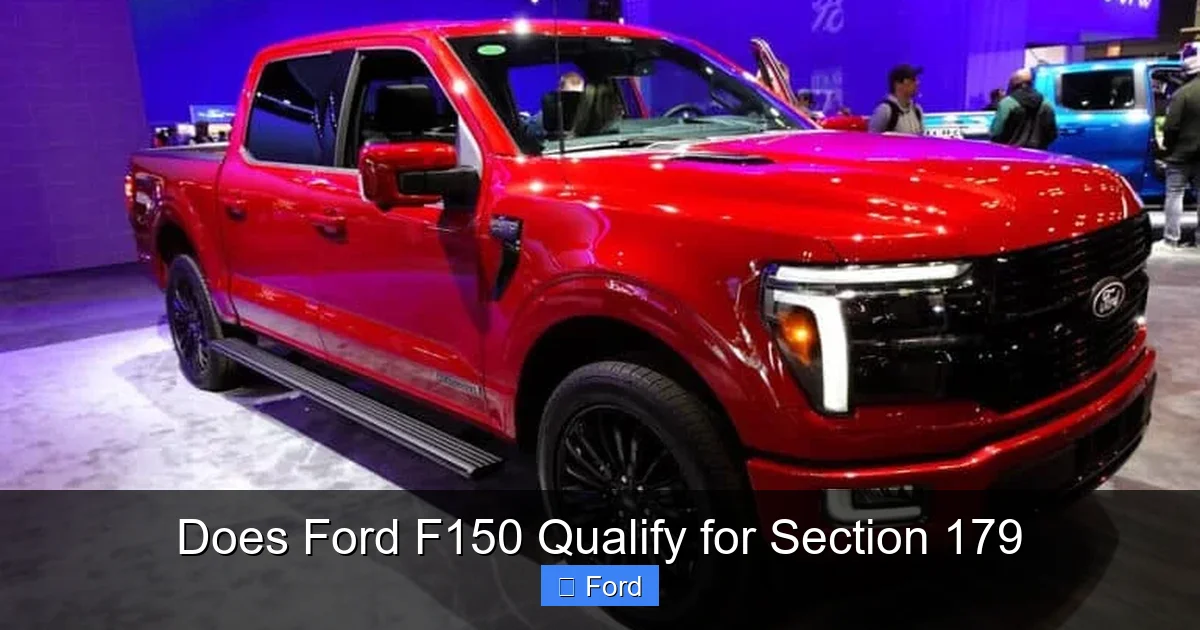
The Ford F150’s reputation as a workhorse is well-earned. Its robust construction and high payload capacity make it ideal for business use. But for Section 179, the critical factor is GVWR. Let’s break down why the F150 usually qualifies and how to confirm for your specific truck.
Visual guide about Does Ford F150 Qualify for Section 179
Image source: di-uploads-pod45.dealerinspire.com
Understanding GVWR and Why It’s Important
GVWR, or Gross Vehicle Weight Rating, is the maximum total weight a vehicle is rated to carry safely. This includes the vehicle’s own weight (curb weight), passengers, cargo, and fluids. The IRS uses GVWR to distinguish between passenger vehicles and work vehicles. A vehicle must have a GVWR of more than 6,000 pounds to be eligible for the full Section 179 deduction without the $28,900 cap that applies to cars and SUVs. Why 6,000 lbs? It’s a threshold set by Congress to target vehicles designed for commercial use. The Ford F150, being a full-size pickup, almost always exceeds this. But it’s not automatic—you must verify the specific vehicle’s GVWR. This number is found on a sticker on the driver’s side door jamb or in the owner’s manual. It’s fixed by the manufacturer and doesn’t change with added accessories.
Ford F150 GVWR by Model and Year
GVWR for the F150 varies by model year, cab style, bed length, engine, and payload package. Here’s a general guide for recent models (always verify your specific vehicle):
- 2024 Ford F150 Regular Cab, 6.5-foot bed, 3.3L V6: GVWR approximately 6,100 – 6,300 lbs.
- 2024 Ford F150 SuperCab, 5.5-foot bed, 2.7L EcoBoost: GVWR around 6,500 – 6,700 lbs.
- 2024 Ford F150 CrewCab, 6.5-foot bed, 5.0L V8 with Heavy-Duty Payload Package: GVWR can reach 7,000 – 7,400 lbs.
- 2023 Ford F150 XLT SuperCrew, 5.5-foot bed: GVWR typically 6,550 lbs.
- 2022 Ford F150 Lariat with Max Trailer Tow Package: GVWR often 6,800 lbs or higher.
To find your F150’s exact GVWR, open the driver’s door and look for the yellow and white “Tire and Loading Information” sticker. It lists GVWR in pounds. You can also check the window sticker from when it was new or look up the VIN on Ford’s website. If your GVWR is over 6,000 lbs, you meet the weight requirement. But note: some early 2000s models or base configurations might have GVWR at or below 6,000 lbs. For example, a 2001 Ford F150 Regular Cab with a 4.2L V6 might have a GVWR of 5,900 lbs. So, for older trucks, double-check.
To give you a better idea, here are GVWR ranges for common Ford F150 configurations from 2020 to 2024:
- CrewCab, 5.5-foot bed, 3.5L EcoBoost: GVWR 6,500 – 6,800 lbs.
- CrewCab, 6.5-foot bed, 5.0L V8: GVWR 6,700 – 7,000 lbs.
- SuperCab, 6.5-foot bed, 2.7L EcoBoost: GVWR 6,400 – 6,600 lbs.
- RegularCab, 8-foot bed, 3.3L V6: GVWR 6,200 – 6,500 lbs.
These are approximate; always check your specific vehicle. For used F150s, GVWR is the same as when new, unless major modifications have been made. But modifications don’t change the manufacturer’s GVWR, so it remains valid. If you’re unsure, contact a Ford dealer with your VIN for the official GVWR.
Which F150 Trims and Packages Qualify?
Almost all modern Ford F150s qualify because their GVWR exceeds 6,000 lbs. However, there are nuances. The base XL trim with the smallest engine and no payload package might have a GVWR just over 6,000 lbs, but it still qualifies. The Heavy-Duty Payload Package, available on XL, XLT, and Lariat trims, increases GVWR by upgrading the suspension, brakes, and tires. This package is common for businesses needing extra capacity. The F150 Raptor, with its off-road focus, has a high GVWR (around 7,500 lbs) and qualifies. What about the F150 Lightning (electric)? It also has a high GVWR, typically over 6,000 lbs, so it should qualify too. The key is GVWR, not luxury features. But be aware: if your F150 is modified to increase weight, the GVWR doesn’t change—it’s set by the manufacturer. So, as long as the factory GVWR is over 6,000 lbs, you’re good. For used F150s, ensure the GVWR hasn’t been altered; it usually doesn’t, but verify with the door sticker.
Step-by-Step Guide to Claiming Section 179 for Your Ford F150
Once you’ve confirmed your F150 qualifies, it’s time to claim the deduction. Here’s a practical step-by-step process.
Visual guide about Does Ford F150 Qualify for Section 179
Image source: cdn.dlron.us
Determining Business Use Percentage
The IRS requires that the vehicle be used more than 50% for business. To calculate this, you must track all miles driven. Keep a logbook—paper or digital—that records each trip’s date, starting and ending odometer readings, purpose, and miles driven. Separate business miles from personal miles, including commuting (which is not business use). At year-end, total your business miles and total miles driven. Divide business miles by total miles to get the percentage. For example, if you drive 30,000 total miles and 18,000 are for business, that’s 60% business use. You can then deduct 60% of the vehicle’s cost under Section 179. If your business use is exactly 50%, you don’t qualify—it must be over 50%. Also, if in future years the business use drops below 50%, you may have to recapture some of the deduction as income in the year it drops. This is called “depreciation recapture.” So, maintain consistent business use.
Gathering Required Documentation
Proper documentation is crucial for a smooth deduction. You’ll need:
- Purchase proof: Invoice or sales contract showing the F150’s cost, VIN, and date placed in service.
- GVWR verification: A photo or copy of the door jamb sticker showing GVWR over 6,000 lbs.
- Business use records: Your mileage log, plus receipts for fuel, maintenance, insurance if allocating costs between business and personal.
- Financing documents: If you have a loan, keep the agreement for interest deduction purposes.
Store these records for at least three years after filing your tax return, as the IRS can audit back that far. Some businesses use accounting software to track vehicle expenses automatically.
Filing Form 4562 and Other Tax Forms
To claim Section 179, you file Form 4562 with your tax return. This form is used for depreciation and amortization. On Part I, you list the property, including your F150. You’ll enter the cost, the amount you’re electing to expense (up to the business use percentage), and other details. If you’re deducting only a portion due to mixed use, you enter the business percentage. For example, if the F150 cost $50,000 and business use is 80%, you elect to expense $40,000. The remaining $10,000 can be depreciated over time if you wish, but often you expense all qualifying cost. Your tax software or preparer will guide you through Form 4562. Remember, the Section 179 deduction cannot exceed your business’s taxable income from all active trades or businesses. If you have a net operating loss, you can’t use Section 179 that year, but you can carry the unused portion forward to future years.
If you lease the F150 instead of buying, you may still qualify for Section 179. For leases, you can deduct the present value of the lease payments, up to the annual limit. However, the vehicle must still have a GVWR over 6,000 lbs and be used more than 50% for business. The rules for leased vehicles are a bit more complex, so consult your tax advisor. Also, if you finance the F150, the interest on the loan is separately deductible as a business expense, but it doesn’t affect the Section 179 deduction on the vehicle’s cost.
Timing Your Purchase for Maximum Benefit
Section 179 applies to property placed in service during the tax year. “Placed in service” means when the vehicle is ready and available for use. If you buy the F150 on December 31, 2024, and drive it that day, it’s placed in service in 2024, and you claim it on your 2024 return. If you buy in January 2025, it’s for the 2025 tax year. So, to maximize deductions for a high-income year, consider purchasing before year-end. But be strategic: if you expect higher income next year, you might defer to offset more taxes. Also, be aware of bonus depreciation. For 2024, bonus depreciation is 80% (it phases down to 0% by 2027). Bonus depreciation is automatic for qualified property, but you can opt out. For vehicles over 6,000 lbs, both Section 179 and bonus depreciation can allow full first-year expensing. However, Section 179 is often preferable because it’s elective and can be limited by income, while bonus depreciation can create a loss. You can use both: first, apply Section 179 up to the limit, then apply bonus depreciation to any remaining cost. But if you use bonus depreciation first, you can’t then use Section 179 on the same property. Consult your tax advisor to decide which method is best for your situation.
Common Mistakes That Can Disqualify Your F150 from Section 179
Even with a qualifying F150, errors can derail your deduction. Avoid these common pitfalls.
Visual guide about Does Ford F150 Qualify for Section 179
Image source: aschenbachford.com
Failing to Maintain Proper Business Use Records
The IRS scrutinizes vehicle deductions heavily. Without a contemporaneous mileage log, they may disallow the deduction or reduce the business use percentage. Many business owners think they can estimate, but estimates are risky. Use an app like Stride or MileIQ to automatically track miles. Record every trip, even short ones to the hardware store or client lunch. Don’t forget to exclude commuting miles. Keep records for at least three years. If audited, you’ll need to produce the log.
Overlooking Vehicle Weight Requirements
Assuming all F150s qualify because they’re trucks is a mistake. You must verify GVWR. For example, a 2005 Ford F150 Regular Cab with a 4.2L V6 might have a GVWR of 5,950 lbs—just below the threshold. If you buy such a truck, it won’t qualify for Section 179; it would be subject to passenger auto limits. Always check the door sticker before purchase. If buying used, ask the seller for the GVWR or look it up by VIN. Also, note that GVWR is not the same as curb weight or payload. GVWR is the total max weight, so if your GVWR is 6,200 lbs, and the truck weighs 5,000 lbs empty, you have 1,200 lbs for passengers and cargo. But for Section 179, only GVWR matters.
Confusing Section 179 with Bonus Depreciation
Section 179 and bonus depreciation are both first-year expensing methods, but they work differently. Section 179 is an election you make on your tax return; you choose how much to expense up to limits. Bonus depreciation is automatic for qualified property placed in service in 2024 (80% for property with recovery period of 20 years or less, including vehicles). However, for vehicles over 6,000 lbs, bonus depreciation also allows full expensing. But Section 179 has the advantage of being limited by business income, which can be beneficial if you want to preserve depreciation for future years. You can use both: first, apply Section 179 up to the limit, then apply bonus depreciation to any remaining cost. But if you use bonus depreciation first, you can’t then use Section 179 on the same property. So, plan carefully. Many small businesses prefer Section 179 because it’s more flexible and doesn’t force expensing if it’s not advantageous.
Not Considering State Tax Conformity
While Section 179 is a federal deduction, not all states conform to the federal rules. Some states have different limits or don’t allow Section 179 at all. For example, California has its own depreciation rules and doesn’t fully conform to federal Section 179. If you file state taxes, check your state’s regulations. You might get a federal deduction but not a state one, leading to different taxable income. Always consult a tax professional familiar with your state’s laws.
Failing to Reduce Basis Upon Sale
Another mistake is failing to reduce the vehicle’s basis by any Section 179 deduction when you later sell it. If you sell the F150 for a gain, you may have to recapture some of the deduction as ordinary income. This is because Section 179 deduction reduces your basis in the vehicle. So, if you sell it for more than its adjusted basis (cost minus deductions), the gain up to the deducted amount is recaptured as ordinary income, not capital gain. Keep this in mind for future planning.
Real-World Scenarios: How Different Businesses Use Ford F150 for Section 179
Let’s see how various businesses leverage the Ford F150 and Section 179 to save money.
Construction and Landscaping Businesses
Take a small construction contractor who buys a 2024 Ford F150 XLT with the Heavy-Duty Payload Package for $48,000. The GVWR is 7,050 lbs. They use the truck 90% for business—transporting tools, materials, and traveling to job sites. They keep a detailed mileage log. Under Section 179, they can deduct 90% of the cost, or $43,200, in the first year. This reduces their taxable income significantly, freeing up cash for other expenses. They also equip the truck with a ladder rack and permanent tool box, which can be added to the vehicle’s cost if installed before placing it in service. For reliable performance on rough job sites, they invest in durable tires that can handle heavy loads and off-road conditions. To find the best tires for their F150, they consult our guide on the best tires for Ford F150, which reviews options for all terrains and payloads.
Check out our best tires for Ford F150 guide for top recommendations.
Sales and Service Professionals
A pharmaceutical sales representative uses an F150 to visit doctors and carry samples. The truck is essential for their work, with 75% business use. They purchase a 2024 Ford F150 Lariat for $55,000. Under Section 179, they deduct $41,250 (75% of cost). To protect their investment and have proof of miles, they install a dash cam. A dash cam can also capture incidents on the road, providing liability protection. For the best dash cam options tailored to F150, they refer to our guide.
Explore the best dash cams for your Ford F150.
Agricultural Uses
A farmer buys a used 2022 Ford F150 XL for $35,000 to transport livestock, feed, and equipment. The GVWR is 6,400 lbs. They use it 85% for farm business. Section 179 deduction: $29,750. Farm vehicles often face harsh conditions, so maintenance is key. They rely on a robust battery for cold winter starts; our battery guide helps them choose one that lasts.
Find the best battery for your Ford F150.
Delivery and Courier Services
A local courier company buys a fleet of Ford F150s for package delivery. Each truck costs $40,000 and has a GVWR of 6,600 lbs. They use each truck 95% for business. Under Section 179, they deduct $38,000 per truck in the first year. With five trucks, that’s $190,000 in deductions, significantly reducing their tax bill. They choose F150s for their durability and payload capacity. To handle frequent stops and starts, they equip each truck with a reliable battery; our battery guide helps them select long-lasting options.
Towing and Recovery Businesses
A towing company uses Ford F150s with tow packages for vehicle recovery. These trucks often have the Heavy-Duty Payload Package, with GVWR over 7,000 lbs. They use them 100% for business. Section 179 allows them to deduct the full cost, say $50,000 per truck, immediately. This is crucial for cash flow in a capital-intensive business. They also need robust tires for towing; our best tires for Ford F150 guide includes heavy-duty options for towing applications.
Conclusion: Making an Informed Decision for Your Business
The Ford F150 is more than just a truck; it’s a business tool that can offer significant tax advantages through Section 179. By ensuring your F150 has a GVWR over 6,000 pounds, using it predominantly for business, and keeping thorough records, you can deduct a large portion of its cost in the first year. Remember to check your specific model’s GVWR, document every business mile, and consult with a tax professional to navigate the complexities. With proper planning, your Ford F150 can boost your productivity and your bottom line. So, if you’re in the market for a work truck, consider the F150—not just for its capability, but for its potential tax benefits. And don’t forget to outfit it with quality accessories like the best tires, batteries, and dash cams to keep it running smoothly for years to come.
Frequently Asked Questions
Does every Ford F150 qualify for Section 179?
No, not every Ford F150 qualifies. The vehicle must have a GVWR over 6,000 pounds and be used more than 50% for business. Most modern F150s meet the weight requirement, but some older or lightweight configurations might not. Always check the specific vehicle’s GVWR on the door jamb sticker.
What is the GVWR requirement for Section 179?
For a vehicle to qualify for Section 179 without the passenger auto limits, it must have a Gross Vehicle Weight Rating (GVWR) of more than 6,000 pounds. This is a key threshold set by the IRS. The Ford F150 typically exceeds this, but you must verify for your specific model.
How much can I deduct for my Ford F150 under Section 179?
If your F150 qualifies and is used over 50% for business, you can deduct the business-use percentage of the vehicle’s cost in the first year. For example, if the truck costs $50,000 and you use it 80% for business, you can deduct $40,000. There is no dollar limit on the vehicle deduction if GVWR is over 6,000 lbs, but the total Section 179 deduction cannot exceed $1,220,000 in 2024 and is limited by your business taxable income.
What if I use my F150 for both business and personal reasons?
You can still claim Section 179 if business use is more than 50%. You must allocate the deduction based on the business use percentage. Keep detailed records of business and personal miles. If business use drops below 50% in future years, you may have to recapture some deduction as income.
Do I need to file any special forms to claim Section 179?
Yes, you must file Form 4562 with your tax return to elect the Section 179 deduction. On this form, you’ll report the vehicle’s cost, business use percentage, and the amount you’re expensing. Your tax preparer or software can assist, but you must provide all documentation.
Can I claim Section 179 for a used Ford F150?
Yes, Section 179 applies to both new and used property, as long as it’s new to your business and meets the eligibility criteria. So, a used Ford F150 with GVWR over 6,000 lbs and used primarily for business qualifies. Ensure you have proof of purchase and GVWR.