Do You Need a Special Battery for Toyota Highlander?

Contents
- 1 Key Takeaways
- 2 📑 Table of Contents
- 3 Understanding Your Highlander’s Electrical Heart: It’s Not Just Any 12V
- 4 AGM vs. Flooded Batteries: Why the Type is Everything
- 5 Selecting the Right Replacement: Decoding the Label
- 6 Installation and Initial Setup: More Than Just Swapping
- 7 Maintenance and Longevity: Getting the Most from Your Investment
- 8 Conclusion: Knowledge is Power (and a Working Battery)
- 9 Frequently Asked Questions

No, your Toyota Highlander does not typically require a “special” or proprietary battery brand, but it absolutely requires the correct *type* and *specification* of battery. The key is understanding whether your specific model year and trim level uses a standard flooded (SLI) battery or an Absorbent Glass Mat (AGM) battery, which is often mandated by the Start-Stop system. Using the wrong type can lead to premature failure, electrical issues, and a poor driving experience. Always check your owner’s manual or consult a professional to confirm the exact Group Size (e.g., 24F, 35) and Cold Cranking Amps (CCA) required for your vehicle.
So, you’re staring at that dead battery in your Toyota Highlander, or maybe you’re just being proactive. The big question pops into your head: “Do I need to hunt down some special, secret, Toyota-only battery?” It’s a fair question! Car manufacturers love to make things seem complicated. But take a breath. The answer is both reassuringly simple and critically important. You do not need a special, proprietary battery sold only by Toyota dealerships. However, you absolutely need the correct specification battery. Using the wrong one is like putting diesel in a gasoline engine—it might fit in the hole, but it’s going to cause a world of trouble. Let’s break down exactly what your Highlander needs, why it matters, and how to get it right.
Think of your car’s battery not just as a simple power box, but as the heart of its electrical system. It cranks the engine, powers everything from your headlights to your infotainment screen when the engine is off, and stabilizes the voltage for all the sensitive computers under the hood and throughout the cabin. The Toyota Highlander, especially models from the early 2010s onward, has become a rolling computer with features that place unique demands on its battery. The most common pitfall is misunderstanding the role of the Start-Stop system. If your Highlander has that feature (often indicated by an “A” with an arrow around it on the dash or a dedicated button), it changes everything about the battery you need. We’ll get into the nitty-gritty of AGM technology versus old-school flooded batteries in just a moment.
Our goal here is to swap out worry for knowledge. By the end of this guide, you’ll be able to walk into any auto parts store or browse any website and confidently identify the exact battery your Highlander requires. You’ll understand the lingo—Group Size, CCA, AGM—and know why cutting corners is a false economy. Let’s pop the hood and take a look.
Key Takeaways
- Type Matters Most: The critical factor is the battery *type* (Flooded vs. AGM), not a special brand. Many Highlanders with Start-Stop systems require an AGM battery.
- Check Your Manual First: Your owner’s manual is the definitive source for the exact Group Size (e.g., 24F, 35) and minimum Cold Cranking Amps (CCA) rating your Highlander needs.
- AGM is Not Optional with Start-Stop: If your Highlander has the factory Start-Stop system, it almost certainly requires an AGM battery. Using a standard flooded battery will cause system errors and battery failure.
- Group Size is Non-Negotiable: The physical dimensions and terminal placement (Group Size) must match exactly. A “Group 24F” battery will not fit properly in a terminal designed for a “Group 35.”
- High CCA is Crucial for V6 Models: The Highlander’s V6 engine requires more cranking power, especially in cold weather. Ensure the replacement battery meets or exceeds the manufacturer’s CCA rating.
- Quality Over Price: Investing in a reputable brand with a good warranty is smarter than choosing the cheapest option, as a failing battery can leave you stranded and potentially cause voltage-sensitive module issues.
- Professional Installation Recommended: While a DIY install is possible, professionals ensure proper disposal of the old battery, secure mounting, and clean terminal connections to prevent corrosion and electrical problems.
📑 Table of Contents
- Understanding Your Highlander’s Electrical Heart: It’s Not Just Any 12V
- AGM vs. Flooded Batteries: Why the Type is Everything
- Selecting the Right Replacement: Decoding the Label
- Installation and Initial Setup: More Than Just Swapping
- Maintenance and Longevity: Getting the Most from Your Investment
- Conclusion: Knowledge is Power (and a Working Battery)
Understanding Your Highlander’s Electrical Heart: It’s Not Just Any 12V
Before we shop, we need to understand what we’re shopping for. Your Toyota Highlander’s battery requirements are dictated by two primary things: the engine size and the presence of specific technology, most notably the Start-Stop system. A 2014 Highlander with a 2.7L 4-cylinder engine and no Start-Stop has vastly different needs than a 2021 Highlander Hybrid with its complex powertrain and constant electrical draw. Let’s decode the system.
The Role of the Start-Stop System: The #1 Battery Game-Changer
Start-Stop technology is designed to save fuel and reduce emissions by automatically shutting off the engine when you come to a complete stop, like at a red light, and seamlessly restarting it when you take your foot off the brake. Sounds simple, but it’s a brutal workout for a battery. In a traditional car, the battery’s main job is to start the engine once and then get a nice, long recharge from the alternator. In a Start-Stop vehicle, the battery is constantly being cycled—drained to restart the engine and recharged in short bursts—all while still powering the radio, climate control, and lights during the stop. This deep, frequent cycling requires a battery that can handle it without wearing out in a year.
This is where Absorbent Glass Mat (AGM) batteries come in. AGM batteries are sealed, spill-proof, and designed for high-cycle life and superior performance in demanding applications. They can accept a charge much faster than traditional “flooded” (wet cell) batteries and are far more resistant to the deep discharges that Start-Stop systems cause. If your Highlander has a factory-installed Start-Stop system, it was almost certainly equipped with an AGM battery from the factory, and you must replace it with another AGM battery. Putting a standard flooded battery in its place will lead to a very short battery life, frequent “Start-Stop disabled” warnings on your dash, and potentially, a drained battery that leaves you stranded because it couldn’t handle the repeated, partial charges. You can usually confirm Start-Stop by looking for a dedicated button on the dash or center stack, often with an icon of a car with an “A” inside. If you’re still unsure, your owner’s manual will have a section detailing the Start-Stop system operation.
Engine Size and Cold Cranking Amps (CCA)
Cold Cranking Amps is the measure of a battery’s ability to start an engine in cold weather. It’s defined as the number of amps a fully charged battery can deliver at 0°F (-18°C) for 30 seconds while maintaining a voltage of at least 7.2 volts. The bigger and more powerful the engine, the more amps it needs to turn over. The Toyota Highlander has historically been offered with a 2.7L 4-cylinder and a 3.5L V6 engine. The V6 is a larger, more powerful engine that requires significantly more cranking power, especially on a frosty morning. Therefore, the manufacturer specifies a higher minimum CCA rating for V6 models. When shopping, you must meet or exceed this number. A battery with 600 CCA will start your V6 Highlander more reliably in the cold than one with 500 CCA, even if they are the same physical size.
Group Size: The Physical Puzzle Piece
This is the most straightforward specification. The Group Size (e.g., Group 24F, Group 35, Group 48) defines the battery’s physical dimensions—length, width, height—and the configuration and location of its terminals (the positive and negative posts). It’s the automotive industry’s standard for ensuring a battery fits securely in the battery tray. A battery that is the wrong Group Size simply won’t fit. The terminals won’t line up with your cables, or it will be too tall, too wide, or too long and won’t sit properly. A loose battery is a dangerous battery; it can shift, cause a short circuit, or get damaged by engine vibration. Your owner’s manual or the label on your current battery will state the required Group Size. Common Group Sizes for Highlanders include 24F and 35, but it varies by year and engine. Never guess this measurement.
AGM vs. Flooded Batteries: Why the Type is Everything
Now we dive into the core technology. As established, the Start-Stop system is the primary reason you might need an AGM battery. But it’s worth understanding the differences because the choice affects performance, lifespan, cost, and even charging requirements.
Visual guide about Do You Need a Special Battery for Toyota Highlander?
Image source: paulstravelpictures.com
What is a Flooded (SLI) Battery?
This is the traditional, classic car battery. It contains lead plates submerged in a liquid electrolyte solution of sulfuric acid and water. It’s reliable, relatively inexpensive, and has been the standard for over a century. However, it has limitations. It is not sealed, so it can leak acid if tipped or cracked (though modern ones are “maintenance-free” and sealed against normal operation). More importantly for modern cars, it does not handle deep discharges well and charges more slowly. It’s perfectly suitable for older vehicles or new vehicles without Start-Stop or significant electrical “hotel loads” (accessories that draw power with the engine off).
What is an AGM Battery?
AGM stands for Absorbent Glass Mat. In these batteries, the electrolyte is held in a fiberglass mat sandwiched between the lead plates. This design makes the battery completely sealed, spill-proof, and extremely vibration resistant. The key benefits for a modern Highlander are:
- High Cycle Life: It can be discharged and recharged hundreds of times, perfect for the constant cycling of a Start-Stop system.
- Fast Charging: It accepts charge current more readily, which is crucial since the alternator has less time to recharge it during short trips with frequent engine stops.
- Low Self-Discharge: It holds its charge longer when parked, reducing the chance of a dead battery after a vacation.
- Better Performance in Cold: Generally provides more reliable cranking power in extreme cold compared to a similarly sized flooded battery.
The downside? Cost. AGM batteries are typically 30-50% more expensive than their flooded counterparts. But for a Start-Stop equipped Highlander, it’s not an upgrade—it’s a requirement.
How to Tell What’s In Your Highlander Right Now
You can often tell by looking at your existing battery. A standard flooded battery will have small, removable caps on top for checking and adding water (though maintenance-free types may not). An AGM battery is completely sealed with no caps. It will almost always have “AGM” or “Absorbent Glass Mat” printed on the top label. The safest method, however, is to check your owner’s manual. It will specify the required battery type. If you’ve lost the manual, a quick VIN-specific search online or a call to a Toyota parts department can confirm it.
Selecting the Right Replacement: Decoding the Label
Armed with the knowledge of your required Group Size and whether you need AGM or Flooded, you can now read a battery label like a pro. Let’s walk through what you’ll see on the box.
Visual guide about Do You Need a Special Battery for Toyota Highlander?
Image source: guide-images.cdn.ifixit.com
Group Size: Your First Filter
This is prominently displayed, often as “Group 24F,” “Group 35,” or “Group 48.” This is your primary filter. If it doesn’t match, stop right there. Don’t try to make it fit with adapters or shims. It’s not safe or reliable.
Cold Cranking Amps (CCA) and Cranking Amps (CA)
Find the CCA rating. For a Highlander, especially a V6, you’ll typically see a requirement of 600-800 CCA. The replacement battery must meet or exceed this number. You’ll also see a Cranking Amps (CA) rating, which is measured at 32°F (0°C). CCA is the more important, colder-weather standard. Always compare CCA.
Reserve Capacity (RC) & Amp-Hours (Ah)
Reserve Capacity indicates how long the battery can run the car’s electrical system if the alternator fails. A higher number is better but is less critical for a standard replacement as long as it meets or exceeds the OEM spec. For AGM batteries, you might also see an Amp-Hour (Ah) rating, which is a measure of its total energy storage. Again, meet or exceed the spec.
The “AGM” Designation
This must be clearly stated on the box if you need one. Don’t rely on a salesperson’s word; see it printed. Some premium brands may have different series for AGM vs. Flooded (e.g., Odyssey, Optima, Interstate MTX).
Practical Example: Let’s say you have a 2017 Toyota Highlander Limited with the 3.5L V6 and Start-Stop. Your owner’s manual specifies a Group 24F battery with 700 CCA. You would look for a battery labeled: “Group 24F, 700 CCA (or higher), AGM.” A popular choice might be an Interstate MTX-24F AGM or a Toyota genuine part number 22800-0J010 (which is an AGM). You would not choose the cheapest Group 24F in the bin if it’s a standard flooded battery.
Installation and Initial Setup: More Than Just Swapping
You’ve got the right battery in hand. Now what? Installation seems simple—disconnect old, connect new—but there are critical steps and considerations, especially for AGM and Start-Stop systems.
Visual guide about Do You Need a Special Battery for Toyota Highlander?
Image source: i.ytimg.com
Safety First: The Right Tools and Sequence
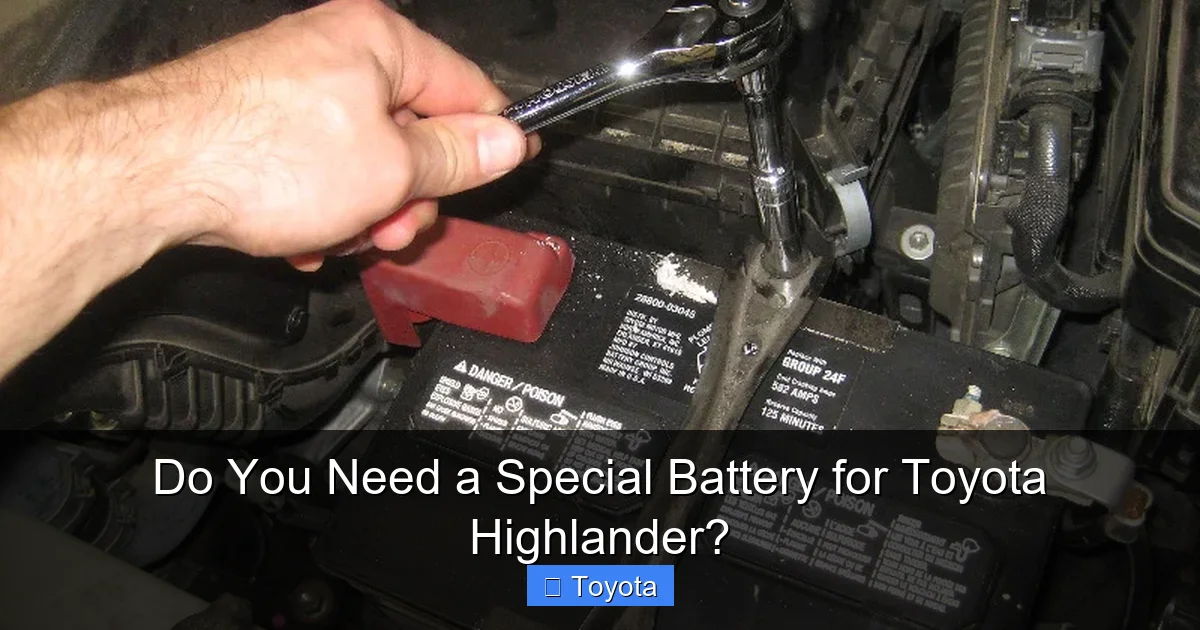
Always wear safety glasses and gloves. Use the correct size wrench (usually 10mm or 13mm) for the terminal nuts. The golden rule: disconnect the NEGATIVE (black, -) terminal FIRST. This prevents a accidental short circuit if your wrench touches metal while undoing the positive terminal. When installing the new battery, connect the POSITIVE (red, +) terminal FIRST, then the negative. This sequence minimizes the risk of a spark near the battery, which can emit hydrogen gas (though AGM batteries produce very little).
Secure Mounting and Clean Connections
Place the new battery firmly in the tray. It should not move or rock. Reinstall the hold-down clamp or bracket securely. A battery that isn’t strapped down can vibrate, crack its internal components, and fail prematurely. Before connecting terminals, inspect the cable ends. Clean any corrosion (white, crusty residue) with a battery terminal brush and a baking soda/water solution. A clean, tight connection is essential for good electrical flow and to prevent future starting problems.
The Critical Step for Start-Stop/AGM Systems: Re-Registration
Here’s the step many DIYers miss, and it’s vital. When you replace the battery in a Start-Stop equipped vehicle, the car’s computer (specifically, the battery management control module) needs to be told, “Hey, a new battery is here. It’s an AGM type with these characteristics. Please reset your learning and optimize the charging strategy for this new battery.” If you don’t do this:
- The system may continue to use the old charging profile designed for the degraded old battery, overcharging or undercharging the new one.
- The Start-Stop system may not function, constantly displaying a warning message.
- The battery’s lifespan will be significantly shortened.
This “re-registration” or “battery adaptation” process requires a compatible OBD2 scan tool. Basic code readers won’t cut it. You need a tool that can communicate with the vehicle’s body control module or battery management system. This is the single biggest reason why professional installation is highly recommended for Start-Stop Highlanders. A shop like a dealership or a reputable independent mechanic will have the necessary tool (e.g., a high-end Autel, Launch, or Toyota-specific Techstream) to perform this 2-minute procedure correctly. If you’re a dedicated DIYer with the right scan tool, follow the vehicle-specific procedure in the service manual. If not, budget for this professional step—it’s worth every penny to protect your $150-$250 battery investment.
Maintenance and Longevity: Getting the Most from Your Investment
You’ve installed the correct battery. How do you make sure it lasts 4, 5, or even 6 years as intended? A little attention goes a long way.
For AGM Batteries: No Water, But Still Needs Care
AGM batteries are “maintenance-free” in the sense you never add water. But they still need clean terminals. Check the terminals and cable ends for corrosion every 6 months. A thin coating of dielectric grease on the terminals after a clean connection can help prevent future corrosion. Ensure the battery is always securely mounted. Extreme heat is the enemy of all car batteries, so if you live in a very hot climate, consider a battery with a higher heat rating or ensure the battery tray shield is intact.
For All Batteries: The #1 Killer is Parasitic Drain
This is the small, constant electrical draw that happens when the car is off—powering the clock, radio presets, and the computer’s memory. A normal draw is about 20-50 milliamps. A faulty module or an aftermarket accessory (like a poorly wired dash cam or stereo) can cause a “parasitic drain” that will slowly but surely kill a battery, especially if the car sits for a week or more. If your battery dies repeatedly and you can’t find a reason (like leaving lights on), have a shop perform a parasitic drain test. For more on electrical system health, understanding other routine maintenance like transmission fluid changes is part of keeping your Highlander’s complex systems in harmony.
Charging: Use the Right Charger
If you ever need to charge the battery outside the car (with a trickle charger or maintainer), you must use a charger specifically rated for AGM batteries if you have one. AGM batteries require a different charging profile—often a slower, more controlled absorption stage—and using a standard charger can damage them. Many modern “smart” chargers have an AGM setting. When in doubt, use the AGM setting. For standard flooded batteries, a standard charger is fine.
Conclusion: Knowledge is Power (and a Working Battery)
So, do you need a special battery for your Toyota Highlander? The final, clear answer is: You need the *correct specification* battery, not a special brand. That specification is determined by your vehicle’s Group Size, required Cold Cranking Amps, and most importantly, whether it has a Start-Stop system (which mandates an AGM battery). Ignoring these specs is the fast track to being stranded with a clicking starter and a dashboard full of warnings.
The process is simple: 1) Open your owner’s manual. 2) Find the battery specification section. Note the Group Size, CCA, and type (AGM/Flooded). 3) Purchase a battery from a reputable brand that meets or exceeds those specs. 4) If you have Start-Stop, ensure the new battery is registered to the car’s computer using the proper scan tool—professional help is strongly advised for this step. 5) Enjoy reliable starts for years to come.
Your Toyota Highlander is a capable, reliable SUV. Giving it the right battery is one of the simplest and most fundamental ways to keep it that way. Don’t overcomplicate it with the myth of a “special” battery. Just get the right one, install it right, and you’re good to go. For more specific advice on your model year, resources like our guide on determining battery size for other Toyota models can provide a helpful cross-reference, as many specifications are shared across the Toyota lineup. And if you’re curious about other Highlander-specific features, like how that handy snow button works, we’ve got you covered there too. Drive safe and worry-free!
Frequently Asked Questions
Can I use a standard flooded battery if my Highlander has Start-Stop?
No. You should never use a standard flooded battery in a Highlander equipped with a factory Start-Stop system. The system is designed to work with an AGM battery’s fast charging and deep-cycle capabilities. A flooded battery will fail prematurely and the Start-Stop function will be disabled, displaying a warning on your dash.
How can I find out what battery my Highlander needs without the manual?
The easiest way is to look at the label on your current battery. It will state the Group Size (e.g., 24F), CCA rating, and type (AGM/Flooded). You can also use your Vehicle Identification Number (VIN) to look up the specification on most auto parts store websites or by calling a Toyota dealership’s parts department.
Is a more expensive battery always better?
Not necessarily “always,” but you often get what you pay for. A higher price usually means better materials, a more robust design, and a longer warranty. For an AGM battery in a Start-Stop Highlander, investing in a reputable brand (like Interstate, Odyssey, or the Toyota genuine part) is wise because the cost of a failure—being stranded and needing a tow—far outweighs the initial savings from a cheap battery.
Do I need to reset anything after changing the battery?
If your Highlander has a Start-Stop system, yes. The battery management system must be re-registered to recognize the new battery’s type and characteristics. This requires a professional scan tool. For models without Start-Stop, no special reset is typically needed, though you may need to reset radio presets or clock settings.
What happens if I install a battery with a higher CCA than specified?
Nothing negative. Installing a battery with a higher Cold Cranking Amps (CCA) rating than the minimum specified is perfectly safe and often beneficial. It will provide extra starting power, especially in very cold weather. The only consideration is physical size—it must still be the correct Group Size to fit in the tray.
How long should a new battery last in my Highlander?
A quality AGM battery in a Start-Stop Highlander should last 4-6 years under normal conditions. A standard flooded battery in a non-Start-Stop model might last 3-5 years. Lifespan is heavily influenced by driving habits (lots of short trips don’t allow full charging), climate (extreme heat kills batteries faster), and the overall health of the charging system. Regularly checking for corrosion and ensuring the battery is secure will also help maximize its life.