
Can You Put a Turbo on Any Car?

The short answer is no—you can’t put a turbo on just any car. While many engines can be modified, success depends on engine strength, cooling, fuel systems, and local laws. Always consult a professional to avoid engine damage and legal issues.
So, you’re dreaming of that distinctive turbo whistle and the surge of power that comes with it. You see turbocharged cars on the road and think, “Can I just put a turbo on my car?” It’s a fantastic question, and the allure of drastically increasing your engine’s output is powerful. But here’s the reality check: while the concept seems simple—bolt on a turbo and go fast—the actual process is a complex web of engineering, compatibility, and legality. The short, honest answer is that you cannot put a turbo on any car and expect it to work well, last long, or stay legal. Let’s break down exactly why, and what you really need to consider before even shopping for a turbo kit.
Key Takeaways
- Engine construction is critical: Cast iron blocks handle boost better than most aluminum engines; forged internals are ideal.
- The entire supporting system must be upgraded: Cooling, fuel delivery, and exhaust systems all need reinforcement to handle a turbo.
- Transmission and drivetrain stress increases dramatically: Stock components may fail quickly under added torque.
- Emissions and legality vary by region: Many modifications will fail inspections and make a car non-compliant with federal standards.
- Costs are often underestimated: A proper, reliable turbo kit with installation and tuning frequently exceeds $5,000.
- Professional tuning is non-negotiable: A poor tune can destroy an engine in minutes, making expert calibration essential.
- Resale value and warranty implications are real: Unapproved modifications typically void warranties and can deter future buyers.
📑 Table of Contents
- Understanding the Turbocharger: More Than Just a Power Adder
- Engine Compatibility: The Core Factor
- Supporting Systems: It’s Never Just the Turbo
- Legal and Emissions Considerations: The Invisible Barrier
- The Realities of Turbocharging Different Engine Types
- Professional Installation vs. DIY: Risks and Rewards
Understanding the Turbocharger: More Than Just a Power Adder
Before we talk about your car, let’s quickly understand what a turbocharger does. It’s essentially an air pump driven by your exhaust gases. It spins a turbine that compresses intake air, forcing more oxygen into the engine’s cylinders. More oxygen means you can burn more fuel, which creates more power. Sounds great! But this process generates immense heat and pressure that your engine was never designed to handle if it wasn’t built for it from the factory.
The Allure and the Hidden Cost
The appeal is obvious: a significant horsepower bump for a relatively small engine displacement. It’s like getting a free engine size increase. However, this “free” power comes with a massive hidden cost in terms of stress on every single component. You’re not just adding a part; you’re fundamentally changing the operating environment of your entire powertrain. A turbo isn’t a plug-and-play performance chip; it’s a major system modification that requires a symphony of supporting upgrades to work in harmony.
Engine Compatibility: The Core Factor
This is the most important section. Your engine’s physical construction is the first and biggest gatekeeper. Can you physically bolt a turbo manifold and downpipe to your engine? Sometimes yes, sometimes no. But physical fitment is only the very beginning.
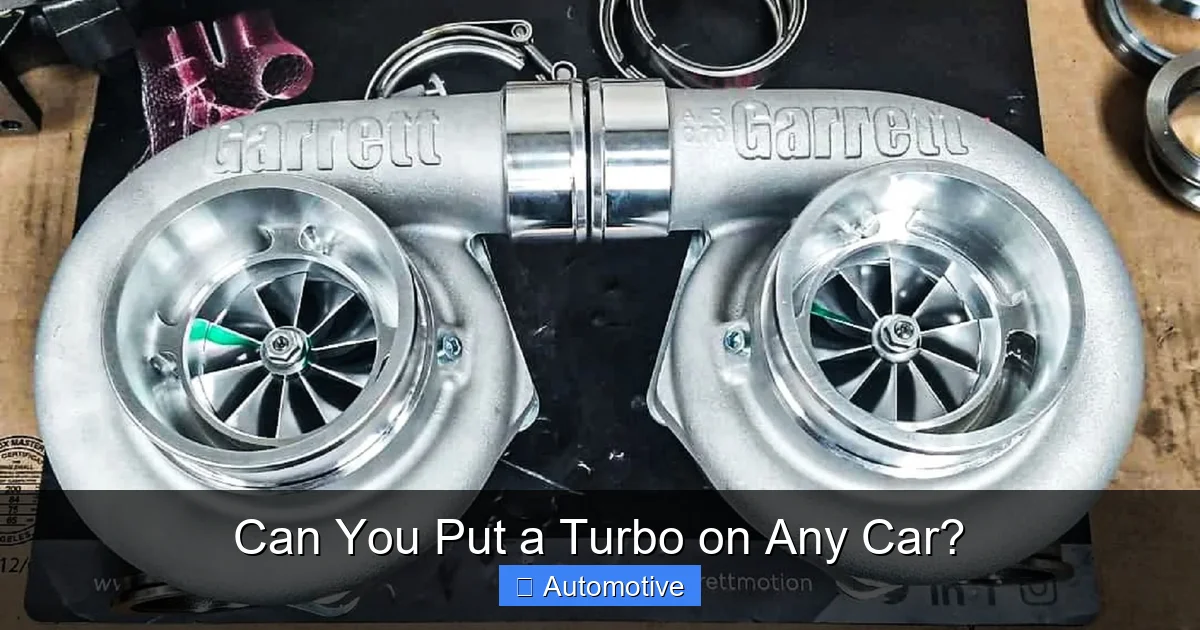
Visual guide about Can You Put a Turbo on Any Car?
Image source: motorbiscuit.com
Block and Head Material: Iron vs. Aluminum
This is the single biggest technical hurdle. Cast iron engine blocks are the gold standard for turbo applications. Iron is incredibly strong and can withstand the high cylinder pressures that boost creates. Engines like the Ford 5.0L Coyote V8 (in certain variants), the Toyota 2JZ-GTE, and the BMW B58 are famous for their iron blocks and turbo-friendly reputations.
Aluminum blocks are lighter but generally weaker. Many modern aluminum engines can handle mild boost (5-10 psi), but they are at a much higher risk of developing cracks in the cylinder walls or deck surface under prolonged stress. If your car has an all-aluminum engine, you must be extremely conservative with boost targets and have a professional evaluate its specific construction. Pushing too hard, too fast on an aluminum block is a recipe for a catastrophic and expensive failure.
Compression Ratio and Internal Strength
Compression ratio is another key metric. High-compression engines (like 10.5:1 or higher) are designed for efficiency on naturally aspirated (NA) power. When you add boost, you effectively raise the compression ratio even further, which can lead to dangerous pre-ignition (detonation) and engine knock. Lowering the compression ratio—usually by using thicker head gaskets or pistons with a dish—is often necessary for a reliable turbo setup on a high-compression NA engine.
Internally, the strength of your connecting rods, pistons, and crankshaft matters immensely. Forged internals (as opposed to cast or powdered metal) are significantly stronger and better handle the increased forces and heat. Many factory turbo engines come with forged or hypereutectic pistons and stronger rods. If your engine has cheap, cast internals, adding boost is like putting a race car engine in a economy car’s skeleton—it will eventually break.
Supporting Systems: It’s Never Just the Turbo
Let’s be clear: installing a turbocharger is not a single-part change. It’s a system-wide overhaul. Your stock components were engineered for a specific power level and thermal range. You are about to exceed both.
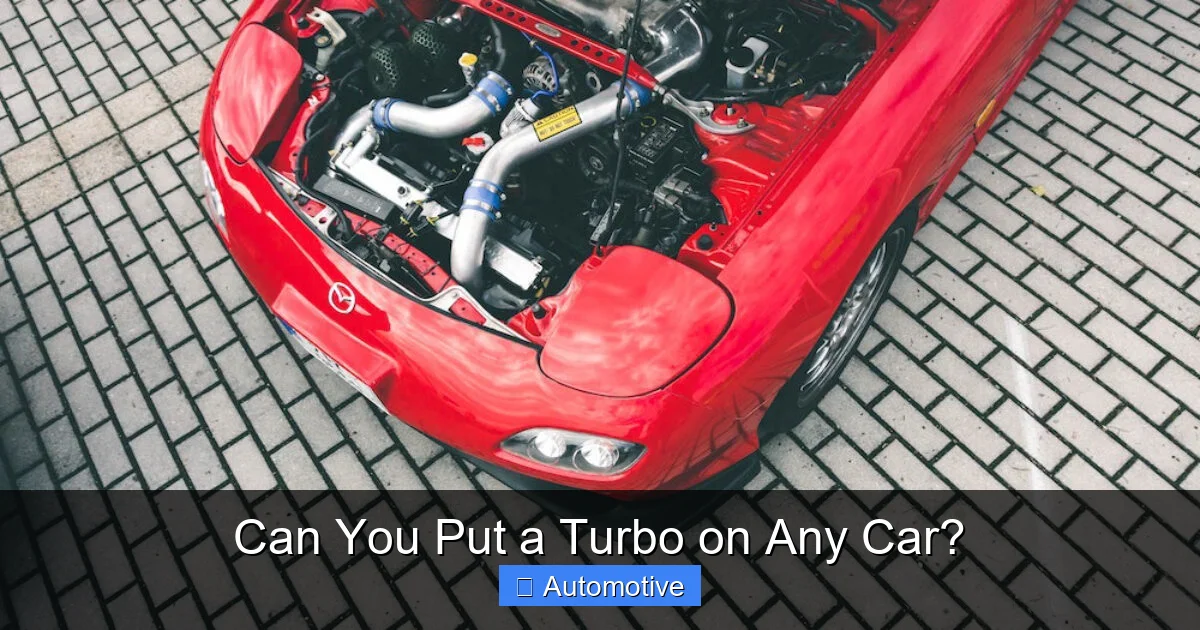
Visual guide about Can You Put a Turbo on Any Car?
Image source: motorverso.com
Fuel Delivery: You Need More Gasoline
More air means you need more fuel to keep the air-fuel ratio in the safe, powerful range (typically around 11.5:1 to 12.5:1 under full boost for gasoline). Your stock fuel injectors and fuel pump are sized for the factory horsepower. They will be completely overwhelmed. You will need larger injectors and almost certainly a higher-flow fuel pump. This might also require a return-style fuel system if your car uses a return-less setup. Skimping here leads to a lean condition, which is the #1 cause of melted pistons and blown head gaskets in turbo cars. For more on engine fluid requirements, understanding proper oil usage is equally critical, as discussed in guides like Can You Put Synthetic Oil In Any Car?, since turbo engines have stringent oil demands.
Cooling System: The Heat Problem
A turbocharger operates at extreme temperatures, often exceeding 1,000°F (538°C) in the turbine housing. This heat soaks into the engine bay. Your stock radiator and cooling system are now undersized. You will absolutely need a high-capacity radiator, possibly an oil cooler, and an efficient intercooler (the radiator for your compressed intake air). Without these, your engine will run hot, leading to detonation, warped heads, and premature failure. Managing this extra heat is a non-negotiable part of the build.
Exhaust and Intake: Breathing Room
Your stock exhaust manifold is likely a restrictive, heavy cast iron piece designed to reduce noise. A turbo requires a free-flowing turbo manifold to allow exhaust gases to spin the turbine quickly. You’ll also need a downpipe (often 3″ in diameter) to exit the turbo. On the intake side, you need a suitable intercooler piping setup and a high-flow air filter. Every restriction in this path hurts turbo spool time and maximum power.
Legal and Emissions Considerations: The Invisible Barrier
This is where many enthusiastic builders get a nasty surprise. You can build the most amazing turbo car in your garage, but you might not be able to legally drive it on public roads.
Visual guide about Can You Put a Turbo on Any Car?
Image source: motorverso.com
Emissions Testing and Smog Laws
In the United States, the EPA and state agencies (like California’s CARB) have strict rules. Any modification that alters or removes your factory catalytic converters, oxygen sensors, or exhaust gas recirculation (EGR) system will almost certainly cause your car to fail emissions testing. In California and several other states, even having a “check engine light” on (which a poorly tuned turbo will trigger) is an automatic fail. Some aftermarket turbo kits are even issued a CARB Executive Order number, making them legal for specific models in California. You must research your local laws before you start. This connects directly to vehicle reliability and inspections; a car with persistent issues, like a check engine light from a bad tune, can also face scrutiny when you try to sell it, as explained in articles about Can You Sell A Car With A Check Engine Light On?.
Warranty and Insurance Implications
Let’s be blunt: any non-factory turbo installation will void your vehicle’s powertrain warranty. Dealerships can and will deny warranty claims for any engine, transmission, or drivetrain failure if they can link it to an unapproved modification. Additionally, you must inform your insurance company of the major modification. Failing to do so could lead to a denied claim if you’re in an accident. Your premiums will likely increase significantly.
The Realities of Turbocharging Different Engine Types
Not all engines are created equal in the turbo world. The starting point dramatically changes the difficulty and risk.
Naturally Aspirated vs. Factory-Turbocharged
Converting a naturally aspirated engine to forced induction is the hardest path. You are starting from zero. You need everything: the turbo, manifold, fuel system, cooling, intercooler, piping, a custom exhaust, an engine management system (a standalone ECU or a piggyback), and likely internal engine work. It’s a full custom build. Adding a larger or more aggressive turbo to a factory-turbocharged engine is a much more straightforward path. The engine already has the internals, fuel, and cooling capacity for *some* boost. You’re just scaling up. The supporting systems are often already in place or require less drastic modification. Always know your starting point.
Diesel vs. Gasoline Engines
Diesel engines are inherently more turbo-friendly. They have incredibly strong blocks (often made of iron), lower compression ratios (for diesels), and handle boost naturally because they rely on compression ignition. Adding more boost to a diesel is a common and relatively simple power upgrade, often just requiring a larger turbo and more fuel. Gasoline engines are more sensitive. They have higher compression ratios and are more prone to detonation. The margin for error is much smaller, requiring precise tuning and stronger internals for reliable high-boost operation.
Professional Installation vs. DIY: Risks and Rewards
This is the final, crucial fork in the road. The “why” behind the “can you” is often about skill and tools.
The Importance of Tuning: The Heart of the System
The single most important part of any turbo build is the engine tune. This is the software that tells the engine’s computer (ECU) how much fuel to inject, how much ignition timing to use, and how to manage boost control under every possible condition. A bad tune will destroy an engine faster than any other single factor. It’s not something you guess at. You need a professional tuner with a dynamometer (dyno) and extensive experience with your specific engine. They will adjust the fuel maps, boost levels, and ignition timing to keep your engine safe and making power. This is why using the correct oil and other high-quality fluids is paramount; a tuned turbo engine operates at the absolute limit of its thermal and mechanical capacity.
Common Pitfalls to Avoid
The DIY path is filled with landmines. Using the wrong turbo size for your engine (too big = lag, too small = high exhaust temps). Forgetting to upgrade the clutch or transmission (they will slip or break). Neglecting to widen your fuel injector pulses, leading to a lean condition. Improper wastegate routing causing boost creep. Not sealing all charge-air piping connections, leading to dangerous boost leaks. Each of these mistakes can cause immediate failure or long-term damage. The complexity is why a turnkey professional installation, while expensive, is often the only responsible choice for a daily driver.
Conclusion: So, can you put a turbo on any car? Technically, you can bolt a turbo to the exhaust manifold of many engines. But should you? That’s a different question. The answer depends on a deep assessment of your engine’s inherent strength, your willingness and budget to upgrade every supporting system, your local emissions laws, and your access to professional tuning expertise. For a stock, modern, high-compression aluminum-block engine, the answer is very likely no without a full internal rebuild and a mountain of supporting mods. For an older, iron-block, simple design, the answer might be yes, but it will still be a major, costly project. Do not take this journey lightly. Research your specific engine, consult with reputable shops, and understand that you are signing up for a complex, expensive, and permanent modification. The goal is not just to add boost, but to add it safely, reliably, and legally.
Frequently Asked Questions
How much does it cost to turbocharge a car?
A proper, reliable turbo kit with all supporting modifications (fuel, cooling, exhaust, tuning) typically starts around $5,000 for a basic setup on a common platform and can easily exceed $15,000 for a high-performance or custom build. DIY can save on labor but requires significant expertise and tools.
What types of cars are best suited for adding a turbo?
The best candidates are older cars with cast iron engine blocks, lower factory compression ratios, and a strong afterparts community (e.g., Nissan 240SX, Mazda MX-5 Miata, Ford Mustang V8s, Toyota Supra/Mark IV). Factory-turbocharged cars looking for more power are also excellent candidates.
Will adding a turbo void my car’s warranty?
Absolutely yes. Any non-factory forced induction modification will void your powertrain warranty (engine, transmission, drivetrain). Dealerships can detect tuning and modifications during diagnostics.
Can I turbocharge a high-mileage engine?
It’s generally not advisable. High-mileage engines have wear on bearings, piston rings, and seals. Adding the extreme stress of boost will accelerate this wear and dramatically increase the chance of a catastrophic failure. A complete rebuild with forged internals is recommended before adding boost.
Do I need to rebuild my engine for a turbo?
It depends on the engine. For mild boost (under 10 psi) on a strong, low-mileage iron-block engine, a rebuild might not be immediately necessary but is highly recommended for longevity. For aluminum blocks, high-compression engines, or higher boost levels, a full rebuild with lower compression pistons, stronger rods, and improved head studs is essential for reliability.
Are turbocharged cars reliable long-term?
Factory-turbocharged cars, when properly maintained with high-quality synthetic oil and scheduled services, can be very reliable. However, aftermarket turbo setups place immense stress on components. Their long-term reliability is 100% dependent on the quality of the installation, the conservatism of the tune, and the diligence of maintenance. Poorly done, they are far less reliable than a stock engine.
