Correct Tire Pressure for Mazda 3

Contents
- 1 Key Takeaways
- 2 📑 Table of Contents
- 3 Why Correct Tire Pressure is Your Mazda 3’s Secret Weapon
- 4 Finding the Goldilocks Zone: Your Mazda 3’s Exact Recommended Pressure
- 5 Seasonal Swings: Why Your Pressure Changes and What to Do
- 6 Your Mazda 3’s TPMS: Friend, Not Foe
- 7 The Step-by-Step Guide to Checking and Adjusting Pressure
- 8 Common Pitfalls and Expert Myths Debunked
- 9 Conclusion: Your Simple Path to a Better Mazda 3
- 10 Frequently Asked Questions

Car Wireless Charger Mount

Anti Rust Spray

Car Sunshade for Windshield

Anti-Slip Dashboard Mat
Maintaining the correct tire pressure for your Mazda 3 is a non-negotiable aspect of safe, efficient, and enjoyable driving. For the 2026 model year, the standard recommended pressure typically ranges from 32 to 35 PSI, but this critical number varies by trim level, tire size, and load. Always verify the exact spec on your vehicle’s driver’s door jamb placard. Proper inflation enhances handling, maximizes fuel economy, prevents uneven tire wear, and ensures your Tire Pressure Monitoring System (TPMS) works correctly. Ignoring it risks blowouts, poor performance, and costly replacements.
Let’s talk about one of the simplest, most overlooked, and yet profoundly impactful maintenance tasks for your beloved Mazda 3: tire pressure. It’s not glamorous. It won’t make your engine roar louder. But getting the correct tire pressure for your Mazda 3 is absolutely fundamental to everything you love about the car—its sharp handling, its impressive fuel economy, its smooth and quiet ride. Think of it as the foundational tune-up that makes all the other upgrades and care worthwhile. In this complete guide for the 2026 model year, we’re going to demystify everything. We’ll find the exact numbers for your specific trim, explain why it changes with the seasons, decode your TPMS warning light, and give you the no-nonsense steps to check and adjust like a pro. By the end, you’ll know more about tire pressure than 99% of drivers on the road.
Key Takeaways
- The #1 Source is Your Door Jamb: Never guess. The manufacturer’s recommended cold tire pressure for your specific 2026 Mazda 3 is printed on a yellow and white sticker on the driver’s side door jamb or inside the fuel filler door.
- Pressure Varies by Trim and Tire: A base Mazda 3 Sport with 16-inch tires may call for 32 PSI, while a premium Carbon Edition with 18-inch performance tires might require 35 PSI. The spare tire (if equipped) has its own, usually much higher, specification.
- Check When Tires Are “Cold”: For an accurate reading, check pressure after the car has been parked for 3+ hours or driven less than 1-2 miles. Driving heats tires and air, giving falsely high readings.
- Seasonal Changes Matter: For every 10°F (5.5°C) drop in temperature, tire pressure decreases by about 1-2 PSI. You’ll need to add air in winter and may need to adjust slightly in summer.
- Your TPMS is a Warning System, Not a Maintenance Tool: The Mazda 3’s TPMS light illuminates when pressure is 25% or more below spec. It does not remind you for small, gradual losses that still harm performance and tire life.
- Proper Pressure Saves Money: Correctly inflated tires can improve fuel economy by up to 3%, extend tread life significantly, and prevent costly damage to suspension components from poor handling.
- Use a Quality Gauge: Invest in a reliable digital or dial tire pressure gauge. Gas station and keychain gauges are often inaccurate.
📑 Table of Contents
- Why Correct Tire Pressure is Your Mazda 3’s Secret Weapon
- Finding the Goldilocks Zone: Your Mazda 3’s Exact Recommended Pressure
- Seasonal Swings: Why Your Pressure Changes and What to Do
- Your Mazda 3’s TPMS: Friend, Not Foe
- The Step-by-Step Guide to Checking and Adjusting Pressure
- Common Pitfalls and Expert Myths Debunked
- Conclusion: Your Simple Path to a Better Mazda 3
Why Correct Tire Pressure is Your Mazda 3’s Secret Weapon
Before we dive into the numbers, let’s understand the “why.” Why does a few PSI matter so much? It comes down to three core pillars: safety, performance, and economics.
The Safety Imperative
Your tires are your only connection to the road. Their ability to grip, brake, and steer depends entirely on the correct contact patch—the part of the tire actually touching the asphalt. Under-inflated tires flex excessively, overheating the sidewalls and tread. This drastically increases the risk of a blowout, especially at highway speeds or during sudden maneuvers. They also have sluggish, mushy steering response, increasing stopping distances. Over-inflated tires, conversely, become overly stiff, reducing the contact patch to a narrow band in the center. This leads to a harsh ride, poor traction on wet surfaces (as the edges can’t splay to channel water), and a tendency to skid or lose control on slippery roads. For a car like the Mazda 3, celebrated for its agile handling, incorrect pressure completely neuters that driver-focused character, making it feel vague and unresponsive.
The Performance & Economy Engine
Rolling resistance is the enemy of fuel economy. An under-inflated tire has more surface area touching the road, creating more friction and drag. The Mazda 3’s efficient Skyactiv engine has to work harder to overcome this, burning more fuel. The U.S. Department of Energy estimates that for every 1 PSI drop below the recommended pressure, fuel economy decreases by about 0.2%. That might not sound like much, but over a year, it adds up to significant extra costs at the pump. On the flip side, over-inflation causes uneven wear, with the center of the tread wearing down much faster than the edges. You’ll be buying new tires sooner than necessary, a cost that stings. Correct pressure ensures even tread wear, maximizing the lifespan of your investment.
The Ride Quality and Comfort Factor
The Mazda 3 is designed to be a refined, comfortable commuter. The wrong tire pressure turns it into a bone-jarring experience or a floaty, unsecure one. Over-inflation transmits every road imperfection directly into the cabin. Under-inflation makes the car feel “wallowy” and slow to respond to steering inputs. The correct pressure is the sweet spot Mazda’s engineers calibrated for, balancing comfort, noise suppression, and precise handling.
Finding the Goldilocks Zone: Your Mazda 3’s Exact Recommended Pressure
Here is the most critical rule: There is no single universal “correct tire pressure for all Mazda 3s.” The 2026 model year continues this tradition. The pressure is determined by the specific tire size and model variant. Your definitive source is the factory placard.
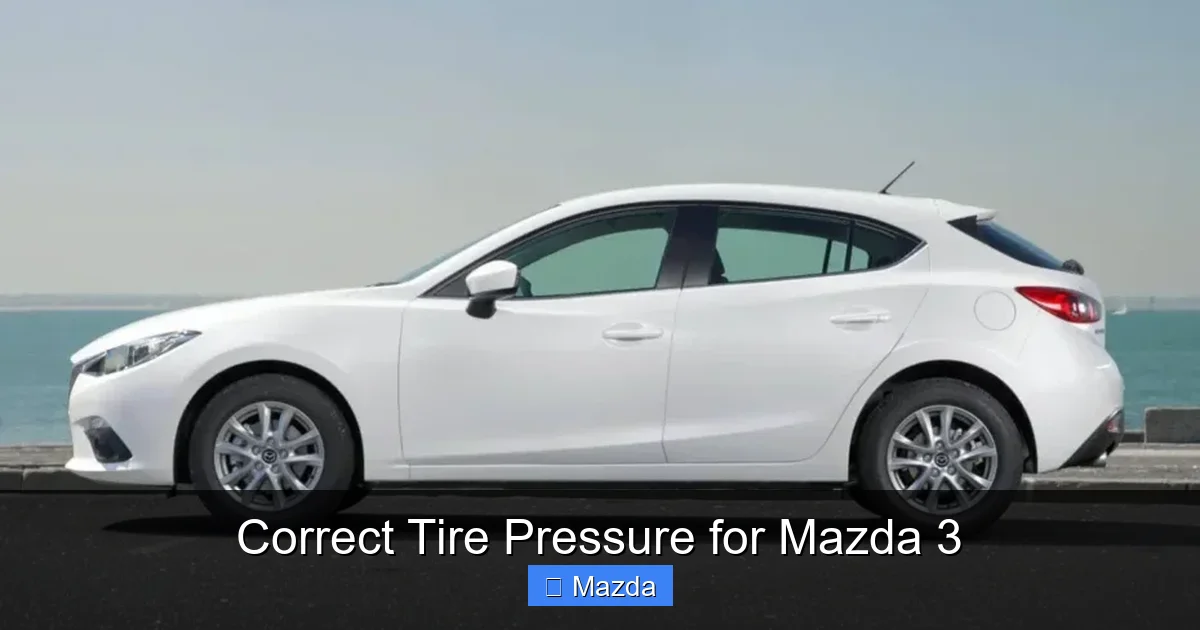
Visual guide about Correct Tire Pressure for Mazda 3
Image source: size-tire.com
Locating Your Manufacturer’s Sticker
Forget the internet, forget your friend’s advice. Your car has the answer physically attached to it. Open the driver’s side door. Look at the door jamb—the pillar you latch the door to. You’ll find a yellow and white sticker, usually near the bottom. It will list pressures for the front and rear tires, often separately. Sometimes it’s on the inside of the fuel filler door. This sticker is the law for your specific vehicle. It accounts for the weight distribution and design of your exact trim.
Decoding the 2026 Mazda 3 Placard
For the 2026 Mazda 3, common configurations you’ll see on the placard are:
- For standard all-season tires (e.g., 205/60R16 on base Sport trims): Typically 32 PSI (220 kPa) front and rear.
- For larger all-season or performance tires (e.g., 215/45R18 on Premium, Carbon, or Turbo trims): Often 35 PSI (240 kPa) front and rear.
- For the Temporary Spare Tire: This is almost always much higher, commonly 60 PSI (415 kPa). This is normal and necessary for the small, compact spare to function safely. Never inflate your regular tires to this pressure.
Key Note: The placard pressure is for “cold” tires. “Cold” means the vehicle has been stationary for at least 3 hours or driven less than 1-2 miles. Driving even a short distance warms the tires and air inside, increasing pressure by a few PSI. If you check hot, you’ll get a falsely high reading. Always adjust when cold.
What About Load? The “Plus” Pressure
The placard lists the standard pressure. If your Mazda 3 is fully loaded with passengers and cargo (e.g., a road trip), Mazda often recommends a “plus” pressure—usually an additional 3-4 PSI above the standard—for the rear tires to handle the extra load. Check your owner’s manual for the specific “maximum load” chart. This is a common oversight that leads to premature rear tire wear when carrying heavy loads regularly.
Seasonal Swings: Why Your Pressure Changes and What to Do
Air is a gas. It expands when hot and contracts when cold. This fundamental physics principle means your tire pressure is not a “set it and forget it” number. It’s a dynamic value that needs seasonal attention.

Visual guide about Correct Tire Pressure for Mazda 3
Image source: i.redd.it
The Temperature Equation
A good rule of thumb: for every 10°F (5.5°C) drop in ambient temperature, your tire pressure will decrease by approximately 1-2 PSI. So if you set your tires to 32 PSI on a 70°F fall day, and a frigid 20°F winter morning arrives, your pressure could have dropped to 28-29 PSI without you adding or losing any air. This is why your TPMS light often comes on in the early morning during a cold snap. The air inside the tire has simply condensed. As you drive and the tires warm up, the pressure and light may turn off, but the underlying under-inflation while cold still causes damage.
Winter: The Critical Adjustment Period
In cold climates, you should check your tire pressure at least once a month during winter. You will likely need to add air to bring it back to the placard’s cold pressure specification. Do not intentionally over-inflate beyond the placard spec for winter; the temperature will naturally increase pressure as it warms during driving. For dedicated winter tires, the recommended pressure is often the same as for all-season tires, but always confirm on your placard, as some manufacturers specify a slight increase (1-2 PSI) for winter tire sets to compensate for their typically softer rubber compounds. For a deep dive into seasonal strategy, our guide on best tire pressure for winter covers the nuances for various conditions.
Summer: Don’t Ignore the Heat
Summer heat can cause pressure to rise significantly. If you check hot tires, the reading might be 3-5 PSI above the cold spec. The temptation is to let air out, but that’s a mistake. The correct procedure is to check and adjust when the tires are cold. If your pressure is within 1-2 PSI of the spec when cold, it’s fine. The hot increase is normal. However, consistently driving with pressure 5+ PSI over spec (checked cold) will lead to a harsh ride, poor traction, and center-tread wear.
Your Mazda 3’s TPMS: Friend, Not Foe
Since 2007, all vehicles, including your Mazda 3, have come equipped with a Tire Pressure Monitoring System (TPMS). It’s a fantastic safety feature, but it’s crucial to understand its limitations.
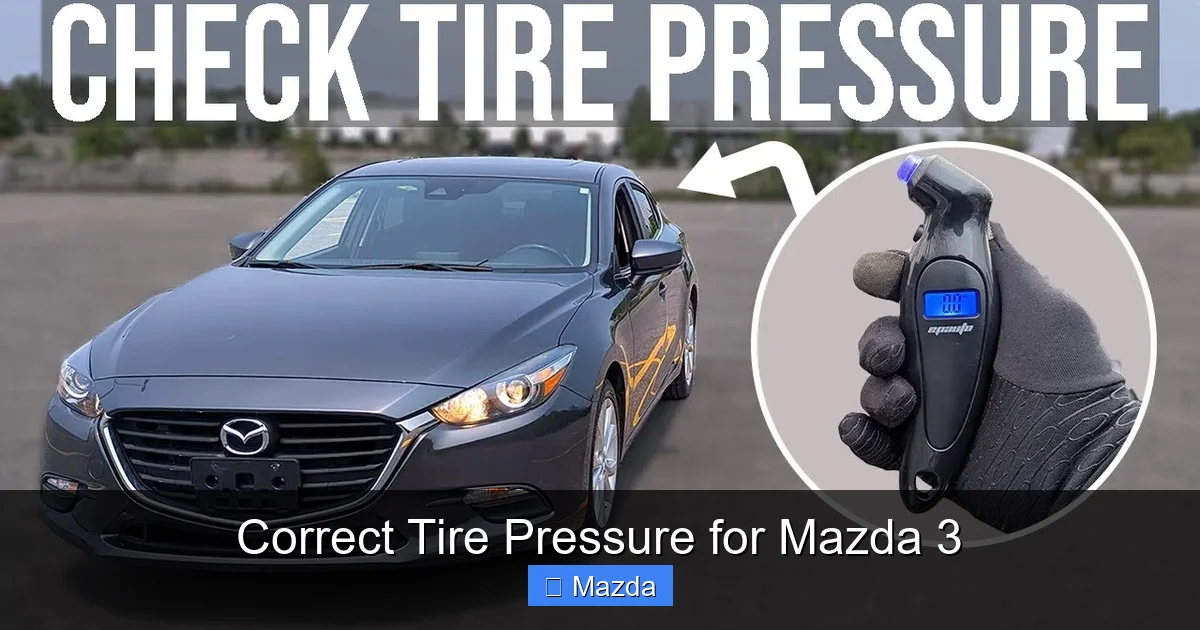
Visual guide about Correct Tire Pressure for Mazda 3
Image source: i.ytimg.com
How Direct TPMS Works in Your Mazda 3
The 2026 Mazda 3 uses a direct TPMS. This means each wheel has a small electronic sensor mounted inside the valve stem. It constantly measures the air pressure and temperature, transmitting that data to your car’s computer. If any sensor reads 25% or more below the manufacturer’s recommended pressure, the low tire pressure warning light—a yellow horseshoe with an exclamation point—will illuminate on your dashboard. Some models may also tell you which specific tire is low.
Why You Should NOT Wait for the Light
This is the most important TPMS fact: the light comes on when pressure is critically low, not when it’s simply sub-optimal. By the time the light illuminates, you’ve already lost significant fuel economy, caused premature tire wear, and degraded handling. The system is a last-resort warning, not a maintenance reminder. You should be checking pressures manually once a month and before long trips, regardless of the TPMS status.
When the Light Comes On: Troubleshooting
If your TPMS light is on steady:
- Check all four tires with a gauge and inflate to the placard spec.
- The light should turn off automatically after driving a few minutes once the sensors read correct pressure.
If the light flashes for 30-60 seconds upon startup then stays on, it indicates a system fault (e.g., a dead sensor battery, which lasts 7-10 years). This requires diagnostic scanning by a professional. If you’ve recently rotated tires or changed them, you may need to perform a TPMS reset procedure. The process varies by model year; your owner’s manual will have the exact steps, which often involve a drive cycle or using the vehicle’s infotainment menu. For general reset principles that often apply, resources on how to reset tire pressure light can provide a conceptual understanding, but always defer to your Mazda-specific manual.
The Step-by-Step Guide to Checking and Adjusting Pressure
Now, let’s get our hands dirty. This is a 5-minute task that pays massive dividends.
Gather Your Tools
You need two things: 1) A reliable tire pressure gauge (digital is easiest and most accurate for beginners), and 2) An air compressor. This can be a home garage compressor, a portable 12V unit you keep in the trunk, or the paid compressor at a gas station (be aware station gauges are often inaccurate).
The Perfect Procedure
- Cold Check: Ensure your Mazda 3 has been parked for at least 3 hours or driven less than a mile.
- Remove the Valve Cap: Unscrew the small plastic cap from the valve stem on one tire. Keep it safe in your pocket.
- Press the Gauge On: Firmly press the gauge’s nozzle onto the valve stem. You should hear a brief hiss of air. Hold it straight and steady. The gauge will display the pressure. Note it down.
- Repeat for All Four Tires: Do not assume they are equal. Check the spare as well if it’s a full-size tire.
- Compare to Placard: Compare your readings to the spec on your door jamb sticker.
- Adjust:
- If Low: Connect the air hose. Add air in short bursts, checking your gauge frequently. It’s easy to over-inflate. Aim for the exact number.
- If High: Press the small metal nib in the center of the valve stem (you’ll hear air hiss out) to release pressure, or use your gauge’s bleed valve if it has one. Check frequently.
- Replace Valve Caps: Screw the plastic caps back on tightly. They keep dirt and moisture out of the valve core.
- Final Check: Re-check all tires after adjusting to ensure they are all equal and to spec.
Pro Tip: Many modern Mazda 3s have a tire pressure display in the infotainment system that shows the real-time PSI for each wheel. This is convenient, but it’s still wise to verify with your own physical gauge periodically, as the sensor itself could be faulty.
Common Pitfalls and Expert Myths Debunked
Even with the best intentions, mistakes happen. Let’s clear up the confusion.
Myth: The Sidewall Number is the Correct Pressure
FALSE. The large number molded into the tire’s sidewall is the maximum pressure that tire can *safely hold*, not the pressure your Mazda 3 *requires*. That number is for the tire in a generic sense. Your car’s placard pressure is always equal to or lower than the sidewall max. Always follow the door jamb.
Myth: I Should Inflate to the TPMS “Reset” Pressure
FALSE. Some people think they should inflate tires to a pressure that makes the TPMS light go off. This is dangerous. The light turning off only means pressure is above the 25% threshold. It could still be several PSI below the optimal placard pressure. Always inflate to the placard spec, not to a TPMS benchmark.
Pitfall: Ignoring the Spare Tire
That compact spare in your trunk is often forgotten. It should be checked annually and inflated to its specific (much higher) pressure, usually 60 PSI. A flat spare is a useless spare. If you use it, remember it has limited speed and range (often 50 mph/70 km/h and 70 miles/112 km).
Pitfall: Using “Tire Sealer” or “Fix-a-Flat” on a TPMS Sensor
These liquid sealants can damage the sensitive TPMS sensor by clogging it. If you have a slow leak and must use a temporary sealant, you will likely need to replace the sensor afterward. It’s better to use a plug or have a professional repair the tire.
Pitfall: Not Replacing Sensor Batteries
TPMS sensor batteries last 7-10 years and are not serviceable. When they die, the sensor must be replaced. If your TPMS light is flashing and all tires are correctly inflated, it’s often a sign of a dead battery in one or more sensors.
Conclusion: Your Simple Path to a Better Mazda 3
Mastering tire pressure is one of the highest-return, lowest-cost investments you can make in your Mazda 3. It directly translates to a safer, more fun, and more economical driving experience. The routine is beautifully simple: once a month, and whenever there’s a major temperature swing, grab your gauge, check all four tires when cold, and adjust to the exact number on your door jamb sticker. Don’t let the TPMS light be your only reminder. By taking this proactive step, you honor the engineering brilliance of your Mazda 3, protect your wallet from wasted fuel and premature tire wear, and ensure that every journey—whether a daily commute or a weekend twisty-road adventure—is as precise, secure, and enjoyable as Mazda intended. It’s a five-minute habit that pays for itself every single time you drive.
Frequently Asked Questions
What is the exact tire pressure for a 2026 Mazda 3?
There is no single number. The correct cold tire pressure for your 2026 Mazda 3 is found on a sticker on the driver’s door jamb. It typically ranges from 32 PSI for base models with 16-inch tires to 35 PSI for higher trims with 18-inch tires. Always use the placard specification for your specific vehicle.
How often should I check the tire pressure on my Mazda 3?
You should manually check all four tires with a gauge at least once a month and before any long trip. Seasonal temperature changes can cause pressure to drop, so be extra vigilant in fall and winter. Do not rely solely on your TPMS light.
My TPMS light is on, but my tires look fine. What do I do?
First, use a physical gauge to check the pressure in all four tires against the placard spec on your door jamb. If any are low, inflate them to the correct pressure. The light should turn off after a few minutes of driving. If all tires are at the correct pressure and the light remains on or flashes, it indicates a TPMS system fault that requires professional diagnosis.
Can I use the pressure number printed on the tire’s sidewall?
No. That number is the maximum pressure the tire can safely hold, not the pressure your Mazda 3 requires. Always inflate to the vehicle manufacturer’s recommendation on the door jamb sticker, which is always equal to or lower than the tire’s sidewall maximum.
Why does my tire pressure drop so much in winter?
For every 10°F (5.5°C) drop in temperature, tire pressure decreases by about 1-2 PSI due to air contracting. This is normal physics. You must add air to bring the pressure back to the placard’s cold specification. Check pressures frequently during cold months.
Do I need to adjust pressure for a fully loaded Mazda 3?
Yes, if you are carrying a full load of passengers and cargo, consult your owner’s manual. Mazda often recommends increasing the rear tire pressure by 3-4 PSI above the standard placard pressure to handle the extra weight and prevent excessive sidewall flex.