Can the Jeep Renegade Be Flat Towed?

Contents
- 1 Key Takeaways
- 2 📑 Table of Contents
- 3 Introduction to Flat Towing and the Jeep Renegade
- 4 Jeep Renegade Towing Capabilities by Model Year and Transmission
- 5 Official Jeep Guidelines and Warranty Implications
- 6 How to Safely Flat Tow a Jeep Renegade (If Applicable)
- 7 Common Mistakes and Pitfalls to Avoid
- 8 Alternatives to Flat Towing for the Jeep Renegade
- 9 Conclusion: Making the Right Choice for Your Jeep Renegade
- 10 Frequently Asked Questions

Tire Pressure Monitoring System (TPMS)

Car Sunshade for Windshield

Rear View Camera

Car Dent Repair Kit
Flat towing a Jeep Renegade depends heavily on model year and transmission type; manual versions may permit it with precautions, while automatics usually require modifications like a lubrication pump. Always consult your owner’s manual, as improper flat towing risks severe transmission damage and warranty voidance. Prioritize safety with proper equipment and professional advice to protect your investment.
Key Takeaways
- Model Year and Transmission are Critical: Jeep Renegades with manual transmissions from earlier years might be flat towable in neutral, but most automatic models cannot without aftermarket modifications.
- Transmission Lubrication is Essential: Automatic transmissions need a lubrication pump during flat towing to circulate fluid and prevent catastrophic damage, as they aren’t designed to spin while in neutral.
- Warranty Can Be Voided: Jeep’s warranty may not cover repairs if flat towing contradicts official recommendations in your owner’s manual, leading to costly out-of-pocket expenses.
- Jeep’s Official Stance is Cautious: Fiat Chrysler Automobiles (FCA) generally advises against flat towing for Renegades, emphasizing trailer or dolly use instead for most configurations.
- Safety Equipment is Non-Negotiable: Use a certified tow bar, supplemental braking system, and proper lighting to ensure safe towing and comply with traffic laws across states.
- Alternatives are Often Safer: For automatic Renegades, consider a full trailer or tow dolly to avoid transmission risks, especially for long distances or frequent towing.
- Professional Consultation is Key: Always verify with a Jeep dealership or certified mechanic before flat towing, as guidelines can vary by region and specific vehicle setup.
📑 Table of Contents
- Introduction to Flat Towing and the Jeep Renegade
- Jeep Renegade Towing Capabilities by Model Year and Transmission
- Official Jeep Guidelines and Warranty Implications
- How to Safely Flat Tow a Jeep Renegade (If Applicable)
- Common Mistakes and Pitfalls to Avoid
- Alternatives to Flat Towing for the Jeep Renegade
- Conclusion: Making the Right Choice for Your Jeep Renegade
Introduction to Flat Towing and the Jeep Renegade
Flat towing, also known as “dinghy towing,” is a popular method for RV enthusiasts, travelers, and anyone needing to transport a vehicle behind another without using a trailer. It involves towing all four wheels on the ground, which seems convenient but comes with significant mechanical considerations. For Jeep Renegade owners, the question “Can the Jeep Renegade be flat towed?” is a common one, given the Renegade’s compact size and adventure-oriented branding. However, the answer isn’t straightforward—it hinges on factors like model year, transmission type, and manufacturer guidelines. In this comprehensive guide, we’ll dive deep into the specifics of flat towing a Jeep Renegade, covering everything from official recommendations to practical steps and risks. Whether you’re planning a cross-country trip with your RV or just need to move your Renegade, understanding these details is crucial to avoid expensive repairs and stay safe on the road.
First, let’s clarify what flat towing entails. Unlike using a tow dolly (which lifts the front wheels) or a full trailer (which carries all wheels), flat towing keeps all tires on the pavement. This method is efficient for fuel economy and ease of setup but puts stress on the drivetrain, particularly the transmission. Vehicles not designed for this can suffer irreversible damage if towed incorrectly. The Jeep Renegade, with its unibody construction and front-wheel-drive-based platforms (except some Trailhawk models with AWD), presents unique challenges. Over the years, Jeep has offered both manual and automatic transmissions, and their suitability for flat towing varies widely. We’ll explore these nuances in detail, helping you make an informed decision for your specific Jeep Renegade.
Jeep Renegade Towing Capabilities by Model Year and Transmission
To determine if your Jeep Renegade can be flat towed, you must first identify its model year and transmission type. The Renegade has been in production since 2015, with updates in 2019 and 2022. Transmission options have included a 6-speed manual (available on base trims like Sport and Latitude in early years) and a 9-speed automatic (standard on most models, including Trailhawk AWD). These differences are pivotal because manual transmissions are often more tolerant of flat towing when shifted into neutral, while automatics typically require additional lubrication to prevent wear.

Visual guide about Can the Jeep Renegade Be Flat Towed?
Image source: jeepmodified.com
Manual Transmission Models: A Closer Look
For Jeep Renegades equipped with a manual transmission—primarily from 2015 to 2018 in the U.S. market—flat towing is theoretically possible under specific conditions. Manual gearboxes don’t rely on a torque converter or complex valve bodies that can overheat when spun without engine-driven lubrication. When placed in neutral, the transmission disengages from the engine, allowing the wheels to turn without transferring power. However, this doesn’t mean it’s always safe. Jeep’s official documentation for early Renegades is sparse, but owner experiences and forums suggest that manual models might be flat towed for short distances at moderate speeds (typically under 50 mph) without issues. Still, precautions like disconnecting the battery to prevent electrical drain and ensuring the steering wheel is unlocked (for models with electric power steering) are recommended. It’s vital to check your specific owner’s manual, as some manual-transmission Renegades may have restrictions based on drivetrain configuration, such as front-wheel-drive versus all-wheel-drive. AWD systems with manual transmissions are rare and may involve additional complexities like transfer cases that need attention.
For example, a 2016 Jeep Renegade Sport with a 6-speed manual and front-wheel drive could likely be flat towed if the owner follows best practices. But even then, prolonged towing or high speeds might cause bearing wear in the transmission or differential. Always start with short test runs to monitor for unusual noises or vibrations. If you own a newer manual Renegade (post-2018), note that Jeep phased out manuals in many markets, so availability is limited. In Europe, manual Renegades persisted longer, but U.S. buyers mostly faced automatics after 2018.
Automatic Transmission Models: The Challenge
The vast majority of Jeep Renegades on the road today have the 9-speed automatic transmission, and this is where flat towing becomes problematic. Automatic transmissions are not designed to be towed with all wheels on the ground because they rely on the engine’s oil pump to circulate fluid through the valve body and torque converter. When the engine is off during flat towing, the transmission lacks lubrication, leading to metal-on-metal contact, overheating, and eventual failure—often within just a few miles. This risk applies to both front-wheel-drive and AWD Renegades with automatics, though AWD versions add complexity with transfer case lubrication.
Jeep explicitly states in owner’s manuals for automatic Renegades that flat towing is not recommended. For instance, the 2020 Jeep Renegade manual warns: “Flat towing this vehicle is not recommended. Towing this vehicle incorrectly can cause damage to the transmission.” Similar language appears across years. Some owners attempt workarounds, such as removing the drive shafts or using a transmission lubrication pump, but these are aftermarket solutions that void warranties if not approved by Jeep. A lubrication pump, which runs off the tow vehicle’s power, forces transmission fluid through the system during tow. While this can mitigate damage, it’s expensive (costing $500-$2,000 installed) and requires professional installation to ensure compatibility. Even with a pump, speed and distance limits often apply—typically under 50 mph and 50 miles—to avoid overheating.
It’s also worth noting that the Jeep Renegade’s towing capacity for trailer use is modest, around 1,500-3,500 pounds depending on engine and configuration. For context, if you’re comparing to other vehicles, our article on how a Nissan Frontier can be flat towed highlights that some trucks with specific transmissions allow it, but the Renegade’s car-based platform makes it less suited. Similarly, Subaru’s flat towing guidelines vary by model, but many also caution against it for automatics, emphasizing the need for manufacturer approval.
Official Jeep Guidelines and Warranty Implications
When considering flat towing your Jeep Renegade, the first step is always to consult the official owner’s manual. Jeep’s stance has been consistent: for most Renegade models, especially those with automatic transmissions, flat towing is not approved. The manual for a 2019 Jeep Renegade, for example, states: “Do not flat tow this vehicle. Towing this vehicle with all four wheels on the ground can result in damage to the transmission.” This warning is clear and should not be ignored. For manual transmission versions, the manual might be less explicit but still advises caution, often recommending trailer towing as the only safe method for long distances.

Visual guide about Can the Jeep Renegade Be Flat Towed?
Image source: adventurejeep.com
Deciphering the Owner’s Manual
Owner’s manuals can be vague, so look for sections titled “Towing,” “Recreational Towing,” or “Dinghy Towing.” In Jeep Renegade manuals, you’ll typically find a table outlining approved towing methods. For instance, the 2017 manual lists “Flat Towing (All Wheels On Ground)” as “Not Recommended” for all trims. If your manual says “Not Recommended,” it means Jeep has not tested or endorsed the practice, and doing so risks voiding your warranty. Sometimes, manuals specify conditions like “only with manual transmission in neutral,” but for Renegades, such allowances are rare. Always cross-reference with the warranty booklet, which often excludes damage from improper towing.
If you’ve lost your manual, Jeep offers digital copies on their website, or you can call customer service with your VIN for clarification. Providing the exact model year, engine size, and transmission type is essential, as guidelines can change mid-production. For example, a 2015 Renegade with a 2.4L engine and manual transmission might have different notes than a 2018 model with the same setup due to minor engineering updates.
Warranty Voidance: What You Need to Know
Your Jeep Renegade’s warranty, typically 3 years/36,000 miles or 5 years/60,000 miles for powertrain, covers defects in materials and workmanship. However, it does not cover damage from misuse or neglect. If you flat tow an automatic Renegade and the transmission fails, Jeep will likely deny warranty coverage, citing the owner’s manual warning. This can leave you with bills exceeding $5,000 for a new transmission. Even with a manual transmission, if you exceed speed or distance limits (even if not explicitly stated), warranty claims might be challenged.
Proving misuse can be straightforward for Jeep: a simple inspection might reveal wear patterns consistent with towing without lubrication. To protect yourself, document any modifications (like a lubrication pump) with receipts and have them installed by a certified shop. Some aftermarket pump systems come with their own warranties, but these don’t override Jeep’s policy. In practice, many Renegade owners who flat tow automatics do so at their own risk, accepting the financial gamble. For peace of mind, sticking to manufacturer-approved methods is wise. If you’re set on flat towing, consider a Jeep model explicitly designed for it, like the Wrangler, which has a removable front axle and is famously flat towable. Our article on Jeep Renegade towing capacity also discusses trailer towing limits, which are safer alternatives.
How to Safely Flat Tow a Jeep Renegade (If Applicable)
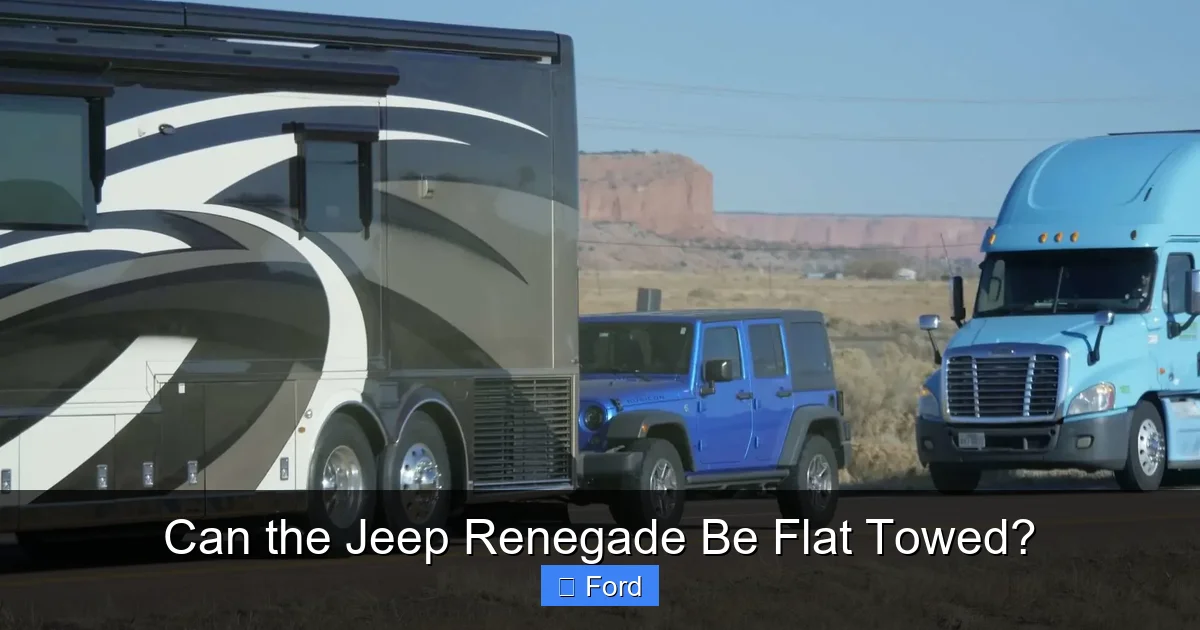
Assuming you’ve confirmed that your Jeep Renegade’s manual and model year allow for flat towing—likely only for certain manual transmission variants—the next step is to execute it correctly. Safety is paramount, as improper setup can lead to accidents, vehicle damage, or legal issues. Here’s a step-by-step guide based on best practices for flat towable vehicles, tailored to the Renegade’s specifics.
Visual guide about Can the Jeep Renegade Be Flat Towed?
Image source: vehiclers.com
Pre-Tow Checklist: Preparation is Everything
Before hitting the road, complete these checks:
- Transmission and Fluid Levels: For manual models, ensure the transmission is in neutral and fluid is at the recommended level. For automatics, if you’ve installed a lubrication pump, test it thoroughly. Never tow an automatic without a pump unless the manual explicitly says it’s safe (which it rarely does for Renegades).
- Steering and Battery: Disconnect the negative battery terminal to prevent drain and avoid electrical system interference. For Renegades with electric power steering, ensure the steering wheel can turn freely; some models require a key in the “on” position to unlock steering, but this can drain the battery—use a battery minder or disconnect as mentioned.
- Tire Pressure and Condition: Inflate all tires to the vehicle’s recommended pressure (found on the driver’s door jamb sticker) and check for wear. Underinflated tires can overheat during towing.
- Tow Bar and Hitch Installation: Use a Class II or III hitch rated for your Renegade’s weight. Install a tow bar that connects to the Renegade’s reinforced tow points—usually under the front bumper. Avoid universal tow bars that might damage body panels. Have it professionally installed to ensure alignment.
- Supplemental Braking System: Many states require a braking system for towed vehicles over a certain weight (often 1,500-3,000 lbs). The Jeep Renegade weighs around 3,200-4,000 lbs, so a system like a ReadyBrake or Blue Ox is necessary. This activates the Renegade’s brakes when the tow vehicle brakes, reducing wear on the tow vehicle and improving safety.
- Lights and Wiring: Connect the Renegade’s tail lights to the tow vehicle’s system using a diode kit or wiring harness. This ensures brake lights, turn signals, and running lights work同步ly, complying with traffic laws.
During the Tow: Driving and Monitoring
Once on the road, adhere to these practices:
- Speed Limits: Keep speeds low, ideally under 50 mph, to reduce stress on the drivetrain and tires. Higher speeds increase heat and wear, especially for manual transmissions without dedicated lubrication.
- Distance Restrictions: For manual Renegades without modifications, limit towing to short distances (under 50 miles). If using a lubrication pump for an automatic, follow the pump manufacturer’s guidelines—often similar limits.
- Regular Stops: Every 50-100 miles, stop to check the Renegade’s tires, lights, and hitch connections. Look for signs of overheating (e.g., burning smell from transmission area) or unusual noises.
- Avoid Tight Turns: Sharp turns can cause the towed vehicle to “cut in” and hit the tow vehicle. Use wide turns and practice in an empty parking lot first. The Renegade’s steering lock-to-lock is moderate, so be cautious.
- Weather Considerations: Towing in extreme heat or cold exacerbates transmission issues. In hot weather, fluid can break down faster; in cold, it may not circulate well. Plan accordingly.
Post-Tow Procedures
After towing, don’t just drive off:
- Reconnect the Battery: If disconnected, reconnect and check for any error codes on the dashboard.
- Inspect Fluids: For manual transmissions, check fluid level and condition; for automatics with pumps, ensure no leaks occurred.
- Test Drive: Take a short drive to listen for grinding, whining, or shifting issues. If anything seems off, have a mechanic inspect immediately.
- Document Everything: Keep a log of towing distances and conditions. This can help with warranty claims or future troubleshooting.
Remember, even with perfect execution, flat towing a Jeep Renegade—especially an automatic—remains a risk. For those with AWD models, additional steps like engaging a neutral position in the transfer case (if available) might be needed, but most Renegade AWD systems lack this feature, making flat towing even less feasible. Always prioritize safety over convenience.
Common Mistakes and Pitfalls to Avoid
Even if your Jeep Renegade seems flat towable, errors in preparation or execution can lead to disaster. Here are the most common mistakes owners make:
Ignoring the Owner’s Manual
The biggest error is assuming your Renegade can be flat towed without checking the manual. Many owners rely on anecdotal advice from forums, but every model year and trim differs. For instance, a 2015 Renegade with a manual might be okay, but a 2021 automatic is not. Skipping this step risks warranty voidance and damage. Always start with the manual—if it says “no,” respect that.
Skipping the Lubrication Pump for Automatics
Some owners try to flat tow automatic Renegades “just a few miles” without a pump, thinking it’s harmless. But transmission damage can occur in under 10 miles, especially at higher speeds. The 9-speed automatic in Renegades is particularly vulnerable because it’s a dry-sump design in some variants, meaning less fluid capacity for cooling when stationary. Never gamble on distance or speed; if you must tow an automatic, invest in a certified lubrication pump system.
Improper Hitch and Tow Bar Setup
Using a hitch not rated for the Renegade’s weight or a tow bar that doesn’t align correctly can cause sway, jackknifing, or even detachment. The Renegade’s front structure has specific tow points; incorrect mounting can bend bumpers or frame rails. Always use OEM-style or high-quality aftermarket kits designed for your exact model year. Have it installed by professionals who understand the Renegade’s weight distribution.
Neglecting Supplemental Braking
Driving without a braking system for the towed vehicle strains the tow vehicle’s brakes and can lead to accidents. In some states, it’s illegal to tow without one for vehicles over 3,000 lbs. The Renegade often exceeds this, so a system is mandatory. Don’t skip this to save money—it’s a critical safety component.
Overlooking Electrical Connections
Failing to sync lights can result in traffic citations or collisions. Use a diode kit to prevent back-feeding electricity into the Renegade’s computer, which might cause dashboard warnings or electrical glitches. Test all lights before departure.
Assuming All-Wheel-Drive Means Better Towing
AWD Renegades (Trailhawk and some higher trims) are not inherently better for flat towing. Their transfer cases often require lubrication and may not have a neutral setting. In fact, AWD adds complexity and weight, making flat towing riskier. Stick to front-wheel-drive manual models if possible, but even then, verify with manual.
To avoid these pitfalls, create a pre-tow checklist based on your vehicle’s specs and consult with a towing specialist. Many RV forums have Renegade-specific threads where owners share experiences—use them cautiously, as individual setups vary. Ultimately, when in doubt, opt for trailer towing.
Alternatives to Flat Towing for the Jeep Renegade
Given the limitations and risks, what are the best ways to transport your Jeep Renegade if flat towing isn’t viable? Here are two primary alternatives, each with pros and cons.
Using a Full Trailer
A full trailer or car hauler carries all four wheels off the ground, eliminating drivetrain stress entirely. This is the safest method for any Jeep Renegade, regardless of transmission. You’ll need a trailer rated for at least 4,000 lbs (Renegades weigh up to 4,000 lbs with options) and a tow vehicle with sufficient capacity—often a larger SUV or truck. Loading requires a ramp, and securing the vehicle with wheel straps and chains is essential. Costs include trailer purchase/rental ($2,000-$10,000 to buy, $50-$150/day to rent) and increased fuel consumption due to trailer weight and wind resistance. However, it protects your Renegade from road debris, weather, and transmission damage. For occasional towing, renting might be economical; for frequent use, investing in a trailer makes sense.
Using a Tow Dolly
A tow dolly lifts the front wheels off the ground while the rear wheels tow freely. This method is suitable for front-wheel-drive Renegades because it prevents transmission engagement—the front wheels, which drive the vehicle, are off the ground. For AWD models, a dolly is not recommended, as the rear wheels would still drive the front axle via the transfer case, causing damage. With a dolly, you’ll need a Class II hitch and a braking system for the dolly itself. Speed and distance limits are less restrictive than flat towing, but dolly towing can be tricky to reverse and may cause tire wear on the rear wheels. Always secure the steering wheel (for power steering models) and disable the Renegade’s parking brake. Dollies are lighter and cheaper than trailers ($1,500-$4,000 to buy, $30-$80/day to rent), making them a good compromise for FWD Renegades.
Considering Other Jeep Models for Flat Towing
If flat towing is a priority, you might reconsider your vehicle choice. Jeep Wranglers (especially TJ, JK, JL models) are famously flat towable with manual transmissions or specific automatics (like the 2018+ with the transfer case in neutral). They’re designed for this use case. Similarly, some Jeep Grand Cherokees with certain engines and transmissions allow flat towing. If you already own a Renegade, exploring these alternatives for future needs might be wise. For now, sticking to trailer or dolly methods preserves your Renegade’s longevity.
In summary, while flat towing a Jeep Renegade is possible in limited scenarios, alternatives like trailer towing are often safer and more warranty-friendly. Assess your towing frequency, distance, and budget to choose the best method.
Conclusion: Making the Right Choice for Your Jeep Renegade
So, can the Jeep Renegade be flat towed? The answer is a cautious “sometimes,” but with significant caveats. For manual transmission models from earlier years (2015-2018), flat towing might be feasible with proper precautions like neutral gear, battery disconnect, and speed/distance limits. However, for the overwhelming majority of Jeep Renegades—especially those with automatic transmissions—flat towing is not recommended by the manufacturer and can lead to devastating transmission damage and warranty denial. Even with modifications like lubrication pumps, risks remain, and costs can escalate quickly.
Your Jeep Renegade is a versatile compact SUV, but it wasn’t engineered with RV dinghy towing in mind. Prioritizing safety and longevity means adhering to Jeep’s guidelines: use a trailer for all models or a tow dolly for front-wheel-drive versions. Before any towing adventure, consult your owner’s manual, talk to a Jeep dealership, and invest in quality equipment. Remember, the goal is to enjoy your travels without turning your Renegade into a costly repair project. By understanding these nuances, you can make an informed decision that protects your vehicle and ensures hassle-free journeys. If you’re still unsure, seek professional towing services—they have the expertise to handle your Renegade correctly. Safe toading!
Frequently Asked Questions
Can all Jeep Renegades be flat towed?
No, only certain model years with manual transmissions might be flat towable, and even then with strict limitations. Most Jeep Renegades with automatic transmissions cannot be flat towed without a transmission lubrication pump, which is not factory-approved and voids warranty if not installed correctly.
What is the maximum speed for flat towing a Jeep Renegade?
If flat towing a manual transmission Renegade, keep speeds under 50 mph to reduce drivetrain stress. For automatics with a lubrication pump, follow the pump manufacturer’s guidelines, typically also under 50 mph. Exceeding these speeds risks overheating and transmission damage.
Do I need a transmission lubrication pump for flat towing?
Yes, for automatic transmission Jeep Renegades, a lubrication pump is essential to circulate transmission fluid during tow, as the engine is off. Without it, the transmission can be damaged in minutes. Manual transmissions do not require a pump but should still be towed cautiously in neutral.
Will flat towing void my Jeep Renegade’s warranty?
Likely yes, if you flat tow against the recommendations in your owner’s manual. Jeep’s warranty excludes damage from misuse, and flat towing an automatic Renegade is explicitly warned against. Even for manuals, exceeding limits could void coverage for related repairs.
How do I prepare my Jeep Renegade for flat towing?
First, confirm your model allows it via the owner’s manual. Then, disconnect the battery, ensure transmission is in neutral (manual) or install a lubrication pump (automatic), check tire pressure, install a proper tow bar and hitch, add a supplemental braking system, and sync all lights. Always do a pre-tow inspection.
Can I flat tow a Jeep Renegade with an automatic transmission?
Not without significant modifications. Jeep does not recommend flat towing automatic Renegades due to transmission lubrication issues. While aftermarket lubrication pumps exist, they are costly, not warranty-approved, and still carry risks. Trailer or dolly towing is strongly advised instead.