Can I Use Unleaded 88 in My Car?

Contents

Battery Terminal Cleaner

Steering Wheel Cover

Car Vacuum Cleaner (Portable)

Car Seat Cover (Universal Fit)
Unleaded 88, also known as E15, is a fuel blend containing up to 15% ethanol. While it’s safe for many modern cars (2001 and newer), it can cause serious damage to older vehicles, motorcycles, and some high-performance or small engines. The only way to be certain is to check your vehicle’s owner’s manual for fuel requirements. Using the wrong fuel can lead to engine corrosion, fuel system damage, and voided warranties.
Ever stood at the gas pump, your finger hovering over the button for “Unleaded 88,” and felt a pang of doubt? You’re not alone. That bright green button, often cheaper than the regular 87 octane, can be tempting. But that one simple question—Can I use Unleaded 88 in my car?—has a surprisingly complex answer. The short answer is: maybe, but you better be sure before you click it. Using the wrong fuel isn’t just about bad mileage; it can lead to real, expensive damage to your engine. Let’s pop the hood and break down everything you need to know about this fuel, so you can pump with confidence.
This guide is for everyday drivers, car owners, and anyone who’s ever wondered about those different colored buttons at the station. We’ll talk in plain language about what Unleaded 88 actually is, which cars can handle it, the real risks of getting it wrong, and the no-brainer steps you must take before ever filling your tank with it. Your car is one of your biggest investments, and protecting it starts with understanding what goes into it.
Key Takeaways
- Unleaded 88 is E15 fuel: It’s a blend of regular gasoline with up to 15% ethanol, different from the more common E10 (10% ethanol) found in standard Unleaded 87.
- Not all cars are compatible: Vehicles manufactured from 2001 onward are generally approved for E15, but you must verify this for your specific model, especially for older or high-performance cars.
- Check your owner’s manual: This is the single most important step. The manual will state if your car is “E15 compatible” or list the acceptable fuel octane and ethanol content.
- Older cars and certain engines are at risk: Vehicles from before 2001, classic cars, motorcycles, boats, and small engines (like in lawn mowers) can suffer damage from the higher ethanol content.
- Warranty and performance matter: Using Unleaded 88 in an incompatible car can void your warranty and may cause reduced fuel economy, rough running, or long-term engine wear.
- Flex-Fuel Vehicles (FFVs) are fine: These cars are specifically designed to run on any ethanol blend up to E85 and have no issue with E15.
- When in doubt, use 87: If you cannot confirm compatibility, stick to standard Unleaded 87 (E10) to avoid potentially costly repairs.
📑 Table of Contents
What Exactly is Unleaded 88?
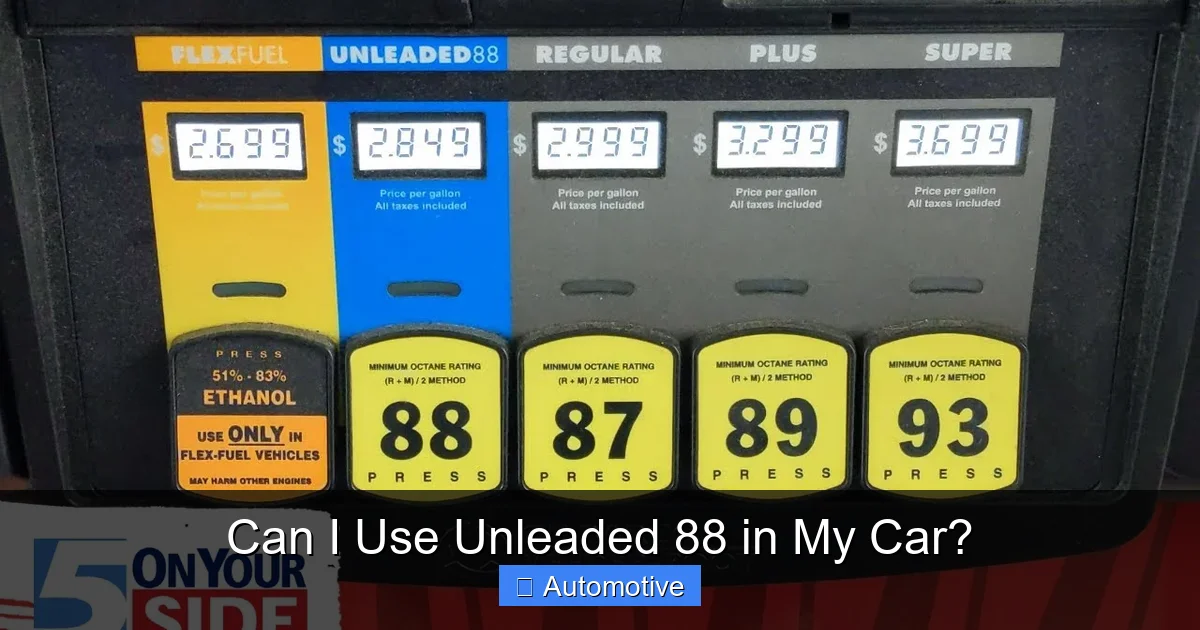
First, let’s clear up the naming confusion. At the pump, you see numbers like 87, 89, 91, and 88. Those numbers refer to the fuel’s octane rating, which measures its ability to resist “knocking” or “pinging” in your engine. But here’s the twist: Unleaded 88 isn’t just a different octane grade; it’s a specific fuel blend.
The E15 Designation: More Ethanol, More Questions
In the United States, most regular gasoline is actually E10—a blend of 90% gasoline and 10% ethanol. Ethanol is an alcohol-based fuel additive, usually made from corn, that boosts octane and burns cleaner. Unleaded 88 is what’s officially called E15, meaning it contains between 10.5% and 15% ethanol. That extra 5% ethanol makes a bigger difference than you might think. The higher ethanol content is what gives E15 its typically higher octane rating, often in the 88-90 range, hence the name “Unleaded 88” used at retail pumps.
So, when you choose Unleaded 88, you’re primarily choosing a fuel with a higher ethanol content, not just a slightly higher resistance to engine knock. This distinction is critical because the potential for engine damage comes from the ethanol itself, not the octane number. For a deeper dive into fuel types and specifications, resources like the U.S. Department of Energy’s fuel overview are excellent references.
Why Does E15 Exist and Why Is It Cheaper?
You might wonder why this fuel is even an option. Its existence is tied to U.S. energy policy. The Renewable Fuel Standard (RFS) program mandates that a certain volume of renewable fuel (like ethanol) be blended into the nation’s gasoline supply. E15 provides a way to use more domestically produced ethanol. Because ethanol is generally less expensive than gasoline on a per-energy-unit basis, E15 often (but not always) carries a lower price tag at the pump compared to E10 (regular 87). That price difference is the main draw for consumers, but it’s a savings that comes with a big “if”—if your car can use it safely.
Which Cars Can Actually Use Unleaded 88 (E15)?
This is the million-dollar question. Compatibility isn’t about your car’s brand (Toyota, Ford, Honda) as much as it is about its model year, engine type, and specific manufacturer approvals. Here is the general rule, followed by the crucial exceptions.

Visual guide about Can I Use Unleaded 88 in My Car?
Image source: carxplorer.com
The 2001 and Newer “Rule” (And Its Big Caveats)
The U.S. Environmental Protection Agency (EPA) has granted a waiver allowing E15 for use in all model year 2001 and newer passenger cars, light-duty trucks, and SUVs. This is the guideline you’ll see cited most often. The thinking is that vehicles from 2001 onward have fuel systems made with materials (like certain metals and elastomers) that are more resistant to ethanol’s potential corrosive effects and can handle the slight increase in fuel volume that ethanol produces (since ethanol has less energy per gallon than gasoline).
However, this “rule” is not a blanket guarantee for every 2001+ vehicle. It’s a minimum federal standard. Individual automakers have the final say on what fuel is acceptable for their specific engines. Many explicitly state that E15 is approved for newer models. For example, you’ll find clear statements in manuals for many recent Ford, GM, and Toyota vehicles. But others may only approve E10, or they may have restrictions based on the specific engine option. This is why your owner’s manual is non-negotiable.
The Flex-Fuel Vehicle (FFV) Exception
If your car is a Flex-Fuel Vehicle (FFV), you have nothing to worry about. These vehicles are engineered from the ground up to run on any ethanol blend from E10 all the way up to E85 (which is 51-83% ethanol). They have special fuel system components, sensors, and engine calibrations to handle the high ethanol content. You can safely use Unleaded 88, regular 87, or even E85 in an FFV. You can usually identify an FFV by a bright yellow gas cap or a badge on the car (often saying “Flex Fuel,” “E85,” or “FFV”).
Specific Model Examples: The Nissan Altima Case Study
Let’s make this concrete. A very common question is: Can a Nissan Altima use Unleaded 88? The answer highlights the need for precision. For recent model years (e.g., 2018-2023), Nissan’s official position, as stated in the owner’s manual, is that the Altima is designed for premium fuel for best performance but can safely run on regular Unleaded 87. Their manuals typically specify “unleaded gasoline with an octane rating of 87 AKI (Anti-Knock Index) or higher” and caution against fuels containing more than 10% ethanol. This means for most recent Altimas, Unleaded 88 (E15) is not factory-approved.
This nuance is why you’ll find detailed articles on sites like this one specifically about Nissan Altima compatibility. They dig into the model-year-specific manuals to give owners a clear answer. The lesson? Don’t assume your sedan, SUV, or truck is compatible just because it’s from 2005 or 2015. You must look it up for your exact vehicle. For a broader look at which common models are approved, you can refer to comprehensive guides like this article on E15 compatibility, which lists manufacturers and their general stances.
The Real Risks: What Happens If You Use It in an Incompatible Car?
So, what’s the worst that can happen? It’s not just a hypothetical. Using E15 in a vehicle not designed for it can cause a cascade of problems, starting subtly and potentially ending in a massive repair bill.
Visual guide about Can I Use Unleaded 88 in My Car?
Image source: i.ytimg.com
Fuel System Corrosion and Damage
Ethanol is a powerful solvent and is mildly corrosive to certain materials. In older cars (pre-2001), fuel tanks, fuel lines, seals, gaskets, and carburetor or fuel injection components were often made with materials like rubber, plastic, or certain metals that can degrade, swell, or crack when exposed to higher ethanol concentrations. This can lead to:
- Leaking fuel tanks or lines: A serious fire hazard.
- Clogged fuel filters and injectors: As degraded rubber and plastic particles break off and circulate.
- Failing fuel pumps: Often located inside the tank, they can be damaged by debris or corrosion.
Engine Damage from “Phase Separation”
This is a sneaky, destructive process. Ethanol is hygroscopic, meaning it absorbs water from the air. In a tank of E15, this can eventually lead to water-ethanol mixtures separating from the gasoline and sinking to the bottom of your tank. If your car sucks up this watery layer, it can cause:
- Poor running, stalling, or failure to start.
- Internal engine rust and corrosion on pistons, cylinder walls, and fuel system components.
- Catastrophic damage to catalytic converters, which are very expensive to replace.
Phase separation is more likely when a vehicle sits unused for long periods (like a classic car or seasonal equipment), but it’s a risk with any ethanol-blended fuel.
Voiding Your Warranty
This is a clear financial risk. If your vehicle’s warranty explicitly states that only E10 or lower ethanol fuels are approved, and you use E15, the manufacturer can legally deny any warranty claim related to fuel system or engine damage. They would need to prove the fuel caused the issue, but the mere use of unapproved fuel is often enough for a denial. Always check your warranty booklet.
Practical Tips: How to Decide and What to Do
Okay, so you’re at the station. The price of 88 is 20 cents cheaper than 87. What’s the safe playbook?

Visual guide about Can I Use Unleaded 88 in My Car?
Image source: fourwheelask.com
Step 1: Consult Your Owner’s Manual (The Golden Rule)
This cannot be stressed enough. Find the section on “Fuel,” “Capacities and Specifications,” or “Recommended Fuel.” Look for phrases like:
- “Use only unleaded gasoline with an octane rating of 87 or higher.”
- “Do not use fuels with more than 10% ethanol (E10).”
- “Your vehicle is designed to operate on E15.”
- “Flexible Fuel Vehicle (FFV): Can use E85.”
If it’s ambiguous, call your dealer’s service department with your VIN ready. They can give you a definitive answer.
Step 2: Know Your Car’s Age and Type
As a very general, unsafe rule of thumb (use only if you’ve confirmed with Step 1):
- Pre-2001 cars, motorcycles, boats, lawn mowers, chainsaws: Avoid E15. Use E10 (87) only.
- 2001-2015 model years: Many are compatible, but not all. Manual check required.
- 2016 and newer: The vast majority are designed for E15, but always verify.
- Any high-performance, turbocharged, or supercharged engine: Proceed with extreme caution. Some manufacturers (like BMW, Mazda for certain models, and some European brands) recommend or require premium (91+) and may not endorse E15. Check the manual.
Step 3: If You Decide to Use It, Start Slow
If your manual gives the green light, you can switch. But don’t immediately fill a nearly empty tank with 100% E15 if you’ve been using E10. Mixing is fine, but a sudden, full concentration change can sometimes cause temporary fuel trim adjustments. It’s usually not a problem, but if you’re cautious, you could start by adding one or two gallons of E15 to a tank that’s a quarter full of E10 and see how the car runs for a few days.
Step 4: Monitor Your Car’s Behavior
After using E15, pay attention. Do you notice:
- Rough idling or hesitation on acceleration?
- A check engine light?
- Reduced fuel economy (though this can vary)?
- Any strange smells (like fuel) in the cabin or around the car?
If anything seems off, switch back to regular 87 immediately and have a mechanic check the fuel system. Don’t ignore warning signs.
Frequently Asked Questions (FAQs)
Can I use Unleaded 88 in my older car from the 1990s?
No, you should not. Vehicles manufactured before 2001 were not designed to handle the higher ethanol content in E15 and are at significant risk for fuel system corrosion and damage. Always use standard Unleaded 87 (E10) in these vehicles.
Will using Unleaded 88 improve my car’s performance?
Probably not, and it might hurt it. Unless your car’s engine is specifically tuned for higher octane fuel (like some premium-required models), the higher octane of 88 offers no performance benefit over 87. If your car is not compatible, using it can cause poor running and reduced performance.
My car is a 2015 model. Is it safe to use Unleaded 88?
It might be, but you cannot assume. While the 2001+ EPA waiver covers it, automakers set their own policies. A 2015 model year vehicle’s compatibility depends on the specific make and engine. You must check your owner’s manual. For example, many 2015 models from Ford, GM, and Chrysler are approved, while some import brands may not be.
Does using E15 affect my car’s warranty?
It can. If your owner’s manual states that only E10 is approved, using E15 could void your warranty for any related fuel system or engine repairs. Always follow the fuel specifications in your warranty document.
Can I mix Unleaded 88 and Unleaded 87 in my tank?
Yes, blending is physically possible and common. If your car is E15-compatible, mixing the two poses no problem. The blend will simply have an ethanol content between 10% and 15%. However, if your car is not compatible, even a mixture with some E15 can be harmful over time. Compatibility is an all-or-nothing proposition.
What about motorcycles, ATVs, and small engines?
As a general, strict rule, do not use E15 in motorcycles, ATVs, snowmobiles, boats, or any small engines (lawn mowers, generators, chainsaws). These engines are almost universally designed for E10 (Unleaded 87) or lower. The higher ethanol content in E15 can rapidly degrade rubber seals, plastic parts, and carburetors in these applications, leading to leaks, blockages, and failure. Use only E10 in these machines.
Frequently Asked Questions
Is Unleaded 88 the same as E15?
Yes, for all practical purposes at the pump, Unleaded 88 is the retail name for E15 fuel, which contains between 10.5% and 15% ethanol. The “88” refers to its typical octane rating.
Can I use Unleaded 88 in my 2010 Honda Civic?
Honda’s official stance for most 2010 models is that they are designed for regular unleaded gasoline (87 octane) and do not recommend fuels with more than 10% ethanol. You should check your specific owner’s manual, but the safe assumption is to use only Unleaded 87 (E10).
Will Unleaded 88 damage a newer car’s catalytic converter?
If the car is manufacturer-approved for E15, its catalytic converter is designed to handle the fuel blend and should not be damaged. However, using E15 in an unapproved vehicle can lead to improper combustion and fuel contamination, which can ultimately overheat and destroy the catalytic converter.
Can I use Unleaded 88 in my rental car?
You should use whatever fuel the rental company instructs, which is almost always standard Unleaded 87. Rental cars are typically standard fleet models, and using a fuel not explicitly approved for that model could make you liable for damage. Always check the fuel door sticker or rental agreement.
Does the temperature affect whether I can use Unleaded 88?
No, ambient temperature does not change the fundamental compatibility of your vehicle’s fuel system with E15. The material compatibility issues exist in all temperatures. However, in very cold weather, some older vehicles might experience more pronounced running issues with any ethanol-blended fuel due to vaporization characteristics.
Where can I find a definitive list of E15-compatible vehicles?
The EPA maintains a partial list, but the most authoritative source is your vehicle’s owner’s manual. You can also often find compatibility information on automaker websites in their owner’s resources sections. Look for PDFs of your manual or searchable databases by model year and engine.