Can I Order a Jeep from the Factory?

Contents
- 1 Key Takeaways
- 2 📑 Table of Contents
- 3 Understanding Factory Orders: It’s Not a “Direct” Purchase
- 4 The Step-by-Step Guide to Ordering Your Jeep from the Factory
- 5 Which Jeep Models and Trims Can You Actually Order?
- 6 Costs, Pricing, and Financial Considerations
- 7 Pros and Cons: Is a Factory Order Right for You?
- 8 Tips for a Successful Jeep Factory Order Experience
- 9 Conclusion: Your Dream Jeep is Worth the Wait
- 10 Frequently Asked Questions

Emergency First Aid Kit

Car Roof Rack Cross Bars
Waterless Car Wash Spray
Side Window Sunshade
Yes, you can order a Jeep directly from the factory, but not as a consumer. The process, known as a “dealer-ordered” or “custom” vehicle, must be initiated through an authorized Jeep dealership. You work with a dealer to specify every detail—from model and trim to color and options—and the factory builds it to your exact specifications. This is the best way to get a brand-new Jeep configured precisely how you want it, though it requires patience for a build and delivery timeline that can span weeks or months.
Key Takeaways
- You Cannot Buy “Direct-to-Consumer”: You must go through a franchised Jeep dealership to place a factory order; manufacturers sell to dealers, not the public.
- Not All Models/Trims Are Available: Some base models, fleet vehicles, or high-demand trims may have restricted factory ordering or be sold only from dealer stock.
- The Process is Dealer-Centric: Your relationship with the dealer’s sales consultant is critical for communication, contract signing, and status updates.
- Expect a Significant Wait: From order submission to delivery, expect anywhere from 6 to 16+ weeks depending on model, plant location, and supply chain factors.
- Pricing is Set at Order Time: The final selling price (including any incentives) is typically locked in when you sign the purchase agreement, protecting you from market fluctuations.
- A Deposit is Usually Required: Dealers commonly require a refundable deposit (often $500-$1,000) to submit your factory order.
- You Can Track Your Order: Once the dealer submits the order (with a VON/VIN), you can often track its status through the dealer or online portals.
[FEATURED_IMAGE_PLACEHOLDER]
📑 Table of Contents
- Understanding Factory Orders: It’s Not a “Direct” Purchase
- The Step-by-Step Guide to Ordering Your Jeep from the Factory
- Which Jeep Models and Trims Can You Actually Order?
- Costs, Pricing, and Financial Considerations
- Pros and Cons: Is a Factory Order Right for You?
- Tips for a Successful Jeep Factory Order Experience
- Conclusion: Your Dream Jeep is Worth the Wait
Understanding Factory Orders: It’s Not a “Direct” Purchase
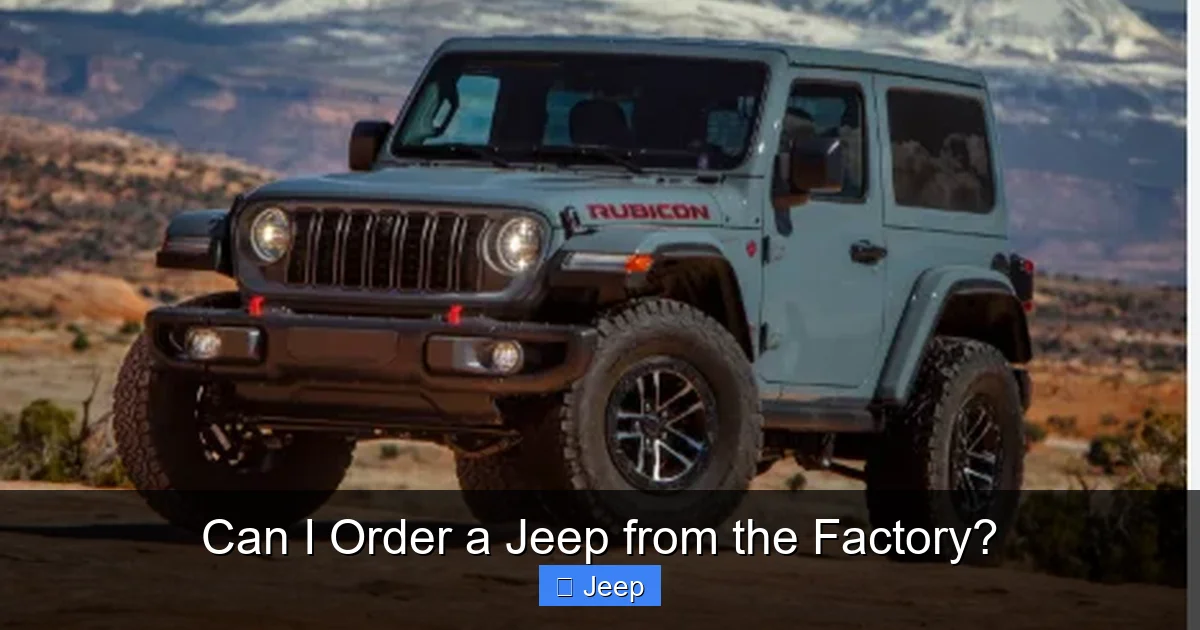
So, you’ve got your heart set on a specific Jeep. Maybe it’s a Wrangler Rubicon in Bikini Pearl with the black soft top and the upgraded audio system. Or perhaps it’s a Grand Cherokee L Summit with every available convenience feature. You walk onto a dealer lot, and the cars you see are close, but not exactly what you want. The color is off. It lacks that one crucial option. You think, “Can I just order this from the factory myself?”
The short answer is yes, you can get a Jeep built to your exact specifications from the factory. The longer, more important answer is that you absolutely cannot do it alone as a consumer. The factory—Stellantis, in Jeep’s case—sells vehicles to its network of franchised dealerships, not to individual buyers. This is the same model used by virtually all mainstream manufacturers in the U.S., a system born from franchise laws. Therefore, your “factory order” is actually a dealer-ordered vehicle. You contract with the dealer, and the dealer contracts with the factory.
This distinction is crucial because it means your experience, your point of contact, and the logistics are all managed through the dealership. Think of the dealer as your personal shopper and project manager for your new Jeep. They are the gateway to the factory’s production system. This process is different from simply buying a car off the lot, and it’s also different from the rare “direct sales” models used by some electric vehicle startups. If you’re curious about the broader landscape, you can read about whether you can buy a car directly from the manufacturer, which highlights why the traditional dealer franchise system remains dominant.
Why Would You Want to Factory Order a Jeep?
The primary reason is personalization. Factory ordering allows you to choose from the entire palette of available options for your chosen model and trim. You’re not limited to what the dealer has in stock or what they can trade from another dealer. You get to decide the engine, drivetrain (4×4 vs. 4×2), transmission, exterior color, interior color and material, wheel style and size, and every available package—from safety tech to off-road gear to towing packages.
Another significant advantage is price protection. When you place your order and sign a purchase agreement, you lock in the vehicle’s selling price based on the MSRP (Manufacturer’s Suggested Retail Price) at that time, minus any applicable manufacturer incentives. If you’re ordering a popular model during a time of high demand and low inventory, this protects you from potential price increases or the dealer adding market-adjusted markups (ADMs) that you might face on a vehicle already on the lot.
The Step-by-Step Guide to Ordering Your Jeep from the Factory
Now that we’ve established the “how” (through a dealer), let’s walk through the actual process. It’s a partnership between you and your chosen Jeep dealer’s sales team.

Visual guide about Can I Order a Jeep from the Factory?
Image source: kentuckyjeepfactory.com
Step 1: Research and Configuration
Before you ever speak to a salesperson, do your homework. Head to the official Jeep website and use their “Build & Price” tool. This is your sandbox. Select your desired model (Wrangler, Grand Cherokee, Gladiator, etc.). Then, select the base trim level you want to start from (Sport, Sahara, Rubicon, Limited, etc.). From there, you’ll step through every available option.
This is where you’ll make key decisions. Do you need the heavier-duty axles and lockers of a Rubicon for serious rock crawling, or is the Sahara’s comfort-oriented suspension sufficient? Is the turbocharged 2.0L I4 engine enough, or do you need the V6 or the powerful 392 Hemi in the Wrangler? You’ll choose packages like the “Towing Group” or “Convenience Group,” individual options like a rear-view camera or heated seats, and of course, the iconic paint color. Be aware that some options are incompatible with others (e.g., certain engines only come with specific transmissions), and the tool will guide you. This configured vehicle becomes your “target build.”
Step 2: Find a Cooperative and Knowledgeable Dealer
Not all dealers are created equal when it comes to factory orders. You need a dealer and, more specifically, a sales consultant who understands the process, communicates clearly, and is willing to be your advocate. Call ahead and explain you want to place a custom factory order. Ask about their process, their typical timeline for that model, and if they require a deposit. A good dealer will be transparent about allocations (see below) and current production schedules. You might also want to check if they have any relationships with other manufacturers; for instance, some dealers sell multiple brands and may have insights into how to order a Kia from the factory, which can provide useful comparative context on process differences.
Step 3: The Purchase Agreement and Deposit
Once you’ve chosen your dealer and finalized your build on their system, you’ll sign a factory order purchase agreement. This is a legally binding contract. It will detail your selected vehicle specifications (often by a code), the agreed-upon selling price, any dealer-installed accessories, and the estimated delivery date (which is usually a best guess). It will also state the deposit amount—typically refundable until the order is officially accepted by the factory—and the terms of the sale (financing, cash, etc.). Read this document carefully. Ensure the vehicle description matches your build sheet exactly and that the price is firm. Ask what happens if the vehicle arrives with damage or if production is delayed for months.
Step 4: Order Submission and the Allocations Game
Here’s where things get fuzzy for the customer. The dealer does not have an unlimited ability to order any car they want. Stellantis allocates production slots to each dealership based on a complex formula of sales performance, market demand, and model popularity. Think of it as a quota. Your dealer must use one of their allocated slots to submit your order. This is why some dealers may be less enthusiastic about taking a custom order for a high-demand model like a Wrangler 4xe—they could use that slot to sell a vehicle from their immediate stock at a higher profit. If a dealer says they “can’t take your order,” it often means they don’t have an allocation or don’t want to use one for a custom build. This is a key reason to find a dealer eager for your business.
When the dealer submits the order, it enters the system and receives a Vehicle Order Number (VON) or eventually a Vehicle Identification Number (VIN). This is your order’s unique tracking code.
Step 5: The Waiting Game: Production and Transit
Now, you wait. The build timeline varies dramatically.
- Model & Plant: A Wrangler (built in Toledo, OH) may have a different timeline than a Grand Cherokee (built in Detroit or elsewhere). A Gladiator shares the Toledo line with the Wrangler.
- Complexity: A basic Sport model might move faster than a fully loaded Rubicon with every option, due to parts availability and scheduling.
- Supply Chain: We’ve all seen the news about chip shortages and supply chain issues. These can cause unpredictable delays.
- Allocation Priority: Your dealer’s position in the allocation queue matters.
A realistic range is 8 to 16 weeks from order acceptance to dealer delivery. During this time, your dealer should provide updates as the status changes in the system (e.g., “Production Scheduled,” “In Production,” “Built,” “In Transit,” “At Railhead,” “Delivered to Dealer”). Patience is a virtue here.
Step 6: Arrival, Inspection, and Final Paperwork
When your Jeep arrives, the dealer will notify you. You’ll need to come in for a final inspection. Look it over meticulously. Check for any transport damage (scratches, dings), verify all options are installed correctly, and ensure the VIN on the vehicle matches your paperwork. Only after you’re satisfied should you sign the final RMV paperwork and take delivery. This is your last chance to address any issues before the vehicle is considered “used.”
Which Jeep Models and Trims Can You Actually Order?
This is a practical reality check. While the factory order system exists for most of the Jeep lineup, its accessibility varies.
Visual guide about Can I Order a Jeep from the Factory?
Image source: pictures.dealer.com
The Most Popular & Available: Wrangler and Grand Cherokee
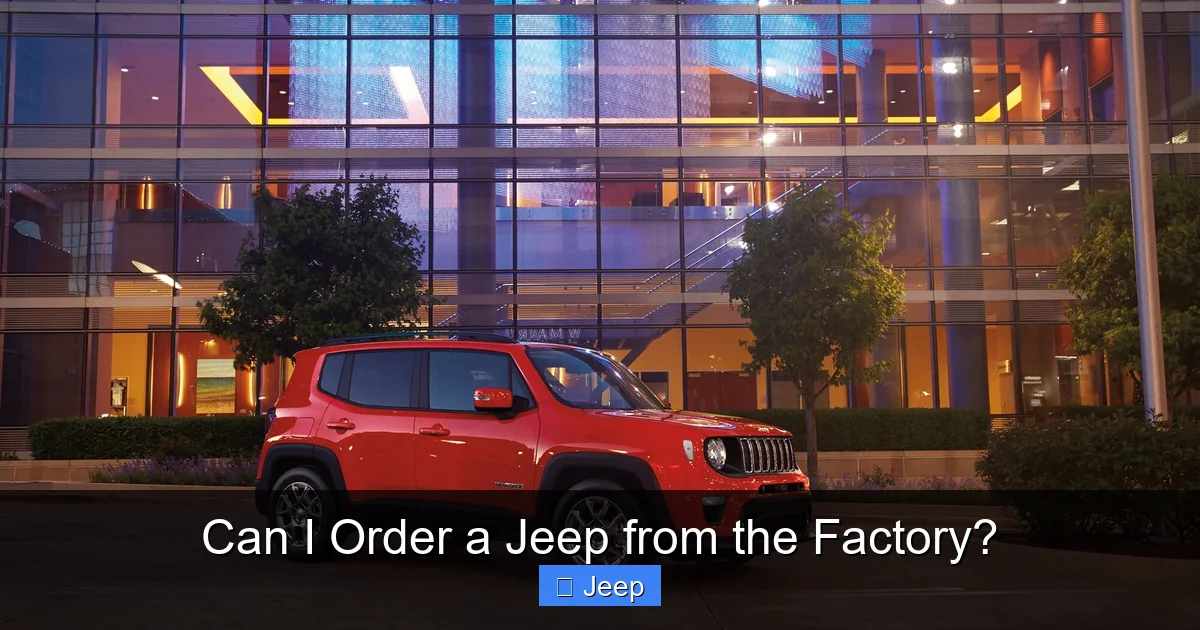
The iconic Wrangler and the family-friendly Grand Cherokee are the two most common models for factory orders. Nearly every trim level—from the basic Sport to the top-tier Rubicon 392 or Grand Cherokee L Summit—is generally available to order. These are Jeep’s volume sellers, and the factories are set up for a wide variety of configurations. However, even here, during extreme shortages or for the hottest new powertrains (like the Wrangler 4xe plug-in hybrid in its early years), allocations can be tight.
The Special Cases: Gladiator, Compass, Renegade, and Wagoneer
- Gladiator: As a Wrangler-based pickup, its ordering process is similar. It’s popular but niche, so dealer allocations might be more limited than for the Wrangler SUV.
- Compass & Renegade: These smaller, more affordable crossovers are often built in higher volumes for specific global markets. While you can order them, dealers may be less motivated as they often have a steady flow of inventory. You might find it easier to just buy one from the lot.
- Wagoneer & Grand Wagoneer: Jeep’s new full-size luxury SUVs are complex builds. Factory ordering is certainly possible, but given their high price point and lower production volumes, the process might have different dynamics. Expect longer lead times.
When Factory Ordering Might Not Be an Option
There are scenarios where a dealer may tell you a factory order isn’t possible:
- Fleet/Base Models: Some very basic, no-frills models intended for rental companies or commercial fleets are not sold to the public and cannot be custom-ordered by individuals.
- Extremely High-Demand, Low-Supply Models: If a particular model/engine combination is in such high demand that the factory’s entire production run is already spoken for by dealer stock orders, they may temporarily stop taking custom orders for it.
- Dealer Allocation Exhaustion: As mentioned, a dealer simply may not have any more allocation slots for that model for the current production cycle.
Costs, Pricing, and Financial Considerations
A common myth is that factory-ordered vehicles cost more. This isn’t inherently true. The pricing structure is key.
Visual guide about Can I Order a Jeep from the Factory?
Image source: adventurejeep.com
MSRP is Locked In
The price you agree to in your purchase order is based on the MSRP of your specific configuration at the time of order. This is a major benefit. If you order a vehicle and, during the 12-week build time, the manufacturer increases the MSRP for the 2025 model year, you are not affected. You pay the 2024 MSRP you agreed to. Conversely, if new incentives are released, you may be able to apply them at delivery if your contract allows for it (this is negotiable). This is a stark contrast to buying a vehicle off the lot today, where you are subject to the current price and any dealer markups on in-demand models.
Dealer Fees and Add-ons
Remember, the MSRP is just the starting point. The dealer will still add their destination charge (non-negotiable, usually ~$1,000), any applicable taxes, titling, and registration fees for your state. They may also include their own “documentation fee” (doc fee), which varies widely by state and dealer. Be cautious of any mandatory dealer-installed accessories or market adjustments added to a factory order. A dealer cannot add an ADM to a factory order the same way they might to a vehicle on the lot, as the price was agreed upon in your contract. However, they can try to sell you extra accessories (like all-weather floor mats, roof racks, etc.) as a condition of taking your order. Stand your ground; these should be optional. For a deep dive into dealer costs and fees, understanding whether you can deduct sales tax on a car can help with the overall financial picture, though this is more relevant for business use.
Financing and Leasing
You can arrange financing or leasing through the dealer or your own bank/credit union. The terms (interest rate, lease money factor) you qualify for will be based on your credit and the terms available at the time of delivery, not at order time. Some dealers may allow you to lock in a rate with a refundable deposit, but this is not standard. It’s wise to get pre-approved for a loan from your own financial institution before ordering, so you have a baseline for comparison when you pick up the vehicle.
Pros and Cons: Is a Factory Order Right for You?
Let’s summarize the trade-offs to help you decide.
The Pros: Getting Exactly What You Want
- Perfect Specification: You get the exact engine, color, and options package you desire, no compromises.
- Price Certainty: You lock in the MSRP, shielding you from price increases and dealer markups on hot models.
- New Car Certainty: You know it’s a brand-new vehicle built for you, with no unknown history or wear from being a test drive unit or a dealer demo.
- Potential for Better Availability: For some rare combinations, ordering might be the only way to get it, as dealers may never stock such a specific build.
The Cons: The Waiting Game and Uncertainty
- Long Wait: You must wait weeks or months. If you need a vehicle immediately, this is not the path.
- No Test Drive Until It Arrives: You are buying a “blind” vehicle. You can test a similar loaner or demo from the dealer, but you won’t drive your specific Jeep until it’s built.
- Dealer Dependency: Your experience is entirely dependent on your dealer’s communication and willingness to advocate for you. A bad dealer can make the process stressful.
- Allocation Risk: There’s no guarantee your order will be accepted by the factory, especially if the dealer’s allocation is limited.
- Incentive Risk: You might miss out on a fantastic incentive that launches after you order but before you take delivery, unless your contract specifically allows you to apply it.
Tips for a Successful Jeep Factory Order Experience
Armed with knowledge, you can navigate this process smoothly. Here’s our best advice.
1. Build a Relationship with a Specific Sales Consultant
Don’t just walk into a random dealership. Call and ask to speak with a sales manager or consultant who handles factory orders. Get their direct contact information. A single point of contact who knows your order inside and out is invaluable. Ask them for their process for updates. Will they email you when the VON is assigned? When it goes into production? A good consultant will be your partner.
2. Get Everything in Writing
Your purchase agreement must match your build sheet pixel-perfectly. Verify the exterior color code (e.g., “Bikini Pearl Pearl Coat” has a specific code), the exact option package names, and the VIN once it’s assigned. Any promises about accessories, discounts, or trade-in value must be on the contract. Verbal promises are worthless.
3. Understand the Dealer’s Allocation
Ask your consultant point-blank: “Do you have an allocation slot available for this specific model and engine for the current production block?” If they hem and haw, it might be a red flag. A confident “yes” is what you want to hear. You can also ask if they have other orders for the same model already in the system, which might indicate they have a healthy allocation.
4. Be Realistic About Timelines
When the dealer gives you an estimated delivery date, treat it as a best-case scenario. Add 4-6 weeks as a buffer for potential supply chain hiccups. Constantly asking “Where’s my Jeep?” won’t make it arrive faster, but a polite check-in every 3-4 weeks is reasonable.
5. Consider the Current Market
In a normal market, factory ordering is a great way to get a perfect car. In a hyper-constrained market with massive dealer markups on the lot, ordering might still be the best way to avoid overpaying, but the wait could be even longer. Weigh your need for a specific vehicle against your need for a vehicle now. Sometimes, finding a stock vehicle with 90% of your desired features is a better practical choice than waiting 4 months for perfection.
6. Inspect Meticulously at Delivery
When your Jeep finally arrives, don’t be so excited you skip the inspection. Go over it in bright light. Check panel gaps, paint finish, and that every button and option works. Test the 4×4 system if equipped. Ensure the correct tires are on it. This is your last, best chance to get any problems fixed before the vehicle is titled in your name.
Conclusion: Your Dream Jeep is Worth the Wait
Ordering a Jeep from the factory is absolutely possible and is often the smartest way to get the exact vehicle you’ve dreamed about. It gives you control over the specification and protects your wallet from price volatility. However, it is not a transaction; it’s a small project that requires patience, clear communication, and a trustworthy dealer partner.
The core truth you must remember is this: you are ordering through a dealer, not from a factory. Your success hinges on choosing the right dealer. Do your online research, call around, and find a consultant who is enthusiastic about your custom build. Get every detail of your agreement in writing, understand the allocation realities, and prepare for a wait that will test your patience but reward you with a vehicle that is uniquely yours.
When you finally turn the key in your custom-ordered Jeep and drive off the lot, the wait will feel worth it. You’ll have a machine that was built for your needs, your style, and your adventures. Start with the Jeep Build & Price tool, find a great dealer, and begin the journey.
Frequently Asked Questions
Is ordering a Jeep from the factory more expensive than buying off the lot?
Not necessarily. You lock in the MSRP at the time of order, which can protect you from price increases and dealer markups on high-demand in-stock vehicles. However, you cannot negotiate below MSRP on a custom order in the same way you might on a dealer’s aged inventory. The final price is typically the agreed-upon MSRP minus any national incentives you qualify for at delivery.
How long does it really take to get a factory-ordered Jeep?
Realistically, plan for 8 to 16 weeks from the time the dealer successfully submits your order with an allocation. Simpler builds on popular models (like a basic Wrangler Sport) may be on the shorter end. Highly complex builds (e.g., a Grand Cherokee L with every option) or models with new powertrains can take 12-20 weeks or more. Supply chain issues can add unexpected delays at any time.
Can I change my order after I’ve placed it?
Can I change my order after I’ve placed it?
Minor changes might be possible while the order is in a “pre-production” or “scheduled” status, but your dealer must submit a change request, and it’s not guaranteed. Once the vehicle is in actual production (status changes to “In Production” or “Built”), changes are virtually impossible. The best strategy is to be 100% sure of your configuration before signing the purchase agreement.
Do I need to put money down for a factory order?
Yes, almost all dealers require a deposit to submit a factory order. This is typically a refundable deposit (often $500 to $1,000) that you get back if the order is canceled by the factory or if you cancel within the contract’s terms before production begins. It shows the dealer you are serious and compensates them for using one of their precious allocation slots.
What if my ordered Jeep arrives with damage or missing options?
This is a critical reason for the thorough pre-delivery inspection. If you find damage (transport scratches, dents) or missing options, do not take delivery. The dealer must repair the damage at their expense or, in severe cases, request a replacement from the factory (which is a lengthy process). Missing options must be installed or corrected before you sign the final paperwork. Your signed purchase agreement is your leverage.
Can I factory order a used or certified pre-owned Jeep?
No. Factory orders are exclusively for brand-new, never-titled vehicles built to your specification from the ground up. Used and Certified Pre-Owned (CPO) Jeeps are vehicles that have already been built, titled, and previously owned. You select from the existing inventory of those vehicles. The process for returning a car you just bought also doesn’t apply to factory orders, as they are new and the contract terms are different.