
Can I File Bankruptcy and Keep My Car?

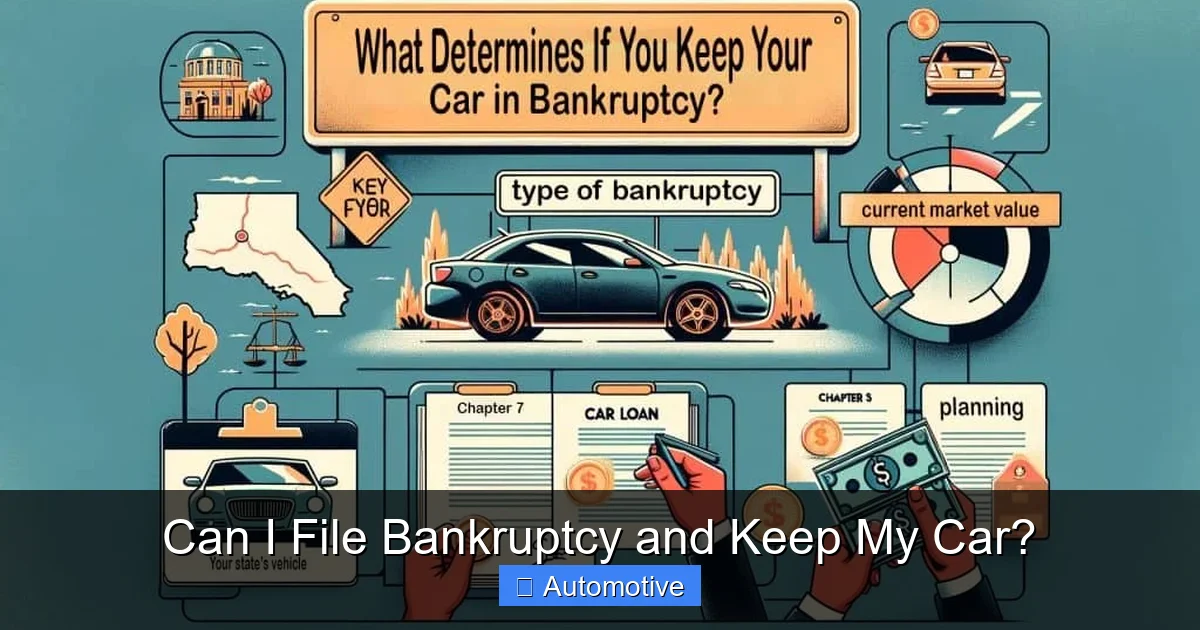
Yes, you can often file bankruptcy and keep your car, but it depends on several critical factors. The type of bankruptcy you file (Chapter 7 or Chapter 13), your state’s vehicle exemption laws, your car’s value, and your loan status all play a deciding role. Understanding exemptions, reaffirmation agreements, and redemption options is key to navigating this process successfully.
Key Takeaways
- Bankruptcy Chapter Matters: Chapter 7 is a liquidation that may require surrendering non-exempt assets, while Chapter 13 is a reorganization plan that almost always allows you to keep your car by catching up on missed payments over 3-5 years.
- Exemptions Protect Equity: Each state has a dollar amount (the “vehicle exemption”) that protects the equity in your car from seizure. If your car’s equity is less than the exemption, you typically keep it in Chapter 7.
- Reaffirmation is a Commitment: In Chapter 7, you can sign a reaffirmation agreement with your lender to keep the loan active and the car, but you remain personally liable for the debt.
- Redemption is a Payoff: In Chapter 7, you can “redeem” the car by paying the lender its current replacement value in a lump sum, removing the lien and owning it free and clear.
- State Laws Dictate Outcomes: Your state’s specific exemption rules and whether you can use federal or state exemptions dramatically change your chances of keeping the vehicle.
- Being Current Helps: If you are current on your car payments when you file, your odds of keeping the car in either chapter are significantly higher.
📑 Table of Contents
- Can I File Bankruptcy and Keep My Car? The Straight Answer
- Understanding the Two Main Paths: Chapter 7 vs. Chapter 13
- The Role of Exemptions: Your Legal Shield for the Car
- Reaffirmation Agreements and Redemption: Special Tools in Chapter 7
- State Laws and Your Car: Why Location is Everything
- Practical Steps to Keep Your Car During Bankruptcy
- What Happens If You Can’t Keep Your Car?
- Conclusion: Knowledge is Your Best Defense
Can I File Bankruptcy and Keep My Car? The Straight Answer
It’s one of the first questions people ask when facing overwhelming debt: “If I file bankruptcy, will I lose my car?” For most Americans, a car isn’t just a convenience; it’s a necessity for getting to work, taking kids to school, and managing daily life. The thought of losing it can be terrifying. The good news is that, in many cases, you can file bankruptcy and keep your car. However, it’s not a guarantee. The outcome depends on a mix of legal procedures, financial details, and the specific chapter of bankruptcy you file under. This guide will walk you through every scenario, from the easiest situations to the more complex ones, so you know exactly what to expect.
Think of bankruptcy not as a one-size-fits-all event, but as a legal process with different tools. Your car’s fate hinges on three main pillars: 1) The type of bankruptcy (Chapter 7 or Chapter 13), 2) The “exemption” laws of your state, which protect a certain amount of property, and 3) Your specific financial situation regarding the car (loan balance vs. car value). We’ll break down each of these pillars in plain language, with practical examples, so you can see how they apply to your life.
Understanding the Two Main Paths: Chapter 7 vs. Chapter 13
The U.S. Bankruptcy Code offers several chapters, but for individuals, the two most common are Chapter 7 and Chapter 13. They are fundamentally different, and your choice (or eligibility) will dictate your car’s future. Imagine them as two different routes to the same destination: debt relief.

Visual guide about Can I File Bankruptcy and Keep My Car?
Image source: massbankruptcyprotection.com
Chapter 7: “Liquidation” Bankruptcy
Chapter 7 is often called “straight” or “liquidation” bankruptcy. A trustee is appointed to your case and has the power to sell your non-exempt assets to pay your creditors. The goal is to get a fresh start quickly, typically within 3-6 months. The big question for your car is: Is it “non-exempt”? This is where state exemption laws come in. If the equity in your car (the car’s current market value minus what you owe on the loan) is fully covered by your state’s vehicle exemption, the trustee cannot take it. You keep it and continue making your regular payments. If you have equity *above* the exemption amount, that “non-exempt equity” is an asset the trustee could sell. However, in practice, trustees often have the option to “abandon” the asset if selling it would yield little after paying costs and the exemption, especially if the car is older or has high mileage.
If you are behind on your car payments when you file Chapter 7, the lender can still repossess the car after the automatic stay is lifted, even if you have an exemption protecting the equity. The exemption protects you from the *trustee*, not necessarily from your *lender*. This is a crucial distinction.
Chapter 13: “Wage Earner’s Plan” Bankruptcy
Chapter 13 is a reorganization plan. You do not surrender assets. Instead, you propose a 3- to 5-year repayment plan to your bankruptcy court, using your future income to pay back all or a portion of your debts. This plan must be approved by the court and your creditors. For car owners, Chapter 13 is often the more secure path to keeping your vehicle. Why? Because it allows you to “cure” defaults. If you are behind on payments, you can include those missed payments (plus any late fees) in your plan and pay them off over the plan’s duration. As long as you make all your plan payments on time, you can keep your car. Additionally, in some cases, if your car loan is very old (more than 910 days old), you might be able to “cram down” the loan, reducing the principal to the car’s current value. This is a powerful tool unique to Chapter 13.
A detailed look at how Chapter 13 bankruptcy specifically helps you keep your car reveals that it’s designed for people with regular income who want to protect assets like vehicles from repossession.
Which Chapter is Better for Keeping Your Car?
There’s no universal answer. Chapter 7 is faster and simpler, but you risk losing the car if you have significant non-exempt equity or are behind on payments. Chapter 13 almost always allows you to keep the car if you can afford the plan payments, but it requires a long-term commitment and you must have enough disposable income to fund the plan. Your eligibility also depends on your income. If your income is below your state’s median income for a similar-sized household, you likely qualify for Chapter 7. If it’s above, you may be required to file Chapter 13 after a “means test” calculation. Consulting with a bankruptcy attorney is essential to run these calculations and see which chapter you qualify for and which best protects your vehicle.
The Role of Exemptions: Your Legal Shield for the Car
Exemptions are the heart of the “keep your car” question in Chapter 7. They are laws that allow you to protect a certain dollar amount of property from the bankruptcy trustee. Every state has its own set of exemption statutes. Some states have a specific “motor vehicle exemption.” Others use a “wildcard” exemption that can be applied to any property, including your car. A few states don’t have a separate vehicle exemption at all, relying solely on a general homestead or wildcard exemption.

Visual guide about Can I File Bankruptcy and Keep My Car?
Image source: i0.wp.com
What Are Bankruptcy Exemptions?
An exemption is simply a dollar limit. For example, if your state has a $6,000 motor vehicle exemption and your car has $4,000 in equity (car worth $10,000, loan $6,000), your equity is fully exempt. The trustee cannot touch it. If your car has $8,000 in equity, $6,000 is exempt, but the remaining $2,000 is non-exempt and could be targeted. The trustee might then offer you the chance to “buy back” that $2,000 of non-exempt equity by paying that amount to the trustee (which then goes to your creditors). If you can’t pay, they may seek to sell the car to get that value.
Federal vs. State Exemptions: You Often Have a Choice
This is a critical strategic decision. Federal law provides a set of exemption amounts (e.g., a $4,000 motor vehicle exemption as of 2024, but this is adjusted periodically). Many states have enacted laws that *force* you to use their state exemptions if you file bankruptcy in that state. Other states allow you to choose between the state set and the federal set. This choice is powerful. You will compare your state’s vehicle exemption to the federal one and pick the one that offers you the most protection for your specific assets. Sometimes, the federal wildcard exemption (currently $1,500 + any unused homestead exemption up to $12,575) is more valuable than a low state vehicle exemption. An attorney can help you make this choice correctly, as it’s generally an all-or-nothing decision—you can’t mix and match.
How Exemption Amounts Affect Your Car: A Practical Example
Let’s make this real. Sarah lives in State A, which has a $5,000 vehicle exemption and forces the use of state exemptions. Her car is a 2018 sedan with a current Kelly Blue Book value of $12,000. She owes $9,000 on her loan. Her equity is $3,000 ($12,000 – $9,000). Since $3,000 is less than her state’s $5,000 exemption, her equity is fully protected. She can file Chapter 7 and keep her car, continuing her payments.
Now, let’s change the numbers. Mike lives in State B, which has a $3,000 vehicle exemption. His truck is worth $15,000, and he owes $8,000. His equity is $7,000. Only $3,000 of that is exempt. The non-exempt $4,000 is at risk. The trustee could demand Mike pay $4,000 to the estate or seek to sell the truck. This is a much dicier situation. He might need to consider Chapter 13 instead, where he could potentially keep all the equity as part of his repayment plan.
Reaffirmation Agreements and Redemption: Special Tools in Chapter 7
Even if your car’s equity is exempt, you still have a loan. In Chapter 7, your relationship with the lender doesn’t automatically end. The debt is not discharged unless you take specific action. Here are your two primary options within Chapter 7 to deal with the loan and keep the car.
Visual guide about Can I File Bankruptcy and Keep My Car?
Image source: autohitch.com
What is a Reaffirmation Agreement?
A reaffirmation agreement is a new contract between you and your car lender, made during your bankruptcy case. By signing it, you agree to remain personally liable for the car loan, as if the bankruptcy never happened for that specific debt. The lender agrees not to repossess the car as long as you continue making payments per the original loan terms (or modified terms, if negotiated). You must file this agreement with the court before your discharge is entered, and the court must approve it if you cannot afford the payments. It’s a serious commitment. If you later default on the reaffirmed loan, the lender can repossess the car and sue you for any deficiency balance (the remaining debt after the sale). It wipes away the “discharge” protection for that debt. You should only reaffirm if you are confident you can make every payment.
Car Redemption in Chapter 7
Redemption is a powerful but underused option. It allows you in Chapter 7 to keep the car by paying the lender the “replacement value” of the car—essentially, what it would cost to buy a similar car at a retail sale—in a single lump-sum payment. You do this by getting a new loan (often from a specialized lender) or using other funds. Once you pay that amount, the lender’s lien is removed, and you own the car free and clear. This is most viable if your car is newer and has a high loan balance relative to its value (you’re “upside-down”). For example, if you owe $20,000 on a car worth $18,000, you could potentially get a new loan for $18,000, pay off the old lender, and have a lower monthly payment with no upside-down equity. However, redemption loans can have high interest rates and are not available to everyone.
Risks and Benefits of Reaffirmation
The benefit of reaffirmation is certainty. You keep the car, your payment history continues (which can help rebuild credit), and you avoid the hassle of finding new transportation. The risk is the binding nature of the contract. Your bankruptcy lawyer will scrutinize your budget to ensure you can afford the payment. If the court finds the reaffirmation would cause you “undue hardship,” it may not approve it. Some lenders will automatically repossess if you don’t reaffirm, even if you are current. You must communicate with your lender and attorney promptly. For a paid-off car in Chapter 7, the analysis is simpler: if the car’s full value is within your exemption limit, you keep it outright with no loan to reaffirm.
State Laws and Your Car: Why Location is Everything
Bankruptcy is federal law, but exemptions are primarily state law. This means your physical address when you file is a massive factor. Let’s look at how this plays out.
States with High Vehicle Exemptions
Some states are very generous. For instance, states like Illinois ($15,000), Indiana ($10,000), and Texas ($7,500 for one motor vehicle) have high exemption limits. In these states, even if you have a relatively new, valuable car with some equity, there’s a very good chance your equity will fall under the exemption. You could file Chapter 7, keep the car, and potentially even have some leftover exemption for other property. If you live in such a state and your car is not ultra-luxury, your path is clearer.
States with Low Vehicle Exemptions
Other states have much lower limits. For example, some states only exempt $1,000 or $2,000 of vehicle equity. In these jurisdictions, unless your car is very old, nearly paid off, or you owe close to its full value (low equity), you will likely have non-exempt equity in a Chapter 7. This forces you into a difficult choice: try to buy back the equity, risk the trustee selling the car, or strongly consider filing Chapter 13 instead, where all equity is protected as part of your repayment plan. The Chapter 7 process in a low-exemption state can be much more perilous for a car owner.
The Wildcard Exemption Advantage
The wildcard exemption is a fantastic tool. It’s a set dollar amount (under federal or some state laws) that you can apply to any single piece of property you choose. If your state’s vehicle exemption is low, but it offers a high wildcard (e.g., $5,000), you can “stack” them or choose to apply the wildcard to your car instead. For example, in a state with a $1,000 vehicle exemption and a $5,000 wildcard, you could use the wildcard to protect an extra $5,000 of your car’s equity, effectively giving you a $6,000 total protection for the vehicle. Federal law also has a wildcard. Understanding and utilizing this is a key strategy for car owners.
Practical Steps to Keep Your Car During Bankruptcy
Knowledge is power, but action is everything. Here is a step-by-step checklist to maximize your chances of keeping your car.
Before Filing: Assess Your Situation
First, get a realistic value for your car. Use Kelley Blue Book, Edmunds, or NADAguides. Be honest about its condition. Then, find your latest loan statement to see the exact payoff amount. Calculate your equity: Value – Loan Balance = Equity. Second, research your state’s bankruptcy exemptions. You can find these online through your state’s court website or by consulting a local attorney. Note the vehicle exemption amount and whether you have a wildcard. Third, gather all your car-related documents: title, registration, loan agreement, and payment history. Being organized from the start makes everything smoother.
During the Process: Work with Your Trustee and Lender
You will file a “Statement of Intention” with the court, which tells the trustee and your creditors what you plan to do with secured debts like your car loan (reaffirm, redeem, or surrender). Be clear and decisive. Communicate proactively with your bankruptcy trustee. Provide them with the car valuation and loan documents promptly. If you have non-exempt equity, be prepared to discuss a potential “buy-back” offer. Most importantly, talk to your car lender. Some lenders have internal programs to help customers in bankruptcy. You need to know their policy on reaffirmation. Do they require it? Will they repossess if you don’t reaffirm? Get answers in writing if possible.
After Filing: Maintain Your Payments
This seems obvious, but it’s critical. Continue making your regular car payments on time throughout the bankruptcy process. If you fall behind during the case, it gives the lender grounds to ask the court for permission to repossess, even if you have an exemption. Your payment history during bankruptcy can also influence the trustee’s decision on a reaffirmation agreement. Once your bankruptcy is discharged (Chapter 7) or your plan is confirmed (Chapter 13), stick to the agreed-upon terms. In Chapter 13, your car payment is often part of your plan payment, so missing a plan payment risks your entire case and your car.
What Happens If You Can’t Keep Your Car?
Sometimes, despite best efforts, keeping the car isn’t feasible. The equity is too high, the payments are unaffordable, or the lender refuses to work with you. If you must surrender the vehicle, bankruptcy still provides a cleaner path than a standard repossession.
Repossession in Chapter 7
If the trustee decides to sell your car because of non-exempt equity, it will be sold at a public auction. The proceeds are distributed: first to pay off your car loan, then to pay your exemption amount to you, and finally, any leftover money goes to your other creditors. If the sale price doesn’t cover the loan balance, the lender may file a claim for the “deficiency.” However, because your personal liability on the loan was discharged in the bankruptcy, the lender cannot come after you for that deficiency. You are free of the debt.
Surrendering Your Vehicle Voluntarily
You can also simply choose to surrender the car as part of your Statement of Intention. You give the car back to the lender. The lender will then sell it and may pursue a deficiency, but once again, the bankruptcy discharge protects you from personal liability for that deficiency. This is often a better option than a forced repossession because it’s cooperative and may look better on your credit report. Surrendering the car can also free up monthly income that was going to a high car payment, helping you afford a more modest used car after bankruptcy.
Rebuilding Credit After Losing Your Car
Losing a car in bankruptcy is a setback, but not the end of the world. Your priority becomes securing affordable transportation. You may need to rely on public transit, biking, or borrowing a car for a while. After your bankruptcy discharge (usually 4-6 months after filing for Chapter 7), you can start looking for a new vehicle. Specialty lenders and some credit unions offer “bankruptcy car loans.” Interest rates will be high initially, but making on-time payments is one of the fastest ways to rebuild your credit. A good practice is to buy a reliable, inexpensive used car with a short loan term (2-3 years) to build positive history quickly. You can read more about timelines and strategies for buying a car post-bankruptcy to plan your next steps.
Conclusion: Knowledge is Your Best Defense
The question “Can I file bankruptcy and keep my car?” has a nuanced but generally hopeful answer. Yes, it is possible, and for many filers, it is the expected outcome. The key determinants are your state’s exemption laws and the chapter of bankruptcy you file. For those with low car equity and current payments, Chapter 7 is a viable path. For those with high equity, missed payments, or a desire to restructure a burdensome loan, Chapter 13 is the robust tool designed to protect assets like your vehicle. The process requires honesty, paperwork, and communication with your trustee and lender. Never assume you will lose your car, and never assume you will automatically keep it. Take the critical first steps: value your car, research your state’s exemptions, and schedule a consultation with a qualified bankruptcy attorney. They can analyze your unique financial picture and chart the safest course to both eliminate overwhelming debt and keep the wheels that your life depends on.
Frequently Asked Questions
Can I keep my car if I file Chapter 7 bankruptcy?
Yes, you can keep your car in Chapter 7 if your state’s vehicle exemption covers all the equity in your car and you are current on your payments. If you have non-exempt equity, the trustee may sell the car, or you may have the option to “buy back” the equity. If you are behind on payments, the lender can still repossess the car.
What if I’m behind on my car payments before filing for bankruptcy?
Being behind on payments complicates keeping your car. In Chapter 7, the lender can repossess after the automatic stay is lifted. In Chapter 13, you can typically “cure” the default by including the missed payments in your 3-5 year repayment plan, allowing you to catch up and keep the vehicle as long as you make all plan payments.
How does Chapter 13 bankruptcy help me keep my car?
Chapter 13 is designed to help you keep secured assets like cars. It allows you to spread out missed payments over the life of your repayment plan. It also may let you “cram down” an old car loan, reducing the principal to the car’s current value if the loan is over 910 days old, potentially lowering your monthly payment.
What is a reaffirmation agreement, and should I sign one?
A reaffirmation agreement is a contract with your car lender to keep the loan active during Chapter 7. You remain personally liable for the debt. You should only sign if you can absolutely afford the payments post-bankruptcy. If you later default, the lender can repossess the car and sue you for any remaining balance.
Can I keep a paid-off car in Chapter 7 bankruptcy?
Yes, a paid-off car is generally easier to keep. Since there is no loan, the only issue is the car’s full value versus your state’s vehicle exemption (or wildcard exemption). If the car’s value is less than your total available exemption amount, you can exempt it and keep it free and clear.
What if my car’s value is more than my state’s exemption limit?
If your car’s equity exceeds your exemption, that non-exempt equity is an asset in your Chapter 7 case. The trustee may demand you pay that amount to the bankruptcy estate or seek to sell the car. In this scenario, filing Chapter 13 is often a better strategy, as it protects all your property, including the full equity in your car, as part of your repayment plan.
