
Can I Drive with Maintenance Required Light on Toyota

The maintenance required light on your Toyota is a friendly reminder, not an emergency warning. It means scheduled service, like an oil change or tire rotation, is due based on your mileage or time. You can typically drive for a few hundred miles safely, but you shouldn’t ignore it for long. Prolonged delay can lead to engine wear, poor performance, and voided warranties. Always check your oil life percentage, schedule service promptly, and reset the light only after the maintenance is completed. For model-specific reset instructions, always consult your owner’s manual or a trusted guide.
That little wrench icon or “MAINT REQD” text glowing on your Toyota’s dashboard can be a moment of panic. Your first thought is likely, “Can I drive with the maintenance required light on?” It’s a totally valid question, and the answer is more nuanced than a simple yes or no. Let’s break down exactly what that light means, what you absolutely should not do, and the smart, safe way to handle it. Think of this as your complete guide from a friend who’s seen it all under the hood.
Key Takeaways
- It’s a reminder, not an emergency: The light indicates scheduled maintenance is due, not an immediate dangerous malfunction like a check engine light.
- Common triggers are oil changes and tire rotations: The system is primarily based on mileage, time, and oil degradation monitors.
- Driving with it on carries real risks: Ignoring it can cause excessive engine wear, reduce fuel economy, and potentially void your warranty.
- You have a limited buffer: Most Toyotas give you 500-1,000 miles after the light illuminates to get service, but don’t test that limit.
- Always check your oil life percentage: Use the trip meter display to see your exact oil life remaining; this is more accurate than just the light.
- Reset the light only AFTER maintenance: Resetting it prematurely erases the system’s memory and defeats its purpose, leading to forgotten service.
- It usually won’t fail a safety inspection: Since it’s not a safety system fault, it’s different from a tire pressure or check engine light for inspection purposes.
📑 Table of Contents
- What Exactly Is the “Maintenance Required” Light?
- Why Did the Light Come On? The Most Common Triggers
- The Real Risks of Ignoring the Light and “Just Driving”
- How Long Can You Actually Drive? (The Practical Buffer)
- What to Do the Moment You See That Light
- Special Cases: What About Other Lights and Scenarios?
- The Bottom Line: Your Action Plan
What Exactly Is the “Maintenance Required” Light?
First, take a deep breath. This light is your car’s way of being a helpful assistant, not a harbinger of doom. It’s fundamentally different from the ominous, usually yellow or red, “check engine” light. The maintenance required light is a purely preemptive, scheduled maintenance reminder system. It’s based on a simple algorithm: when your car’s computer calculates you’ve reached a certain mileage interval (like 5,000 or 7,500 miles) or a time interval (like 6 or 12 months) since your last reset, it illuminates. Its job is to say, “Hey, it’s time for your factory-recommended service!”
The Evolution from Simple Mileage to Intelligent Monitoring
In older Toyotas (pre-2000s era), this was often a simple mileage-based reminder. You’d get it at, say, 5,000 miles, and you’d have to manually reset it after an oil change. Modern Toyotas, however, use a much smarter system. It’s often integrated with the engine control module and monitors actual engine operating conditions. It tracks things like engine RPM, temperature, trip duration, and ambient temperatures to calculate engine oil degradation. This means your “oil life” percentage is a dynamic calculation, not just a clock ticking down from 5,000 miles. So when the light comes on, it’s because the system has determined your oil’s effectiveness has dropped below a safe threshold, or another critical service interval has been met.
Why Did the Light Come On? The Most Common Triggers
Knowing why the light is on helps you understand what’s at stake. While the specific intervals vary by model year, engine type, and your driving conditions (severe vs. normal), here are the primary culprits:

Visual guide about Can I Drive with Maintenance Required Light on Toyota
Image source: i.ytimg.com
1. Oil and Oil Filter Change (The #1 Reason)
This is the most common trigger. The system has determined your engine oil has degraded to a point where its lubricating and cleaning properties are compromised. Driving with old, sludgy oil is like running a marathon with thick syrup in your joints—it causes immense friction and heat. The light is your last line of defense before potential damage.
2. Tire Rotation
Regular tire rotations (typically every 5,000-7,500 miles) promote even tread wear, which is crucial for tire longevity, safety, and fuel efficiency. The maintenance reminder system is often programmed to prompt for this at the same interval as the oil change.
3. Multi-Point Inspection & Other Services
The “maintenance” part covers a suite of checks. When the light comes on, it’s a signal to have a technician perform a comprehensive inspection. This includes checking brake pads/rotors, fluid levels (coolant, brake, transmission), belts, hoses, battery health, air filter, and cabin filter. For many models, these are all bundled into the “A” or “B” service codes you might see on the display before the light comes on solid.
4. Specific Model Year or Model Variations
Some models have different service schedules. A Toyota Tacoma used for heavy towing might need service sooner than a Corolla used for city commuting. The system adapts to some degree. For instance, if you frequently take short trips where the engine doesn’t fully warm up, oil degradation happens faster, and the light may come on earlier. If you’re curious about your specific model’s schedule, your owner’s manual is the ultimate authority.
The Real Risks of Ignoring the Light and “Just Driving”
So, you can physically turn the key and drive. But should you? Let’s talk about what happens if you decide that little wrench icon is more of a suggestion than a rule.
Visual guide about Can I Drive with Maintenance Required Light on Toyota
Image source: towingless.com
1. Accelerated Engine Wear and Potential Failure
Engine oil’s primary jobs are to lubricate moving parts, reduce friction, cool the engine, and suspend contaminants. As oil ages, it breaks down, loses viscosity, and gets contaminated with metal shavings, fuel, and moisture. Driving with oil past its life means your engine’s pistons, rings, camshaft, and bearings are being bathed in an inferior lubricant. This leads to increased friction, higher operating temperatures, and microscopic damage that accumulates. Over time, this causes premature wear, loss of compression, and can ultimately lead to catastrophic engine failure—a repair that can cost thousands. It’s the single biggest risk of delay.
2. Poor Performance and Fuel Economy
Old, thick oil makes your engine work harder. You might notice a slight drop in throttle response, a rougher idle, or a decrease in miles per gallon. The engine has to overcome more internal drag. While subtle at first, this inefficiency costs you money at the pump over time.
3. Voiding Your Warranty
This is a critical point often overlooked. Your Toyota’s warranty, especially the powertrain warranty, is contingent upon following the factory-recommended maintenance schedule outlined in your owner’s manual. If you consistently ignore the maintenance required light and suffer a related failure (like an oil-related engine seizure), Toyota may deny your warranty claim. They can argue you failed to uphold your end of the warranty bargain by not performing necessary maintenance. Keep your service records as proof.
4. Cascading Failure of Other Systems
The maintenance reminder isn’t just about the engine. That scheduled service includes inspecting brakes, fluids, and belts. Ignoring the reminder means you’re also skipping these vital checks. Worn brake pads can damage rotors, leading to a much more expensive repair. Low or degraded coolant can lead to overheating. A cracked serpentine belt can leave you stranded with a dead battery and power steering. The light is the tip of the iceberg; the full inspection is what’s beneath the surface.
How Long Can You Actually Drive? (The Practical Buffer)
Here’s the pragmatic answer: most modern Toyotas are designed to give you a buffer of approximately 500 to 1,000 miles after the light first illuminates. This is a safety net, not an invitation to procrastinate. The exact distance depends on your driving style and conditions. Highway driving at steady speeds is easier on an engine than constant stop-and-go city traffic. The system’s algorithm accounts for this to some extent.
Visual guide about Can I Drive with Maintenance Required Light on Toyota
Image source: i.ytimg.com
Understanding Oil Life Percentage: Your Real Gauge
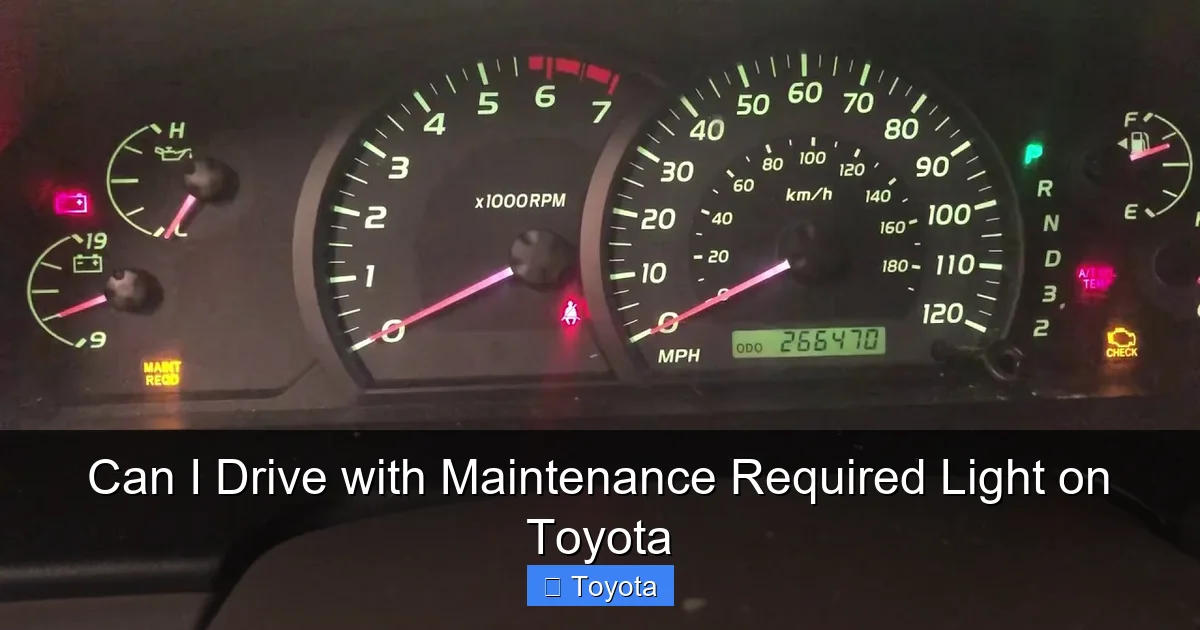
Don’t just look at the light. Your Toyota has a hidden feature: the oil life percentage display. Here’s how to find it (methods vary slightly):
- Turn the ignition to “ON” (do not start).
- Press the “ODO/TRIP” button until you see the odometer.
- Press and hold the button. You’ll see the display change to show “A” or “B” service codes and then the oil life percentage (e.g., “15%”).
This percentage is your most accurate tool. When it hits 0%, the system will typically start blinking before going solid. Plan your service when you see it dip below 20%. Driving with 0% oil life is exceptionally risky and should be avoided. If you find yourself in that situation, get to a shop immediately and do not drive more than absolutely necessary. There’s a related article on our site about driving with 0% oil life that details the extreme risks.
The “Mileage Debt” Concept
Think of the light coming on as your car saying, “I’ve completed my scheduled interval.” Every mile you drive after that is like adding debt. You’re operating outside the designed maintenance window. The longer the debt, the higher the “interest” in terms of wear and tear. A 100-mile delay is minor; a 1,500-mile delay is significant and risky. The goal is to pay off that debt by getting service as soon as conveniently possible.
What to Do the Moment You See That Light
Okay, the light is on. Don’t panic, but do act. Here is your step-by-step action plan:
Step 1: Check Your Oil Level and Condition (Immediately)
Pop the hood, pull the dipstick, and check. Is the oil level between the MIN and MAX marks? Does it look excessively dark, gritty, or sludge-like? This quick check gives you an immediate, physical assessment. If the level is low, top it up with the correct oil type (check your cap) to buy you a little safe margin, but this is a temporary measure, not a solution.
Step 2: Consult Your Owner’s Manual
Your manual has the definitive service schedule for your specific model and year. It will tell you exactly what “Service A” or “Service B” entails. This helps you communicate clearly with your mechanic and understand what you’re paying for.
Step 3: Schedule Service Promptly
Call your trusted Toyota dealer or independent mechanic. Tell them, “My maintenance required light is on, and my oil life is at X%.” They’ll book you in for the appropriate service. If you’re using a third-party shop, ensure they use genuine Toyota parts or high-quality equivalents and reset the light properly.
Step 4: Drive Cautiously Until Your Appointment
Until you get serviced, avoid aggressive driving, excessive idling, towing, or high-speed highway runs. Keep your RPMs moderate. This minimizes stress on an engine with potentially degraded oil. Combine your service trip with other errands to be efficient.
Step 5: Verify the Reset
After the service is complete, start your car. The light should be off. If it comes back on immediately, the shop may have forgotten to reset it. Politely bring it back. Resetting it yourself is possible, but only do this after the actual maintenance is performed. Premature resetting makes your car “forget” it needs service. You can find model-specific guides on our site, such as how to reset the light on a Toyota Tacoma or reset it on a Highlander. The general procedure is similar across most models.
Special Cases: What About Other Lights and Scenarios?
Let’s clear up some common points of confusion that often get mixed up with the maintenance required light.
Maintenance Required vs. Check Engine Light
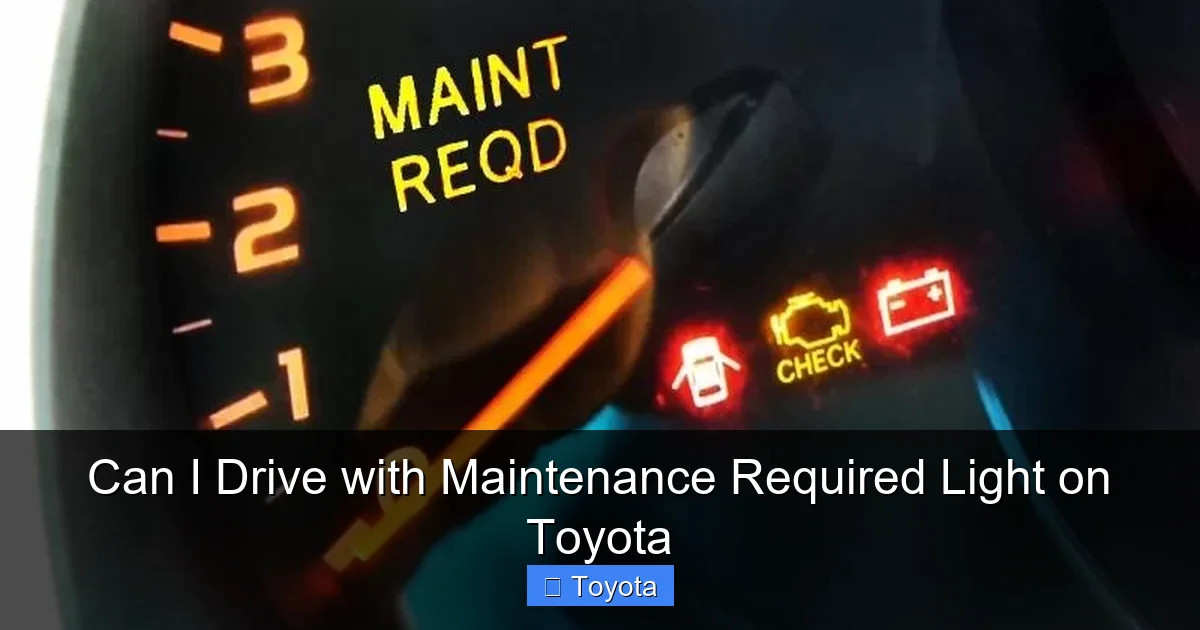
This is the most important distinction. The maintenance required light (usually yellow/amber, a wrench icon or “MAINT REQD”) is a preventive reminder. The check engine light (usually yellow, an engine icon) is a reactive warning that the engine’s emissions or management system has detected a fault. You should never ignore a check engine light. It could be something as simple as a loose gas cap or as serious as a misfiring cylinder. Driving with a check engine light on can damage the catalytic converter. So, if you see an engine icon, get it scanned for codes immediately. The wrench icon is your friend; the engine icon is your car calling for help.
Will This Light Make Me Fail a Safety or Emissions Inspection?
Generally, no. A solid maintenance required light is not a “malfunction indicator” for a safety-critical system (like ABS or airbags) or for the emissions system (which the check engine light covers). Inspectors are looking for active fault codes and safety system failures. However, rules can vary by state or country. It’s always best practice to have your car in optimal condition for an inspection. More importantly, if the underlying issue that would trigger a check engine light (like a failing oxygen sensor) is also overdue for service, that would cause a fail. So, getting the maintenance done is still the smart move.
What If the Light is Blinking?
A solid maintenance required light is normal. A blinking maintenance required light is less common on modern Toyotas but can occur on some older models. A blinking light usually indicates the system has reached an extreme point (like 0% oil life) and is trying to get your urgent attention. Treat a blinking light as a “get serviced within 50 miles” warning. If your light behaves unusually, consult your manual.
The Bottom Line: Your Action Plan
To bring it all home, here is your clear, no-nonsense guide:
- Yes, you can drive a short distance (a few hundred miles) to get to your service appointment.
- No, you should not delay for weeks or thousands of miles. The 500-1,000 mile buffer is a grace period, not a warranty extension.
- Your immediate action is to check oil life % and level. Knowledge is power.
- Schedule the service as soon as humanly possible. Make it a priority.
- Drive gently until then. No racing, no towing.
- Never, ever reset the light without doing the work. It defeats the entire safety system your car built for you.
- Keep records. Your service receipt is your proof of compliance for warranty and future sale.
Your Toyota is engineered for reliability and longevity. That maintenance required light is one of the tools that makes that possible. By respecting it and acting promptly, you protect your investment, ensure your safety, and keep your car running smoothly for years to come. You’re not just avoiding a repair bill; you’re investing in the health of your vehicle.
Frequently Asked Questions
Can I drive long distances with the maintenance required light on?
It’s not advisable. While the light gives a buffer of 500-1,000 miles, long-distance driving puts sustained stress on an engine with potentially degraded oil. Get the service done before any major trip. If you must drive, check your oil level and life percentage first and drive gently.
Will my Toyota fail a state inspection with the maintenance required light on?
No. This light is a scheduled service reminder, not an active fault code for a safety or emissions system. Inspections focus on check engine lights, tire pressure systems, and functional safety equipment. However, getting the maintenance done is still crucial for overall vehicle health.
How is the maintenance required light different from the check engine light?
The maintenance required light (wrench icon) means it’s time for routine, scheduled service like an oil change. The check engine light (engine icon) means the computer has detected a problem with the engine or emissions system that needs immediate diagnosis. Never ignore a check engine light.
What if my maintenance required light is blinking?
A blinking maintenance light is a more urgent warning, typically indicating you’ve reached 0% oil life. You should plan to get service within the next 50-100 miles at most and drive with extreme caution. Check your oil level immediately.
How do I reset the maintenance required light myself after service?
You can reset it using the trip meter button with the ignition on. The exact steps vary by model year. For a 2021 RAV4, it’s different from a 2010 Camry. We have detailed, model-specific guides on our site, like how to reset it on a 2021 RAV4. Always only reset it after the maintenance is fully completed.
Can I just ignore the light if my car seems to be running fine?
No. Internal engine damage from old oil happens silently and cumulatively. By the time you notice performance issues, significant wear may have already occurred. The light is your early warning system to prevent costly damage. Your car may feel fine, but the oil is breaking down at a molecular level.