
Can I Buy a Toyota Extended Warranty After Purchase?

Yes, you can absolutely purchase a Toyota extended warranty after you’ve bought the vehicle, but timing is critical. You typically have a limited window, often up to 36 months or 36,000 miles from the original in-service date, to buy Toyota’s own plans. Costs vary based on your vehicle’s model, trim, mileage, and where you buy it. Always compare the manufacturer’s plan to reputable third-party options and read the full contract to understand exclusions and transfer policies before committing.
So, you just drove your shiny new (or new-to-you) Toyota off the lot. The excitement is palpable. The paperwork is signed, the keys are in your hand. Then, a thought creeps in: “Did I make a mistake by not getting that extended warranty?” Or perhaps you’re a few years into ownership, your factory bumper-to-bumper warranty is ticking down, and you’re wondering if it’s too late to get that peace of mind. The short, reassuring answer is: Yes, you can buy a Toyota extended warranty after purchase. But, and it’s a big but, the process, options, and costs change dramatically depending on when you decide to buy.
This isn’t a simple yes-or-no question. It’s a journey through timing, eligibility, cost structures, and a marketplace filled with both genuine protection and potential pitfalls. Whether you call it a Vehicle Service Agreement (VSA), an extended service plan, or a vehicle protection plan, the goal is the same: to shield you from costly, unexpected repairs after the manufacturer’s warranty expires. Let’s break down everything you need to know, step-by-step, so you can make a smart, informed decision for your Toyota.
Key Takeaways
- Yes, it’s possible: You are not required to buy an extended warranty at the dealership during the initial purchase. Toyota allows you to add its official extended service plans later.
- Strict eligibility windows apply: Toyota’s own plans (Vehicle Service Agreements) must be purchased while your new vehicle’s basic warranty is still active, typically within 3 years/36,000 miles of the original in-service date.
- Costs increase with time/mileage: The price you pay will be higher if you wait until your factory warranty is about to expire compared to buying it right at purchase.
- Third-party options are always available: Independent warranty companies can offer coverage at almost any time, though terms, costs, and reliability vary significantly.
- Read the contract, not just the brochure: Understand exactly what is covered, what is excluded (wear items, abuse), the deductible per visit, and if the plan is transferable to a future buyer.
- Negotiation is possible: The price from the dealer is often marked up. You can negotiate, especially if you’re financing or servicing with them, or shop for better quotes online.
- Financing the warranty adds cost: Rolling the warranty cost into your car loan means you pay interest on it for the entire loan term, increasing the total cost.
📑 Table of Contents
- Understanding Toyota’s Official Warranty Structure
- The Golden Window: When to Buy a Toyota Extended Warranty
- How to Purchase a Toyota Extended Warranty After the Initial Sale
- The Cost Factor: Why Price Varies So Much
- Third-Party Extended Warranties: The Alternative Path
- Making the Decision: Is It Worth It for Your Toyota?
- Critical Questions to Ask Before You Sign
- Conclusion: Your Action Plan
Understanding Toyota’s Official Warranty Structure
Before we talk about buying later, we need to understand what you’re starting with. Every new Toyota comes with a suite of warranties. The most relevant for our discussion is the New Vehicle Limited Warranty, which is essentially a bumper-to-bumper warranty. For 2024 models, this covers most parts and labor for 3 years or 36,000 miles, whichever comes first. There’s also a powertrain warranty (5 years/60,000 miles) and corrosion perforation warranty (5 years/unlimited miles).
The “In-Service Date” is Your Anchor
This is the most critical date you need to know. The “in-service date” is the day your vehicle was first put into service, usually the day it was sold to the first retail customer. All warranty clocks—both the factory warranty and your eligibility for a Toyota extended plan—start from this date, not from when you bought it used. If you’re the second owner, you must get this date from the Toyota dealer or your vehicle history report. Your eligibility for Toyota’s own plans is tied directly to how much time and mileage has elapsed since that in-service date.
What Toyota’s Official Extended Plan Covers
Toyota’s genuine extended service plans (VSAs) are administered by Toyota Motor Insurance Services (TMIS) and are backed by Toyota. They are designed to extend the coverage of the original New Vehicle Limited Warranty. This means they typically cover the same components: most mechanical and electrical parts against failure due to defects in materials or workmanship. They do not cover routine maintenance (oil changes, tire rotations), wear-and-tear items (brake pads, wiper blades, tires), or damage from accidents, abuse, or neglect. Understanding this distinction is vital when comparing plans.
The Golden Window: When to Buy a Toyota Extended Warranty
This is the core of your question. Toyota sets specific eligibility periods for purchasing its official Vehicle Service Agreements. You cannot buy a Toyota VSA at any arbitrary time. The rule of thumb is: You must purchase the plan while your original New Vehicle Limited Warranty is still in effect. In practical terms, this means you have up to 3 years or 36,000 miles from the in-service date to buy. However, the most common and cost-effective time is at the time of initial purchase or very shortly thereafter.
Visual guide about Can I Buy a Toyota Extended Warranty After Purchase?
Image source: toyota.ie
Buying at the Time of Purchase (The Dealer’s Push)
This is when the finance and insurance (F&I) manager will present the extended warranty as an add-on to your financing. Pros: it’s locked in at the lowest possible price because your mileage is zero and the factory warranty is fresh. The cost is often rolled into the loan. Cons: you’re making a significant financial decision under pressure, in a fast-paced office, with the total cost sometimes obscured by monthly payment talk. It’s easy to say “yes” just to finish the deal. You should never feel pressured to decide then and there. You can (and should) take time to research.
Buying After Purchase, But Within the Eligibility Period
This is your sweet spot if you missed the initial pitch. You can call your Toyota dealer’s service department, finance department, or even contact Toyota Customer Experience directly. You can purchase the plan online through Toyota’s official portals or through authorized third-party sellers who offer the genuine Toyota VSA. The key is to do this before your 3-year/36,000-mile factory warranty expires. Once that expires, Toyota will not sell you its own VSA for that vehicle. Your only options then are third-party providers. The price will be higher than if you bought it with 10,000 miles on the clock, but it’s still a valid, manufacturer-backed option.
The Hard Deadline: After Factory Warranty Expiration
If your Toyota’s bumper-to-bumper warranty has ended, the door to purchasing a genuine Toyota Vehicle Service Agreement is officially closed. You are now solely in the market for third-party extended warranties. This is a completely different landscape with different companies, different coverage tiers (often called “exclusionary” or “stated component”), and a much wider range of quality and customer service experiences. You lose the seamless integration with Toyota’s own service network and the direct backing of the manufacturer.
How to Purchase a Toyota Extended Warranty After the Initial Sale
So you’ve decided to proceed. How do you actually buy it after you’ve already taken delivery? The process is straightforward but requires you to be proactive.
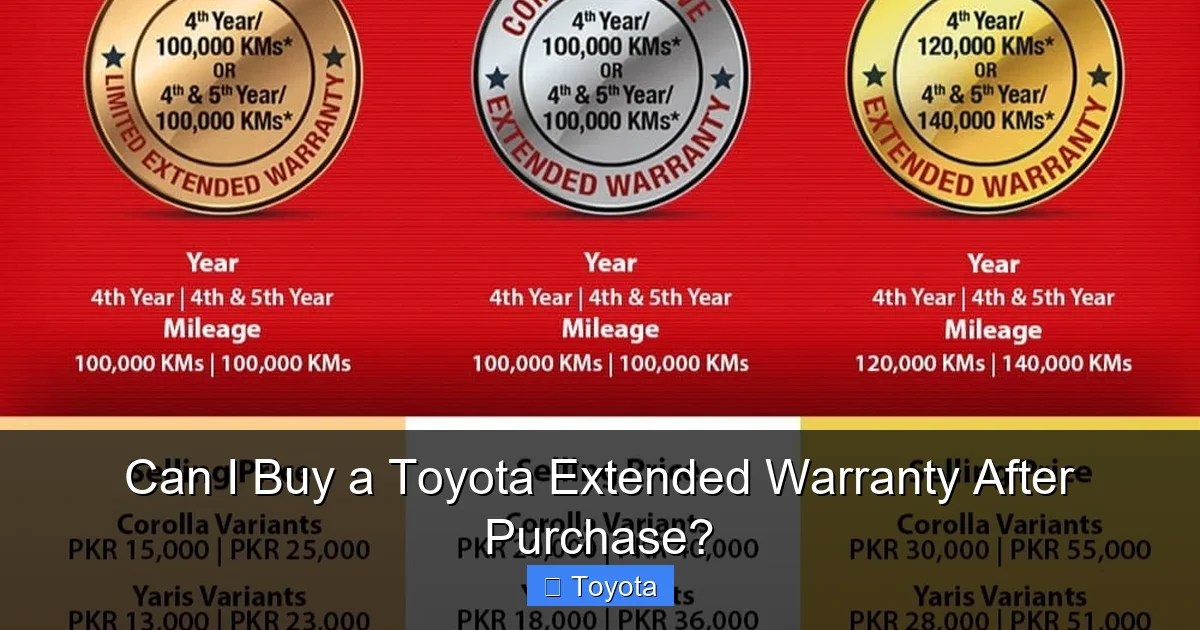
Visual guide about Can I Buy a Toyota Extended Warranty After Purchase?
Image source: toyota-highway.com
Step 1: Gather Your Vehicle Information
You’ll need your Vehicle Identification Number (VIN), current mileage, and the exact date of your original in-service date. This date is non-negotiable for eligibility. You can find the in-service date on your original window sticker (if you have it) or by calling a Toyota dealer with your VIN. Have this info ready for any quote.
Step 2: Get Multiple Quotes
Do not take the first price you’re given. Get quotes from at least three sources:
- Your Selling Dealer: They have a relationship with you and your vehicle. They may offer a competitive price to keep your service business. They can also process it directly.
- A Different Toyota Dealer: Call the finance or service department of another local Toyota dealer. Prices can vary significantly between dealers. Some are more flexible.
- Official Toyota Online Channels: Visit the “Owners” section of the Toyota USA website. They often have tools to get a quote or purchase a VSA directly.
When you get a quote, ask for the full, all-in cash price, not just a monthly payment. Get it in writing (email is fine).
Step 3: Compare the Fine Print
A “Toyota Platinum VSA” from Dealer A should be identical in coverage to a “Toyota Platinum VSA” from Dealer B, as they are all the same underlying contract from TMIS. However, some dealers may bundle in perks like roadside assistance or rental car reimbursement differently. Ensure the term length (e.g., 5 years/60,000 miles total from in-service date) and mileage limit are clearly stated. The most important thing to confirm is that the plan is cancelable for a pro-rated refund if you sell the car. This is a key consumer protection.
The Cost Factor: Why Price Varies So Much
You’ll see quotes ranging from a few hundred to several thousand dollars. Why? Several factors drive the cost of a Toyota extended warranty, and understanding them helps you negotiate.
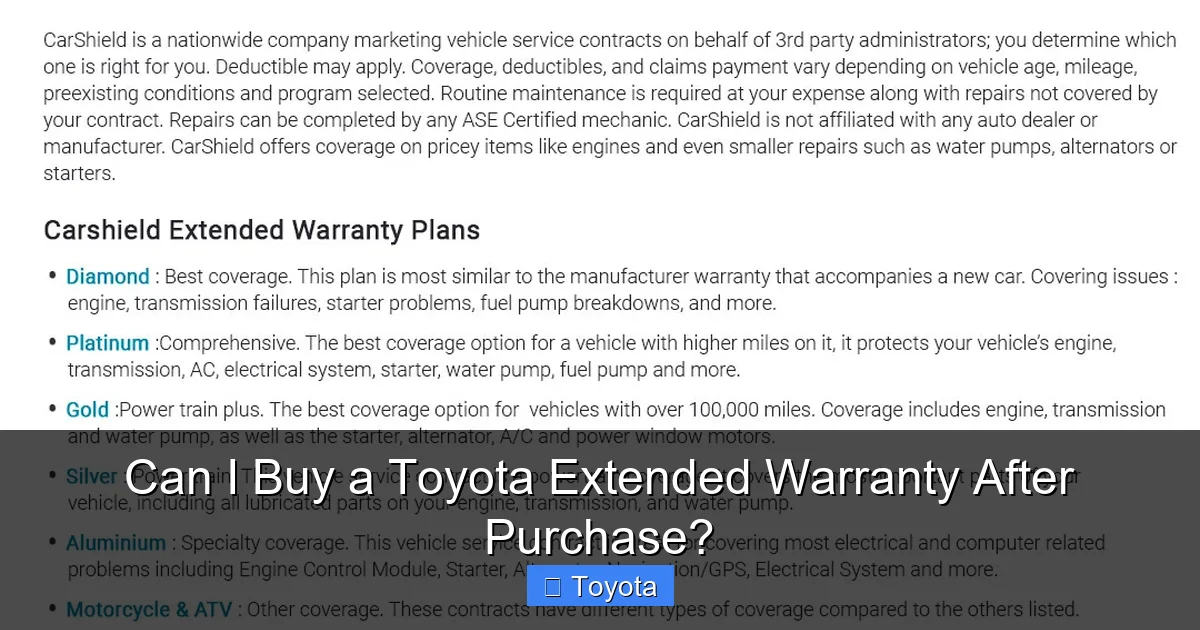
Visual guide about Can I Buy a Toyota Extended Warranty After Purchase?
Image source: toyota-extended-warranty-plans.autowarrantynowlm.com
Primary Drivers of Cost
- Vehicle Model & Trim: A Toyota Camry’s repair costs are different from a Toyota Tundra’s. A base model has fewer complex electronics than a top-trim Limited or Hybrid. High-performance or hybrid models (like the RAV4 Prime) often cost more to cover.
- Current Mileage & Time Elapsed: This is the biggest variable. A plan purchased at 10,000 miles is cheaper than one purchased at 30,000 miles because the perceived risk of a failure occurring during the plan term is lower.
- Deductible: Like insurance, you can choose a deductible per repair visit (e.g., $0, $50, $100, $200). A higher deductible lowers your upfront cost but means you pay more out-of-pocket each time you use the plan.
- Term Length: Extending coverage to 7 years/100,000 miles costs more than extending to 5 years/60,000 miles from your in-service date.
- Dealer Markup: The dealer’s cost for the VSA from Toyota is set. The price they sell it to you for is where their profit lies. This markup is highly negotiable. Some dealers add $500-$1,500 or more.
How to Save Money on Your Toyota VSA
First, get those multiple quotes. Second, be prepared to negotiate. Say, “I have a quote for $X from another dealer. Can you match or beat it?” Third, consider purchasing it online directly through Toyota’s portal, which sometimes has standardized pricing with less room for dealer markup. Fourth, if you’re financing the car, you can often add the VSA cost to the loan, but only do this if the interest rate on the loan is very low (e.g., 0-2%). Otherwise, you’re paying interest on the warranty itself, which is a bad deal. It’s almost always cheaper to pay for the warranty upfront in cash.
Third-Party Extended Warranties: The Alternative Path
Once your Toyota factory warranty expires, or even before, you’ll be inundated with offers from companies like Endurance, CARCHEX, CarShield, and many others. These are not backed by Toyota, but by private insurance companies or warranty administrators. They are a viable option, but they require more diligence.
Pros of Third-Party Plans
- Availability: You can buy them at almost any time, for almost any vehicle, regardless of age or mileage (within their limits).
- Potential Cost: They can sometimes be cheaper than a Toyota VSA, especially for older vehicles.
- Flexibility: You can often choose repair shops, not just Toyota dealers (though using a dealer is usually recommended for complex repairs). Some offer “exclusionary” coverage that lists what’s NOT covered, which is broader than Toyota’s “stated component” list.
Cons and Major Cautions
- Inconsistent Quality: The biggest risk. Some companies have poor customer service, deny claims on technicalities, or have networks of low-quality repair shops. Research is non-negotiable. Read thousands of reviews on BBB, Trustpilot, and consumer forums. Look for patterns of complaint about claim denials or slow payments.
- Coverage Gaps: Read the contract exclusions meticulously. They often exclude “pre-existing conditions,” and proving a failure occurred after you bought the plan but was caused by a pre-existing issue is a common claim denial.
- Direct Repair Shop Relationships: Some third-party administrators have direct pay arrangements with shops. Others require you to pay upfront and get reimbursed, which can be a cash flow problem.
Expert Tip: If you go the third-party route, choose a plan that allows repairs at the Toyota dealer. The dealer’s technicians know your car best and use genuine Toyota parts. This can prevent disputes over whether a repair was done correctly or with proper parts. If you’re considering this path, you might also want to read our article on whether to buy an extended warranty on a used car, as many principles overlap.
Making the Decision: Is It Worth It for Your Toyota?
This is the personal calculus. An extended warranty is, at its heart, a financial product that transfers the risk of large repair bills to the warranty provider in exchange for a known, upfront cost. It’s not an investment; it’s an insurance policy against an uncertain event.
Factors That Favor Buying
- You plan to keep the car long-term: Past the original warranty period, especially if you lack a large emergency repair fund.
- You own a complex, expensive-to-fix model: A Toyota Prius with a hybrid battery, a Tundra with a complex transmission, or a high-tech Avalon with every option. Repair costs for electronics and hybrids can be staggering.
- You value predictable ownership costs: The warranty provides peace of mind and a fixed cost for repairs over the term.
- You are not mechanically inclined: If a breakdown would mean significant rental car costs, lost wages, and logistical hassle.
Factors That Suggest Skipping It
- You plan to sell/trade the car before the factory warranty expires. The money might be better saved as a down payment on your next car.
- Your Toyota is a simple, proven, reliable model with a good repair history. A base-model Camry or Corolla has a reputation for longevity and relatively inexpensive parts.
- You have a robust emergency fund. If you could comfortably write a check for $2,000-$5,000 for a major repair, you may be better off self-insuring and putting the warranty cost into a high-yield savings account.
- The warranty cost is a significant percentage of the car’s current value. If the warranty costs $3,000 and your car is worth $12,000, you’re paying 25% of the car’s value for extra coverage. That’s a high premium.
Remember, your ownership budget is part of a bigger picture. You need to consider total cost of ownership. Our article on how much you can afford for a car can help you frame this warranty decision within your overall finances.
Critical Questions to Ask Before You Sign
Regardless of whether you choose Toyota’s plan or a third-party plan, you must ask these questions and get the answers in writing within the contract.
Is the Plan Transferable?
This is huge. If you sell your car before the warranty term is up, a transferable plan can increase your resale value and is a selling point. Toyota’s VSA is transferable for a small fee. Most third-party plans are transferable, but confirm the fee and process. A non-transferable plan is essentially dead money if you sell the car.
What is the Deductible and How is it Applied?
Is it $0 per visit? $100? Is it per repair visit or per diagnosed problem? A $100 deductible on a $1,200 repair is manageable. A $100 deductible on a $150 repair feels terrible. Understand the structure.
What are the Specific Exclusions?
Do not accept a summary. Read the “What is NOT Covered” section. Common exclusions: wear items (brakes, tires, belts), maintenance, damage from improper fuel, aftermarket parts, pre-existing conditions, and consequential damage (e.g., a failed water pump damages the engine—is the engine damage covered?).
What is the Claims Process?
Do you call the warranty company first, or can you take it to your trusted Toyota dealer and have the dealer handle the authorization? A direct-to-dealer process is far more convenient. Ask about average claim approval times and payment methods (direct pay to shop vs. reimbursement to you).
Who Backs the Plan?
For Toyota, it’s TMIS. For third-party, it’s an insurance company. Look up the financial strength rating of the backing entity (from A.M. Best or similar). You want a company that will be solvent 5 years from now when you might need a major repair.
Conclusion: Your Action Plan
So, can you buy a Toyota extended warranty after purchase? Absolutely. The path you take depends entirely on your vehicle’s current mileage, its age, your long-term ownership plans, and your risk tolerance. Here is your clear action plan:
- If your Toyota is still under its original 3-year/36,000-mile bumper-to-bumper warranty: You are in the prime eligibility zone for a genuine Toyota VSA. Get quotes from multiple dealers and the official Toyota website. Negotiate the cash price hard. Compare that final number to your own assessment of risk and your budget.
- If your Toyota’s factory warranty has expired: Your only option is a third-party plan. This requires intense research. Do not buy based on a low monthly payment or a persuasive sales call. Read the actual contract exclusions. Check the company’s BBB profile and recent reviews. Get a full, written quote for the exact coverage you want. Consider starting your search with highly-rated companies, but always read the fine print.
- If you are unsure: Take the money you would have spent on a warranty (e.g., $2,500) and put it into a separate high-yield savings account. Treat it as a “self-insured” repair fund. If you have a major repair, use it. If you sell the car, you keep the cash. This eliminates the risk of claim disputes and gives you full control.
The extended warranty decision is a personal one with no one-size-fits-all answer. By understanding the rules, the timing windows, the true costs, and the fine print, you move from being a potential target for high-pressure sales to an informed consumer making a strategic choice for your Toyota’s future. Your goal isn’t to avoid all risk—that’s impossible—but to make a calculated decision that aligns with your financial plan and gives you genuine peace of mind on the road.
Frequently Asked Questions
What is the absolute latest I can buy a Toyota extended warranty?
You must purchase Toyota’s official Vehicle Service Agreement (VSA) while your vehicle’s original New Vehicle Limited Warranty is still active. This means you have until the earlier of 3 years or 36,000 miles from the vehicle’s original in-service date. After that date, Toyota will not sell you its own extended plan for that vehicle.
Will buying an extended warranty after I buy the car cost more?
Yes, almost certainly. The premium is based on the vehicle’s current mileage and the remaining time on the original warranty. A plan purchased with 5,000 miles is significantly cheaper than one purchased with 30,000 miles because the statistical risk of a failure during the plan term is lower. Waiting always increases the cost.
Can I finance an extended warranty after the car purchase?
Yes, you can often roll the cost of a warranty into your existing auto loan if you’re financing through the dealer, but this is generally not advisable. You will pay interest on the warranty cost for the entire remaining loan term, making the total cost much higher than paying cash upfront. It’s better to save and pay cash for the warranty separately.
What’s the biggest difference between a Toyota VSA and a third-party warranty?
The biggest difference is who backs the plan and the network. A Toyota VSA is administered by Toyota and typically requires repairs at a Toyota dealer, using genuine Toyota parts. It’s integrated with the manufacturer’s systems. A third-party warranty is backed by an independent insurance company, may allow repairs at any certified shop, and has vastly different contract terms, customer service quality, and claim approval processes that require careful vetting.
If I sell my car, can I get my money back for the unused portion of the warranty?
With a Toyota VSA and most reputable third-party plans, yes—you can receive a pro-rated refund for the unused time and mileage if you cancel the plan. There is usually a small administrative fee (e.g., $25-$50) and you must cancel within a specified period, often 30-60 days from purchase, for a full refund. Always confirm the cancellation and refund policy in the contract before signing.
Is an extended warranty a good idea for a high-mileage, reliable Toyota like a Camry?
It depends on your personal risk tolerance and financial situation. A high-mileage, simple-model Toyota like a Camry has a lower probability of a catastrophic repair but is not immune. If you lack a $3,000-$5,000 emergency fund and plan to keep the car for several more years, a warranty might provide valuable peace of mind. If you have a solid savings buffer, you might be better off self-insuring and saving the warranty payment for potential future repairs.
