Can Hail Damage Total a Car?

Contents
- 1 Key Takeaways
- 2 📑 Table of Contents
- 3 What Does “Totaled” Actually Mean?
- 4 How Hail Damage Actually Works on a Car
- 5 The Math Behind the Total Loss Decision
- 6 When Hail Almost Guarantees a Total Loss
- 7 What To Do Immediately After Hail Damage
- 8 Protecting Your Car From Future Hail
- 9 Frequently Asked Questions

Waterless Car Wash Spray

Car Mud Flaps (Universal)

Liquid Car Polish

Car Paint Touch Up Pen
Yes, hail damage can absolutely total a car. An insurance company declares a car a “total loss” when the cost to repair it exceeds a certain percentage of its actual cash value (ACV), typically 70-80%. A single severe hailstorm can cause enough dents, broken glass, and structural damage to meet or surpass that threshold, especially on older or less valuable vehicles. The process involves an adjuster’s assessment, your deductible, and ultimately, the insurance company taking ownership and paying you the car’s pre-damage value.
Key Takeaways
- Total Loss is a Financial Calculation: A car is “totaled” not just because it’s badly damaged, but because repair costs exceed a set percentage (usually 70-80%) of its pre-damage market value.
- Hail Causes Multi-Faceted Damage: It’s not just cosmetic dents. Hail can shatter windows, damage the roof, hood, and trunk, and even compromise the structural integrity of the frame.
- Older & Less Valuable Cars Are Most At Risk: A $3,000 repair bill on a car worth $8,000 will easily be totaled, while the same damage on a $40,000 vehicle might be repaired.
- Your Deductible Matters: If your comprehensive deductible is $500 and the repair estimate is $3,000, the insurance company’s payout is $2,500. This net cost is what’s compared to the car’s value.
- Frame Damage is a Major Red Flag: Hail can cause misalignment and hidden frame damage. If the frame is bent, repair costs skyrocket, making a total loss highly likely. You can learn more about the serious implications of frame damage in our detailed guide.
- You Have Options if Your Car is Totaled: You can accept the settlement and surrender the car, negotiate the value, or keep the salvage (if allowed) and get a reduced payout.
📑 Table of Contents
What Does “Totaled” Actually Mean?
Let’s clear up the biggest misconception right away. When we say a car is “totaled,” it doesn’t automatically mean it’s a mangled, un-drivable wreck sitting in a junkyard—though it can be. In insurance terms, a total loss is a purely financial decision. It happens when the estimated cost to repair the vehicle exceeds a certain percentage of its Actual Cash Value (ACV)—what the car was worth immediately before the damage occurred.
This threshold varies by state and insurance company but is most commonly between 70% and 80%. This is often called the “total loss threshold” or “total loss formula.” So, if your 2015 Honda Civic with 100,000 miles has an ACV of $7,000, and the repair shop estimates $5,500 in hail damage, the insurance company will likely declare it a total loss because $5,500 is over 70% of $7,000 ($4,900). They pay you the $7,000 (minus your deductible) and take ownership of the damaged car.
The Role of Your Deductible
Your comprehensive deductible is the amount you pay out of pocket before insurance kicks in. This directly impacts the total loss calculation. Using the example above, if your deductible is $500, the insurance company’s net cost to repair is $5,000 ($5,500 – $500). That’s still 71.4% of the $7,000 value, so it’s still a total. But if the repair was $4,800, the net cost is $4,300, which is 61.4% of the value—it might get repaired. Your deductible effectively lowers the repair cost from the insurer’s perspective.
How Hail Damage Actually Works on a Car
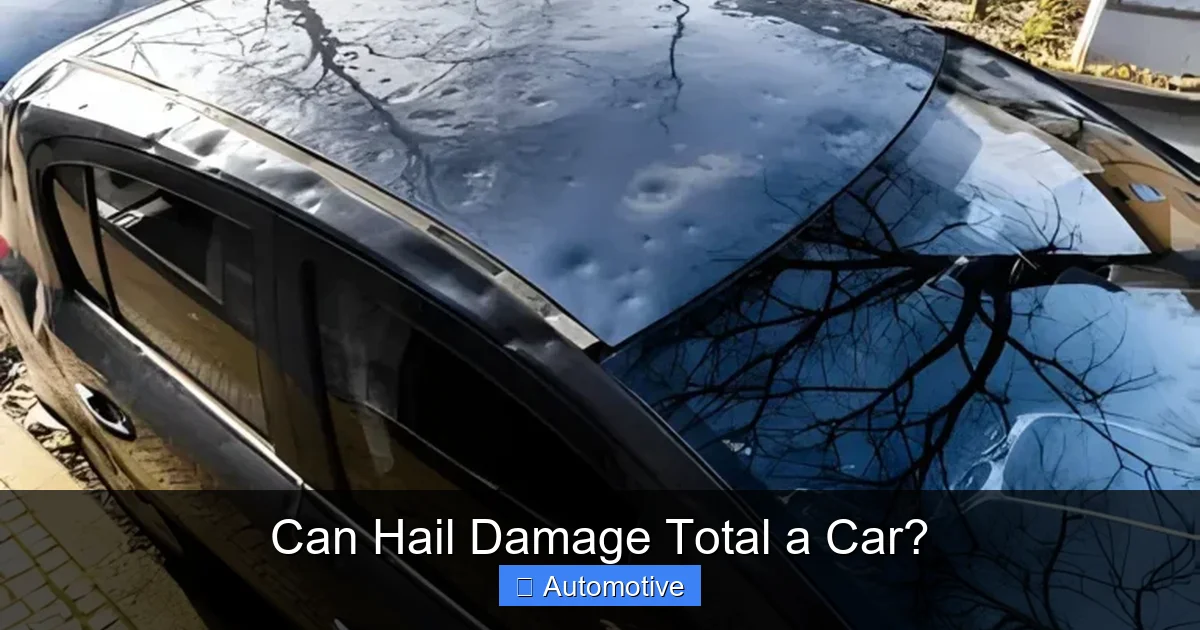
Hail is nature’s sandblaster. When golf ball-sized or larger hailstones bombard a vehicle at high speed, they cause a specific type of damage that can be deceptively expensive to fix. It’s rarely just a few dents.

Visual guide about Can Hail Damage Total a Car?
Image source: stormwisehailrepair.com
The Trio of Damage: Dents, Glass, and Structure
Hail damage typically manifests in three ways:
- Cosmetic Dents: The most obvious. These are on horizontal surfaces like the hood, roof, and trunk lid. Fixing them involves paintless dent repair (PDR) or traditional bodywork. On a large surface area, the labor hours add up incredibly fast.
- Glass Breakage: Windshields, sunroofs, and rear windows are highly vulnerable. A single large hailstone can crack or shatter them. Replacing a windshield costs $500-$1,500+ depending on the car, and modern cars with sensors (rain, lane assist) in the glass are far more expensive.
- Structural Damage: This is the silent killer of a car’s value. Hail can dent roof rails, crush the roof’s structural integrity, and even cause subtle bends in the frame. Assessing and repairing frame damage is complex and costly, often involving laser measuring and hydraulic straightening. If the structural damage is severe, the car may be deemed unsafe to drive even if it looks repairable.
The severity depends on hail size, density, wind speed, and duration of the storm. A 10-minute barrage of baseball-sized hail will do vastly more damage than a brief shower of pea-sized hail. For a clearer picture of how even smaller hail can cause problems, check out our analysis on pea-sized hail damage.
The Math Behind the Total Loss Decision
So how does an insurance adjuster actually decide? It’s a process with a few key steps.

Visual guide about Can Hail Damage Total a Car?
Image source: robinsonstith.com
Step 1: Determining the Actual Cash Value (ACV)
The insurer will first determine your car’s ACV. They use proprietary software that considers make, model, year, mileage, condition, pre-existing damage, and local market sales data (like Kelley Blue Book or NADA guides). They might also ask for maintenance records and photos. This is the baseline number. If you disagree with their valuation, you can negotiate by providing comparable listings for similar vehicles in your area.
Step 2: Getting the Repair Estimate
An adjuster will inspect the car, often alongside a certified mechanic or body shop estimator. They itemize every repair: each dent, each broken part, labor hours, paint, and the cost of an alignment check (to rule out frame damage). This estimate is their official number. It’s not uncommon for a full-hood and roof of dents to generate a 20-40 hour labor estimate before parts are even added.
Step 3: The Calculation and Threshold
They take the total repair cost and subtract your comprehensive deductible. The result is the net repair cost. They then divide that by the ACV.
Example:
Car ACV: $12,000
Repair Estimate: $9,500
Your Deductible: $1,000
Net Repair Cost to Insurer: $8,500 ($9,500 – $1,000)
Net Repair Cost / ACV = $8,500 / $12,000 = 0.708 (or 70.8%)
If your insurer’s threshold is 70%, this car is a total loss. If their threshold is 80%, it might be repaired. The insurer will choose the lesser of the two outcomes: pay for repairs OR pay you the ACV and take the car.
When Hail Almost Guarantees a Total Loss
While every case is unique, certain scenarios make a total loss almost inevitable:
Visual guide about Can Hail Damage Total a Car?
Image source: metamechanics.ae
Older Cars with High Mileage
A 10-year-old car with 150,000 miles might have an ACV of $4,000. A moderate hailstorm that causes $2,500 in damage (after deductible) totals 62.5% of its value. A bad storm easily pushes that to 100% or more. The lower the car’s value, the lower the repair cost threshold needed to total it.
Cars with Pre-Existing Damage
If your car already had a dented fender or cracked headlight, the adjuster will note that. They will only pay for the new hail damage. However, the pre-existing damage can sometimes lower the ACV, making a total loss slightly less likely, but it’s a minor factor.
Luxury and Performance Cars with Expensive Parts
Paradoxically, a high-end car like a new Mercedes or Tesla might be less likely to be totaled by hail because its ACV is so high. A $15,000 repair bill on a $80,000 car is only 18.75%. However, if that same storm shatters a $3,000 panoramic sunroof and dents every aluminum panel, the repair bill could hit $35,000+, which could still trigger a total. The key is the ratio.
Multiple Hail Events
If your car was in a previous hailstorm and you made a claim, your car now has a “hail damage” notation on its history report (like Carfax). This significantly lowers its ACV for a future claim. A second, even minor hailstorm could then push repair costs over the lowered value threshold, resulting in a total loss.
What To Do Immediately After Hail Damage
If you’ve been through a hailstorm, your actions in the first few days are critical.
1. Document Everything Thoroughly
Before moving anything, take hundreds of photos and videos from every angle. Get close-ups of dents, broken glass, and any interior water intrusion. Capture the license plate and VIN. If it’s safe, take wide shots showing the hailstones on the ground and the general area. This is your evidence for the claim and for disputing any lowball valuations.
2. Contact Your Insurance Company Promptly
File a claim under your comprehensive coverage as soon as possible. Many insurers will have a surge of claims after a major storm. Report it, get your claim number, and ask about their specific process. Do not authorize any repairs until an adjuster has seen the car, unless you have explicit permission.
3. Get Independent Repair Estimates
While the insurer will send their adjuster, it’s wise to get 2-3 written estimates from reputable, local body shops you trust. These can be used to challenge the insurer’s estimate if it seems too low. Be sure the shops inspect for potential frame damage using proper measuring tools.
4. Understand Your Rights and Options
If the car is totaled, the insurer will offer you the ACV minus your deductible. You can:
- Accept the settlement: Sign over the title and the insurer takes the car.
- Negotiate the ACV: Use your research (comparable sales) to argue for a higher value. This is common and often successful.
- Retain the salvage: In some states, you can buy the totaled car back from the insurer for its salvage value. You’ll get a reduced payout (ACV minus salvage value and your deductible). The car will get a “salvage” or “rebuilt” title, which drastically reduces its future value and makes it very hard to insure.
If frame damage is confirmed, your options become more limited and the financial hit greater. The implications of driving or selling a car with compromised structural integrity are serious, as detailed in our articles on dealerships selling frame-damaged cars and private sales of such vehicles.
Protecting Your Car From Future Hail
While you can’t control the weather, you can be proactive.
Know Your Risk and Have a Plan
If you live in “Hail Alley” (Texas, Colorado, Nebraska, Oklahoma, etc.), hail is a real annual threat. Know where you can park safely—a permanent garage is best. If you don’t have one, consider a high-quality, thick car cover rated for hail (not just sun/rain). Some comprehensive policies offer “hail deductible waivers” for an extra premium, which can be worth it in high-risk areas.
Use Weather Apps and Alerts
Enable severe weather alerts on your phone. If a hailstorm is imminent while you’re out, try to pull under a sturdy overpass or into a parking garage. Avoid trees—falling branches cause additional damage. If you’re caught in the open, pull over safely, face the car away from the wind (to protect the front windshield and engine), and cover yourself with a blanket if possible.
Review Your Insurance Policy Annually
Understand your comprehensive deductible. If you have a $1,000 deductible on a $10,000 car, a moderate hailstorm might not be worth claiming (as you’d pay the first $1,000). Some people with older cars choose a higher deductible to lower premiums, accepting the risk of minor damage. For newer cars, a lower deductible ($250-$500) makes more sense.
Frequently Asked Questions
Can a car be totaled from hail if it still drives fine?
Absolutely. A car can be perfectly drivable but still be declared a total loss. The decision is based on the math of repair costs versus the car’s value, not its operational status. Severe cosmetic and structural damage can make the repair uneconomical.
Will my insurance rates go up if I file a hail damage claim?
Generally, no. Hail damage is considered an “act of God” or a comprehensive claim, which is not-at-fault. Most states prohibit insurers from raising your rates solely for a comprehensive claim. However, if you live in a high-risk area and file multiple claims, your insurer could non-renew your policy at the end of your term.
What if I disagree with the insurance company’s total loss decision or valuation?
You have the right to dispute it. First, negotiate the ACV by providing evidence like local sales listings for comparable cars. You can also get your own independent repair appraisal. If you still disagree, you can request a third-party appraisal (if your policy has an appraisal clause) or consult with a lawyer specializing in insurance bad faith.
Can I keep my hail-damaged car if it’s totaled?
Yes, in most cases you can “retain the salvage.” You would pay the insurer the estimated salvage value of the damaged car, and they would pay you the ACV minus your deductible and minus that salvage value. The car gets a salvage title, which is a major red flag for future buyers and insurers.
Is hail damage always covered by insurance?
Hail damage is covered if you have comprehensive coverage (also called “other than collision” coverage) as part of your auto insurance policy. This is an optional coverage in most states. If you only have liability insurance, hail damage would not be covered.
What’s the difference between a salvage title and a rebuilt title after a hail total loss?
A salvage title is issued when an insurer declares a car a total loss. A rebuilt title (sometimes called “reconstructed”) is issued after a salvage-titled car has been repaired, passes a state inspection, and is deemed roadworthy again. Both titles severely hurt a car’s value and make it difficult to obtain full insurance coverage.