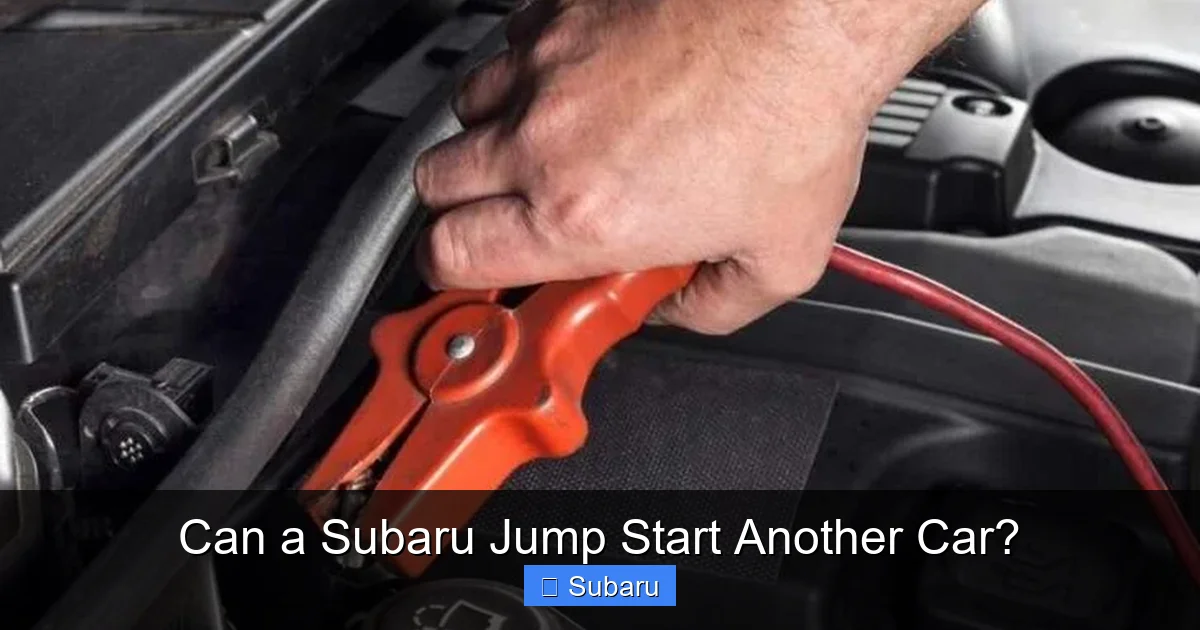
Can a Subaru Jump Start Another Car?

Contents
- 1 Key Takeaways
- 2 📑 Table of Contents
- 3 How Jump Starting Works
- 4 Tools and Equipment You’ll Need
- 5 Step-by-Step Guide to Jump Starting with a Subaru
- 6 Safety Precautions and Common Mistakes
- 7 Alternative Solutions: Portable Jump Starters
- 8 Tips for Maintaining Your Subaru’s Battery
- 9 Real-World Example: Jump Starting in the Snow
- 10 Conclusion
- 11 Frequently Asked Questions

Radiator Coolant
Fuel Injector Cleaner

Car Interior LED Light

Tire Shine Spray
Yes, a Subaru can jump start another car—safely and effectively—as long as you follow the correct procedures. With its reliable battery and electrical system, a Subaru is well-suited for jump-starting other vehicles, but it’s crucial to use proper cables and techniques to avoid damage or injury.
Have you ever been stranded in a parking lot, staring at a dead car battery and wondering if your trusty Subaru can come to the rescue? You’re not alone. Whether you’re helping a friend, family member, or even a stranger, knowing whether your Subaru can jump start another car is a valuable skill. The good news? Yes, it absolutely can—and it’s often a straightforward process when done correctly.
Subaru vehicles, from the compact Impreza to the rugged Outback and powerful WRX, are built with reliable 12-volt electrical systems. These systems are designed to handle the demands of daily driving, including powering accessories and starting the engine. Because most cars on the road today use similar 12-volt batteries, a Subaru is fully capable of providing the necessary power to jump start another vehicle. However, while the capability is there, the key lies in doing it safely and correctly.
Jump-starting might seem simple—just attach some cables and hope for the best—but a few wrong moves can lead to damaged electronics, blown fuses, or even personal injury. That’s why understanding the right steps, the right equipment, and the right precautions is essential. In this guide, we’ll walk you through everything you need to know about using your Subaru to jump start another car, from preparation to execution and beyond.
Key Takeaways
- Subarus are capable jump starters: Most Subaru models have 12-volt electrical systems compatible with standard jump-starting procedures.
- Use quality jumper cables: Thick, well-insulated cables with strong clamps ensure a solid connection and reduce the risk of sparks or short circuits.
- Follow the correct sequence: Connecting cables in the right order—positive first, then negative—prevents electrical surges and protects both vehicles.
- Never let the clamps touch: Accidental contact between the positive and negative clamps can cause sparks, damage electronics, or even start a fire.
- Let the donor car run during charging: Keeping your Subaru’s engine running helps maintain voltage and speeds up the charging process.
- Disconnect in reverse order: Remove the negative clamp first when disconnecting to minimize the risk of short circuits.
- Know when to call a pro: If the dead battery shows signs of damage or the car still won’t start after multiple attempts, seek professional help.
📑 Table of Contents
How Jump Starting Works
At its core, jump starting is a way to transfer electrical energy from a healthy battery to a dead one. When a car battery dies, it no longer has enough charge to power the starter motor, which is needed to turn over the engine. By connecting the dead battery to a live one using jumper cables, you allow current to flow into the dead battery, giving it enough juice to restart the engine.
The process relies on basic principles of electricity. A car battery stores direct current (DC) electricity and delivers it through two terminals: positive (red) and negative (black). When you connect the positive terminal of the working battery to the positive terminal of the dead one, and the negative terminal to a grounded metal part on the dead car, you complete a circuit. This allows electrons to flow from the donor battery to the dead one, recharging it just enough to start the engine.
It’s important to note that jump starting doesn’t fully recharge a dead battery—it only gives it a temporary boost. Once the engine is running, the alternator takes over, recharging the battery as you drive. That’s why it’s recommended to drive the revived car for at least 20–30 minutes after a jump start to help restore the battery’s charge.
Why a Subaru Is a Good Donor Vehicle
Not all cars are created equal when it comes to jump starting. Some vehicles have sensitive electronics that can be damaged by improper connections, while others may have weak batteries that can’t provide enough power. Subarus, however, are generally well-suited for the job.
Most Subaru models come equipped with robust 12-volt lead-acid batteries that are designed to deliver high cranking amps—the amount of current a battery can produce at 32°F (0°C) for 30 seconds without dropping below a specified voltage. This makes them capable of not only starting their own engines in cold weather but also providing enough power to jump start another car.
Additionally, Subaru’s electrical systems are built with durability in mind. Whether you’re driving a Forester on a mountain trail or a Legacy in city traffic, the wiring and components are engineered to handle real-world conditions. This reliability extends to jump-starting scenarios, where consistent voltage and stable current flow are crucial.
Another advantage is the placement of the battery. In most Subaru models, the battery is located in the engine bay and is easily accessible, making it simple to connect jumper cables without crawling under the car or removing panels. This accessibility reduces the risk of fumbling with connections in low-light or high-traffic situations.
Tools and Equipment You’ll Need

Visual guide about Can a Subaru Jump Start Another Car?
Image source: suoutback.com
Before you attempt to jump start another car with your Subaru, it’s essential to have the right tools on hand. Having everything ready beforehand ensures a smooth, safe process and minimizes the risk of mistakes.
Jumper Cables
The most critical tool is a good set of jumper cables. Not all cables are created equal—cheap, thin cables may not carry enough current or could overheat during use. Look for cables that are at least 4-gauge or thicker, with strong, insulated clamps and a length of 10 to 20 feet. This gives you enough reach to position the cars close but not touching.
High-quality cables often feature color-coded clamps (red for positive, black for negative) and built-in surge protection to reduce the risk of electrical spikes. Some premium sets even include LED indicators that show when a proper connection is made.
Safety Gear
Safety should always come first. Wear safety glasses to protect your eyes from sparks or battery acid, and consider wearing gloves to protect your hands. Batteries can leak or vent gases, especially if they’re old or damaged, so minimizing direct contact is wise.
Owner’s Manuals
Keep both your Subaru’s and the other car’s owner’s manuals handy. These can provide specific instructions for jump starting, including the location of the battery terminals and any special precautions. Some modern vehicles have designated jump-start points or require the use of a specific grounding location.
Optional Tools
While not always necessary, having a few extra items can make the process easier:
– A flashlight for visibility in low light
– A small towel or rag to wipe off battery terminals
– A portable jump starter as a backup (more on this later)
Step-by-Step Guide to Jump Starting with a Subaru

Visual guide about Can a Subaru Jump Start Another Car?
Image source: multimeterworld.com
Now that you’re prepared, let’s walk through the actual process of using your Subaru to jump start another car. Follow these steps carefully to ensure safety and success.
Step 1: Position the Vehicles
Park your Subaru close to the dead car, but make sure the two vehicles are not touching. Turn off both engines and engage the parking brakes. If possible, position the cars so the batteries are within reach of the jumper cables—usually about 3 to 6 feet apart.
Step 2: Turn Off Electronics
In both cars, turn off all electrical accessories: headlights, radio, air conditioning, phone chargers, etc. This reduces the load on the electrical system and helps prevent voltage spikes when the connection is made.
Step 3: Locate the Battery Terminals
Open the hoods of both vehicles and locate the batteries. Identify the positive (+) and negative (-) terminals. The positive terminal is usually marked with a red cover or a “+” symbol, while the negative is black or marked with a “-”.
In some modern cars, especially those with advanced electronics, the negative terminal may not be directly accessible. In such cases, look for a designated grounding point—often a metal bracket or bolt near the engine—specified in the owner’s manual.
Step 4: Connect the Jumper Cables
Follow this exact sequence to avoid sparks or short circuits:
1. **Connect the red (positive) clamp** to the positive terminal of the dead battery.
2. **Connect the other red clamp** to the positive terminal of your Subaru’s battery.
3. **Connect the black (negative) clamp** to the negative terminal of your Subaru’s battery.
4. **Connect the remaining black clamp** to an unpainted metal surface on the dead car—such as a bolt or bracket on the engine block. Do not connect it to the negative terminal of the dead battery, as this can cause sparks near potentially flammable gases.
Step 5: Start the Donor Car
Start your Subaru’s engine and let it run for a few minutes. This allows the alternator to generate power and begin charging the dead battery. You may notice the headlights or dashboard lights on the dead car flicker slightly—this is normal.
Step 6: Attempt to Start the Dead Car
After 3–5 minutes, try starting the dead car. If it doesn’t start right away, wait another minute or two and try again. Do not crank the engine for more than 10 seconds at a time. If it still won’t start after three attempts, there may be a deeper issue—such as a faulty starter, alternator, or severely damaged battery.
Step 7: Disconnect the Cables
Once the dead car is running, disconnect the cables in the reverse order:
1. Remove the black clamp from the grounded metal on the dead car.
2. Remove the black clamp from your Subaru’s negative terminal.
3. Remove the red clamp from your Subaru’s positive terminal.
4. Remove the red clamp from the dead battery’s positive terminal.
Be careful not to let the clamps touch each other or any metal surfaces during removal.
Step 8: Let the Revived Car Run
Keep the revived car running for at least 20–30 minutes to allow the alternator to recharge the battery. Avoid turning it off immediately, as the battery may not have enough charge to restart.
Safety Precautions and Common Mistakes

Visual guide about Can a Subaru Jump Start Another Car?
Image source: static.pakwheels.com
While jump starting is generally safe, it’s not without risks. A few common mistakes can lead to serious consequences, so it’s important to be aware of the dangers and how to avoid them.
Avoiding Sparks and Short Circuits
One of the biggest risks during jump starting is creating a spark near the battery. Car batteries can emit hydrogen gas, which is highly flammable. A single spark can ignite the gas, causing an explosion.
To minimize this risk:
– Always connect the positive cable first and the negative last.
– Never let the clamps touch each other while connected to a battery.
– Connect the final negative clamp to a grounded metal part, not the dead battery’s negative terminal.
Protecting Electronics
Modern cars are packed with sensitive electronics—ECUs, sensors, infotainment systems—that can be damaged by voltage spikes. While most Subarus are built to handle jump starting, improper connections can still cause issues.
To protect both vehicles:
– Use high-quality jumper cables with surge protection.
– Avoid jump starting if either battery is cracked, leaking, or swollen.
– If the dead car has a known electrical issue, consult a mechanic before attempting a jump.
Don’t Jump Start a Frozen Battery
Never attempt to jump start a battery that is frozen. A frozen battery can expand and crack, leaking acid or even exploding when current is applied. If the battery feels cold or you suspect it’s frozen, let it warm up naturally before attempting a jump.
Know When to Call a Professional
Sometimes, a dead battery isn’t the real problem. If the car still won’t start after a proper jump, there could be issues with the starter motor, alternator, or fuel system. Repeated jump attempts can drain your Subaru’s battery and strain its electrical system.
If you’ve tried jump starting multiple times with no success, it’s time to call a tow truck or roadside assistance. It’s better to be safe than sorry.
Alternative Solutions: Portable Jump Starters
While using your Subaru to jump start another car is effective, it’s not always the most convenient option. What if you’re alone? Or the dead car is in a tight spot? That’s where portable jump starters come in.
A portable jump starter is a compact, battery-powered device that can jump start a car without needing another vehicle. These devices are becoming increasingly popular due to their convenience and reliability.
How They Work
Portable jump starters contain a lithium-ion battery that stores enough charge to start most gasoline engines. Simply connect the clamps to the dead battery (following the same positive-first, negative-last sequence), turn on the device, and start the car.
Many models include additional features like USB ports for charging phones, LED flashlights, and even air compressors for inflating tires.
Benefits Over Traditional Jump Starting
– No need for a second vehicle
– Safer in tight spaces or busy roads
– Can be used in remote areas
– Often lighter and easier to store
Choosing the Right Portable Jump Starter
When shopping for a portable jump starter, look for one with at least 1000 peak amps for most cars. Check compatibility with your vehicle type (gas, diesel, hybrid) and ensure it has safety features like reverse polarity protection and spark-proof clamps.
While a portable jump starter is a great backup, it’s still smart to keep jumper cables in your Subaru. You never know when you might need to help someone else—or when your own battery might fail.
Tips for Maintaining Your Subaru’s Battery
A healthy battery is essential not only for your own car but also for jump-starting others. Regular maintenance can extend your battery’s life and ensure it’s always ready when needed.
Check the Battery Regularly
Inspect your Subaru’s battery every few months. Look for signs of corrosion (a white, powdery substance on the terminals), loose connections, or physical damage. Clean corrosion with a mixture of baking soda and water, and tighten any loose clamps.
Test the Battery and Charging System
Most auto parts stores offer free battery and alternator testing. Have your system checked annually, especially before winter, when cold weather can reduce battery performance.
Drive Regularly
Short trips don’t give the alternator enough time to fully recharge the battery. If you only drive short distances, consider taking longer drives occasionally or using a battery maintainer.
Avoid Draining the Battery
Leaving lights, chargers, or accessories on when the engine is off can drain the battery quickly. Get in the habit of double-checking that everything is off before you walk away.
Replace When Needed
Most car batteries last 3–5 years. If your Subaru is struggling to start, especially in cold weather, it may be time for a replacement. Don’t wait until you’re stranded.
Real-World Example: Jump Starting in the Snow
Imagine this: It’s a cold winter morning, and your neighbor’s sedan won’t start. The temperature dropped overnight, and the battery is too weak to turn over. You grab your jumper cables and head over in your Subaru Outback.
You position the cars carefully on the icy driveway, making sure they don’t slip. After turning off all electronics, you connect the cables in the correct order. You start your Outback and let it run for five minutes, watching the dashboard lights on the sedan flicker to life.
After a few tries, the sedan roars to life. You disconnect the cables, thank your neighbor, and head back inside—mission accomplished. This scenario is not only possible but common, especially in colder climates where batteries struggle in low temperatures.
Your Subaru, with its all-wheel drive and reliable engine, is not just a great winter vehicle—it’s also a dependable helper in emergencies.
Conclusion
So, can a Subaru jump start another car? The answer is a resounding yes. With its strong battery, accessible terminals, and durable electrical system, a Subaru is an excellent choice for jump-starting other vehicles. Whether you’re helping a friend on a chilly morning or assisting a stranded motorist on the highway, knowing how to do it safely and correctly is a valuable skill.
Remember, the key to successful jump starting lies in preparation, proper technique, and safety. Use quality cables, follow the correct connection sequence, and always prioritize safety over speed. And while your Subaru is more than capable of lending a hand, don’t forget to maintain your own battery so you’re always ready to help—or be helped—when the need arises.
With these tips in mind, you can confidently use your Subaru to jump start another car, turning a stressful situation into a simple fix. After all, being prepared isn’t just about having the right tools—it’s about knowing how to use them.
Frequently Asked Questions
Can a Subaru jump start a larger vehicle like a truck or SUV?
Yes, a Subaru can typically jump start larger vehicles like trucks or SUVs, as long as both vehicles use 12-volt electrical systems. However, larger engines may require more cranking power, so it may take a few extra minutes of charging before the engine starts.
Is it safe to jump start a car with a hybrid or electric vehicle?
Jump starting a hybrid is generally safe and follows the same process, but always consult the owner’s manual first. Electric vehicles (EVs) usually cannot be jump started in the traditional sense and may require specialized assistance or a tow to a charging station.
What if my Subaru’s battery is weak? Can it still jump start another car?
If your Subaru’s battery is weak or old, it may not have enough power to jump start another car. In such cases, it’s better to use a portable jump starter or call for roadside assistance to avoid draining your own battery completely.
Can jump starting damage my Subaru’s electrical system?
When done correctly, jump starting poses minimal risk to your Subaru’s electrical system. However, improper connections, using damaged cables, or jump starting a severely damaged battery can cause voltage spikes that may harm sensitive electronics.
How long should I let my Subaru run after jump starting another car?
After jump starting, let your Subaru run for at least 10–15 minutes to ensure its battery remains charged. If you turned off the engine immediately, your battery might not have enough charge to restart, especially if it was already low.
Can I use a portable jump starter instead of my Subaru?
Absolutely. A portable jump starter is a convenient alternative that doesn’t require another vehicle. It’s ideal for solo drivers or situations where positioning two cars is difficult. Just make sure the jump starter is fully charged and compatible with the dead vehicle.