
Can a Car Run Without a Battery

Yes, a car can technically run without a battery—but only under very specific conditions and for a limited time. Once the engine is started using an external power source, the alternator takes over to power electrical systems and recharge the battery. However, removing the battery entirely often leads to system failures, stalling, or damage.
Key Takeaways
- A car can run briefly without a battery if the engine is already started. The alternator generates electricity to power the vehicle’s electronics once the engine is running.
- Modern cars are not designed to operate without a battery. Even if the alternator supplies power, the battery stabilizes voltage and prevents electrical surges.
- Starting the engine requires a battery. Without it, you cannot crank the engine unless using a jump start or push-start method (manual transmissions only).
- Push-starting works only on manual transmission vehicles. Automatic cars cannot be push-started due to their transmission design.
- Running without a battery risks damaging electronics. Voltage spikes from the alternator can fry sensitive components like the ECU, sensors, or infotainment systems.
- Battery acts as a buffer and stabilizer. It smooths out power delivery and protects against fluctuations that could disrupt engine performance.
- It’s unsafe and impractical to drive long-term without a battery. Most vehicles will shut down within minutes or experience erratic behavior.
📑 Table of Contents
- Can a Car Run Without a Battery? The Surprising Truth
- How Your Car’s Electrical System Works
- Can You Start a Car Without a Battery?
- What Happens When You Run a Car Without a Battery?
- Why Modern Cars Can’t Run Without a Battery
- When Might You Need to Run Without a Battery?
- Safety and Practical Considerations
- Conclusion: Should You Ever Run a Car Without a Battery?
Can a Car Run Without a Battery? The Surprising Truth
You’re out on a quiet country road when suddenly your car sputters and dies. You pop the hood, check the belts, and everything looks fine—except the battery is completely dead. Panic sets in. But then you wonder: *Can a car run without a battery?* Maybe if you just get it started somehow, it’ll keep going?
This question pops up more often than you’d think, especially among DIY mechanics, road-trippers, and curious car owners. The short answer? Yes—but with major caveats. While a car *can* technically run without a battery once the engine is already going, doing so is risky, unreliable, and generally not recommended.
To understand why, we need to dive into how your car’s electrical system actually works. It’s not just about starting the engine. Modern vehicles rely on a complex network of electronics that depend on stable, consistent power. The battery isn’t just a starter motor fuel tank—it’s the heart of your car’s electrical ecosystem.
In this article, we’ll break down exactly what happens when you remove or disconnect your car battery, explore real-world scenarios where cars have run (briefly) without one, and explain why most mechanics and manufacturers strongly advise against it. Whether you’re troubleshooting a dead battery or just satisfying your curiosity, this guide will give you the full picture—no jargon, no fluff, just practical facts.
How Your Car’s Electrical System Works
Visual guide about Can a Car Run Without a Battery
Image source: vehiclefreak.com
Before we get into whether a car can run without a battery, let’s clarify how the electrical system functions when everything is working properly. Think of your car’s electrical setup like a small power grid—similar to your home, but much more compact and mobile.
At the center of this system are two key components: the battery and the alternator. They work together in a carefully balanced dance to keep your car running smoothly.
The battery’s main job is to provide a burst of high-voltage power to start the engine. When you turn the key (or press the start button), the battery sends electricity to the starter motor, which cranks the engine until it ignites and begins running on its own. This initial surge is critical—without it, the engine won’t turn over at all.
Once the engine is running, the alternator takes over. It’s driven by a belt connected to the engine’s crankshaft, and as the engine spins, the alternator generates electricity. This power is used to run all the car’s electrical systems—lights, radio, climate control, fuel injectors, sensors, and more—while also recharging the battery for the next start.
But here’s the catch: the alternator doesn’t produce perfectly smooth power. Its output fluctuates with engine speed and load. That’s where the battery comes in again—not just as a backup, but as a stabilizer. It acts like a shock absorber for your car’s electrical system, smoothing out voltage spikes and dips to protect sensitive electronics.
The Role of the Battery Beyond Starting
Many people think the battery’s only job is to start the car. But that’s like saying your smartphone battery only powers the screen. In reality, the battery plays several vital roles:
– **Voltage stabilization:** It absorbs excess voltage when the alternator overproduces (like at high RPMs) and supplies extra power when demand spikes (like when you turn on headlights, AC, and the radio at idle).
– **Backup power:** If the alternator fails or can’t keep up with electrical demand, the battery picks up the slack to keep critical systems running.
– **Surge protection:** Sudden power surges from the alternator can damage delicate components. The battery buffers these spikes, acting as a protective layer.
– **Engine management support:** Modern engines rely on electronic control units (ECUs) that need constant, clean power. Even minor voltage drops can cause misfires, stalling, or error codes.
Without the battery, the alternator is essentially feeding raw, unregulated power directly into the system. That’s like plugging your laptop into a wall socket with no surge protector—it might work for a moment, but it’s only a matter of time before something fries.
Alternator vs. Battery: Who Does What?
It’s easy to confuse the alternator and battery, especially since both deal with electricity. But they serve very different purposes:
| Component | Primary Function | When It’s Active |
|———|——————|——————|
| Battery | Provides high-current power to start the engine | Only during startup and when engine is off |
| Alternator | Generates electricity to power systems and recharge battery | Only when engine is running |
Think of the battery as the sprinter—it delivers a quick, powerful burst of energy when needed. The alternator is the marathon runner—it sustains power over time but can’t handle sudden high-demand situations on its own.
This分工 (division of labor) is why you can’t just remove the battery and expect everything to work. The alternator keeps the car running, but it can’t start it—and it can’t protect the system from electrical chaos.
Can You Start a Car Without a Battery?
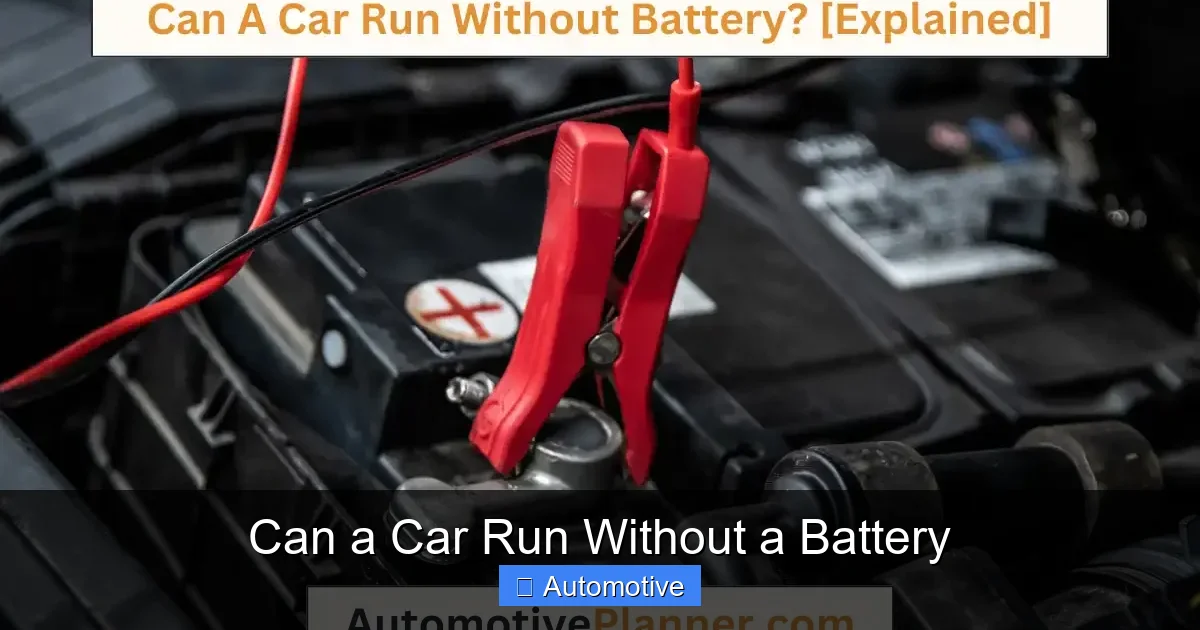
Visual guide about Can a Car Run Without a Battery
Image source: automotiveplanner.com
Now for the million-dollar question: Can you even *start* a car without a battery? The short answer is no—not in most cases.
The battery is essential for cranking the engine. The starter motor requires a significant amount of electrical current (often 100–200 amps or more) to turn the engine over. No other component in your car can deliver that kind of power surge on demand.
Jump-Starting: Using External Power
If your battery is dead but still in place, you can use jumper cables and another vehicle (or a portable jump starter) to supply the necessary power. This effectively “borrows” the other battery’s energy to crank your engine. Once the engine starts, the alternator takes over, and your car can run normally—assuming the battery is still functional enough to stabilize the system.
But what if the battery is completely removed or missing? Can you jump-start a car with no battery at all?
Technically, yes—but it’s tricky and not recommended. You’d need to connect jumper cables directly to the car’s main power terminals (usually the positive terminal on the starter solenoid and a solid ground on the engine block). However, without the battery to absorb voltage spikes, the risk of frying electronics is extremely high. Many modern cars have safeguards that may prevent starting altogether if the battery isn’t detected.
Push-Starting (aka Bump-Starting)
There’s one exception: manual transmission vehicles can sometimes be push-started. This method uses the car’s momentum to turn the engine over, bypassing the need for the starter motor.
Here’s how it works:
1. Turn the ignition to the “on” position (so electronics are active).
2. Press the clutch and shift into second gear.
3. Have someone push the car (or roll it down a hill).
4. Once the car reaches about 5–10 mph, quickly release the clutch.
5. The engine should turn over and start.
This works because the wheels spin the transmission, which turns the engine via the clutch. Once the engine fires, the alternator begins generating power.
But—and this is a big but—push-starting only works on manual cars. Automatic transmissions don’t allow the engine to be turned over by the wheels in the same way. The torque converter and hydraulic systems prevent this mechanical link, making push-starting impossible.
Even in manual cars, push-starting without a battery is risky. Without the battery to stabilize voltage, the ECU and sensors may not function properly, leading to rough running, stalling, or failure to start at all.
What Happens When You Run a Car Without a Battery?
Visual guide about Can a Car Run Without a Battery
Image source: shunauto.com
Let’s say you somehow get the engine running—maybe via jump-start or push-start—and then disconnect or remove the battery. What happens next?
In theory, the alternator should keep the car running. After all, it’s designed to power the vehicle once the engine is going. And in very old, simple cars (like pre-1980s models with basic electrical systems), this might actually work for a short time.
But in modern vehicles, running without a battery is a recipe for trouble.
Voltage Spikes and Electrical Damage
The alternator doesn’t produce clean, steady power. Its output varies with engine speed. At idle, it might produce 13.5 volts. At high RPMs, it can spike to 15 volts or more. Without the battery to absorb these fluctuations, those spikes travel directly to your car’s electronics.
Sensitive components like the engine control unit (ECU), fuel injectors, oxygen sensors, and infotainment systems are designed to operate within a narrow voltage range—typically 12–14.5 volts. Exceeding this can cause permanent damage.
For example, a voltage spike could fry the ECU, leaving your car unable to manage fuel delivery or ignition timing. Or it could destroy the radio, navigation system, or even the dashboard display. Repairs can cost hundreds or thousands of dollars.
Erratic Engine Performance
Even if no components are immediately damaged, running without a battery often leads to poor engine performance. The ECU relies on stable power to make precise adjustments to fuel mixture, ignition timing, and emissions controls. Voltage fluctuations can cause:
– Rough idling
– Hesitation or stalling
– Misfires
– Check engine lights
– Reduced fuel efficiency
In some cases, the car may run fine at high RPMs (when the alternator produces steady power) but stall at idle or low speeds.
Sudden Shutdowns
One of the most common outcomes of running without a battery is sudden engine shutdown. This happens when the alternator can’t keep up with electrical demand—especially when multiple systems are active (like headlights, AC, and heated seats).
Without the battery to supply extra power during these peaks, the voltage can drop below the level needed to keep the ECU and fuel pump running. The result? The engine dies unexpectedly, often in traffic or at low speeds.
This isn’t just inconvenient—it’s dangerous. Losing power steering, brakes, and lights while driving can lead to accidents.
Real-World Examples
There are anecdotes of people driving short distances without a battery—usually in older cars or as a last resort. For instance, some truck drivers in remote areas have reported running diesels without batteries for brief periods. But these are exceptions, not the rule.
One Reddit user shared a story of disconnecting their battery to “test” if the alternator was working. The car ran for about two minutes before the engine sputtered and died. When they reconnected the battery, the car started normally—but the check engine light came on, indicating a potential sensor issue.
Another case involved a 1970s muscle car with a simple carbureted engine and minimal electronics. The owner removed the battery and drove a few blocks. The car ran, but the headlights flickered, and the radio cut in and out. It worked—but barely.
These examples highlight a key point: the simpler the car, the more likely it is to run without a battery. But even then, it’s unreliable and risky.
Why Modern Cars Can’t Run Without a Battery
Modern vehicles are essentially computers on wheels. They rely on dozens of electronic control units (ECUs) to manage everything from engine performance to safety systems. These systems demand stable, clean power—something only a battery can reliably provide.
Complex Electronics and Sensors
Today’s cars have hundreds of sensors monitoring engine temperature, airflow, throttle position, oxygen levels, and more. Each sensor sends data to the ECU, which adjusts fuel, spark, and emissions in real time. If power fluctuates, these sensors can send incorrect signals, leading to poor performance or false error codes.
For example, a voltage drop might cause the mass airflow (MAF) sensor to report incorrect data, leading the ECU to inject too much or too little fuel. This can cause the engine to run rich (wasting fuel) or lean (risking engine damage).
Computer-Controlled Systems
Many critical systems are now fully electronic:
– Electronic fuel injection (EFI)
– Variable valve timing (VVT)
– Turbocharger wastegates
– Anti-lock braking systems (ABS)
– Electronic stability control (ESC)
These systems require precise timing and consistent power. Without the battery’s stabilizing effect, they may malfunction or shut down entirely.
Alternator Limitations
While alternators are powerful, they’re not designed to handle sudden loads. For example, turning on the headlights, AC, and heated seats at idle creates a high electrical demand. The alternator may not respond quickly enough, causing a voltage dip. The battery fills this gap instantly.
Without it, the voltage drop can be enough to reset the ECU or disable key systems.
Manufacturer Warnings
Most car manufacturers explicitly warn against running a vehicle without a battery. Owner’s manuals often state that the battery is a required component for proper operation. Some vehicles even have diagnostic systems that detect a missing or disconnected battery and may prevent the engine from starting or running.
For example, some BMW and Mercedes models will trigger a “battery malfunction” error and limit engine performance if the battery is removed. Similarly, many Toyotas and Hondas use smart charging systems that rely on battery feedback to regulate alternator output.
When Might You Need to Run Without a Battery?
Despite the risks, there are rare situations where someone might consider running a car without a battery—usually as a temporary fix or diagnostic step.
Testing the Alternator
One common reason people remove the battery is to test whether the alternator is working. The logic: if the car keeps running after disconnecting the battery, the alternator must be functional.
But this is a flawed test. As we’ve seen, the car might run briefly even with a faulty alternator—or fail to run even with a good one, due to voltage instability. Modern alternators also have built-in regulators that may shut down if they detect abnormal conditions (like no battery).
A better way to test the alternator is with a multimeter. Measure the voltage at the battery terminals with the engine off (should be ~12.6V) and then with the engine running (should be 13.5–14.5V). If it’s outside this range, the alternator may be faulty.
Emergency Situations
In extreme cases—like being stranded in a remote area with a dead battery and no replacement—someone might attempt to run the car without one. But even then, the risks often outweigh the benefits.
If you’re in this situation, it’s usually better to:
– Use a portable jump starter
– Call for roadside assistance
– Wait for help rather than risk damaging your car
Older or Classic Cars
Some vintage cars with simple electrical systems (like pre-1970s models) may tolerate running without a battery better than modern vehicles. These cars often have mechanical fuel pumps, points ignition, and minimal electronics.
But even then, it’s not ideal. The battery still helps stabilize voltage and protect the generator (the older term for alternator).
Safety and Practical Considerations
Running a car without a battery isn’t just mechanically risky—it’s also a safety hazard.
Loss of Critical Systems
Without stable power, systems like power steering, power brakes, and ABS may not function properly. This increases stopping distance and reduces control, especially in emergencies.
Fire Risk
Voltage spikes can cause wires to overheat or components to short-circuit, potentially leading to electrical fires. This is especially dangerous in older cars with degraded wiring.
Legal and Warranty Issues
Modifying your car’s electrical system by removing the battery could void your warranty or violate local regulations. Insurance companies may also deny claims if damage results from improper modifications.
Environmental Impact
Car batteries contain lead and acid, which are hazardous if mishandled. Removing and discarding a battery improperly can harm the environment. Always recycle batteries at approved facilities.
Conclusion: Should You Ever Run a Car Without a Battery?
So, can a car run without a battery? Technically, yes—but only under very specific conditions and for a short time. Once the engine is started using an external power source, the alternator can keep it running. However, removing the battery disrupts the electrical system’s balance, leading to voltage spikes, erratic performance, and potential damage to sensitive electronics.
In modern vehicles, the battery is not optional. It’s a critical component that stabilizes power, protects electronics, and ensures reliable operation. Running without one is unsafe, impractical, and likely to cause more problems than it solves.
If your battery is dead, the best solution is to replace it or use a jump starter. If you’re troubleshooting electrical issues, consult a professional mechanic rather than experimenting with your car’s power system.
Remember: your car’s electrical system is designed to work as a team. The battery and alternator are partners—not competitors. Removing one disrupts the entire system.
So the next time you’re tempted to disconnect the battery to “see what happens,” think twice. Your car—and your wallet—will thank you.
Frequently Asked Questions
Can a car run without a battery if the alternator is working?
Yes, but only briefly and with significant risks. The alternator can power the car once the engine is running, but without the battery to stabilize voltage, electrical systems may malfunction or get damaged.
Can you drive a car long-term without a battery?
No. Most modern cars will stall within minutes or experience erratic behavior. The battery is essential for voltage regulation and protecting sensitive electronics.
Can you push-start an automatic car without a battery?
No. Automatic transmissions cannot be push-started because the torque converter doesn’t allow the engine to be turned over by the wheels.
Will removing the battery damage the alternator?
Not directly, but running without a battery can cause voltage spikes that damage the alternator or other components over time.
Can a car start with a completely dead battery?
Only with external help, like jumper cables or a portable jump starter. The battery is required to power the starter motor.
Is it safe to disconnect the battery while the engine is running?
No. This can cause severe voltage spikes, damaging the ECU, sensors, and other electronics. Always shut off the engine before disconnecting the battery.
