California Window Tint Law Explained

Contents
- 1 Key Takeaways
- 2 📑 Table of Contents
- 3 Understanding VLT: The Heart of the Law
- 4 The Front Windshield and Front Side Windows: Strictly Light
- 5 Rear Side Windows and Rear Window: The Privacy Zone
- 6 Reflective, Colored, and Other Restricted Tints
- 7 Medical Exemptions: A Narrow Path
- 8 Enforcement, Penalties, and What Happens if You Get Caught
- 9 Choosing the Right Tint for Your BMW: A Practical Guide
- 10 Conclusion: Style Meets Compliance for Your BMW
- 11 Frequently Asked Questions


California’s window tint law is strict but clear for BMW owners. The front windshield and front side windows must allow over 70% of visible light (VLT), while rear windows have no darkness limit. Reflective and mirrored tints are heavily restricted, and only specific medical conditions grant exemptions. Violations result in fix-it tickets with fines, and improper tint can fail registration. Always get tint from licensed installers who provide a compliance certificate to ensure your BMW stays legal and stylish.
So, you just picked up your dream BMW—maybe a sleek 3 Series or a powerful X5—and you’re thinking about adding some aftermarket window tint. It’s a popular mod for a reason. Tint gives your car a sharper, more aggressive look, provides privacy for you and your passengers, and, let’s be honest, helps keep that SoCal sun from baking you alive in your luxury cabin. But before you book that appointment, you need to understand the California window tint law. It’s one of the stricter states in the nation, and getting it wrong can lead to tickets, failed inspections, and a major headache. Let’s break it all down, BMW style.
Key Takeaways
- Front windows must be very light: The front windshield (below the AS-1 line) and both front side windows must have a VLT of at least 70%, meaning they must remain mostly clear.
- Rear windows can be dark: There is no minimum VLT requirement for the back side windows and rear window on passenger vehicles, allowing for limousine-level privacy.
- Reflective tint is banned up front: Metallic or mirrored tint that creates a reflective appearance is illegal on the front windshield and front side windows.
- Medical exemptions are rare and specific: Only drivers with conditions like lupus or porphyria documented by a physician can get a medical exemption for darker front tint.
- Enforcement is common and penalties apply: Law enforcement uses tint meters. First-time violations typically result in a “fix-it” ticket requiring tint removal or replacement, plus court fees.
- Factory tint is not a free pass: Even if your BMW came with tinted glass from the factory, aftermarket additions must still comply with California’s VLT laws for the respective windows.
- Certification is your proof: Reputable installers provide a signed certificate stating the tint’s VLT percentage. Keep this in your vehicle as proof of compliance during a traffic stop.
📑 Table of Contents
- Understanding VLT: The Heart of the Law
- The Front Windshield and Front Side Windows: Strictly Light
- Rear Side Windows and Rear Window: The Privacy Zone
- Reflective, Colored, and Other Restricted Tints
- Medical Exemptions: A Narrow Path
- Enforcement, Penalties, and What Happens if You Get Caught
- Choosing the Right Tint for Your BMW: A Practical Guide
- Conclusion: Style Meets Compliance for Your BMW
Understanding VLT: The Heart of the Law
Everything in California’s tint regulations revolves around a single, critical metric: VLT, or Visible Light Transmission. Simply put, VLT is the percentage of visible light that a window allows to pass through. A 70% VLT tint allows 70% of light in and blocks 30%. A 5% VLT “limo” tint only allows 5% of light in. The lower the percentage, the darker the tint.
California law sets different VLT thresholds for different windows on your vehicle. It’s not a one-size-fits-all rule. The state is primarily concerned with ensuring law enforcement officers can see inside a vehicle during a traffic stop for officer safety. This is why the front windows have such high light transmission requirements.
How VLT is Measured and Certified
It’s not a casual guess. Professional installers use a device called a tint meter, which shines a light through the window and measures the output. Reputable shops will measure the tint on your car after installation and provide you with a certificate or sticker that lists the exact VLT percentage for each window. This documentation is your first line of defense if you’re pulled over. Always insist on getting this certificate and keep it in your glove compartment.
For BMW owners, a common question is about factory-tinted glass. Many BMW models, especially higher trims, come with what’s called “privacy glass” from the factory. This is actually a dyed glass, not a film, and it often meets around a 20% VLT. The law explicitly states that the factory-installed glass is considered part of the vehicle’s original equipment and is legal. The problem arises when you add aftermarket tint *on top* of that factory glass. The combined VLT of the factory glass plus any added film must still meet the legal minimum for that window position. For the front windows, even a very light 50% film over factory 20% glass would likely push you well below the 70% legal limit, making it illegal.
The Front Windshield and Front Side Windows: Strictly Light
This is the non-negotiable part of the California window tint law that catches most people off guard. The rules here are designed to maximize visibility for police and for you as the driver.
Visual guide about California Window Tint Law Explained
Image source: lawyersfavorite.com
Front Windshield Rules
On the front windshield, tint is only permitted in the top 4 inches (often marked by the manufacturer’s AS-1 line on the glass). This “stripe” or “shade band” is meant to reduce glare from the sun high in the sky. It must be non-reflective. You cannot tint the entire windshield. Any attempt to apply a full windshield tint, no matter how light, is a violation. For a BMW with a large windshield, this means the vast majority of your forward view must remain completely clear.
Front Side Windows (Driver & Passenger)
Both the driver’s and front passenger’s side windows must allow a minimum of 70% of light to pass through. This is a very light tint—often described as “clear” or “limo clear.” It provides minimal privacy and heat rejection compared to darker films but is the only legal option for these windows in California. A common misconception is that you can have a darker tint on the front passenger window if the driver’s window is light. This is false. Both must meet the 70% VLT standard independently. For BMW owners, this is a key consideration. If you want the aesthetic of darker windows all around, you’ll have to accept that the front two will remain relatively light, creating a two-tone look that some find less appealing.
Practical BMW Example: Let’s say you have a BMW 3 Series with factory privacy glass (approx. 20% VLT) in the rear. If you add a 50% VLT film to the front windows, the combined VLT would be roughly 10% (0.20 * 0.50 = 0.10), which is far darker than the legal 70% minimum. To be legal, you would need to use a film on the front windows that, when combined with the factory glass, results in 70% or higher VLT. This often means using a film rated at 70% or even slightly higher (like 75% or 80%) on the front, assuming the factory glass is already tinted. If your BMW has clear factory glass (70%+ VLT), you could add a very light film, but it’s rarely necessary.
Rear Side Windows and Rear Window: The Privacy Zone
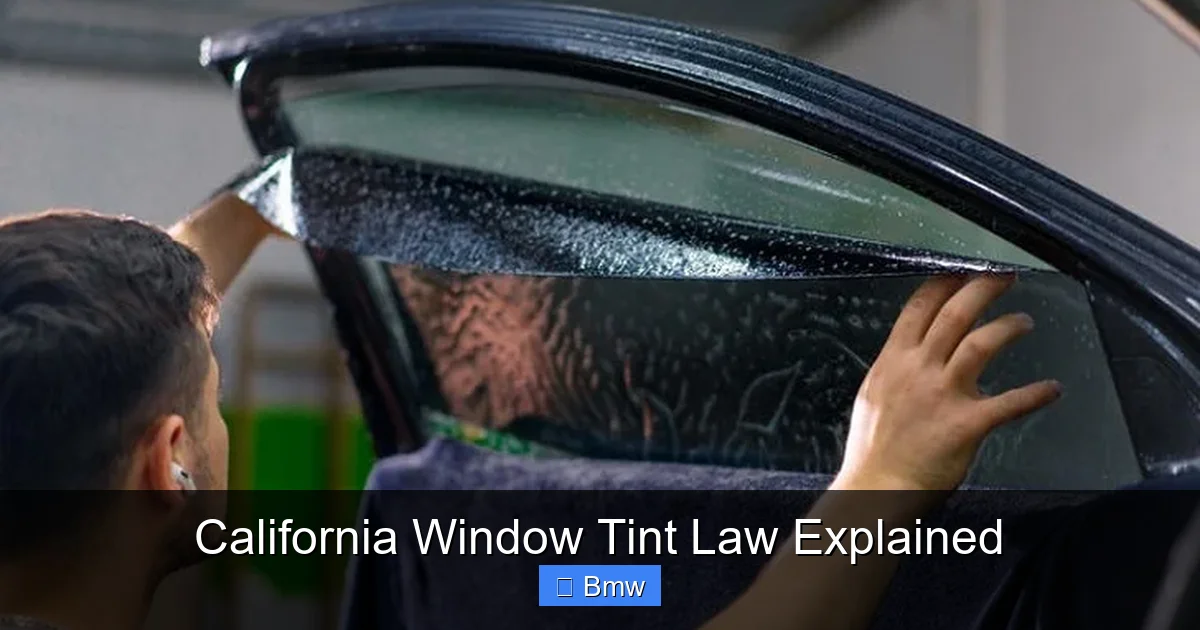
Here’s where you have real freedom. California has no VLT limit for the rear side windows and the rear window on passenger vehicles. This means you can go as dark as you want—5%, 10%, whatever your heart desires—for that ultimate limousine look and maximum heat/UV protection. This is great for BMW owners who want to protect their rear passengers, cargo, or just create a sleek,一体化 appearance from the back.
Visual guide about California Window Tint Law Explained
Image source: lawyersfavorite.com
The SUV and Van Caveat
It’s crucial to note the vehicle classification. The “no limit” rule applies to passenger vehicles. If your BMW is an X5, X6, or X7 and it’s registered as an SUV or a van (based on its manufacturer’s classification), the same rear-window freedom applies. However, for vehicles designed to carry more than 10 persons (like a converted BMW coach bus), different rules apply, but that’s not relevant for standard BMW models.
Side Mirrors and the “See-Through” Rule
Even with ultra-dark rear tint, you must have a clear view. California law requires that your side mirrors provide an unobstructed view of the highway behind you. If your rear window is so dark that you cannot see adequately through it, you are required to have two side mirrors (which you already have) and use them. The law doesn’t specify a VLT number for this; it’s a subjective safety standard. A good installer will advise you that a 5% tint on the rear window of a BMW with a small rear window might significantly impair your direct rearward vision, making those side mirrors critical. For safety and legal compliance, many tint shops recommend against going darker than 15-20% on the rear window of smaller cars.
Reflective, Colored, and Other Restricted Tints
VLT isn’t the only regulation. California also bans certain *types* of tint based on their appearance and reflectivity.
Visual guide about California Window Tint Law Explained
Image source: windowtintlaws.us
The Reflective/Metallic Tint Ban
Tint films that have a metallic or mirrored appearance—they look like a one-way mirror or have a shiny, chrome-like finish—are illegal on the front windshield and front side windows. The law is clear: “No person shall place… any material upon the front windshield… or the front side windows… which is reflective or the optical quality of which is such that it would constitute a safety hazard.” This is a safety measure to prevent glare that could blind other drivers or distort the driver’s view. You can use reflective tint on the rear windows, but it’s still not recommended as it can create a confusing, mirror-like effect for drivers behind you.
Color Tint Restrictions
California does not specifically ban the *color* of tint (like red, blue, yellow). However, any tint must meet the VLT requirements. A deep red or blue film that is also very dark (low VLT) on the front windows would be illegal because of its darkness, not its color. The primary concern is light transmission, not hue. That said, some colors (like very dark blue) can appear almost black and may be more likely to attract an officer’s attention for a closer VLT check. For a BMW, a neutral grey or charcoal is the most common and least conspicuous choice.
Other Bans: Stickers, Sandblasting, and More
You cannot place any stickers, decals, or other materials on the front windshield except for those required by law (like an emissions sticker or toll transponder) in a specific, small area. “Sandblasted” or “etched” glass, where a design is permanently etched into the glass, is also prohibited on the front windshield and front side windows if it reduces light transmission below 70%. This is common on some high-end factory options, but aftermarket etching on front windows is a violation.
Medical Exemptions: A Narrow Path
California does provide a pathway for drivers with certain medical conditions to obtain an exemption from the front window VLT requirements. This is not a get-out-of-jail-free card for wanting darker windows for style; it’s a strict medical necessity program.
Qualifying Conditions
The law lists specific conditions that may qualify, including:
- Lupus erythematosus
- Porphyria
- Photosensitivity due to certain medications (like some antibiotics or chemotherapy drugs)
- Severe sunburn history (documented by a physician)
- Other conditions where exposure to sunlight would be a significant hazard, as certified by a physician.
The Application Process
To get an exemption, you must:
- Obtain a signed statement from a licensed physician (MD or DO) on their letterhead. The statement must include your name, the specific medical condition, and a certification that the condition requires the use of a motor vehicle with a sun-screening device (tint) for the driver’s and/or passenger’s side windows.
- Submit this statement to the California Department of Motor Vehicles (DMV). The DMV will review it and, if approved, issue you a special medical exemption document.
- You must carry this document in your vehicle at all times. It is not a permanent sticker for your window; it’s a permit you show if questioned.
The exemption, if granted, applies only to the front side windows. The 70% VLT rule for the front windshield strip still stands. Also, the exemption is tied to the registered owner/driver, not the vehicle itself. If you sell your BMW, the exemption does not transfer. The new owner must meet the standard tint laws. This process is rigorous and not commonly used, but for those with legitimate needs, it’s an important option.
Enforcement, Penalties, and What Happens if You Get Caught
This is where the rubber meets the road. California law enforcement takes tint violations seriously because of the officer safety implications.
How They Check
Police officers use handheld tint meters, similar to what professional installers use. During a routine traffic stop for another reason (speeding, broken light), an officer may ask you to roll down your windows to check the tint. They can also use the meter from outside the vehicle. It’s a quick, objective test.
The “Fix-It” Ticket System
For a first-time tint violation in California, you will almost always receive what’s called a “correctable violation” or “fix-it” ticket. This is not a traditional moving violation that adds points to your license. Instead, it’s an administrative notice that you must correct the violation. The process is:
- You get the ticket, which has a due date (usually about 30 days).
- You must get the illegal tint removed or replaced with legal tint.
- You must obtain a signed certificate from the repair facility (the tint shop) stating that the vehicle now complies with Vehicle Code Section 26708.
- You take this certificate, along with the ticket and a small administrative fee (usually around $25) to the court or DMV, and the violation is dismissed.
If you ignore the fix-it ticket, the court will assess the full fine, which can be several hundred dollars, and it may become a regular citation on your record. For BMW owners, this is a crucial point. The initial cost of a professional, legal tint job is far cheaper than the time, hassle, and potential fines of a fix-it ticket, not to mention the risk of being pulled over repeatedly. For more details on the financial impact, you can read about how much a window tint ticket actually costs once all fees are tallied.
Registration and Inspection Implications
In California, your vehicle must pass a biennial smog check, but there is no official statewide safety inspection that includes tint. However, some local jurisdictions or private companies performing pre-purchase inspections may check for tint compliance. More importantly, if your vehicle is repeatedly cited for tint violations, it could raise a flag with the DMV. Furthermore, if you ever sell your BMW, a buyer who is aware of the laws may use an illegal tint as a bargaining point to lower the price or demand you fix it before sale. Maintaining compliance protects your vehicle’s value.
Choosing the Right Tint for Your BMW: A Practical Guide
Now that you know the rules, how do you apply them to get the best look and performance for your BMW?
Step 1: Understand Your Factory Glass
First, find out what VLT your BMW’s factory glass has. This isn’t always listed in the owner’s manual, but forums for your specific model (e.g., BimmerPost for a 3 Series) are goldmines for this info. Generally, most BMWs from the early 2000s onward have clear glass (70%+ VLT) in the front and privacy glass (15-25% VLT) in the rear. Some newer models, especially SUVs, may have privacy glass all around. Knowing this baseline is essential for calculating the final VLT when adding film.
Step 2: Select Your Rear Tint
Since the rear is wide open, choose based on your goals. For maximum heat rejection (critical for a BMW’s interior), look for high-quality ceramic or nano-ceramic films with good SHGC (Solar Heat Gain Coefficient) ratings, not just low VLT. A 15% or 20% ceramic tint offers a great balance of deep privacy, excellent heat rejection, and still enough visibility for safe reversing. A 5% tint is very dark and can make night driving challenging, especially if your rear windows are small.
Step 3: Choose Your Front Tint
This is the most important legal decision. You need a film that, when combined with your factory front glass, results in 70% VLT or higher. If your factory front glass is already 75% VLT (clear), you can technically add any film, but adding a 70% film would give you a combined ~52% VLT (0.75 * 0.70), which is illegal. You would need to use a film rated at 95% or higher, which is essentially a clear UV/heat-rejection film with no visible darkening effect. Most people with clear factory glass simply leave the front windows untinted to avoid the complexity and cost of a nearly invisible film. If your factory front glass is already tinted (e.g., 50% VLT), you would need a film that is about 35% VLT to hit the 70% combined target (0.50 * 0.35 = 0.175? Wait, that’s wrong. To get 70% combined, if factory is 50%, you need film X such that 0.50 * X = 0.70. That’s impossible because 0.50 * anything is less than 0.50. This means if your factory front glass is already darker than 70% VLT (e.g., 50%), you are *already illegal* from the factory and cannot add any film. You would need to remove the factory tint, which is not feasible. Therefore, you must verify your factory front glass is 70% VLT or higher before adding any film. This is a critical check.
Step 4: Hire a Licensed, Reputable Installer
Do not use a mobile “guy in a van” you found on Craigslist. California requires window tint installers to be licensed by the Bureau of Security and Investigative Services (BSIS). Ask for proof of license. A professional installer will:
- Know the law cold and advise you on legal options for your specific BMW model.
- Use a calibrated tint meter to measure your factory glass before recommending a film.
- Provide a detailed, signed certificate with the exact VLT for each window after installation.
- Offer a warranty on both the film and the installation.
- Have a physical shop you can visit to see their work.
The cost for a quality ceramic tint job on a BMW can vary. For a full set (excluding the front windshield strip), you’re looking at anywhere from $200 for a basic film to $600+ for premium ceramic on a larger SUV like an X5. For a detailed breakdown, check out how much auto window tint costs across different vehicle types and film qualities. Investing in a good shop ensures the job is done right, legally, and will last for years without bubbling or peeling. Speaking of longevity, a properly installed high-quality film on a BMW can last 10+ years. You can learn more about how long car window tint lasts and what affects its lifespan.
Conclusion: Style Meets Compliance for Your BMW
California’s window tint law might seem restrictive, especially when you see those gorgeous, dark-tinted BMWs in other states. But understanding the VLT rules—70% minimum for front windows, no limit for rears—and the restrictions on reflective tint is the key to enjoying your modified BMW without legal worries. Remember, the goal is officer safety, and the law is applied uniformly.
Your action plan is simple: First, verify your factory front glass VLT. Second, choose a rear tint level that suits your privacy and heat-rejection needs. Third, select a front-side solution that is either a very light clear film or, more commonly, no film at all if your factory glass is already legal. Fourth, hire a licensed, professional installer who provides a compliance certificate. Finally, keep that certificate in your car.
By following these steps, you can achieve the sleek, private, and cool interior you want for your BMW while staying firmly on the right side of California law. It’s a small investment in peace of mind that lets you enjoy your drive on Pacific Coast Highway or through downtown LA without the constant fear of a tint-related traffic stop. Drive legal, drive proud.
Frequently Asked Questions
Can I have any tint on my BMW’s front windshield in California?
No. Tint is only allowed on the top 4 inches of the front windshield (the AS-1 line), and it must be non-reflective. Full windshield tint is illegal.
How does an officer measure my window tint’s VLT?
They use a handheld tint meter. The device is placed on the inside of the window, and it shines a light through to measure the exact percentage of visible light transmitted. This is an objective, scientific measurement.
What is the fine for a first-time window tint violation in California?
The initial ticket is a “fix-it” violation. You’ll pay a small administrative fee (around $25) to the court after getting the tint corrected. If you fail to correct it, the full fine can exceed $250. The real cost is in time and the need to re-tint legally.
Do I need to carry my medical exemption card in the car at all times?
Yes. The medical exemption is a document issued by the DMV. You must have it in your vehicle (like your registration) to present to law enforcement if you are stopped and your front tint is darker than 70% VLT. The exemption is tied to you, not your BMW.
My BMW came with dark factory glass in the front. Is that legal?
If your BMW’s factory-installed front-side glass has a VLT below 70%, it is technically non-compliant with California law. However, factory glass is generally grandfathered in for the original owner. The problem arises if you add aftermarket film, which would make it even darker and definitely illegal. You cannot legally add film to front glass that is already below 70% VLT.
How can I check if my current window tint is legal before getting pulled over?
You can purchase a handheld tint meter online for $30-$100. Use it on each window, especially the front sides, to get an accurate VLT reading. Alternatively, take your car to a reputable tint shop for a free compliance check; they have professional meters and know the law. Keep the certificate they provide for your records.