Are Toyota Tacomas Four Wheel Drive

Contents
- 1 Key Takeaways
- 2 📑 Table of Contents
- 3 Are Toyota Tacomas Four Wheel Drive? A Complete Breakdown
- 4 Understanding Drivetrain Basics: 2WD vs. 4WD
- 5 Which Toyota Tacoma Trims Offer Four Wheel Drive?
- 6 How Does the Toyota Tacoma 4WD System Work?
- 7 Real-World Performance: How Does the 4WD Tacoma Handle Off-Road?
- 8 Fuel Economy and Maintenance: The 4WD Trade-Offs
- 9 Resale Value and Market Demand
- 10 Should You Buy a 4WD Toyota Tacoma?
- 11 Conclusion: The Tacoma’s 4WD Legacy
- 12 Frequently Asked Questions

Fuel Injector Cleaner

Car Wash Mitt

Digital Tire Pressure Gauge

Tire Pressure Monitoring System (TPMS)
Not all Toyota Tacomas are four wheel drive—many come with rear-wheel drive (RWD) as standard. However, most trims offer an optional or standard four-wheel drive (4WD) system, making the Tacoma a versatile choice for both city driving and off-road adventures.
Key Takeaways
- Not all Tacomas are 4WD: Base models often come with rear-wheel drive (RWD), especially in lower trims like the SR.
- 4WD is widely available: Most Tacoma trims—including TRD Off-Road, TRD Pro, and Limited—offer 4WD as standard or optional.
- Two 4WD systems: Toyota offers part-time 4WD for off-roading and an advanced A-TRAC system on select models.
- Manual and automatic options: 4WD Tacomas are available with both manual and automatic transmissions, depending on the year and trim.
- Off-road ready: 4WD Tacomas feature skid plates, locking rear differentials, and crawl control for serious trail performance.
- Fuel economy trade-off: 4WD models typically get slightly lower gas mileage than their 2WD counterparts due to added weight and drivetrain drag.
- Resale value: 4WD Tacomas hold their value better, especially in regions with rough terrain or harsh weather.
📑 Table of Contents
- Are Toyota Tacomas Four Wheel Drive? A Complete Breakdown
- Understanding Drivetrain Basics: 2WD vs. 4WD
- Which Toyota Tacoma Trims Offer Four Wheel Drive?
- How Does the Toyota Tacoma 4WD System Work?
- Real-World Performance: How Does the 4WD Tacoma Handle Off-Road?
- Fuel Economy and Maintenance: The 4WD Trade-Offs
- Resale Value and Market Demand
- Should You Buy a 4WD Toyota Tacoma?
- Conclusion: The Tacoma’s 4WD Legacy
Are Toyota Tacomas Four Wheel Drive? A Complete Breakdown
If you’re in the market for a midsize pickup truck that can handle everything from daily commutes to weekend trail excursions, the Toyota Tacoma is likely on your shortlist. Known for its rugged reliability, strong resale value, and legendary off-road capability, the Tacoma has earned a loyal following over the past two decades. But one question keeps popping up among buyers: Are Toyota Tacomas four wheel drive?
The short answer? It depends. Not every Tacoma comes with four-wheel drive (4WD) straight from the factory. In fact, many base models are built with rear-wheel drive (RWD) as the standard configuration. However, 4WD is available across most of the lineup—and in some trims, it’s even standard. Whether you’re tackling muddy backroads, snowy mountain passes, or just want extra traction during rainy weather, understanding the Tacoma’s drivetrain options is key to making the right choice.
In this guide, we’ll dive deep into the world of Toyota Tacoma drivetrains. We’ll explore which models come with 4WD, how the system works, what features enhance off-road performance, and why so many drivers swear by the Tacoma’s capability. Whether you’re a first-time truck buyer or a seasoned off-roader, this article will help you decide if a 4WD Tacoma is right for you.
Understanding Drivetrain Basics: 2WD vs. 4WD
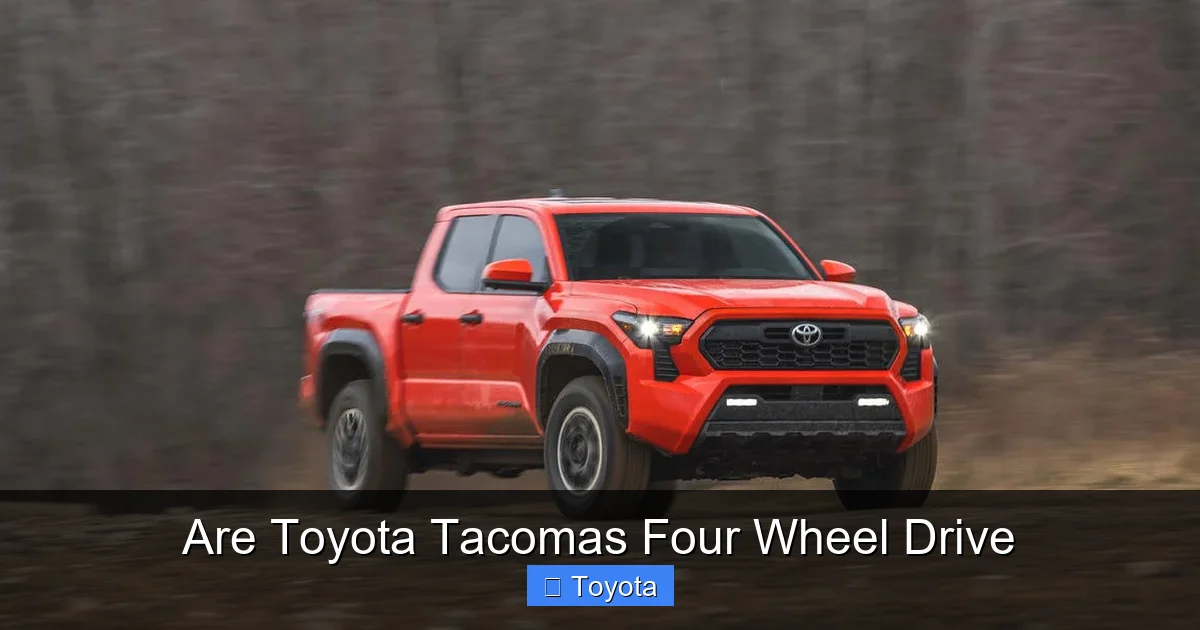
Visual guide about Are Toyota Tacomas Four Wheel Drive
Image source: cdn.motor1.com
Before we get into the specifics of the Tacoma, let’s clarify what we mean by “four wheel drive.” In simple terms, a 4WD system sends power to all four wheels simultaneously, improving traction in low-grip conditions like mud, snow, sand, or loose gravel. This is especially useful when one or more wheels start to slip.
In contrast, rear-wheel drive (RWD) sends power only to the rear wheels. While RWD is lighter and can offer better fuel economy, it struggles in slippery or uneven terrain. Front-wheel drive (FWD) is less common in trucks, but some compact pickups use it—Tacomas, however, are either RWD or 4WD.
Now, not all 4WD systems are created equal. Toyota offers a part-time 4WD system in most Tacomas, which means the driver can switch between 2WD and 4WD depending on conditions. This is different from full-time 4WD (which always powers all four wheels) or all-wheel drive (AWD), which automatically adjusts power distribution without driver input.
The Tacoma’s 4WD system is designed for off-road use and isn’t meant for everyday driving on dry pavement. That’s why it’s “part-time”—you engage it when needed, then switch back to 2WD for normal driving to avoid drivetrain binding and improve fuel efficiency.
Which Toyota Tacoma Trims Offer Four Wheel Drive?
So, which Tacomas actually come with 4WD? Let’s break it down by trim level. Toyota offers the Tacoma in several trims, including SR, SR5, TRD Sport, TRD Off-Road, Limited, and TRD Pro. Here’s how 4WD availability stacks up:
SR and SR5 Trims
The SR and SR5 are the entry-level trims and are often used as work trucks or budget-friendly options. These models typically come with rear-wheel drive (RWD) as standard. However, 4WD is available as an optional upgrade on both trims. If you’re looking for a no-frills Tacoma that can still handle light off-roading, you can spec it with 4WD—but it will cost extra.
TRD Sport
The TRD Sport is tuned for on-road performance with sportier suspension, larger wheels, and a more aggressive look. Like the SR and SR5, 4WD is optional on the TRD Sport. It’s a great choice if you want a sporty ride but still want the option to venture off the beaten path.
TRD Off-Road
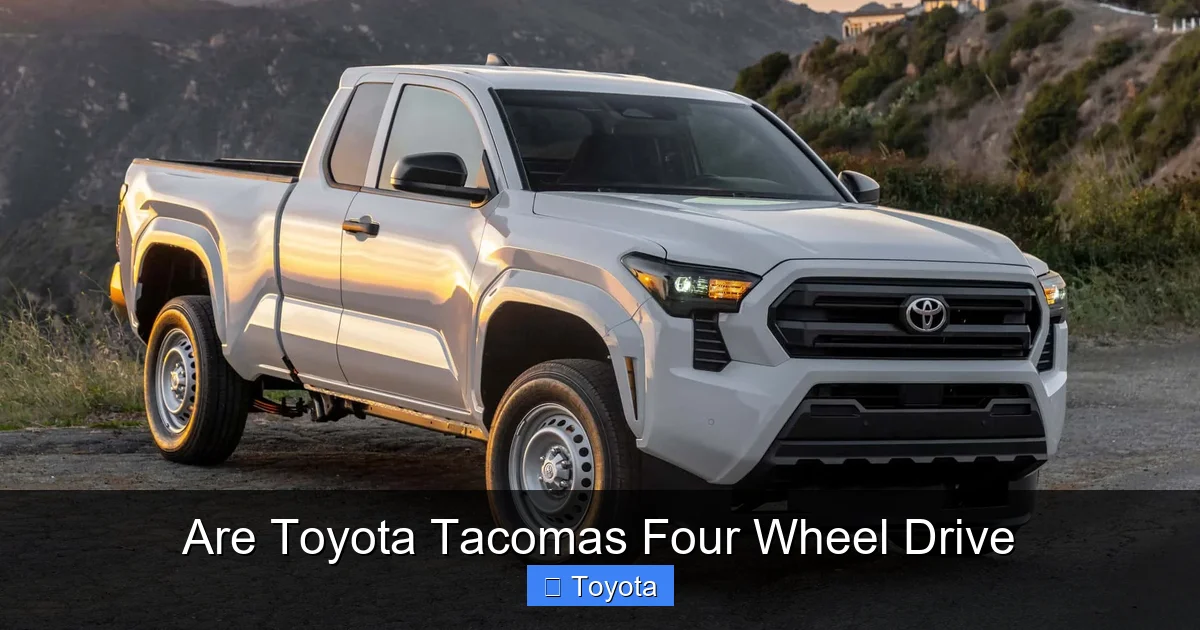
This is where things get serious. The TRD Off-Road trim comes with 4WD as standard. It’s built specifically for trail use and includes features like Bilstein shocks, a locking rear differential, and Toyota’s Multi-Terrain Select system. If you plan to do any serious off-roading, this is the trim to consider.
TRD Pro
The TRD Pro is the ultimate off-road Tacoma. It includes 4WD standard, along with Fox internal bypass shocks, a reinforced suspension, all-terrain tires, and unique styling. It’s designed for extreme terrain and is a favorite among overlanders and rock crawlers.
Limited
The Limited trim focuses on luxury and comfort, with leather seats, premium audio, and advanced tech features. 4WD is optional on the Limited, so you can have both refinement and capability—if you’re willing to pay the premium.
Manual Transmission and 4WD
One unique feature of the Tacoma is that 4WD is available with both automatic and manual transmissions. However, not all trims offer a manual. For example, the TRD Pro and Limited are automatic-only, while the SR, SR5, and TRD Sport offer a 6-speed manual with 4WD (depending on the model year). If you love driving a stick, you’ll want to check availability carefully—Toyota has reduced manual options in recent years.
How Does the Toyota Tacoma 4WD System Work?
Now that we know which Tacomas offer 4WD, let’s look under the hood—literally—at how the system operates.
The Tacoma uses a part-time 4WD system with a transfer case that allows the driver to shift between 2WD and 4WD High (4H) or 4WD Low (4L). Here’s how it works:
2WD Mode
In normal driving conditions, the Tacoma runs in 2WD (rear-wheel drive). This mode is ideal for city driving, highways, and dry roads. It improves fuel economy and reduces wear on the drivetrain.
4WD High (4H)
When you need extra traction—like in rain, snow, or light off-roading—you can shift into 4H. This mode sends power to all four wheels and can be engaged while driving at normal speeds (usually up to 55 mph, depending on the model). It’s great for slippery roads or gravel paths.
4WD Low (4L)
For serious off-roading—rock crawling, deep mud, or steep inclines—you’ll want 4L. This mode provides maximum torque at low speeds and is only used when the vehicle is moving slowly. You typically need to come to a complete stop (or near-stop) to engage 4L, and you should never use it on dry pavement.
A-TRAC (Automatic Limited-Slip Traction Control)
On TRD Off-Road and TRD Pro models, Toyota includes A-TRAC, which simulates a locking differential by applying brake force to a slipping wheel. This helps maintain traction without needing a physical locker in every axle. It’s especially useful on uneven terrain where one wheel might lift off the ground.
Crawl Control
Available on TRD Off-Road and TRD Pro trims, Crawl Control acts like an off-road cruise control. You set a target speed (as low as 1 mph), and the system automatically manages throttle and braking to maintain that speed over rough terrain. It’s perfect for technical trails where you don’t want to risk over-accelerating.
Multi-Terrain Select
This feature, also found on TRD Off-Road and TRD Pro models, lets you choose from different driving modes—like Mud & Sand, Loose Rock, or Rock—based on the terrain. The system adjusts throttle response, traction control, and other parameters to optimize performance.
Real-World Performance: How Does the 4WD Tacoma Handle Off-Road?
Let’s get practical. How does a 4WD Tacoma actually perform when the pavement ends?
We took a 2023 TRD Off-Road with 4WD on a weekend trip to the desert trails near Moab, Utah. The terrain included loose sand, rocky inclines, and dry riverbeds. Here’s what we found:
The Tacoma handled everything with confidence. The 4WD system engaged smoothly, and the locking rear differential made a noticeable difference when one rear wheel started to spin. The suspension soaked up bumps well, and the 32-inch all-terrain tires provided solid grip.
One highlight was Crawl Control. On a steep, rocky descent, we activated it and let the truck do the work. It crept down at a steady 2 mph, allowing us to focus on steering and avoiding obstacles. It felt like having a co-pilot who knows the trail.
Another advantage was the approach and departure angles. The Tacoma’s short overhangs and high ground clearance (up to 9.4 inches on the TRD Pro) let us tackle steep inclines without scraping the bumper.
That said, the Tacoma isn’t a full-size truck. It’s smaller and lighter, which helps in tight trails but can feel less stable in deep mud or heavy snow compared to a larger 4×4. Still, for most off-road enthusiasts, the Tacoma strikes a great balance between capability and maneuverability.
Fuel Economy and Maintenance: The 4WD Trade-Offs
While 4WD adds capability, it comes with some trade-offs—especially in fuel economy and maintenance.
Fuel Economy
4WD Tacomas typically get lower gas mileage than their 2WD counterparts. For example, a 2023 Tacoma SR with RWD and the 2.7L 4-cylinder engine gets about 20 mpg city / 23 mpg highway. The same truck with 4WD drops to around 18 mpg city / 22 mpg highway.
The V6 models see a similar drop. A 2WD TRD Sport with the 3.5L V6 gets about 19/24 mpg, while the 4WD version gets 18/22 mpg. It’s not a huge difference, but it adds up over time—especially if you drive a lot.
Maintenance Considerations
4WD systems have more moving parts, which means more potential for wear and repair. The transfer case, front differential, and driveshaft all require periodic inspection and fluid changes. Toyota recommends servicing the 4WD system every 30,000 to 60,000 miles, depending on usage.
Off-road driving can also accelerate wear. Mud, water, and debris can damage seals and joints. If you plan to take your Tacoma off-road regularly, consider undercoating, skid plates, and regular undercarriage washes.
That said, Toyota’s 4WD system is known for its durability. Many Tacoma owners report 200,000+ miles with minimal issues—proof that proper maintenance goes a long way.
Resale Value and Market Demand
One of the biggest advantages of the Tacoma—especially the 4WD models—is its resale value. According to Kelley Blue Book, Tacomas consistently rank among the top vehicles for retained value, often holding 60–70% of their original price after five years.
4WD models tend to depreciate even slower, particularly in regions with harsh winters or rugged terrain. A 4WD TRD Off-Road or TRD Pro can often sell for nearly as much as a new one after just a few years—especially if it’s well-maintained and has low mileage.
This strong resale value makes the Tacoma a smart investment. Even if you’re not planning to keep it forever, you’ll likely get a great return when it’s time to sell or trade in.
Should You Buy a 4WD Toyota Tacoma?
So, is a 4WD Tacoma right for you? Here’s a quick checklist to help decide:
- You live in a snowy or rainy climate: 4WD provides better traction in winter conditions.
- You plan to off-road: Whether it’s camping, overlanding, or rock crawling, 4WD is essential.
- You tow or haul heavy loads: 4WD improves stability when pulling trailers or carrying cargo.
- You want long-term value: 4WD Tacomas hold their value better than 2WD models.
- You’re okay with slightly lower fuel economy: The trade-off is worth it for most buyers.
On the other hand, if you only drive on paved roads and live in a warm, dry climate, a 2WD Tacoma might save you money upfront and at the pump. But even then, many buyers opt for 4WD just for the peace of mind.
Conclusion: The Tacoma’s 4WD Legacy
To answer the original question: Are Toyota Tacomas four wheel drive? The answer is—many are, but not all. While base models start with rear-wheel drive, 4WD is widely available and standard on off-road-focused trims like the TRD Off-Road and TRD Pro.
The Tacoma’s 4WD system is robust, reliable, and packed with features that make it one of the best midsize trucks for adventure. Whether you’re navigating a muddy trail, a snowy driveway, or just want extra confidence on the road, a 4WD Tacoma delivers.
With strong resale value, legendary Toyota reliability, and a loyal community of owners, the Tacoma remains a top choice for drivers who want a truck that can do it all. So if you’re ready to hit the trails—or just want a capable daily driver—consider a 4WD Tacoma. It might just be the perfect ride for your next adventure.
Frequently Asked Questions
Do all Toyota Tacomas come with four wheel drive?
No, not all Toyota Tacomas come with four wheel drive. Base models like the SR and SR5 typically have rear-wheel drive (RWD) as standard, but 4WD is available as an option on most trims.
Which Tacoma trims have 4WD standard?
The TRD Off-Road and TRD Pro trims come with four wheel drive as standard. Other trims, like the SR5 and TRD Sport, offer 4WD as an optional upgrade.
Can you drive a 4WD Tacoma on dry pavement?
You can drive in 4WD High on dry pavement at low speeds, but it’s not recommended for extended periods. For normal driving, use 2WD to avoid drivetrain stress and improve fuel economy.
Does 4WD affect fuel economy in the Tacoma?
Yes, 4WD Tacomas typically get 1–2 mpg less than their 2WD counterparts due to added weight and drivetrain resistance.
Is the Tacoma’s 4WD system good for off-roading?
Absolutely. With features like a locking rear differential, Crawl Control, and Multi-Terrain Select, the 4WD Tacoma is one of the best midsize trucks for off-road adventures.
Can you get a manual transmission with 4WD on a Tacoma?
Yes, but availability is limited. Some SR, SR5, and TRD Sport models offer a 6-speed manual with 4WD, but newer trims like the TRD Pro are automatic-only.