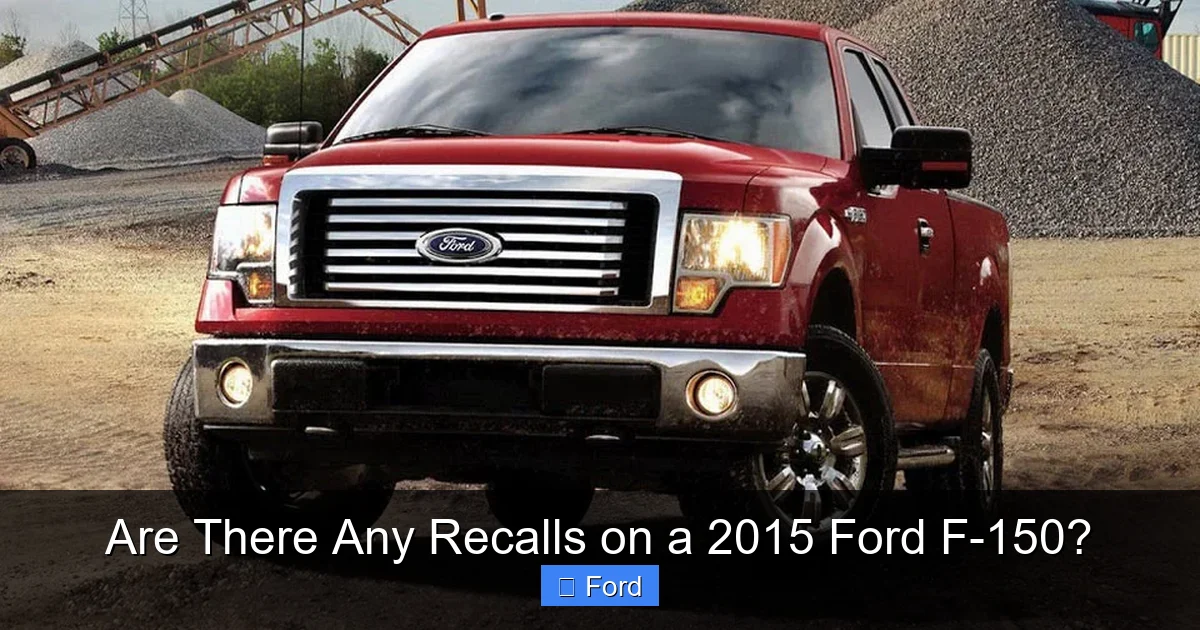
Are There Any Recalls on a 2015 Ford F-150?

Contents
- 1 Key Takeaways
- 2 📑 Table of Contents
- 3 Why Recalls Matter for Your 2015 Ford F-150
- 4 How to Check for Recalls on Your 2015 Ford F-150
- 5 The 2015 F-150’s Major Recall History
- 6 What to Do If Your Truck Is Affected
- 7 Debunking Common Recall Myths
- 8 Beyond Recalls: Maintaining Your F-150’s Safety
- 9 Conclusion: Your Action Plan
- 10 Frequently Asked Questions


Yes, the 2015 Ford F-150 has several open and completed recalls. Key issues involve the transmission shifter, Takata airbags, and other safety systems. All recall repairs are free and must be performed by an authorized Ford dealer. It’s critical to check your specific Vehicle Identification Number (VIN) immediately to see if your truck is affected and schedule a repair without delay.
Key Takeaways
- Recalls Are Serious: The 2015 F-150 has significant recalls for the transmission shifter and airbags that pose safety risks if unaddressed.
- Repairs Are Always Free: Federal law requires manufacturers to fix recall defects at no cost to the vehicle owner, regardless of warranty status.
- Check Your VIN: The only way to know your truck’s recall status is to enter your unique 17-digit VIN into the NHTSA or Ford recall websites.
- Dealer-Only Repairs: Recall fixes must be performed by an authorized Ford dealer to ensure proper parts, software, and documentation.
- No Time Limit: There is no expiration on getting a recall fixed; you are entitled to the repair for the life of the vehicle.
- Stay Informed: Recalls can be issued years after a model year; sign up for email alerts from NHTSA to be notified of new campaigns.
- Safety First: Addressing recalls promptly protects you, your passengers, and others on the road, and maintains your truck’s value and reliability.
📑 Table of Contents
Why Recalls Matter for Your 2015 Ford F-150
Let’s talk about something that should be on every 2015 Ford F-150 owner’s mind: recalls. I know, it sounds like a boring, bureaucratic term. But trust me, it’s one of the most important safety topics for your truck. A recall isn’t just a memo from the automaker; it’s a formal order from the National Highway Traffic Safety Administration (NHTSA) that says a part or system on your vehicle has a defect that could cause a crash, fire, or injury. For a heavy-duty truck like the F-150, which is built for work and family hauls, that’s not something to ignore.
Think of your 2015 F-150 as a complex machine with thousands of parts. Sometimes, despite rigorous testing, a component fails in ways engineers didn’t predict. A faulty transmission part might let the truck roll away unexpectedly. A bad airbag inflator could explode and send metal shrapnel into the cabin. These aren’t hypotheticals—they’re real defects that have led to actual injuries and recalls. The good news? The system is designed to fix these problems. The manufacturer foots the entire bill. Your job is simple: find out if your truck is affected and get it fixed. Period.
Ignoring a recall is like driving with a known time bomb. It jeopardizes your safety, risks costly repairs if the part fails and causes secondary damage, and can even lower your truck’s resale value. Smart buyers always check the recall history before purchasing a used vehicle. So, let’s get into the specifics for your 2015 F-150.
The Real-World Impact of Ignoring Recalls
To understand why this is urgent, consider a past recall that sounds almost unbelievable. In the early 2000s, some Ford trucks had a faulty ignition switch that could cut power while driving, disabling steering and brakes. It sounds like a movie plot, but it happened. Drivers lost control on highways. That’s the extreme. For your 2015 F-150, the most prominent recall involves the transmission shifter. It could allow the truck to roll away if the driver thinks it’s in “Park” but it’s actually in “Neutral.” Imagine parking on a slight incline, getting out, and having your 5,000-pound truck start rolling. The potential for property damage or serious injury is enormous.
Then there are the Takata airbag inflators. This massive, industry-wide recall affected millions of vehicles, including many 2015 F-150s. The inflator can rupture in a crash, blasting sharp metal fragments at occupants. Even a minor fender-bender could turn deadly. These aren’t minor “annoyances.” They are critical safety failures. The NHTSA and Ford have been aggressive in pushing owners to get these repairs. They’ve even issued “Do Not Drive” warnings for some high-risk vehicles. While your 2015 F-150 may not have received that extreme directive, the underlying defect is the same. The message is clear: a recall is a call to action, not a suggestion.
How to Check for Recalls on Your 2015 Ford F-150
Okay, so you’re convinced it’s important. Now, how do you actually check? It’s incredibly easy and takes less than 60 seconds. You have two primary, official sources: the NHTSA website and Ford’s own owner portal. Both are free, secure, and require only your Vehicle Identification Number (VIN).
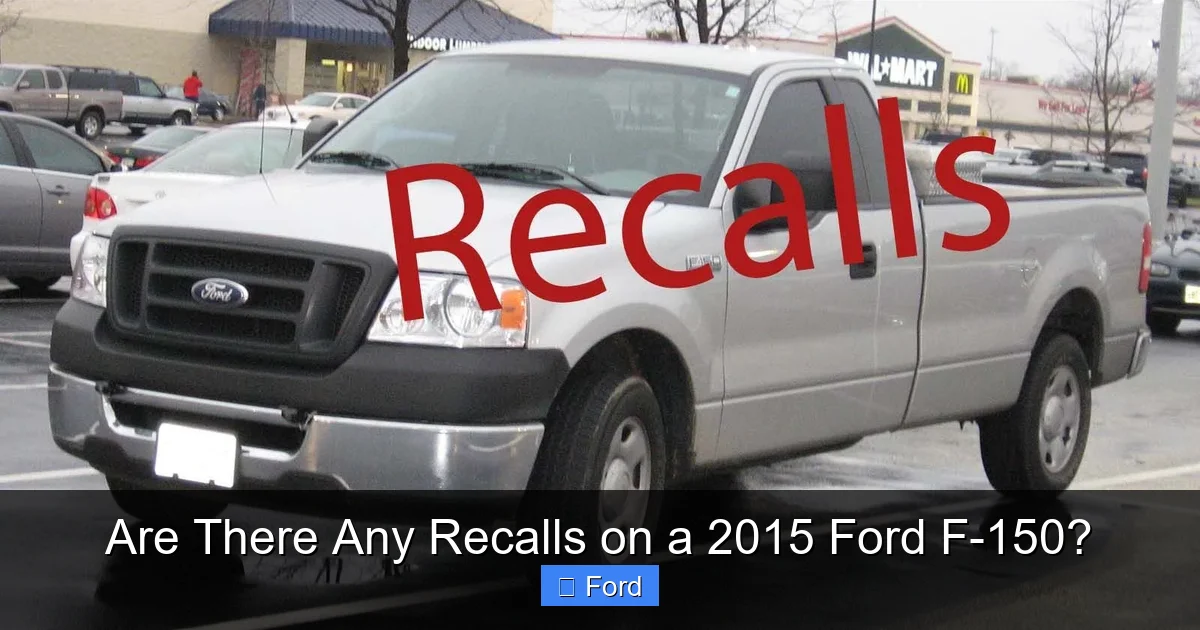
Visual guide about Are There Any Recalls on a 2015 Ford F-150?
Image source: cimg3.ibsrv.net
Your VIN is a 17-character code that identifies your exact truck. You can find it on the driver’s side dashboard near the windshield, on the driver’s side door jamb sticker, or on your registration and insurance documents. Write it down or have it handy on your phone. Once you have it, you’re ready.
Using the NHTSA Recall Database
The NHTSA’s recall lookup tool (nhtsa.gov/recalls) is the gold standard. It’s a federal resource that pulls data directly from all automakers. Here’s the step-by-step:
- Go to nhtsa.gov/recalls.
- Enter your 17-digit VIN in the search box.
- Click “Search.”
- The page will instantly show any open recalls (unrepaired safety issues) for your specific vehicle. It will also list any completed recalls from the past, which is useful for verifying a used truck’s history.
What you’re looking for is a clear message like “No open recalls” or a list of campaigns with brief descriptions, recall numbers (e.g., 15S28 for the transmission), and the potential risk. If something is listed under “Open Recalls,” that’s your red flag. Don’t just glance at it—note the recall number and summary. You’ll need this when you call the dealer.
Checking Through Ford’s Owner Portal
Ford offers a similar, personalized service through its Ford Owner website or app. After creating a free account and adding your vehicle (again, using the VIN), you get a tailored dashboard. It shows recalls, but also warranty status, maintenance tips, and owner manuals. Some owners prefer this because it’s Ford-branded and can feel more integrated. The process is similar: sign up, add your 2015 F-150 by VIN, and navigate to the “Recalls” section. It will list any open campaigns. One advantage is that sometimes Ford provides more specific instructions or estimated repair times here. However, the NHTSA site is the official, unmediated source. I recommend checking both to be absolutely certain.
The 2015 F-150’s Major Recall History
So, what are we actually looking for? The 2015 model year, part of the 13th generation F-150, has been subject to several notable NHTSA campaigns. It’s crucial to understand that not every 2015 F-150 is affected by every recall. It depends on specific production dates, trim levels, engine types, and even where the truck was sold. That’s why the VIN check is non-negotiable. Here are the most significant recalls that have impacted this model year.
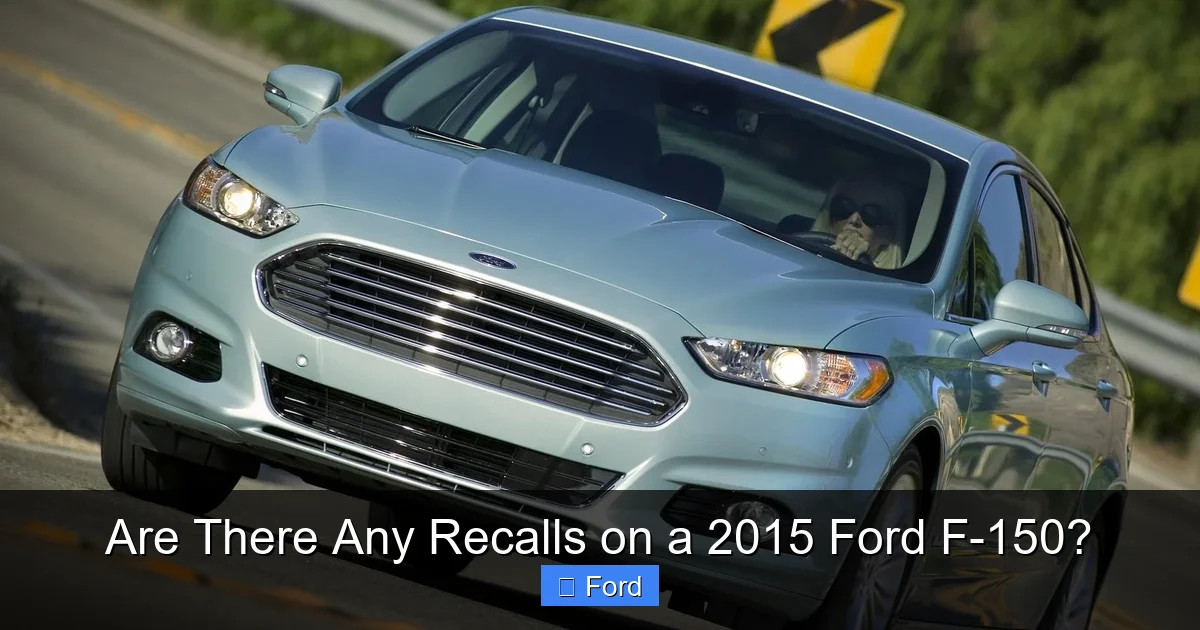
Visual guide about Are There Any Recalls on a 2015 Ford F-150?
Image source: s1.cdn.autoevolution.com
Recall Spotlight: The Transmission Shifter (P58394N / 15S28)
This is the big one. In 2015, Ford recalled certain 2015 F-150s equipped with the 6-speed automatic transmission (the 6R80) because of a defective shifter. The problem? The shifter’s electronic control module or the shifter assembly itself could fail. This could cause the gear indicator to show “Park” when the transmission was actually in “Neutral” or another gear. The truck could then roll away if the parking brake wasn’t set. This recall affected a large number of trucks built between specific dates in 2014 and 2015. The fix involved replacing the shifter assembly or updating the software, depending on the root cause. If your truck is part of this recall, it is absolutely critical to get it repaired immediately. Always engage the parking brake firmly until the repair is done.
Recall Spotlight: Takata Airbag Inflators
The largest automotive recall in history. Many 2015 F-150s, particularly those with certain driver or passenger frontal airbags, were equipped with Takata inflators that use a volatile chemical propellant. Over time, especially in hot, humid climates, this propellant can degrade. In a crash that triggers the airbag, the inflator can rupture explosively, spraying metal fragments. The NHTSA has classified these as “Risk of Serious Injury or Death.” Ford has conducted multiple phases of this recall, sometimes using new inflators or even removing the airbag entirely in extreme cases. The repair strategy evolved as new information came in. If your truck is part of this recall, Ford has likely contacted you multiple times. Do not delay. This is a life-or-death fix.
Other Notable 2015 F-150 Recalls
While the transmission and airbags are the headliners, other smaller recalls have occurred:
- Seat Belt Anchor: Some trucks had improperly tightened front seat belt anchor bolts. The fix was a simple inspection and retorque.
- Software Updates: Various powertrain control module (PCM) or other software updates to prevent stalling, improve drivability, or fix false diagnostic codes. These are often done via a simple reflash at the dealer.
- Accessory Drive Belt: A recall for the serpentine belt tensioner that could fail and cause the belt to come off, leading to loss of power steering and charging.
Again, your VIN will tell you exactly which, if any, of these apply to your specific VIN. Don’t assume your truck is clear based on a friend’s similar truck. The manufacturing window is often just a few weeks or months that separate affected and unaffected vehicles.
What to Do If Your Truck Is Affected
You’ve checked your VIN. There’s an open recall. Now what? Don’t panic. The process is designed to be smooth and free for you. Here is your action plan.
Step 1: Contact Your Ford Dealer Immediately
Call the service department of your preferred Ford dealership. Have your VIN and the recall number(s) handy. Say, “I’d like to schedule a recall repair for campaign number [XXXXX].” They will look it up in their system. For major recalls like the transmission shifter, they may have a backlog of parts. Be polite but persistent. Ask for the earliest available appointment. If your local dealer says they can’t see you for months, call another dealer in your region. Sometimes a dealer 50 miles away has availability sooner. It’s worth the drive for a critical safety fix.
Step 2: Understand the Repair Process
For most recalls, you’ll drop the truck off and they’ll call you when it’s done, often the same day if it’s a software update or simple part replacement. For more complex jobs like the transmission shifter or airbag, they may need the truck for a full day. Ask the advisor for a loaner vehicle or a rental car reimbursement. Ford’s policy often provides a rental if the repair will take a significant amount of time. Confirm this when you book. You should not be without a vehicle due to a mandatory safety recall.
When you pick up your truck, inspect it briefly. Make sure the shifter feels solid and the airbag light is off. The service advisor should give you a repair order that explicitly states “Recall Repair – No Charge.” Keep this document for your records. It’s proof the work was done correctly and at no cost.
Step 3: What If the Dealer Fails or Delays?
In rare cases, a dealer might be unresponsive, claim they don’t have parts, or try to charge you. If this happens:
- Ask to speak to the Service Manager, then the General Manager. Explain the recall is a federal safety mandate and must be performed free of charge.
- Contact Ford Customer Relationship Center directly at 1-800-392-3673. They can escalate and sometimes arrange for parts or a different dealer.
- As a last resort, file a complaint with the NHTSA at nhtsa.gov/recalls. They investigate dealer compliance.
Remember, you have rights. The manufacturer is legally obligated to fix the defect. Be polite but firm.
Debunking Common Recall Myths
I hear a lot of misconceptions that stop people from getting vital recall work done. Let’s clear them up right now.
Myth 1: “Recalls Will Void My Warranty.”
False. In fact, it’s the opposite. Having recall work done by a dealer protects your warranty. The repair is documented in the manufacturer’s system. Ignoring a recall could void your warranty if the unaddressed defect later causes a related failure. For example, if you ignore a transmission shifter recall and the transmission fails because of that exact issue, Ford could deny warranty coverage for the new transmission, arguing you neglected a known defect.
Myth 2: “My Truck Seems Fine, So I Don’t Need the Fix.”
This is the most dangerous myth. Recalls are for potential failures. The defect might not have manifested yet—it could be waiting for the right temperature, humidity, or mileage to fail. You are driving a known time bomb. The “seems fine” phase is exactly when you should get it fixed, before it fails at the worst possible moment. The Takata airbag is the prime example: many cars drove for years with the defective inflator before it ruptured.
Myth 3: “I Can Get the Recall Fixed at My Local Mechanic for Cheaper.”
No. Recall repairs must be done by an authorized franchised dealer of that brand. Independent shops don’t have access to the specific recall bulletins, manufacturer-approved parts, and software updates. They also cannot document the repair in the manufacturer’s central system, which is required to close the recall on your VIN. If you try to pay an independent shop to do it, you will be paying out of pocket for a repair that should be free, and it may not even be done correctly or officially recorded.
Myth 4: “Recalls Are Just a Tactic to Get Me into the Dealer for Upsells.”
While dealers hope you’ll consider other services while you’re there, the recall appointment itself is purely for the safety repair. You are under no obligation to purchase anything else. Be polite but clear: “I’m here for the recall on [X]. I’m not interested in any additional service today.” The advisor will still perform the recall work. It’s a separate, mandated process.
Beyond Recalls: Maintaining Your F-150’s Safety
Getting your recalls fixed is the single most important thing you can do for your 2015 F-150’s safety. But it’s not the only thing. A safe truck is a well-maintained truck. Once your recalls are handled, turn your attention to proactive upkeep. Think of it as building layers of safety around that solid foundation.
Prioritize Critical Wear Items
Your brakes, tires, and wipers are your primary controls and contact points with the road. Worn tires drastically increase stopping distance and reduce grip, especially in wet or icy conditions. A good set of all-season or winter tires is non-negotiable for safety. If your factory wipers are smearing or skipping, replace them immediately—poor visibility is a leading cause of accidents. For the 2015 F-150, finding high-quality replacement parts is easy. You can explore guides on the best tires for Ford F-150 Lariat (which apply to most trims) or the best wiper blades for Ford F-150 to ensure you get reliable components that fit perfectly.
Don’t Neglect the Interior
Safety isn’t just about what’s under the hood. A clean, organized cabin reduces distractions. Faded, cracked, or dirty seat covers can be more than an eyesore; they can affect your comfort and focus on long drives. Investing in durable, well-fitting seat covers protects your original upholstery from spills, UV damage, and wear, keeping the cabin looking sharp and functional for years. Check out resources on the best seat covers for 2015 Ford F-150 to find options that match your truck’s trim and your lifestyle, whether you’re hauling gear or a family.
Follow a Regular Maintenance Schedule
Your owner’s manual is your bible. Stick to the severe or normal service intervals, whichever matches your driving habits. This includes oil changes, transmission fluid checks (especially important for the 6-speed in your 2015), coolant flushes, and spark plug replacements. A well-maintained engine and drivetrain are less likely to fail unexpectedly, which is a form of safety. For example, a neglected transmission fluid change can lead to harsh shifting or failure, compounding any lingering concerns from the old recall repair. Use high-quality fluids and filters that meet Ford’s specifications (WSS-M2C947-A for engine oil, for instance).
Conclusion: Your Action Plan
So, are there any recalls on a 2015 Ford F-150? Almost certainly, yes. The data shows a high probability that your specific VIN is part of at least one campaign, most likely the transmission shifter or Takata airbag recall. The path forward is simple and powerful:
- Right Now: Find your VIN. Go to nhtsa.gov/recalls and enter it.
- If There’s an Open Recall: Call your Ford dealer service department today. Schedule the repair. Be polite but firm about getting an appointment. Ask about a loaner.
- If There Are No Open Recalls: Bookmark the NHTSA page and check again every six months. Recalls can be issued years later.
- After Recalls Are Fixed: Commit to a solid maintenance routine. Check your tires, brakes, wipers, and fluids regularly. Consider comfort and protection upgrades like seat covers.
Your 2015 Ford F-150 is a capable, valuable machine. Protecting it with recall repairs and diligent upkeep is the best way to ensure it serves you safely and reliably for many more years. Don’t wait. Take five minutes, check your VIN, and take control of your truck’s safety story. It’s the most important 300 seconds you’ll spend on your F-150 this year.
Frequently Asked Questions
How do I check if my 2015 Ford F-150 has any open recalls?
Visit the NHTSA recall website (nhtsa.gov/recalls) and enter your 17-digit VIN. You can also use the Ford Owner website or app. This will instantly show any unrepaired safety campaigns for your exact vehicle.
Will I have to pay for recall repairs on my 2015 F-150?
No. Federal law mandates that all recall repairs are performed free of charge by an authorized Ford dealer, regardless of your warranty status or how long you’ve owned the truck. You only pay for unrelated maintenance or damage you caused.
What if my local Ford dealer doesn’t have the parts for my recall repair?
Recall parts are prioritized by Ford. If your dealer says they’re out of stock, ask for an estimated availability date. You can call other Ford dealers in your area, as parts allocation varies. If delays are extreme, contact Ford Customer Service at 1-800-392-3673 to escalate and possibly arrange for a different dealer.
Can I still drive my 2015 F-150 if it has an open recall?
Usually, yes. However, for severe defects like the Takata airbags or the transmission shifter, Ford or the NHTSA may issue a “Do Not Drive” advisory. Always read the recall description carefully. For the shifter recall, always use the parking brake until repaired. When in doubt, call your dealer for specific guidance.
Do recalls affect my insurance or the truck’s resale value?
Recalls themselves do not affect insurance premiums. However, failing to address a known recall could be considered negligence if that defect later causes an accident. For resale, a truck with an open recall is less valuable and harder to sell, as the buyer inherits the repair obligation. A truck with all recalls completed has a cleaner history and is more desirable.
How long do I have to get a recall fixed on my 2015 F-150?
There is no expiration date. As long as the vehicle is still on the road, the manufacturer is obligated to provide the repair free of charge. You can get it fixed next month, next year, or ten years from now. The only practical limit is the availability of parts, which is why it’s best to address recalls sooner rather than later.