
Are There Any Recalls on a 2009 Ford F-150?

If you own or are considering buying a 2009 Ford F-150, checking for recalls is non-negotiable for safety. This model year is part of a massive, long-running recall for faulty Takata airbag inflators that can explode. Beyond that, several other important safety and mechanical recalls exist. The excellent news is that all recall repairs are performed free of charge by authorized Ford dealers. Never ignore a recall notice; verify your Vehicle Identification Number (VIN) today and schedule any needed repairs immediately to protect yourself, your passengers, and your investment.
Key Takeaways
- Recalls are free repairs: Federal law mandates that the manufacturer (Ford) pays for all parts and labor to fix any safety recall on your 2009 F-150.
- The Takata airbag recall is critical: This is the most severe recall, involving front passenger and driver airbags that can deploy with excessive force, shooting metal fragments.
- You must check your specific VIN: Not every 2009 F-150 is affected by every recall. The only way to know for sure is to look up your unique 17-digit VIN on official sites.
- Address recalls immediately: Some recalls, like the airbag, pose an immediate, life-threatening risk. Do not delay in scheduling a repair appointment with your dealer.
- Recalls don’t mean your truck is “bad”: Recalls are common across all manufacturers and model years. They are a corrective action, not a condemnation of the vehicle’s overall quality.
- Keep detailed records: Always get a receipt or service report for the recall repair. This is crucial for future resale value and proof the work was completed.
- Used car buyers must verify: If you’re buying a used 2009 F-150, you must independently check for open recalls, as sellers are not always forthcoming or aware.
📑 Table of Contents
- Understanding Vehicle Recalls: What They Are and Why They Matter
- The Major Recalls Affecting the 2009 Ford F-150
- How to Check for Open Recalls on Your 2009 Ford F-150
- What to Do If Your 2009 F-150 Has an Open Recall
- The Long-Term Impact: Why Ignoring a Recall is a Terrible Idea
- Beyond Recalls: Comprehensive Maintenance for Your 2009 F-150
- Conclusion: Peace of Mind is a Free Click Away
Understanding Vehicle Recalls: What They Are and Why They Matter
Let’s start with the basics, because there’s a lot of confusion around the word “recall.” A recall is an official order from the National Highway Traffic Safety Administration (NHTSA) that requires a vehicle manufacturer to fix a safety-related defect or non-compliance with federal safety standards, at no cost to the vehicle owner. It’s not a suggestion; it’s a mandatory correction. The manufacturer identifies a problem—often from warranty claims, accident reports, or internal testing—and must propose a fix to the government for approval. Once approved, they notify all known owners and provide a remedy.
For a truck like the 2009 Ford F-150, which was a best-seller with millions on the road, a recall can affect a huge number of vehicles. But here’s the key thing to remember: a recall is a good thing. It means the manufacturer has identified a potential failure and is taking responsibility to make your vehicle safer. Ignoring it is like knowing your brakes have a weak spot and choosing not to get them fixed. The stakes are incredibly high. A safety defect can lead to a crash, severe injury, or death. Furthermore, an unrepaired recall can drastically hurt your truck’s resale value and even make it impossible to sell in some states during inspections. Checking for recalls is a fundamental part of responsible vehicle ownership, as essential as checking your oil or tire pressure.
The Major Recalls Affecting the 2009 Ford F-150
The 2009 model year sits in the middle of the twelfth generation of the F-150 (2009-2014). This generation is notably impacted by one of the largest and most dangerous automotive recalls in history, but it also has several other significant recalls. We’ll break them down by severity and component. Always confirm your truck’s status with your VIN, as not all recalls apply to every single vehicle built in that model year.
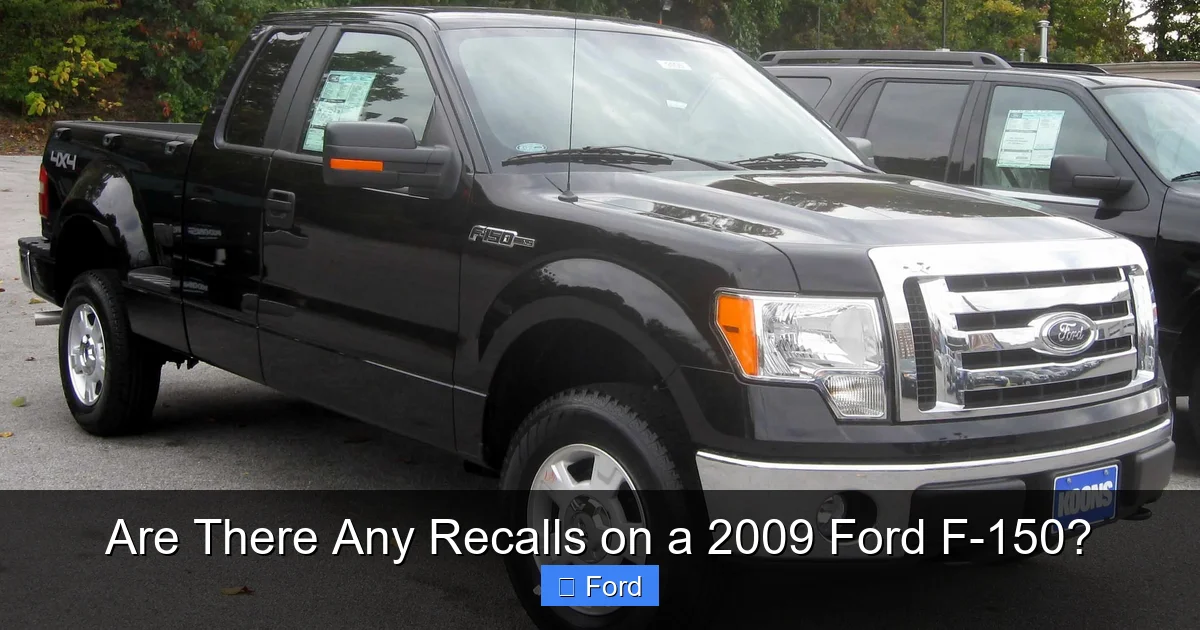
Visual guide about Are There Any Recalls on a 2009 Ford F-150?
Image source: autodetective.com
The Takata Airbag Inflator Recall (The Most Critical)
This is the elephant in the room. The 2009 Ford F-150 is included in multiple NHTSA campaigns for faulty Takata airbag inflators. The defect is terrifying in its simplicity: upon deployment, the inflator can rupture, shredding metal fragments that are propelled toward the driver and passenger. These fragments can cause severe, even fatal, injuries. The problem is exacerbated by long-term exposure to high humidity and temperature cycles, which degrade the propellant inside the inflator. This is not a “maybe” problem; it’s a known, explosive failure mode.
Ford has issued multiple, phased recalls for different populations of 2009 F-150s, often identifying specific build plants or VIN ranges. The repair typically involves replacing the entire airbag module (for the driver side) or both the inflator and module (for the passenger side, which is often a “dual-stage” design). This is a Priority Recall. Ford has an ample supply of replacement parts for most models now, but you must act. If you get a notice in the mail, it’s because your specific VIN is on the list. If you haven’t received a notice but own a 2009 F-150, you must proactively check—owners of older vehicles sometimes fall through the cracks as manufacturers focus on newer models. The risk is real and immediate. Do not drive this truck without confirming the status of this recall. For context, this same defect has caused deaths in other Ford and non-Ford vehicles.
Fuel Pump Driver Module (FPDM) Recall
Separate from the airbag, a significant recall addresses the Fuel Pump Driver Module. This electronic control unit manages the fuel pump’s operation. The defect involves a potential failure of the solder joints on the circuit board. If it fails, your F-150’s engine can stall without warning while driving, which creates a major risk of a collision, especially at highway speeds or in heavy traffic. There’s often no check engine light or gradual performance loss—it can just quit. The fix is a replacement of the FPDM with a redesigned, more robust unit. This recall highlights that “safety” isn’t just about crashes; a sudden loss of propulsion is a serious safety hazard. Owners have reported being stranded on busy roads. This recall, like all others, is free, and the part is generally available.
Cruise Control Deactivation Switch Recall
This is a classic Ford recall pattern from the early-to-mid 2000s that persisted into some 2009 models. A defective cruise control deactivation switch can short circuit and, in rare cases, cause an under-hood fire, even when the vehicle is parked and turned off. The switch is located on the brake pedal assembly. The recall involves inspecting the switch and its wiring for damage or signs of overheating and replacing it with a new, redesigned switch if necessary. While the incidence rate is low, the potential consequence—a vehicle fire—is severe. If you smell burning plastic or see smoke under the hood, immediately disconnect the battery and have the vehicle towed, but this is a preventative fix you shouldn’t wait for symptoms to appear.
Other Notable Recalls for the 2009 F-150
While the three above are the most prevalent and severe, your truck may be subject to others. It’s vital to check your VIN for a complete list. Examples include:
- Brake Hose Recall: Some models had a front brake hose that could rub against a component, leading to a leak and potential brake failure. The fix is replacing the hose with a protected version.
- Rear Axle Shaft Recall: A small number of trucks had incorrectly manufactured rear axle shafts that could fracture, leading to a loss of power and control. The repair is axle shaft replacement.
- Seat Belt Recall: Certain front seat belt retractors could fail to lock properly during a crash. The remedy is replacing the retractor assembly.
- Powertrain Control Module (PCM) Recall: A software issue could cause the engine to stall or fail to start. The fix is a free software reflash at the dealer.
This list isn’t exhaustive. NHTSA and Ford may identify new issues years after a vehicle goes on sale, so a truck that was clear in 2015 could have a new recall issued in 2023. This is why annual checks are a smart habit.
How to Check for Open Recalls on Your 2009 Ford F-150
Checking is free, fast, and easy. You have three primary, official methods. Never rely on a used car dealer’s word or a casual internet search. You must check using your specific VIN.
Visual guide about Are There Any Recalls on a 2009 Ford F-150?
Image source: bringatrailer.com
Method 1: The NHTSA Recall Lookup Tool (The Gold Standard)
The National Highway Traffic Safety Administration maintains the definitive, official database. Go to nhtsa.gov/recalls. Enter your 17-digit Vehicle Identification Number (VIN). You can find your VIN on the driver’s side dashboard near the windshield (viewable from outside), on the driver’s side door jamb sticker, and on your title and insurance documents. The tool will instantly show any unfinished safety recalls for your exact vehicle. It will also show if there are no open recalls. This is the most authoritative source. Bookmark this page. It’s a tool you should use at least once a year for any vehicle you own.
Method 2: Ford’s Official Owner Portal
Ford Motor Company provides its own online lookup at ford.com/recalls or through their “Ford Owner” app. You enter your VIN here as well. This site may provide slightly more manufacturer-specific information, such as estimated parts availability or the ability to schedule a service appointment directly online. It’s a great complementary tool to NHTSA. Sometimes Ford’s site will have more up-to-date information on repair parts logistics for specific campaigns.
Method 3: Contact Your Local Ford Dealer Directly
Pick up the phone and call the service department of any Ford dealership. Give them your VIN and ask them to run a full recall status check in their system. This is often the fastest way to schedule a repair if an open recall exists, as they can check parts availability and appointment slots in real-time. A good service advisor will walk you through what needs to be done and how long it will take. This is also a chance to build a relationship with a dealer you trust for future maintenance.
Practical Tip: Do this check when you buy the truck, during your annual maintenance planning, and any time you get a vague “recall notice” in the mail that seems generic. Always verify with your VIN. If you’re buying a used 2009 F-150 from a private party, this check is part of your pre-purchase due diligence. A seller who refuses to provide the VIN or allow you to check it is a major red flag.
What to Do If Your 2009 F-150 Has an Open Recall
So you’ve checked, and there’s an open recall. Don’t panic. The system is designed to get this fixed. Here is your step-by-step action plan.
Step 1: Understand the Recall and Its Risks
From the NHTSA or Ford site, note the recall number (e.g., 22SXX) and a brief description. Do a quick, deeper search for that specific recall campaign number. Owner forums like F150Gen14.com or F150Forum.com are invaluable here. You’ll find real-world experiences: How long did the repair take? Were loaner cars provided? Were there any parts delays? This gives you realistic expectations. For the Takata airbag recall, understand that the repair is invasive; the dealer may need to disable the airbag system for a period and will likely require the truck to be left for several hours. For a fuel pump module, it’s a shorter under-hood job. Knowing what to expect reduces stress.
Step 2: Contact Your Dealer and Schedule
Call your preferred Ford dealer’s service department. Have your VIN and recall number handy. Say: “I have an open recall, campaign number [XXX], on my 2009 F-150. I’d like to schedule a time to have it repaired.” The dealer will pull up the campaign, confirm parts are available (for most 2009 recalls, they are), and schedule you. Insist on a written appointment confirmation that states the recall number. If your dealer says parts aren’t available, ask for a status and if they can transfer the part from another dealer or put you on a waitlist. For critical recalls like Takata, Ford prioritizes parts supply. If your local dealer is unhelpful or has a poor reputation, you can go to any Ford dealer in the country—recall repairs are honored nationwide.
Step 3: Prepare for Your Service Appointment
Clean out your truck, especially the area where the work will be done (e.g., the cabin for airbag work, the engine bay for fuel pump). Remove personal valuables. Make a list of any other minor issues (a rattling noise, a warning light) and mention them to the advisor. They can often diagnose these during the same visit for a separate, billable repair if you approve. Understand loaner car policies—some dealers provide them for longer repairs, others do not. Ask when you schedule. For a simple fuel pump switch, you might wait. For an airbag replacement, expect to leave the truck for a day.
Step 4: Get Documentation and Follow Up
When you pick up your truck, get a detailed service invoice or report that explicitly states the recall number was completed. It should list the parts and labor. Keep this in your permanent vehicle file. If the repair involves a software update (PCM), ask if they can show you the before/after calibration screens. Sometimes, a repair might not fully solve a symptom you had (e.g., an intermittent stall), so be prepared to describe the issue again if it persists post-repair. The recall fix addresses the specific defect, but there could be an unrelated, secondary problem.
The Long-Term Impact: Why Ignoring a Recall is a Terrible Idea
We’ve stressed “get it fixed,” but let’s talk about the concrete consequences of putting it off.
Safety is Paramount
The first and most important reason is your life and the lives of others. A stalling fuel pump on a highway, an airbag that shoots shrapnel, or brake failure leaves you with seconds to react. These aren’t hypotheticals; they are documented failure modes that have caused injuries and fatalities. The statistical probability might be low for any one vehicle, but the consequence is catastrophic. You simply cannot put a price on avoiding that risk. The “it won’t happen to me” mindset is dangerous with mechanical defects.
Financial and Legal Repercussions
If you are in an accident caused by an unrepaired recalled component, your insurance company could deny coverage or reduce your payout, arguing you were negligent by ignoring a known, free safety fix. In a lawsuit, the fact that you had a open recall and did nothing about it would be a devastating piece of evidence against you. Furthermore, if you ever try to sell the truck, a savvy buyer or dealership will run a recall check. An open recall will lower your selling price significantly, as the buyer will demand the repair be made or will deduct the estimated cost from their offer. In some states, a vehicle cannot pass a mandatory safety inspection with an open recall on a critical system like airbags or brakes. You could be legally barred from registering it.
Resale Value and Vehicle History
A clean vehicle history report (from Carfax, AutoCheck) that shows all recalls were addressed promptly is a major selling point. It demonstrates responsible ownership. A report that shows an open recall, or worse, one that was issued but never completed, is a huge red flag. It suggests the owner was careless, which often makes buyers wonder what other maintenance was neglected. Completing recalls proactively preserves your truck’s value and makes it easier to sell when the time comes.
Beyond Recalls: Comprehensive Maintenance for Your 2009 F-150
Addressing recalls is the safety foundation. But for a 15-year-old truck like the 2009 F-150, holistic maintenance is what keeps it reliably on the road for years to come. Think of recalls as fixing known design flaws; general maintenance is fighting the inevitable wear and tear of time and miles.
Once your truck is recall-free, focus on a rigorous maintenance schedule. This generation’s 5.4L or 4.6L V8 engines are generally robust but have known weak spots. Spark plugs on the 5.4L require careful torqueing to avoid stripping the aluminum heads. The timing chain and tensioners should be inspected, as failure can be catastrophic. The 6-speed automatic transmission (for most trims) needs fluid and filter changes every 60,000 miles. Suspension components like ball joints, tie rods, and the rear axle bearings wear out and need regular inspection.
Don’t neglect the basics: high-quality oil changes every 5,000-7,500 miles, coolant flushes, brake fluid changes, and differential fluid changes. The electrical system, especially with the age of these trucks, can develop gremlins. A strong, healthy battery is crucial. If your original battery is still in the truck, it’s living on borrowed time. Consider a premium replacement—our guide to the best battery for a 2008 Ford F-150 offers excellent options compatible with your 2009 model, as the electrical requirements are nearly identical.
Tires are your only contact with the road. Worn or incorrect tires nullify all the safety work you’ve done. Inspect tread depth, sidewall condition, and age (tires over 10 years old can fail regardless of tread). For all-season capability, the best tires for a 2007 Ford F-150 are a perfect match for your 2009’s size and load capacity needs. Finally, protect your interior. If you had an airbag recall, the dash and steering wheel were disturbed. A good set of durable seat covers for your Ford F-150 can safeguard the seats from daily wear and tear, keeping your cabin looking fresh for the next owner.
Conclusion: Peace of Mind is a Free Click Away
Owning a 2009 Ford F-150 is about enjoying a capable, versatile workhorse. But part of that enjoyment comes from the confidence that your truck is mechanically sound and safe. The recall process exists to give you that confidence. The most dangerous thing you can do is assume your truck is fine because it “seems” to drive okay. The silent, internal defects that recalls address don’t announce themselves until it’s too late.
Take 60 seconds right now. Find your VIN. Go to nhtsa.gov/recalls. Enter it. That simple act might reveal a life-threatening airbag issue or a potentially stall-causing fuel pump defect. The subsequent phone call to your dealer to schedule a free repair is the most important maintenance task you will ever perform for this vehicle. It’s a small investment of time for an enormous return in safety, legal protection, and long-term value. Your 2009 F-150 has served you well. Return the favor by making sure it’s as safe as it can be. Check for recalls, get them fixed, and then enjoy the road with true peace of mind.
Frequently Asked Questions
How much does it cost to fix a recall on a 2009 Ford F-150?
Absolutely nothing. Federal law requires Ford to pay for all parts and labor associated with a safety recall repair. You should never be charged for a recall fix at an authorized Ford dealer.
How long does a typical recall repair take?
It varies dramatically by the recall. A simple cruise control switch might take 1-2 hours. A fuel pump driver module replacement might take 2-3 hours. The Takata airbag replacement is more extensive, often requiring 3-5 hours as the steering wheel or dashboard must be removed. The dealer will give you an estimate when you book.
What if my local Ford dealer says they don’t have the part for my recall?
While rare for common 2009 recalls now, parts delays can happen. Ask the dealer to check national inventory and transfer a part. They can also put you on a waiting list. For critical recalls like Takata, Ford prioritizes parts allocation. You may also try a different Ford dealer, as inventory can vary by location.
Can I sell my 2009 F-150 with an open recall?
Legally, yes, but it’s unethical and will severely hurt your sale price. The buyer will almost certainly discover the open recall during their own check and either demand you fix it before sale or deduct the cost from their offer. It’s always best to get the recall completed first to get full value and avoid post-sale disputes.
I bought my 2009 F-150 used and never got a recall notice in the mail. Does that mean it’s clear?
No. Recall notices are mailed to the last registered owner on file. If you bought it from a dealer or private party, you may not have received it. The only way to know for certain is to check your VIN yourself using the NHTSA or Ford websites. Never assume.
My 2009 F-150 had the recall repair done years ago. Do I need to check again?
Yes, but only to confirm it was done and to see if any new recalls have been issued since. Use your VIN to check. The system will show “remedy available” or “remedy completed” for past recalls, and list any new ones. A recall that was fixed is not a concern, but new ones could have been added.
