
When Was the First Ford F-150 Made?

The first Ford F-150 was manufactured in 1975. It was introduced as a heavier-duty version of the existing F-100, featuring a higher payload capacity and more robust components. This strategic move created the separate model line that would eventually dominate the truck market for decades. Understanding its origin explains the F-150’s legendary build quality and capability.
Ask any truck enthusiast, and they’ll tell you the Ford F-150 isn’t just a vehicle—it’s an American icon. For years, it has sat proudly at the top of the best-selling vehicle list in the United States, a testament to its versatility, capability, and deep cultural roots. But every legend has a beginning, and the story of how the first Ford F-150 was made is a fascinating tale of marketing savvy, engineering pragmatism, and perfect timing. It’s not a story of a blank-sheet design, but one of strategic rebranding that accidentally created the world’s most successful truck nameplate.
Many people assume the F-150 has existed since the dawn of the Ford pickup, but its origin is more specific. The year was 1975. The automotive landscape was shifting, and Ford was looking to sharpen its competitive edge against a growing threat from General Motors. To understand why 1975 was the pivotal year, we need to look back at the truck that came before it and the market forces that demanded a change. This journey takes us through the F-Series generations, the subtle but critical badge change on a tailgate, and the decision that would echo through five decades of automotive history.
Key Takeaways
- The F-150 debuted in 1975: It was not a completely new truck but a re-badged, heavier-duty F-100, officially creating the “F-150” nameplate.
- It was a response to market demand: Ford created the F-150 to compete with GM’s C/K series (which offered 1500/2500/3500 designations) and to give buyers a clear “half-ton” option.
- The “150” denotes payload: The number originally signified a 1,500-pound payload capacity, though modern ratings vary widely.
- Generational evolution is key: The F-150 has undergone 14 major generational changes since 1975, with each bringing significant advancements in technology, safety, and capability.
- It became America’s favorite in 1977: Just two years after its introduction, the F-150 surpassed the Chevrolet C10 to become the best-selling full-size pickup truck in the U.S.
- Longevity and parts availability: Its 50+ year history means an immense aftermarket for parts and accessories, from batteries for a 2007 model to the latest tech for a 2024.
- The name is synonymous with capability: The F-150’s heritage is built on a foundation of ruggedness that continues to define its brand identity today.
📑 Table of Contents
- The Pre-F-150 Era: The Ford F-100 Reigns Supreme
- The 1975 Pivot: Why Ford Created the F-150 Name
- Generational Evolution: From 1975 to the Modern Titan
- The Market Impact: How the F-150 Became #1
- Common Misconceptions and Clarifications
- The Legacy and What It Means for Owners Today
- Conclusion: The Year That Changed Everything
The Pre-F-150 Era: The Ford F-100 Reigns Supreme
Before there was an F-150, there was the F-100. Introduced in 1953 for the 1954 model year, the F-100 was Ford’s half-ton (1,000-pound payload) pickup. It was the workhorse, the family hauler, and the foundational model of the F-Series line. Through the 1950s, 60s, and early 70s, the F-100 (alongside the three-quarter-ton F-250 and one-ton F-350) was the default Ford truck for millions of Americans. It was simple, rugged, and effective.
The F-Series Generational Timeline (Pre-1975)
- First Generation (1948–1952): The post-war “Bonus-Built” trucks that established the modern F-Series format.
- Second Generation (1953–1956): The introduction of the F-100 name. More car-like styling and comfort features.
- Third Generation (1957–1960): The iconic “long-hood, short-deck” look. Bigger, bolder, and more powerful.
- Fourth Generation (1961–1966): Cleaner, more integrated designs. The introduction of the Styleside bed.
- Fifth Generation (1967–1972): The rugged, utilitarian “Ford Tough” styling that defined an era. This generation is a classic favorite.
- Sixth Generation (1973–1979): The platform that would birth the F-150. Boxy, robust, and built for the oil crisis and changing emissions standards.
The sixth-generation truck, launched in 1973, was the immediate predecessor. It was a substantial, no-nonsense vehicle available as an F-100, F-250, or F-350. For 1973, ’74, and the first part of the ’75 model year, Ford offered the F-100 as its standard half-ton. So, what happened in 1975 to change the nameplate?
The 1975 Pivot: Why Ford Created the F-150 Name
The decision to create the F-150 was not born from a desire to launch an entirely new truck. Instead, it was a brilliant, if subtle, piece of marketing and product strategy aimed directly at General Motors. Throughout the late 1960s and early 1970s, GM’s Chevrolet and GMC trucks used a different nomenclature: they were simply “C10” or “K10” for half-tons, “C20/K20” for three-quarter tons, and “C30/K30” for one-tons. There was no numerical distinction between payload ratings within the half-ton class.
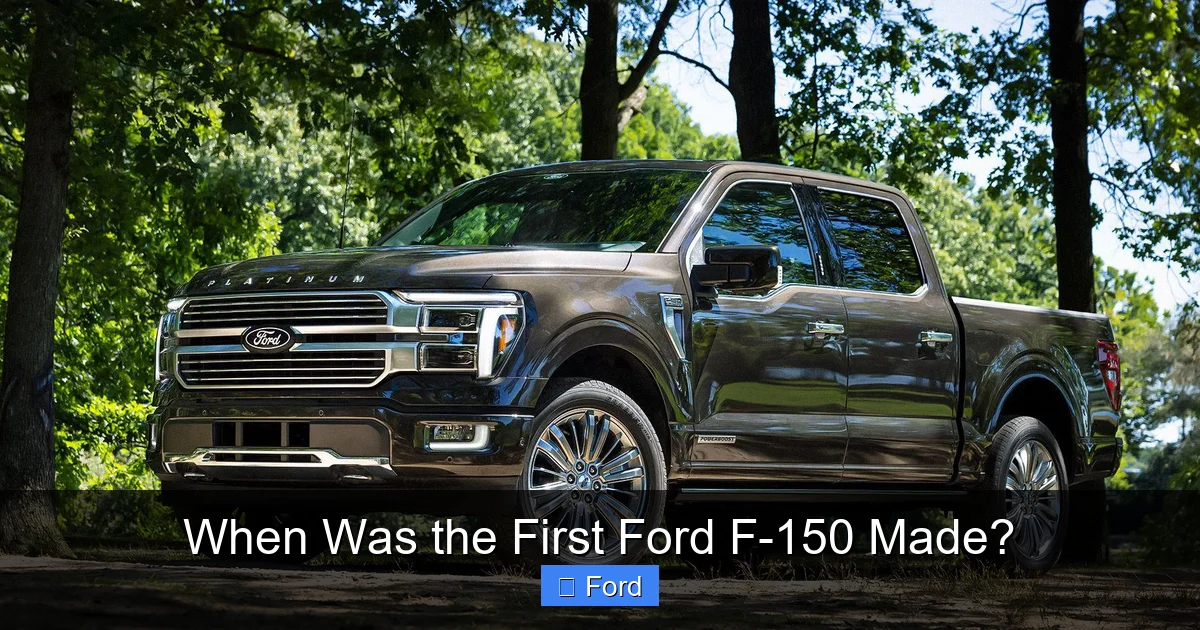
Visual guide about When Was the First Ford F-150 Made?
Image source: bakurentacars.com
Ford saw an opportunity. While their F-100 was a half-ton, many buyers who wanted more heavy-duty components (like heavier suspension, bigger brakes, or more powerful engine options) often opted for the F-250. But the F-250 was officially a three-quarter-ton truck. Ford realized there was a segment of buyers who wanted the “heavier-duty” F-250’s parts and capabilities but didn’t need the full three-quarter-ton payload rating or the associated ride characteristics. They wanted the best of both worlds: the stronger components of the 3/4-ton with the size and manners of a half-ton.
The Solution: A Re-badged, Upgraded F-100
For the 1975 model year, Ford’s solution was elegantly simple. They took the existing sixth-generation F-100 chassis and, for certain configurations, upgraded it with the heavier-duty components from the F-250. This included:
- Heavier-duty suspension (springs, shocks)
- Larger brakes
- Stronger axle housings
- Upgraded tires
- Often, the option for the larger engine lineup typically reserved for the F-250
They then slapped an “F-150” badge on it. The payload capacity was officially rated at 1,500 pounds—hence the “150” designation. It was, in essence, a “heavy-half” truck. The move allowed Ford to offer a truck that was clearly differentiated from the standard F-100, giving customers a more capable option without stepping up to a full 3/4-ton. It also allowed them to match GM’s numerical naming scheme (C10/K10 vs. F-150) with a higher number implying more capability, a powerful psychological marketing tool.
This is why the first Ford F-150 was made by modifying an existing assembly line. It wasn’t a new plant or a clean-sheet design. It was a strategic package option that grew into its own model. The 1975 F-150 shared its basic body with the F-100 but had the “heavier-duty” suspension and component package. You could often spot early F-150s by their “F-150” emblem on the front fender or tailgate, replacing the “F-100” badge.
Generational Evolution: From 1975 to the Modern Titan
The year 1975 was a starting point, not an end. The F-150 nameplate would evolve dramatically over the next 50 years, growing from a simple badge engineering exercise into a global symbol of capability. Each generation brought seismic shifts in technology, design, and capability.
Visual guide about When Was the First Ford F-150 Made?
Image source: oaklandpta.org
Seventh Generation (1980–1986): The Modernization Begins
The 1980 redesign was the first truly unique platform for the F-150. It shed the last vestiges of its 1970s predecessor with more aerodynamic, squared-off styling. This generation saw the introduction of the iconic “Ranger” trim (unrelated to the smaller Ranger pickup) and the first serious forays into diesel power with the International Harvester 6.9L IDI V8. It was also the first generation where the F-150 truly began to outsell its Chevrolet rival consistently.
Eighth Generation (1987–1991): Refinement and the First Lightning
An evolutionary update with more rounded edges and improved aerodynamics. The big news was under the hood: the debut of the electronically fuel-injected 5.0L (302) V8 and the powerful 7.3L Power Stroke diesel (in 1994). This era also gave us the first SVT Lightning (1993–1995), a high-performance F-150 that proved trucks could be both supremely capable and supremely fast, paving the way for the modern Raptor.
Ninth Generation (1992–1997): The “Aero” Look
Radically new, incredibly smooth, and controversial styling. This “aero” truck was designed in a wind tunnel and represented a massive leap in reducing drag and wind noise. It was a bold departure that polarized buyers but set the design language for all trucks to follow. The 1994–1996 SVT Lightning continued to thrill, and the 1997 introduction of the SuperCab (extended cab) with rear doors was a game-changer for family truck buyers.
Tenth Generation (1997–2004): The Revolutionary Super Duty
Split into two lines: the F-150 (1997-2004) and the all-new, heavier-duty Super Duty (F-250/F-350, 1999+). The F-150 became more car-like with a fully independent front suspension on two-wheel-drive models, offering a vastly improved ride. The 2001 introduction of the posh King Ranch trim cemented the F-150 as a luxury-laden family hauler. This era also saw the first major push into crew cabs (SuperCrew) as a mainstream option.
Eleventh Generation (2004–2008): The “Ford Tough” Redesign
Another massive styling shift to a more aggressive, boxy “Ford Tough” aesthetic. It was larger, more powerful, and packed with new features like the innovative “Stow’n Go” folding rear seats in SuperCabs. The 2004–2008 Harley-Davidson Edition and the 2004–2006 SVT Lightning (now with a supercharged 5.4L) were standout models. This generation solidified the F-150’s dominance in the segment.
Twelfth Generation (2009–2014): Aluminum and Innovation
The 2009 redesign brought more car-like handling and the revolutionary (for a full-size truck) “EcoBoost” turbocharged V6 engine in 2011. But the biggest story was the 2015 model year update (for the 2015 model): the switch to an all-aluminum body. This audacious move shaved up to 700 pounds, improving fuel efficiency, payload, and towing without sacrificing strength. It was a masterclass in engineering that competitors are still catching up to.
Thirteenth Generation (2015–2020): The Aluminum Revolution
The first high-volume, mass-produced vehicle with an all-aluminum body. It featured a new, stronger frame, advanced powertrains (including the 3.5L EcoBoost and 5.0L V8), and cutting-edge technology like the available 360-degree camera system. The 2017+ Raptor returned as a dedicated, off-road desert racing-inspired model. This generation proved the durability of aluminum in a harsh truck environment.
Fourteenth Generation (2021–Present): The Digital and Electric Frontier
The latest F-150 is a technological tour de force. It offers a hybrid powertrain (PowerBoost), a fully electric version (F-150 Lightning), and a massive 12-inch or 15-inch touchscreen running SYNC 4. The frame is stronger, the cabs are more spacious, and features like the Pro Power Onboard generator (turning the truck into a mobile power source) redefine what a pickup can be. The first Ford F-150 made in 1975 would be utterly unrecognizable to its great-great-grandchildren.
The Market Impact: How the F-150 Became #1
The creation of the F-150 nameplate gave Ford a powerful marketing tool. By 1977, just two years after its debut, the F-Series (primarily the F-150) overtook the Chevrolet C/K to become the best-selling full-size pickup in America. It has held that title every single year since. The clear “F-150” designation helped consumers easily identify the most popular, “standard” full-size Ford truck. It became the default, the benchmark, and the vehicle other manufacturers aimed to beat.
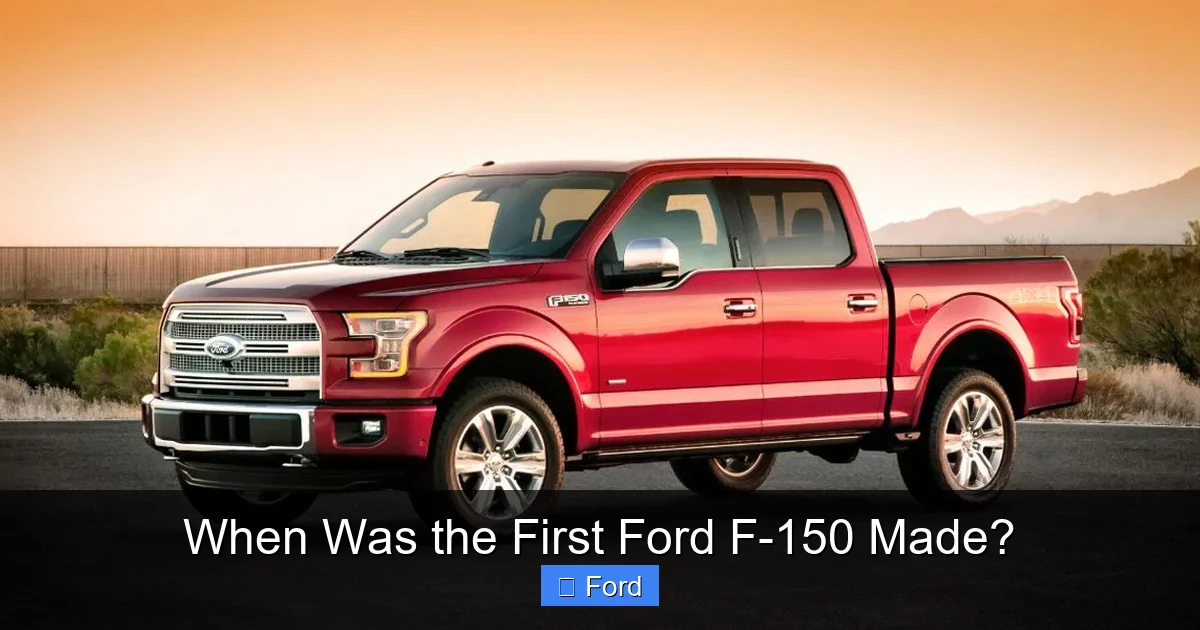
Visual guide about When Was the First Ford F-150 Made?
Image source: consumerguide.com
This dominance created a virtuous cycle. High sales volume meant massive profits, which Ford plowed back into constant development, more features, better technology, and a wider range of trims—from the basic work truck to the luxurious Platinum and the off-road Raptor. It also meant an unparalleled aftermarket. If you own an F-150, from a 1975 model to a 2024, you can find tire chains, seat covers, LED headlights, and every conceivable part and accessory with ease. This ecosystem of support is a direct result of its 50-year, continuous production run.
The F-150’s success also reshaped Ford’s corporate identity. “Built Ford Tough” is more than a slogan; it’s the core of the brand’s promise, built on the reputation of this single truck model. The profit from F-150 sales funds Ford’s other ventures, from sports cars to SUVs. It is, without exaggeration, the cornerstone of the Ford Motor Company.
Common Misconceptions and Clarifications
With such a long history, some myths about the F-150’s origin persist. Let’s clear them up.
“Wasn’t the F-150 Around in the 1960s?”
Absolutely not. The F-Series was, but the specific “150” numerical designation did not exist until 1975. All half-ton trucks before then were F-100s. You might see a 1960s truck with an “F-150” badge, but that is a later modification or an error.
“Did the F-150 Replace the F-100?”
Effectively, yes. After 1975, the F-100 was gradually phased out in North America. For the 1976 model year and beyond, the F-150 was the standard half-ton offering. The F-100 lingered in some export markets for a while but was gone from the U.S. lineup. The F-150 absorbed the F-100’s position and then grew far beyond it.
“Is a 1975 F-150 Really a ‘Real’ F-150?”
Yes, it is 100% a legitimate, factory-produced F-150. Ford assigned it the VIN and model designation, sold it through dealerships, and it was covered by the warranty. Purists and collectors recognize 1975 as the first model year. However, because it was so closely related to the F-100, some early models can have a mix of F-100 and F-150 parts. For authenticity, the presence of the correct “F-150” fender badge and a build sheet or VIN decode confirming the heavier-duty package are key.
The Legacy and What It Means for Owners Today
The fact that the first Ford F-150 was made as an upgraded F-100 tells us something important: the core DNA of the F-150 is about robustness and over-engineering. From day one, it was designed to be more capable than its nominal class suggested. That philosophy—of building a truck that can do more than expected—is what has defined every generation since.
For today’s owner, this legacy manifests in several ways. The first is sheer durability. A well-maintained F-150 from any generation can last for hundreds of thousands of miles. That’s why you see 1990s and 2000s models still on the road, and why guides for a 2010 F-150 battery or wipers for a late-model truck are so common. The second is the incredible parts commonality. The evolutionary nature of the platform means many components are shared across multiple model years, making repairs and upgrades more affordable and accessible.
Finally, it means the F-150 is more than a utility vehicle; it’s a cultural artifact. A 1975 F-150 is a classic truck. A 1997 Lightning is a modern icon. A 2021 Raptor is a technological marvel. They all share a nameplate and a spirit that traces directly back to that pivotal decision in 1974-1975 to create a new badge for a stronger truck. It’s a story of identifying a customer need, executing a simple solution, and watching it grow into a global empire on four wheels.
Conclusion: The Year That Changed Everything
So, when was the first Ford F-150 made? The definitive answer is the 1975 model year. It rolled off the same production lines as the F-100 but wore a different badge and carried heavier-duty equipment under the skin. This seemingly minor tweak was a masterstroke of product planning that aligned perfectly with consumer demand and competitive pressure. It gave buyers a clear, capable choice and gave Ford a nameplate that would become synonymous with American trucking.
From that first “heavy-half” truck to the high-tech, multi-powerplant lineup of today, the F-150’s journey is a masterclass in consistent evolution. It has adapted to fuel crises, emissions regulations, safety mandates, and shifting consumer tastes without ever losing its core identity as a tough, capable, and versatile tool. The next time you see an F-150—whether it’s a pristine vintage model or a brand-new Lightning—remember that its story began not with a revolutionary new design, but with a smart decision to badge an already great truck as something even better. That decision in 1975 is why, nearly 50 years later, we’re still talking about it.
Frequently Asked Questions
Was the 1975 F-150 completely different from the F-100?
No, the first F-150 was essentially a heavier-duty version of the existing F-100. It used the same body and basic chassis but came standard with upgraded suspension, brakes, and axles from the F-250, along with a higher payload rating.
Why did Ford stop making the F-100 and only make the F-150?
The F-150 proved so popular and effectively covered the half-ton market that there was no need to keep the F-100 name. The F-150 became the default “standard” full-size Ford truck, and the F-250/F-350 covered the heavier-duty segments.
What does the “150” in F-150 actually mean?
>Originally, it denoted the truck’s maximum payload capacity in hundreds of pounds—1,500 lbs. While modern F-150s have vastly different and often higher payload ratings depending on configuration, the name has stuck as the model designation for Ford’s standard full-size pickup.
Did the first F-150 have any unique styling?
Externally, it was identical to the contemporary F-100. The only visual differentiators were the “F-150” badges on the front fender and tailgate, replacing the “F-100” badges. Some later models in the generation got a unique grille.
Is a 1975 F-150 a good investment or classic truck?
Yes, early F-150s are becoming increasingly collectible as the first of the legendary nameplate. Their simple, rugged design and parts availability make them popular with enthusiasts. Values are rising, especially for clean, original examples with the heavier-duty package.
How can I verify if my old Ford is an authentic first-generation F-150?
The best way is to decode the Vehicle Identification Number (VIN). The 5th character in a 1975-1979 F-Series VIN indicates the model line: “1” for F-150, “2” for F-250, etc. You can also look for the original “F-150” fender badge and check for the heavier-duty suspension components (like 8-lug wheels vs. 5-lug on some F-100s).
