Are All Toyota Tpms Sensors the Same

Not all Toyota TPMS sensors are the same—they vary by model, year, and technology. Understanding these differences ensures proper tire pressure monitoring, safety, and optimal vehicle performance.
Key Takeaways
- TPMS sensors differ by Toyota model and production year: Sensors are not universally interchangeable across all Toyota vehicles due to design and frequency variations.
- Two main types exist: direct and indirect TPMS: Most modern Toyotas use direct sensors that measure pressure in real time, while older models may rely on wheel speed sensors.
- Frequency and protocol matter: Sensors operate on specific radio frequencies (315 MHz or 433 MHz) and use different communication protocols depending on the vehicle.
- Original Equipment (OE) vs. aftermarket sensors: OE sensors are designed specifically for your Toyota, while aftermarket options may offer compatibility but vary in quality and reliability.
- Relearn procedures are required after replacement: Installing new TPMS sensors often requires a reset or relearn process using a scan tool or manual method.
- Incorrect sensors can cause warning lights and safety risks: Using the wrong sensor may lead to inaccurate readings or failure to detect low tire pressure.
- Professional installation is recommended: While some DIYers can replace sensors, proper programming and calibration are best handled by trained technicians.
📑 Table of Contents
- Are All Toyota TPMS Sensors the Same? Understanding the Truth
- What Is TPMS and Why Does It Matter?
- Why Toyota TPMS Sensors Aren’t All the Same
- How to Identify the Right TPMS Sensor for Your Toyota
- Replacing Toyota TPMS Sensors: What You Need to Know
- Common Mistakes to Avoid
- Conclusion: Choose Wisely for Safety and Performance
Are All Toyota TPMS Sensors the Same? Understanding the Truth
If you’ve ever had a tire pressure warning light pop up on your Toyota’s dashboard, you’ve likely wondered about the tiny devices inside your wheels—TPMS sensors. These small but critical components monitor your tire pressure and alert you when something’s off. But here’s a question many Toyota owners ask: Are all Toyota TPMS sensors the same?
The short answer is no. While they all serve the same basic function—keeping your tires properly inflated for safety and efficiency—Toyota TPMS sensors are not one-size-fits-all. They vary significantly depending on your vehicle’s make, model, year, and even trim level. From the frequency they transmit on to the way they’re programmed, these differences matter more than you might think.
Understanding these variations is essential, especially if you’re replacing a faulty sensor or upgrading your wheels. Using the wrong sensor can lead to inaccurate readings, persistent warning lights, or even safety hazards. In this guide, we’ll break down everything you need to know about Toyota TPMS sensors—what makes them different, how to identify the right one for your vehicle, and why choosing correctly is crucial for your safety and driving experience.
What Is TPMS and Why Does It Matter?

Visual guide about Are All Toyota Tpms Sensors the Same
Image source: themegavehicle.com
Before diving into whether all Toyota TPMS sensors are the same, let’s first understand what TPMS actually is and why it’s so important.
TPMS stands for Tire Pressure Monitoring System. It’s a safety feature mandated in all new vehicles sold in the United States since 2007. The system continuously monitors the air pressure in your tires and alerts you if any tire drops below the recommended level—typically 25% underinflated. Low tire pressure can reduce fuel efficiency, increase tire wear, and even lead to blowouts, especially at high speeds.
There are two main types of TPMS: direct and indirect.
Direct TPMS
Most modern Toyotas—like the Camry, RAV4, Highlander, and Corolla—use direct TPMS. This system relies on individual sensors mounted inside each wheel (usually attached to the valve stem or banded to the wheel). These sensors measure the actual air pressure and temperature inside the tire and transmit that data wirelessly to the vehicle’s onboard computer.
Direct TPMS is highly accurate because it provides real-time pressure readings. If a tire loses air slowly—say, due to a small puncture—the system can detect it early, giving you time to address the issue before it becomes dangerous.
Indirect TPMS
Older Toyota models, particularly those from the early 2000s, may use indirect TPMS. Instead of measuring pressure directly, this system uses the vehicle’s anti-lock braking system (ABS) sensors to monitor wheel speed. When a tire is underinflated, it rotates faster than the others due to its smaller diameter. The system detects this difference and triggers a warning light.
While indirect TPMS is less expensive to maintain (no physical sensors to replace), it’s also less precise. It can’t tell you which tire is low or how much pressure is lost—only that something’s off. It also can’t detect gradual pressure loss if all tires are equally underinflated.
So, while both systems aim to improve safety, direct TPMS—used in most current Toyotas—is far more reliable and informative.
Why Toyota TPMS Sensors Aren’t All the Same

Visual guide about Are All Toyota Tpms Sensors the Same
Image source: themegavehicle.com
Now that we know how TPMS works, let’s tackle the core question: Are all Toyota TPMS sensors the same? The answer lies in several key factors that make sensors unique to specific vehicles.
Model and Year Variations
Toyota has produced hundreds of vehicle models over the decades, and each generation often comes with different TPMS requirements. For example, a 2015 Toyota Camry may use a different sensor than a 2020 Camry, even though they’re the same model. Changes in design, electronics, and safety standards mean that sensors evolve over time.
Even within the same model year, different trims or engine options can use different TPMS sensors. A base-model Corolla might have a simpler system compared to a sportier TRD version with upgraded wheels and monitoring capabilities.
Frequency Differences
TPMS sensors communicate with your vehicle using radio frequencies. In North America, most Toyota sensors operate at 315 MHz, while in Europe and other regions, 433 MHz is more common. Using a sensor with the wrong frequency will prevent it from communicating with your car’s computer, rendering it useless.
This is especially important if you’re buying sensors online or from a third-party supplier. Always confirm the frequency matches your vehicle’s requirements.
Sensor Protocol and Programming
Beyond frequency, sensors use different communication protocols—essentially, the “language” they use to talk to your car. Toyota vehicles use proprietary protocols that vary by model and year. Some sensors are pre-programmed for specific vehicles, while others are “universal” and need to be programmed after installation.
For example, a 2018 Toyota RAV4 uses a specific protocol that’s different from a 2012 Toyota Tacoma. Even if both use 315 MHz sensors, they won’t work interchangeably without proper programming.
Valve Stem and Mounting Style
TPMS sensors also differ in physical design. Some are integrated into the valve stem (called snap-in sensors), while others are banded to the wheel using a metal strap. Snap-in sensors are easier to install but can be damaged during tire changes. Banded sensors are more durable but require special tools to mount.
Additionally, the material of the valve stem matters. Rubber valve stems can degrade over time, especially in harsh climates, while metal stems last longer but may interfere with sensor signals if not properly grounded.
Original Equipment (OE) vs. Aftermarket Sensors
Another major factor is whether you’re using an Original Equipment (OE) sensor or an aftermarket one. OE sensors are made by Toyota or its suppliers and are designed specifically for your vehicle. They’re guaranteed to match the frequency, protocol, and physical specs.
Aftermarket sensors, on the other hand, are made by third-party companies and may offer broader compatibility. Some are “clone” sensors that mimic OE performance, while others are universal and require programming. While aftermarket sensors can be cheaper, they vary widely in quality. A low-quality sensor might fail prematurely or give inaccurate readings.
How to Identify the Right TPMS Sensor for Your Toyota
Visual guide about Are All Toyota Tpms Sensors the Same
Image source: i.ytimg.com
So, how do you know which TPMS sensor is right for your Toyota? Here’s a step-by-step guide to help you choose correctly.
Check Your Vehicle’s Year, Make, and Model
Start by confirming your Toyota’s exact year, model, and trim. This information is crucial because even small differences can affect sensor compatibility. For example, a 2016 Toyota Sienna LE and a 2016 Sienna XLE might use different sensors due to wheel or electronics differences.
Consult the Owner’s Manual or VIN
Your owner’s manual often lists TPMS specifications, including sensor type and frequency. If you don’t have the manual, you can use your Vehicle Identification Number (VIN) to look up detailed specs online. Many parts websites and Toyota dealerships can decode your VIN to identify the correct sensor.
Look at the Existing Sensor
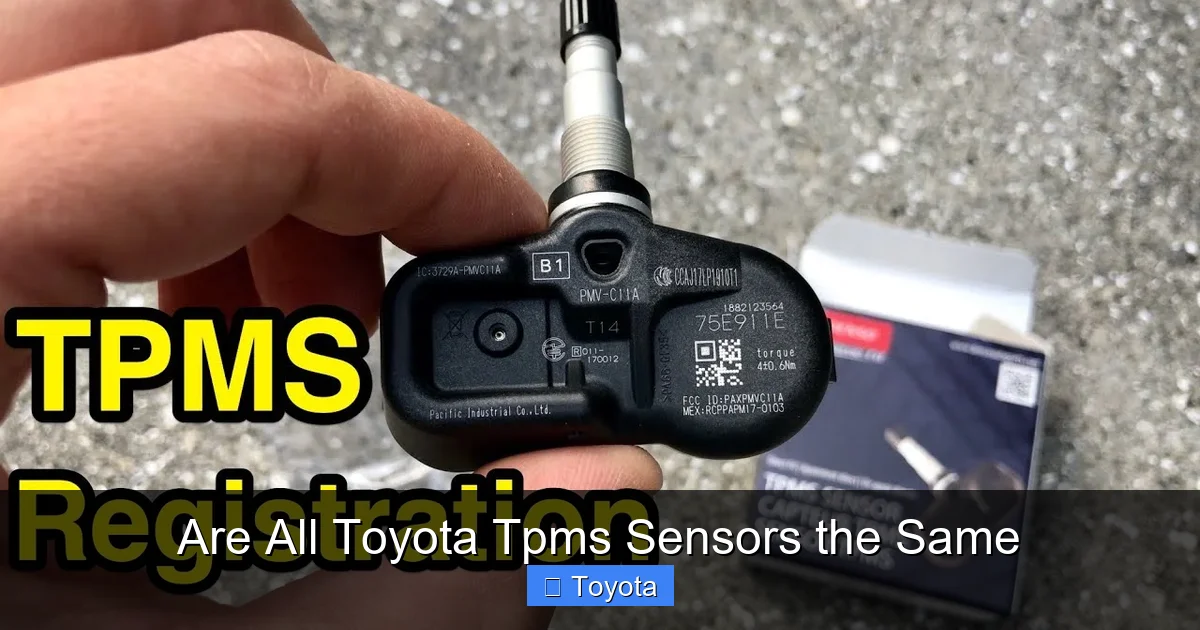
If you’re replacing a sensor, inspect the one you’re removing. Most sensors have a part number printed on them. This number can be cross-referenced with Toyota’s parts catalog or online databases to find the exact replacement.
For example, a common Toyota TPMS sensor part number is 42607-33010, used in many 2013–2018 Camry and RAV4 models. Knowing this number ensures you get the right match.
Use a TPMS Lookup Tool
Many automotive parts retailers—like AutoZone, O’Reilly, or RockAuto—offer online TPMS lookup tools. Simply enter your vehicle details, and the tool will show compatible sensors. These tools often include notes about frequency, protocol, and whether programming is required.
Ask a Professional
When in doubt, consult a Toyota dealership or certified mechanic. They have access to factory databases and can confirm the correct sensor for your vehicle. While this may cost a small fee, it’s worth it to avoid buying the wrong part.
Replacing Toyota TPMS Sensors: What You Need to Know
Once you’ve identified the right sensor, the next step is replacement. But replacing a TPMS sensor isn’t as simple as swapping out an old tire valve. It involves several steps, including removal, installation, and relearning.
Removing the Old Sensor
To replace a sensor, the tire must be removed from the wheel. This is typically done at a tire shop using specialized equipment. The technician will break the bead, remove the tire, and then unscrew or unclip the old sensor from the valve stem or band.
Be careful not to damage the wheel or sensor during removal. Damaged sensors can’t be reused, and damaged wheels may require costly repairs.
Installing the New Sensor
The new sensor is installed in the same location as the old one. Snap-in sensors are pressed into the valve hole and secured with a nut. Banded sensors are wrapped around the wheel and tightened with a bolt.
After installation, the tire is remounted and inflated to the recommended pressure. It’s important to ensure the valve stem is properly seated and there are no leaks.
Programming and Relearning
This is where many people run into trouble. Simply installing a new sensor isn’t enough—it must be programmed to communicate with your vehicle.
Some OE sensors come pre-programmed and will work immediately. Others, especially aftermarket or universal sensors, require programming using a TPMS scan tool. This tool sends a signal to the sensor, telling it which wheel position it’s in (front left, rear right, etc.).
After programming, the vehicle must undergo a “relearn” procedure. This tells the car’s computer to recognize the new sensors. The relearn process varies by model but often involves:
– Turning the ignition on
– Pressing the TPMS reset button (if equipped)
– Driving the vehicle at a certain speed for a set time
– Using a scan tool to initiate the relearn sequence
For example, many 2015–2020 Toyotas require driving at 15 mph for 10 minutes to complete the relearn. Others may need a scan tool like an Autel or Foxwell to reset the system.
Testing the System
Once the relearn is complete, check the dashboard for the TPMS warning light. If it stays off, the system is working. You can also use a TPMS tool to verify that all sensors are transmitting data correctly.
Common Mistakes to Avoid
Even with the right sensor, mistakes during replacement can cause problems. Here are some common pitfalls to avoid.
Using the Wrong Sensor
This is the biggest mistake. Buying a sensor that looks similar but has a different frequency or protocol will result in a non-functional system. Always double-check compatibility.
Skipping the Relearn Process
Many people assume the sensor will work right away. But without the relearn, the car won’t recognize the new sensor, and the warning light will stay on.
Ignoring Sensor Battery Life
TPMS sensors have internal batteries that last 5–10 years. If your sensor is old, it may be nearing the end of its life. Replacing it proactively can prevent future issues.
Not Checking All Four Sensors
If one sensor fails, the others may not be far behind. Consider replacing all four sensors at the same time, especially if they’re over 7 years old.
Using Low-Quality Aftermarket Sensors
Cheap sensors may save money upfront but can fail quickly or give false readings. Stick to reputable brands or OE parts when possible.
Conclusion: Choose Wisely for Safety and Performance
So, are all Toyota TPMS sensors the same? The answer is a clear no. While they all monitor tire pressure, they differ in design, frequency, protocol, and compatibility. Using the wrong sensor can lead to inaccurate readings, warning lights, and even safety risks.
The key is to match the sensor to your specific Toyota model, year, and trim. Always verify the frequency, check the part number, and follow proper installation and relearn procedures. When in doubt, consult a professional.
Investing in the right TPMS sensor isn’t just about fixing a warning light—it’s about ensuring your tires are properly inflated, your vehicle handles safely, and you get the best fuel efficiency. With the right knowledge and care, you can keep your Toyota running smoothly and safely for miles to come.
Frequently Asked Questions
Can I use any TPMS sensor in my Toyota?
No, you cannot use any TPMS sensor. Sensors must match your Toyota’s specific frequency, protocol, and physical design. Using an incompatible sensor will prevent proper communication with your vehicle’s computer.
Do I need to reprogram TPMS sensors after replacement?
Yes, most new TPMS sensors require programming and a relearn procedure. This ensures the vehicle recognizes the new sensor and knows its wheel position. Some OE sensors are pre-programmed, but others need a scan tool.
How long do Toyota TPMS sensors last?
TPMS sensors typically last 5 to 10 years, depending on usage and environmental conditions. The internal battery eventually dies, requiring replacement even if the sensor itself is undamaged.
Can I replace a TPMS sensor myself?
You can replace the sensor yourself if you have the right tools and knowledge, but tire removal and programming often require professional equipment. For most people, it’s best to visit a tire shop or dealership.
Why does my TPMS light stay on after replacing a sensor?
The light may stay on if the sensor wasn’t programmed correctly, the relearn process wasn’t completed, or the new sensor is incompatible. Use a scan tool to check sensor communication and reset the system.
Are aftermarket TPMS sensors reliable?
Some aftermarket sensors are reliable and cost-effective, but quality varies. Stick to reputable brands and ensure compatibility with your Toyota. OE sensors are the safest choice for guaranteed performance.