
Do Jeep Wranglers Have Airbags?

Yes, all modern Jeep Wranglers come equipped with airbags. The number and type of airbags have evolved significantly from basic driver-side units in early models to comprehensive systems with front, side-curtain, and seat-mounted airbags in newer JL and JT generations. Understanding your specific model year’s airbag configuration, its safety ratings, and proper maintenance is crucial for maximizing occupant protection in this iconic off-road vehicle.
It’s one of the most common and important questions about automotive safety: “Do Jeep Wranglers have airbags?” The answer is a definitive yes, but the story is far more nuanced than a simple yes or no. The Jeep Wrangler, an icon of freedom and rugged capability, has undergone a profound safety transformation over its generations. What began as a bare-bones, doorless, topless utility vehicle is now a modern SUV packed with advanced safety technology, with airbags being a cornerstone of that evolution. This guide will dive deep into the airbag history of the Wrangler, break down the specific systems for each generation, discuss the critical Takata recall, explain how to maintain your system, and debunk common myths. Whether you own a vintage CJ, a classic TJ, a popular JK, or the latest JL or JT Gladiator, understanding your vehicle’s airbag suite is non-negotiable for responsible ownership.
Key Takeaways
- All post-1997 Wranglers have at least a driver’s airbag: Federal mandate required dual front airbags by 1998, making them standard on all 1997.5+ Wranglers (TJ generation).
- Airbag systems evolved dramatically: Early TJs had basic front airbags. JK/JKU models (2007-2018) added front side-seat mounted airbags. Current JL/JT models (2018+) feature advanced front airbags and standard side-curtain airbags for all rows.
- The massive Takata airbag recall affected millions: Wranglers from model years 2007-2018 were part of the recall for potentially lethal defective inflators. Check your VIN immediately for recall status, as repairs are free and urgent.
- Side-curtain airbags are a recent safety upgrade: These deploy from the roof rail to protect heads in side impacts or rollovers, a critical feature for a vehicle often driven without a roof or doors.
- Airbag warning lights require immediate attention: An illuminated SRS light indicates a fault in the system. Driving with a disabled airbag system is dangerous and often illegal for safety inspections.
- Off-road use can affect airbag sensors: Severe impacts, extreme angles, or aftermarket modifications (like rigid bumpers that block sensors) can trigger or damage airbag components.
- Replacement costs are high but sometimes covered: Airbag module replacement can cost $1,000-$3,000+. If deployed in an accident, your auto insurance policy will typically cover the cost minus your deductible, which is why understanding your insurance coverage is so important.
📑 Table of Contents
- The Evolution of Airbags in the Jeep Wrangler Lineage
- Understanding the Takata Airbag Recall: A Critical Safety Issue
- Airbag Locations and Types: A Model Year Breakdown
- Safety Ratings and Real-World Protection
- Maintenance, Troubleshooting, and Common Myths
- What to Do After an Airbag Deploys
- Conclusion: Safety is Part of the Adventure
The Evolution of Airbags in the Jeep Wrangler Lineage
To truly understand the airbag situation in a Wrangler, you must view it through the lens of generational change. Each major Wrangler platform—CJ, YJ, TJ, JK/JKU, and JL/JT—reflects the shifting safety mandates and engineering philosophies of its time.
The Pre-Airbag Era: CJ and Early YJ (1944-1995)
The original Jeep, the CJ (Civilian Jeep), and its successor, the YJ (1987-1995), were products of a different era. Safety regulations were minimal, and the concept of a supplemental restraint system (SRS) was in its infancy in passenger cars, let alone a bare-bones off-roader. These models have no factory-installed airbags whatsoever. The interior was spartan, with a simple steering wheel and a focus on mechanical durability over crash energy management. If you own one of these classics, your safety relies entirely on seat belts (if equipped), your driving skill, and the vehicle’s robust, albeit non-crumpling, frame. This is a key distinction when comparing older models to the modern Wrangler.
The Infancy of Safety: The TJ Generation (1997-2006)
The TJ Wrangler, with its return to round headlights and classic look, marked a pivotal turning point. For the 1997 model year (technically starting in mid-1996 as a 1997.5 model), Chrysler, Jeep’s parent company, installed a driver’s side airbag as standard equipment. This was a direct response to the Intermodal Surface Transportation Efficiency Act (ISTEA) of 1991, which mandated that all new passenger cars built after September 1, 1997, must have dual front airbags. For the 1998 model year, a passenger’s side airbag became standard, fulfilling the dual-front requirement. The TJ’s system was basic by today’s standards—a single-stage inflator with no seat or side-impact protection. The airbag module was housed in a distinctive “pie plate” cover on the steering wheel and a similar unit on the passenger dash. This generation is the first where you can confidently say “yes, it has airbags,” but only two of them, up front.
A Major Leap Forward: The JK/JKU Generation (2007-2018)
The JK and its four-door variant, the JKU, represented the Wrangler’s full embrace of modern SUV norms. This generation saw the most significant expansion of its airbag system. Standard on all JK/JKU models were the expected dual front airbags. However, the big news was the addition of front side-impact airbags mounted in the outboard side of the front seats. These were designed to deploy in a side collision to protect the driver’s and passenger’s torso and pelvis. This was a huge step for a vehicle often used with doors removed, as it provided some protection even in an open-air configuration. It’s important to note that the JK/JKU did not come with side-curtain airbags from the factory. This omission was a point of criticism in safety reviews compared to more car-based crossovers. The system also included advanced sensors and a more sophisticated Occupant Restraint Controller (ORC) that considered seat belt status and impact severity.
The Modern Standard: The JL/JT Generations (2018-Present)
The current JL Wrangler and JT Gladiator pickup represent the pinnacle of Wrangler safety, bringing the platform in line with modern expectations. They feature a comprehensive 7-airbag system (in 4-door models) or a 6-airbag system (in 2-door models). This includes:
- Dual-stage front airbags for driver and passenger. “Dual-stage” means the inflator can deploy with varying force based on crash severity and seat belt usage, reducing the risk of injury from the airbag itself.
- Front seat-mounted side-impact airbags (thorax bags), continuing from the JK.
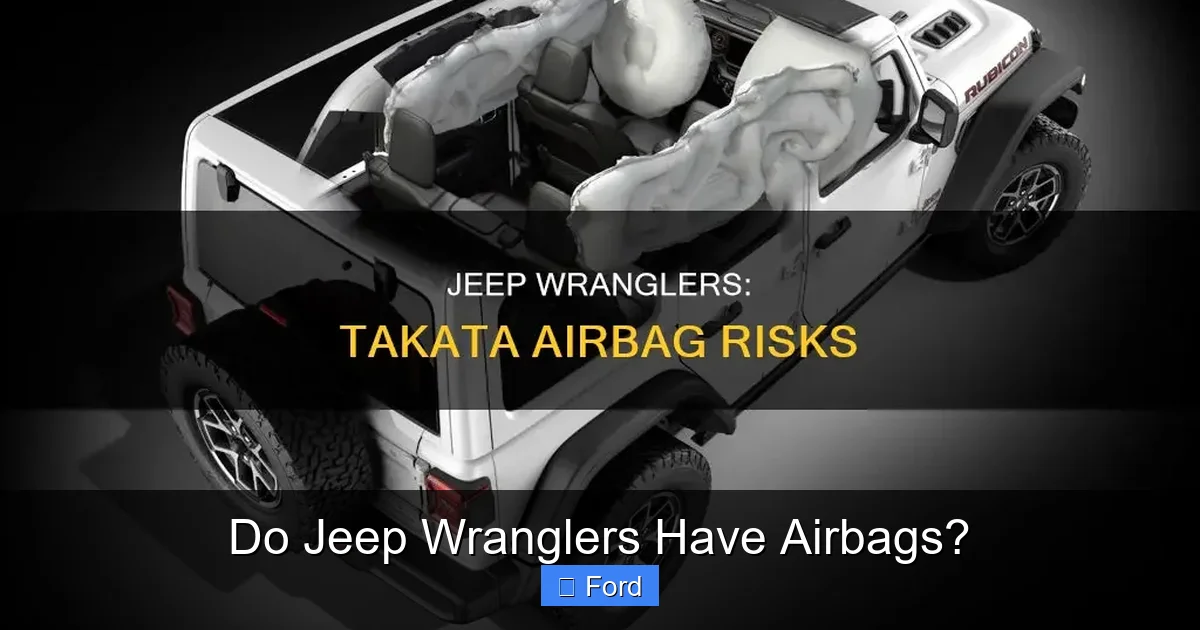
- Side-curtain airbags that deploy from a concealed housing in the roof rail along both sides. This is the most critical new addition. In a rollover—a scenario more plausible in a high-center-of-gravity vehicle like the Wrangler—these curtain airbags stay inflated longer to provide head protection as the vehicle rolls. They also deploy in side impacts. For the 4-door JL/JT, the curtain airbags cover both rows of seats.
- Knee airbags for the driver and passenger, located in the lower dash. These help control forward movement and reduce leg injuries.
This full suite earned the JL Wrangler significantly better crash test ratings from the IIHS and NHTSA than its predecessors, particularly in side-impact and rollover tests.
Understanding the Takata Airbag Recall: A Critical Safety Issue
No discussion of Wrangler airbags is complete without addressing the largest and most dangerous automotive recall in history: the Takata airbag inflator recall. This recall impacted millions of vehicles from nearly every major manufacturer, and Jeep Wranglers were heavily affected.
Visual guide about Do Jeep Wranglers Have Airbags?
Image source: shunauto.com
What Was the Problem?
Certain Takata inflators used a propellant that could degrade over time, especially when exposed to repeated cycles of high heat and humidity. If the inflator ruptured during deployment—which happens in a fraction of a second—it could send sharp metal shrapnel flying into the passenger cabin. This wasn’t just a failure of the airbag; it was the transformation of a safety device into a lethal weapon. The defect caused numerous deaths and serious injuries worldwide.
Which Wranglers Were Affected?
The recall covered Jeep Wrangler (JK/JKU) models from 2007 through 2018. It also included some 2006 models built in 2005. The specific inflators were in the driver’s and/or passenger’s front airbag modules. If your Wrangler falls within these years, it is almost certainly subject to this recall. The repair involves replacing the entire front airbag module (the bag and the inflator) with a new, safe unit from a different manufacturer.
How to Check and What to Do
This is urgent. You must check your vehicle’s recall status. The only official way is to visit the National Highway Traffic Safety Administration (NHTSA) website (nhtsa.gov/recalls) and enter your 17-digit Vehicle Identification Number (VIN). You can also call Jeep customer service or your authorized Jeep dealer. Do not ignore a recall notice. The repair is free, and the risk of a violent, shrapnel-producing explosion is real, especially in older, hot-climate vehicles. If you have a used Wrangler from this era and are unsure of its service history, checking this should be your absolute first step. For context on how serious recalls can be, you might read about common problems in other models like the 2015 Toyota RAV4, which also had its share of safety-related recalls.
Airbag Locations and Types: A Model Year Breakdown
Let’s make it concrete. Here is a quick-reference guide to what airbags you should expect in your Wrangler based on its generation and body style.
Visual guide about Do Jeep Wranglers Have Airbags?
Image source: shunauto.com
- CJ (1944-1986): None. Period.
- YJ (1987-1995): None. Some aftermarket kits exist, but no factory system.
- TJ (1997-2006): 2 Airbags (Driver & Passenger Front). No side, curtain, or knee bags.
- JK/JKU 2-Door (2007-2018): 6 Airbags. Dual Front, Front Seat-Mounted Side, Driver Knee, Passenger Knee. No side-curtain airbags.
- JK/JKU 4-Door (2007-2018): 6 Airbags. Same as 2-door. No side-curtain airbags for any row.
- JL/JT 2-Door (2018-Present): 6 Airbags. Dual Front, Front Seat-Mounted Side, Driver Knee, Passenger Knee. Side-curtain airbags are for the front seats only.
- JL/JT 4-Door / JT Gladiator (2018-Present): 7 Airbags. Dual Front, Front Seat-Mounted Side, Driver Knee, Passenger Knee, and Side-curtain airbags covering both front and rear rows.
The absence of rear-seat curtain airbags in the 2-door JL is a notable compromise due to the shorter wheelbase and lack of a permanent B-pillar structure. Owners who frequently carry rear passengers (even in a 2-door, which has a small rear seat) should be aware of this limitation.
Safety Ratings and Real-World Protection
Airbags are one part of a larger safety system. Their effectiveness is measured by crash test ratings, which evaluate the entire vehicle structure and restraint system working together.
Visual guide about Do Jeep Wranglers Have Airbags?
Image source: shunauto.com
NHTSA and IIHS Scores
The National Highway Traffic Safety Administration (NHTSA) gives the 2024 Jeep Wrangler a 4-star overall rating. It scores 5 stars for frontal driver, 4 stars for frontal passenger, and 5 stars for side barrier and pole tests. The Insurance Institute for Highway Safety (IIHS) gives it a “Marginal” rating overall, with “Good” scores in many areas but a “Poor” rating for the updated moderate overlap front test (which simulates a crash with a larger vehicle or offset barrier). The IIHS specifically notes that the Wrangler’s structure can be compromised in severe crashes, which can affect airbag performance. This underscores a key point: a strong vehicle cage is what gives airbags the time and space to work effectively.
The Rollover Factor
The Wrangler’s high center of gravity makes it more susceptible to rollovers than a standard sedan. This is precisely why the side-curtain airbags in the JL/JT are so vital. They are designed to deploy in rollover events and remain inflated to protect occupants’ heads as the vehicle rolls multiple times. However, no airbag can overcome the laws of physics entirely. Safe driving, proper tire pressure, and not exceeding speed limits for conditions are your primary defenses against a rollover.
Maintenance, Troubleshooting, and Common Myths
An airbag system is a “use once, replace” device, but it requires constant monitoring to be ready.
The SRS Warning Light: Your Canary in the Coal Mine
When you start your Wrangler, the Supplemental Restraint System (SRS) warning light on the instrument cluster should illuminate for a few seconds and then go out. This is the system’s self-test. If the light stays on or comes on while driving, it means a fault has been detected. Common causes include:
- A faulty clock spring (the spiral cable in the steering wheel that maintains electrical connection as you turn).
- A loose or damaged connector under the front seats (where seat-mounted side airbags connect).
- A problem with the Occupant Classification System (OCS) sensor in the passenger seat, which determines if the seat is occupied and by an adult or child.
- Previous deployment that wasn’t properly repaired.
Never ignore this light. It means your airbags may not deploy in an accident. Diagnosis requires a professional scan tool that can read SRS codes, which are different from standard engine/transmission codes. A mechanic will need to diagnose the specific fault code to proceed.
Aftermarket Accessories and Airbag Safety
Jeep owners love to modify their rigs. But be warned: some modifications can interfere with airbag sensors or deployment paths.
- Steering Wheel Swaps: Aftermarket wheels often lack the necessary cutouts or space for a properly sized airbag module. Using a non-compatible wheel can cause the airbag to deploy incorrectly or not at all. If you change wheels, you must use a compatible airbag module and ensure the clock spring is properly installed.
- Seat Covers: Thick, non-OEM seat covers can interfere with the seat-mounted side airbags’ deployment or damage the airbag seam in the seatback. Always use seat covers specifically designed and rated for vehicles with side airbags.
- Rigid Front Bumpers: Some aftermarket bumpers can block or alter the crush zone of the front frame rails, which are designed to trigger the front airbag sensors in a controlled manner. This can lead to untimely or failed deployment.
When in doubt, consult with a reputable Jeep shop about how any modification might interact with the SRS.
Myth Busting: “Airbags Are Dangerous”
A persistent myth is that airbags cause more harm than good. This stems from early-generation airbags in the 1990s, which were designed with a one-size-fits-all, high-pressure deployment for unbelted occupants. They could cause injuries to children, small adults, or out-of-position occupants. Modern airbags, like those in your Wrangler, are “smart.” They use multiple sensors (accelerometers, pressure sensors, seat belt switches, occupant weight sensors) to determine crash severity and occupant position. They often have multi-stage inflators that can deploy with less force if the occupant is belted and smaller. The risk of injury from a properly functioning modern airbag in a crash where it is needed is far, far lower than the risk of fatal injury from hitting the steering wheel or dashboard without it. Always wear your seat belt—it works with the airbag.
What to Do After an Airbag Deploys
This is a critical scenario. If your Wrangler’s airbag(s) deploy, here is the immediate protocol:
- Ensure Safety: Move the vehicle to a safe location if possible. Turn off the engine.
- Check for Injuries: Airbag deployment is loud and can cause burns, abrasions, or hearing damage. Seek medical attention immediately, even if you feel fine. Adrenaline can mask injuries.
- Do Not Drive: A vehicle with deployed airbags is not street legal and is unsafe to drive. The SRS system is now completely disabled.
- Call for Tow: Have the vehicle towed to a repair shop or your home. Do not attempt to replace the airbags yourself; they are explosive devices and must be handled by certified technicians.
- Insurance Claim: Contact your insurance company to file a claim. They will guide you through the process. The cost to replace a single front airbag module, including parts and labor, typically ranges from $1,200 to $2,500. A full system reset after deployment is required. For more on the insurance process, especially if you’re in a state like Florida, reviewing your policy’s specifics for accident coverage is essential.
- System Reset: After replacement, the SRS computer must be reset with a professional scan tool. Simply replacing the bag is not enough.
You can find detailed steps on what to do after airbag deployment in other resources, but the core principles are safety first, professional repair, and insurance notification.
Conclusion: Safety is Part of the Adventure
So, do Jeep Wranglers have airbags? The journey from the CJ’s open cabin to the JL’s 7-airbag system tells a story of relentless safety progress. Today’s Wrangler is a far cry from its minimalist ancestors, offering a level of occupant protection that meets, and in some aspects exceeds, modern standards. The key for every Wrangler owner is knowledge. Know your model year’s specific system. Know if your vehicle is part of the historic Takata recall and get it fixed. Pay attention to the SRS light. Understand how your driving and modifications impact the system. The Wrangler’s legendary capability is best enjoyed with the peace of mind that comes from knowing you and your passengers are as protected as possible on the road and the trail. Treat your airbag system with the respect it deserves—it’s the one piece of technology you hope you never need, but will be incredibly grateful for if you do.
Frequently Asked Questions
Do all Jeep Wranglers have airbags?
No. Models before the 1997.5 TJ generation (CJ and YJ) have no factory airbags. All TJ, JK/JKU, JL/JT, and JT Gladiator models are equipped with at least a driver’s airbag and, from 1998 onward, a passenger airbag as well.
How many airbags does a 2023 Jeep Wrangler have?
A 2023 4-door Jeep Wrangler Unlimited (JL) has 7 airbags: dual front, front seat-mounted side, driver knee, passenger knee, and side-curtain airbags covering both rows. A 2-door model has 6, as the curtain airbags only cover the front seats.
What should I do if my Jeep Wrangler’s airbag light is on?
Have it diagnosed by a professional immediately. The light indicates a fault in the SRS, meaning your airbags may not deploy. Do not attempt to reset it yourself; a technician must identify and repair the specific faulty component, which could be a clock spring, sensor, or connector.
Can I remove the airbag fuse to disable the system?
Technically yes, but it is highly dangerous and illegal in many areas for safety inspections. Disabling your airbags eliminates a critical safety system, increases injury risk, and can affect your insurance coverage in an accident. It should never be done.
Will removing my Jeep’s doors affect the side-curtain airbags?
No. The side-curtain airbags deploy from the roof rail, not the door. They are designed to function even with the doors removed, which is a key safety feature for the Wrangler’s open-air driving experience. However, ensure no loose wiring or components are exposed when doors are off.
Is it safe to drive a Jeep Wrangler without a roof if it has side-curtain airbags?
Yes, the side-curtain airbags are specifically designed to work with the roof removed or with the soft top folded. They deploy from the fixed roof rail structure. However, driving without a roof or doors always carries increased risk in a rollover or ejection scenario, so seat belts are absolutely mandatory for all occupants.
