
How Long Will a Toyota Highlander Hybrid Battery Last?

A Toyota Highlander Hybrid battery typically lasts between 10-15 years or 150,000-200,000 miles, backed by a strong warranty. Its longevity surpasses many traditional car components, often outlasting the vehicle itself with proper care. Factors like driving habits, climate, and maintenance significantly influence its lifespan. Understanding these elements helps owners avoid premature failure and costly replacements. This guide breaks down the science, real-world expectations, and practical steps to keep your hybrid system running efficiently for the long haul.
So, you’re thinking about a Toyota Highlander Hybrid, or you already own one. That’s a fantastic choice for a reliable, fuel-efficient three-row SUV. But a big question, maybe even a worry, is lurking in the back of your mind: “How long will that complicated and expensive hybrid battery actually last?” It’s the single most expensive component in your hybrid, and understanding its lifespan is crucial for your peace of mind and your wallet. Let’s pull back the curtain on this topic, combining Toyota’s engineering specs with real-world owner experiences and expert insights.
First, take a breath. Toyota has been in the hybrid game since the Prius launched in the late 1990s. They’ve had over two decades to refine this technology. The battery in your Highlander Hybrid isn’t some fragile, experimental part; it’s a robust, heavily tested component designed for longevity. The common worry stems from the early days of hybrids when battery technology was newer and more expensive. Today, the story is much different, and the data is overwhelmingly positive. This article will give you a clear, no-nonsense answer, backed by warranty information, engineering principles, and practical advice you can use today.
Key Takeaways
- Typical Lifespan: The Highlander Hybrid battery is engineered to last 10-15 years or 150,000-200,000 miles, often matching or exceeding the vehicle’s lifespan.
- Strong Warranty Protection: Toyota provides a robust warranty—typically 8 years/100,000 miles—covering battery failure, offering significant peace of mind.
- Longevity is Not Guaranteed: Real-world lifespan varies based on driving patterns, extreme temperatures, and charging habits; aggressive use in very hot climates can shorten life.
- Warning Signs of Failure: Watch for reduced fuel economy, inconsistent engine behavior, warning lights (check hybrid system), or a noticeable loss of electric-only driving range.
- Replacement is a Major Investment: While rare, a out-of-warranty replacement can cost $3,000-$5,000+, though remanufactured options and core charges can lower the expense.
- It’s a Different Beast: Unlike a 12V starter battery, the hybrid traction battery is a complex, high-voltage NiMH or lithium-ion pack designed for deep cycling and decades of service.
- Maintenance is Minimal but Key: There are no user-serviceable parts, but ensuring the hybrid system cooling fins are clean and avoiding deep discharges extends life.
📑 Table of Contents
- Understanding the Highlander Hybrid’s Power Plant
- Official Toyota Stance: Warranty and Engineering Claims
- Real-World Longevity: What Owners Are Actually Seeing
- Factors That Can Shorten (or Extend) Battery Life
- Essential Maintenance to Maximize Battery Life
- What Happens When It Fails? Costs and Replacement Process
- The Verdict: A Long-Term Partner
Understanding the Highlander Hybrid’s Power Plant
Before we talk about lifespan, we need to understand what we’re talking about. The “hybrid battery” in your Highlander is officially called a traction battery or high-voltage (HV) battery. It’s fundamentally different from the 12-volt battery under your hood that starts the engine and powers the accessories.
The Difference: Traction Battery vs. 12V Battery
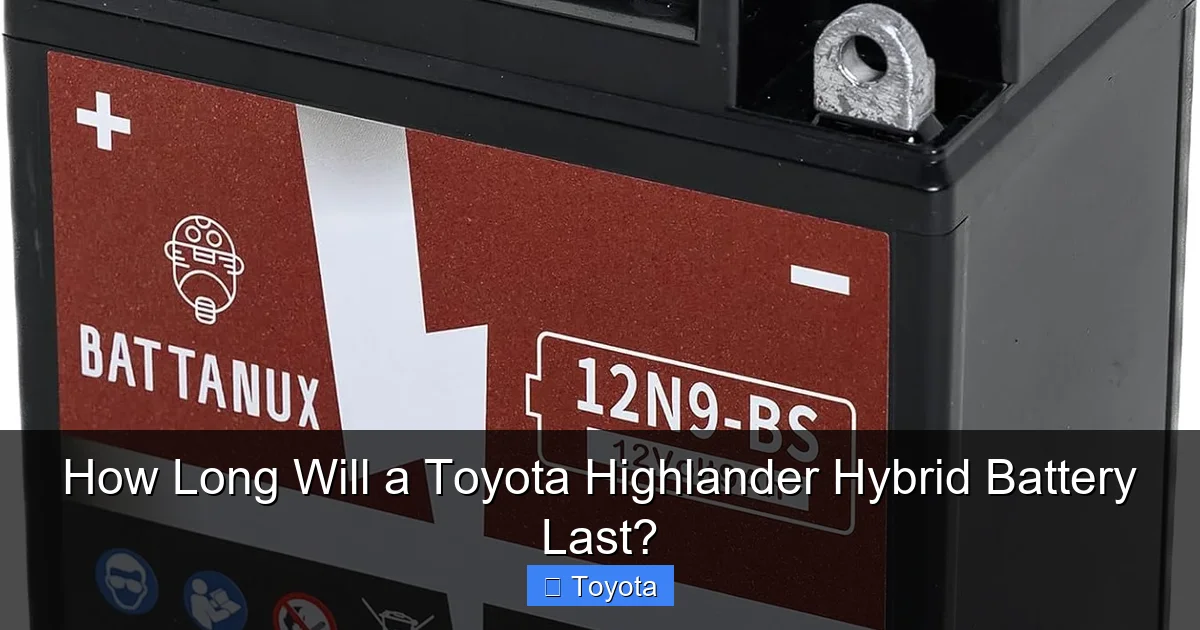
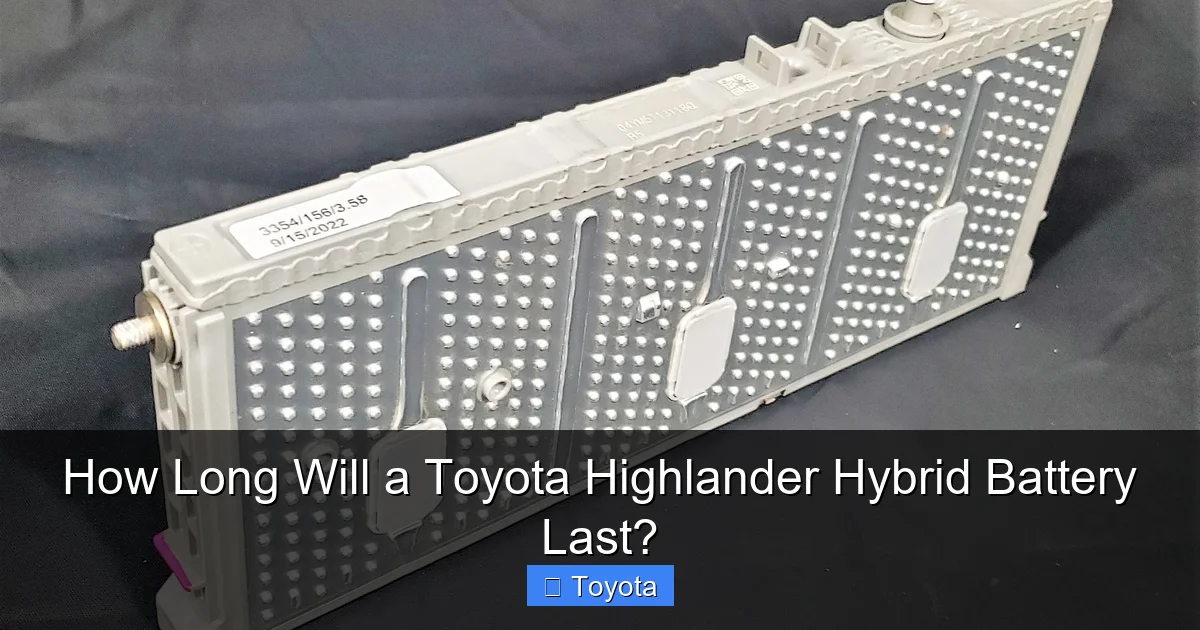
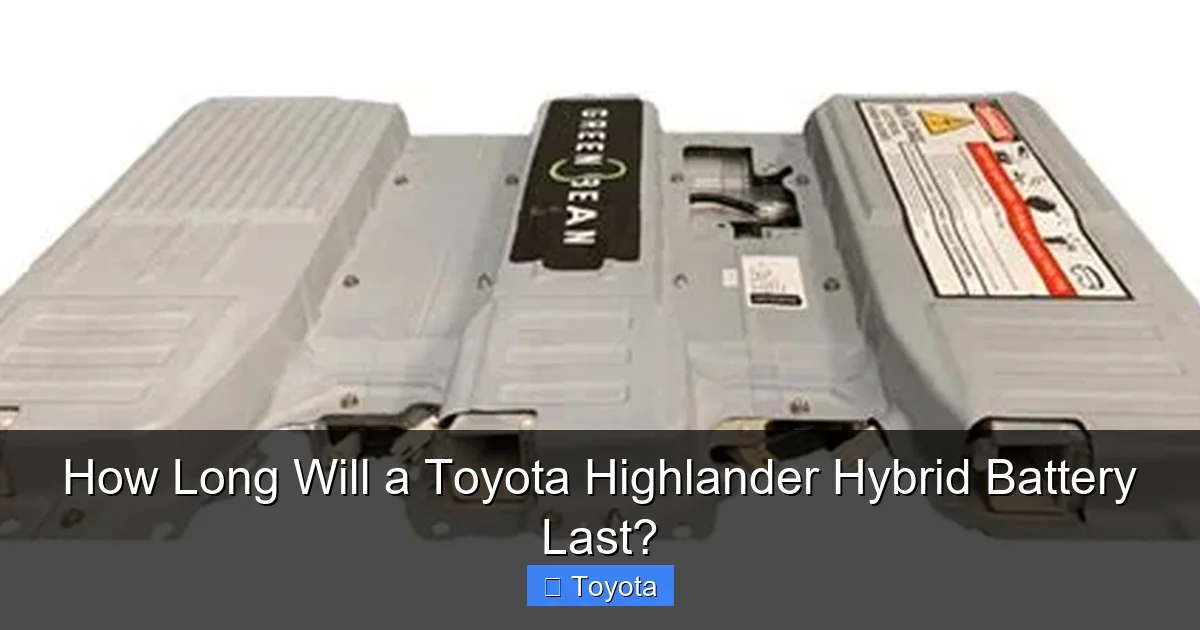
The 12V battery is a lead-acid battery. It’s designed to provide a huge burst of power to crank the engine and then be immediately recharged by the alternator. It doesn’t like being deeply discharged. The HV battery, however, is a completely different animal. Current Highlander Hybrid models use a nickel-metal hydride (NiMH) pack, though some global variants and the related Toyota Venza hybrid use lithium-ion. This pack is made up of many individual cells grouped into modules, all managed by a sophisticated battery management system (BMS).
The BMS is the unsung hero here. It constantly monitors the voltage, temperature, and state of charge of every cell. It ensures cells are balanced, prevents overcharging and deep discharging, and manages active cooling (using cabin air or dedicated fans) to keep the pack in its optimal temperature window. This active management is why these batteries last so long. It’s not just a static box of chemicals; it’s a dynamically controlled energy storage system. For a deeper dive into hybrid battery technology across Toyota’s lineup, you can read our general guide on how long a hybrid car battery lasts.
How It’s Used: Deep Cycling Designed for Long Life
In a traditional car, the 12V battery’s job is mostly to start the car. In a hybrid, the HV battery’s job is constant and varied. It provides power to the electric motor(s) for acceleration, captures energy during braking (regenerative braking), and can power the vehicle at low speeds on electric-only power. This means it’s regularly charged and discharged—what’s called “deep cycling.”
Consumer-grade NiMH batteries in toys or old cordless phones would die quickly under this cycle. But automotive-grade NiMH, like Toyota uses, is specifically formulated for high-cycle life. The chemistry and the BMS are designed to handle thousands of these charge/discharge cycles with minimal degradation. Think of it like a marathon runner versus a sprinter; it’s built for endurance, not just short bursts of power.
Official Toyota Stance: Warranty and Engineering Claims
This is the most concrete data we have. Toyota doesn’t just hope the battery lasts; they guarantee it with one of the best warranties in the industry. For the 2024 Toyota Highlander Hybrid, the warranty is:
Visual guide about How Long Will a Toyota Highlander Hybrid Battery Last?
Image source: m.media-amazon.com
- Hybrid Battery Components: 8 years or 100,000 miles (whichever comes first).
- Hybrid System (including battery): In some states that have adopted California’s emission standards (CA, CT, ME, MD, MA, NJ, NY, OR, RI, VT), the warranty extends to 10 years or 150,000 miles.
This warranty is not a prediction of failure; it’s a floor. It’s Toyota’s official statement: “We are so confident this part will not fail within this period that we will fix it for free if it does.” To offer this warranty, Toyota’s engineers have tested these batteries to extremes—in hot deserts, frozen tundras, and on relentless durability test tracks—simulating hundreds of thousands of miles of use. They know the failure rate within the warranty period is statistically very, very low. This engineering and warranty commitment is a primary reason why a well-maintained Highlander Hybrid battery is expected to last the life of the vehicle.
Real-World Longevity: What Owners Are Actually Seeing
Warranties are one thing, but what’s happening in driveways and repair shops across the country? The real-world data from high-mileage owners, taxi fleets, and independent mechanics is reassuring and aligns closely with Toyota’s projections.
Visual guide about How Long Will a Toyota Highlander Hybrid Battery Last?
Image source: exclusivelyhybrid.com
The 150,000 to 200,000 Mile Club is Common
Browse any Toyota Highlander Hybrid forum, and you’ll find countless threads from owners with 200,000, 250,000, and even 300,000 miles on their original hybrid batteries. These aren’t anomalies; they are becoming the norm. The battery’s state of health (SoH) at these mileages is often still in the 80-90% range, meaning it’s performing nearly as well as new. The degradation curve for these NiMH packs is quite shallow after the first few years. It loses a small percentage of capacity early on and then degrades very slowly thereafter.
For example, a 2014 Highlander Hybrid with 180,000 miles might show a slight reduction in its ability to run on electric-only power at higher speeds, but its fuel economy and overall hybrid system functionality remain excellent. The car doesn’t suddenly stop being a hybrid; it gradually becomes a slightly less capable hybrid. For most drivers, this subtle change is acceptable and goes unnoticed for years.
Outlasting the Vehicle Itself
Here’s a critical point: it’s increasingly common for the original hybrid battery to outlast the rest of the vehicle. A Toyota Highlander, hybrid or not, is built to last 250,000+ miles with proper maintenance. The battery, thanks to its design and management system, is often the most durable powertrain component. You might replace struts, brakes, or even an alternator (you can read about typical Toyota alternator lifespan here) long before the hybrid battery gives up. This flips the script on traditional car ownership where the engine or transmission is the big-ticket worry. With the Highlander Hybrid, that worry is largely transferred to a component with a much longer track record of reliability.
Factors That Can Shorten (or Extend) Battery Life
While the design is robust, it’s not immortal. Certain conditions and habits can accelerate wear and tear. Understanding these helps you maximize your battery’s potential.
Visual guide about How Long Will a Toyota Highlander Hybrid Battery Last?
Image source: autozonic.com
Heat: The Number One Enemy
Extreme heat is the most significant stressor for any battery, and hybrid packs are no exception. High temperatures accelerate chemical reactions inside the cells, leading to faster degradation. This is why a Highlander Hybrid used year-round in Phoenix, Arizona, will likely see a slightly faster capacity loss than one used in San Francisco, California. The battery’s cooling system (which often uses cabin air blown over the pack) works hard to combat this. Keeping the cooling ducts clean and ensuring the hybrid system fan is functioning properly is a simple, critical maintenance item.
Charging Habits and Deep Discharges
The HV battery operates within a narrow “sweet spot” of state of charge (usually between 40% and 80%). The BMS works hard to keep it there. Situations that force the battery to operate at the very top or very bottom of its range frequently cause stress.
- Frequent Short Trips: On very short trips, the battery may not get a chance to fully recharge, leading to a gradual “surface charge” issue and keeping it in a lower state of charge.
- Extended Idling with Accessories On: Running the air conditioning or heater while the engine is off for long periods can deeply discharge the battery.
- Aggressive, Constant Hard Acceleration: While fun, this repeatedly drains the battery to its lower limits before the engine kicks in to recharge it.
Driving normally—a mix of gentle and moderate acceleration—allows the system to cycle efficiently and keep the battery in its optimal range.
Age and Calendar Degradation
Even if you drove your Highlander zero miles, the battery would still degrade over time due to internal chemical processes. This is “calendar aging.” NiMH chemistry is relatively good here, but it’s a factor. A 15-year-old battery with 50,000 miles may have less capacity than a 10-year-old battery with 150,000 miles. This is why the warranty is based on both years and miles.
Essential Maintenance to Maximize Battery Life
The beauty of a hybrid system is that there’s very little you can do wrong, but a few simple things can help. There are no user-serviceable cells—do not attempt to open or touch the high-voltage pack. Your maintenance role is about care and observation.
1. Follow ALL Scheduled Maintenance Relentlessly
This is non-negotiable. The hybrid system relies on engine oil, coolant, and air filters being in perfect condition. A clogged engine air filter makes the gasoline engine work harder, which can affect how often and how efficiently it recharges the battery. Using the correct oil is vital for the engine’s health, which in turn supports the hybrid system. Keep up with oil change intervals and all other manufacturer-recommended services.
2. Keep the Hybrid Cooling System Clean
Locate the hybrid battery cooling intake, usually in the rear quarter panel or under the rear seat area (consult your manual). This intake draws cabin air to cool the battery pack. Periodically check it for leaves, dirt, or debris clogging the duct. Use a vacuum or gentle compressed air to clear it. A blocked cooling duct can cause the battery to run hotter, accelerating degradation.
3. Drive It Regularly and Avoid Extreme Discharge
Batteries, especially NiMH, like to be used. Letting a hybrid sit for months with a low state of charge can be harmful. If you won’t drive it for an extended period, consider using a maintenance charger designed for hybrid systems, or at least start it and let it run for 20-30 minutes every few weeks to allow the engine to cycle and top up the battery. Avoid the temptation to run it down to “E” on the battery gauge frequently.
4. Address Warning Lights Immediately
If the check engine light illuminates, or more specifically, if you see a warning like “Check Hybrid System,” get it diagnosed by a professional immediately. These warnings can indicate issues with the battery, its cooling system, or other hybrid components. Catching a minor problem (like a faulty cooling fan) early can prevent major battery stress.
What Happens When It Fails? Costs and Replacement Process
While rare, a complete battery failure is possible, usually after the warranty expires. Understanding the process and cost helps you plan.
Diagnosis is Key
First, a failure must be confirmed. A weak battery often triggers multiple dashboard warnings. A Toyota dealer or a specialist with the proper diagnostic software (Techstream) will run a battery health test, measuring the capacity of the pack against its original specification. They can often identify if a single module or cell is bad, but typically, the entire pack is replaced as a unit due to complexity.
The Cost of a New Battery
This is the big number. A brand-new, OEM Toyota Highlander Hybrid battery pack from a dealer can range from $3,500 to $5,500+ for parts and labor. This price has come down significantly from the early hybrid days. Several factors influence cost:
- Remanufactured/Refurbished: A excellent and much more affordable option. Companies take used core batteries, test and replace bad modules, and rebuild them to like-new condition with a solid warranty (often 1-3 years). Cost: $1,800 – $3,000.
- Core Charge: When you buy a new or remanufactured battery, you pay a “core charge” (often $500-$1,000) which is refunded when you return your old battery pack.
- Independent vs. Dealer: Independent hybrid specialists often have lower labor rates and may source remanufactured packs, offering better value.
For context, this is a major repair, but it’s comparable to replacing an automatic transmission in a conventional SUV. Given that the battery often lasts 200,000+ miles, its cost per mile is actually quite reasonable over the vehicle’s life. You can also explore options for a Toyota Camry Hybrid battery cost to get a sense of the market for similar Toyota hybrid packs.
The Verdict: A Long-Term Partner
So, how long will your Toyota Highlander Hybrid battery last? The evidence points to a very, very long time. With an expected lifespan of 10-15 years or 150,000-200,000 miles as a realistic baseline, and countless real-world examples exceeding 250,000 miles, it’s a component built for the long haul. The 8-year/100,000-mile warranty is your safety net, and in many states, it’s even longer.
Your role is simple: drive the car normally, keep up with all scheduled maintenance (especially engine oil and filters), ensure the battery cooling ducts are clear, and address any hybrid system warnings promptly. Do this, and you will likely never have to think about the hybrid battery for the entire time you own your Highlander. It will be a silent, reliable partner, delivering excellent fuel economy and smooth, quiet electric motoring for years to come. The initial anxiety about this complex component is understandable, but the data and Toyota’s proven track record should give you tremendous confidence in your hybrid SUV’s long-term reliability.
Frequently Asked Questions
What is the average lifespan of a Toyota Highlander Hybrid battery?
The average lifespan is 10-15 years or 150,000-200,000 miles. Many batteries last significantly longer, often outlasting the vehicle itself with proper care and maintenance.
Is the hybrid battery covered under warranty?
Yes. Toyota provides a hybrid battery warranty of 8 years or 100,000 miles. In states that follow California emission standards, this extends to 10 years or 150,000 miles, covering defects and failure.
How much does it cost to replace a Highlander Hybrid battery?
>A new OEM battery can cost $3,500-$5,500+ installed. A remanufactured unit with a good warranty is a more common and affordable option, typically ranging from $1,800 to $3,000.
What are the signs my Highlander Hybrid battery is failing?
Signs include a significant drop in fuel economy, a warning light for the “Check Hybrid System,” reduced or lost electric-only driving range, and inconsistent engine behavior where the engine runs more frequently than normal.
Can I charge the hybrid battery myself?
No. The high-voltage hybrid battery is charged automatically by the vehicle’s systems via regenerative braking and the gasoline engine. It is not a user-chargeable component like an electric vehicle’s pack. Attempting to interfere with it is extremely dangerous.
How does the Highlander Hybrid battery compare to a normal car battery in terms of lifespan?
It’s in a different league. A standard 12V car battery lasts 3-5 years. The Highlander’s high-voltage hybrid traction battery is engineered for a decade or more of service, with a much deeper cycle life and sophisticated thermal management, making it far more durable and long-lasting.