
How Far Can a Toyota Corolla Go on a Full Tank of Gas?

A Toyota Corolla can typically travel between 350 to 480 miles on a full tank of gas. This range depends heavily on the specific model year, engine type, driving conditions, and your personal driving habits. The standard 13.2-gallon tank combined with an EPA-estimated 30-40 MPG creates this variable but generally impressive distance for a compact sedan. Always consult your owner’s manual for your specific model’s precise capacity and estimates.
So, you’re behind the wheel of your trusty Toyota Corolla, the little sedan that could. The fuel gauge is pointing resolutely at “F.” You’ve just filled up, and a natural question pops into your head as you merge onto the highway: “Just how far can this thing actually take me before I need to do this again?” It’s a practical question every driver wonders, and for the Corolla—renowned for its efficiency—the answer is both straightforward and wonderfully variable. Let’s pop the hood, check the specs, and dive deep into the numbers, the realities, and the secrets to stretching every last drop of gasoline in your Corolla’s tank.
The short answer is that a modern Toyota Corolla can generally travel somewhere between 350 and 480 miles on a single, full tank of regular unleaded gasoline. But that’s a wide spread, isn’t it? That’s because “how far” isn’t a single number stamped on the car. It’s a calculation, a promise, and a reality all rolled into one. It’s determined by three core components: the size of your fuel tank, the efficiency of your engine (measured in miles per gallon, or MPG), and the conditions under which you drive. We’ll break down each of these pieces, show you how to calculate your own personal maximum range, and give you the tools to actually achieve it.
Key Takeaways
- Tank Capacity Varies: Most modern Corollas have a 13.2-gallon fuel tank, but some hybrid models and older generations may differ slightly.
- MPG is the Biggest Factor: Your actual miles per gallon—influenced by driving style, terrain, and vehicle maintenance—directly determines your total range.
- EPA Estimates are a Starting Point: Use the official EPA combined MPG rating for your specific Corolla model year and trim as a baseline calculation, not a guarantee.
- The Gas Light is a Warning, Not a Guide: When your low fuel light illuminates, you typically have 30-50 miles remaining, but it’s best to refuel promptly.
- Real-World Range is Lower: Expect your real-world, consistent range to be about 10-15% less than the simple calculation of tank size multiplied by EPA MPG.
📑 Table of Contents
The Foundation: Your Corolla’s Fuel Tank Capacity
Before we can talk about miles, we must talk about gallons. The first variable in our range equation is the size of the container: the fuel tank. You might assume all Corollas are created equal here, but there are subtle distinctions across generations and powertrains.
Standard Gasoline Models: The 13.2-Gallon Workhorse
For the vast majority of model years from the late 1990s through today’s current generation (E210 series launched in 2018), the Toyota Corolla sedan is equipped with a fuel tank that holds 13.2 gallons of gasoline. This has become something of a standard in the compact car segment, offering a great balance of physical space (the tank is usually under the rear seats) and practical range. For example, a 2023 Corolla LE with the 2.0L four-cylinder engine uses this exact tank size. This is the number you’ll plug into your calculations 90% of the time.
The Hybrid Exception: Slightly Smaller, Dramatically More Efficient
The Toyota Corolla Hybrid, which joined the lineup more recently, uses a slightly different setup. To make room for its hybrid battery pack, its fuel tank is typically a bit smaller, often around 11.4 gallons. Don’t let this smaller number fool you, however. The hybrid’s incredible efficiency—often an EPA-estimated 50 MPG or more—means its total range can actually meet or even exceed that of the standard gasoline models. We’ll do the math on this in the next section.
How to Find Your Exact Tank Size
While 13.2 gallons is the standard, the only way to know for absolute certain for your specific vehicle is to check the owner’s manual. Look in the “Fuel” or “Specifications” section. You can also sometimes find it on a sticker inside the fuel filler door. Knowing this number is your first step to accurate range prediction. For a deep dive into tank sizes across the Toyota lineup, you can read our article on how big is the gas tank on a Toyota Camry, which illustrates the variety even within one brand.
The Efficiency Engine: Decoding MPG Ratings
This is the most dynamic and impactful part of the equation. Miles Per Gallon tells you how efficiently your Corolla converts gasoline into motion. A higher MPG number means you go farther on that same 13.2 gallons. Toyota has consistently improved the Corolla’s efficiency over the years, and engine choice plays a huge role.
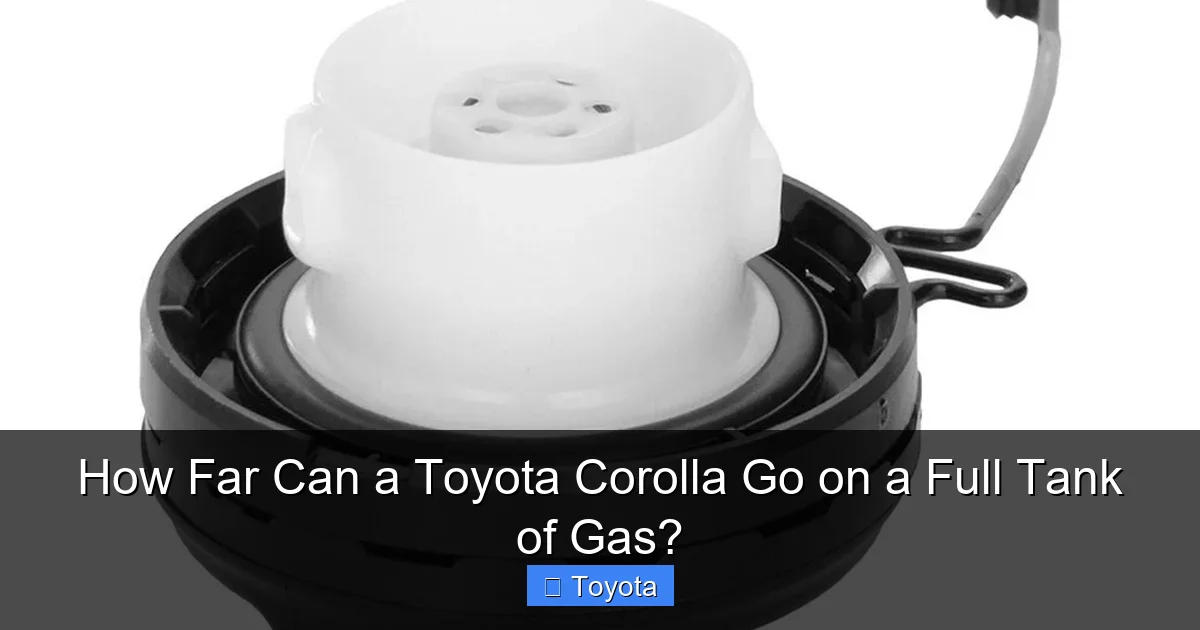
Visual guide about How Far Can a Toyota Corolla Go on a Full Tank of Gas?
Image source: images.nexusapp.co
EPA Estimates: The Official Baseline
The U.S. Environmental Protection Agency (EPA) puts every new vehicle through standardized tests to determine its official MPG ratings. These are the numbers you see on the window sticker. For the current gasoline-only Corolla (2.0L 4-cylinder), the EPA estimates are typically:
- City: 30-31 MPG
- Highway: 38-40 MPG
- Combined: 33-35 MPG
For the Corolla Hybrid, the numbers jump dramatically:
- City: 49-51 MPG
- Highway: 47-52 MPG
- Combined: 50 MPG
Important: These are estimates achieved in a lab under controlled conditions. Your real-world results will vary. Use the “Combined” number for the most realistic overall range calculation.
Real-World MPG: The Honest Truth
In the real world, your MPG is a living, breathing number that changes with your foot, your route, and your car’s health. Aggressive acceleration and heavy braking can drop your MPG by 15-20% or more. Conversely, gentle, predictable driving on the highway can sometimes help you *exceed* the EPA estimates. Other factors include:
- Terrain: Hilly roads require more energy than flat ones.
- Climate: Extreme cold thickens oil and makes the engine work harder; extreme heat taxes the air conditioning.
- Traffic: Stop-and-go city traffic is the MPG killer. Highway cruising is its best friend.
- Vehicle Load & Accessories: Carrying extra weight or using roof racks increases drag and weight, lowering MPG.
- Tire Pressure: Under-inflated tires create more rolling resistance, significantly hurting fuel economy. This is a quick fix with a big impact.
For practical advice on maintaining optimal efficiency, our guide on how to check tire pressure on a 2021 Toyota Corolla is a great resource.
The Math: Calculating Your Theoretical Maximum Range
Now for the fun part. The formula is beautifully simple:
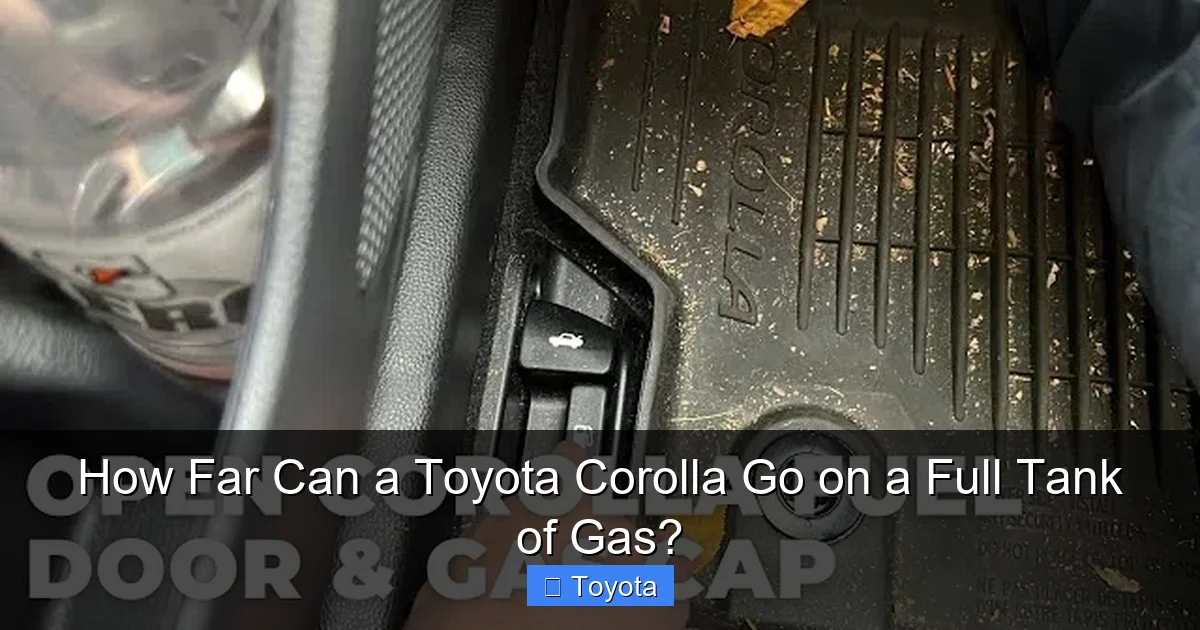
Visual guide about How Far Can a Toyota Corolla Go on a Full Tank of Gas?
Image source: automotivian.com
Maximum Range (miles) = Fuel Tank Capacity (gallons) x Estimated MPG (miles/gallon)
Let’s run a few scenarios with the standard 13.2-gallon tank:
- Scenario A (Conservative Real-World): You drive a mix of city and highway, and your real-world average is 32 MPG.
13.2 gallons x 32 MPG = 422 miles. - Scenario B (EPA Combined Estimate): You achieve the EPA’s combined rating of 34 MPG.
13.2 gallons x 34 MPG = 449 miles. - Scenario C (Highway-Only Optimistic): You’re on a long, flat highway trip, maintaining a steady 70 mph, and you hit 40 MPG.
13.2 gallons x 40 MPG = 528 miles.
Now, let’s look at the Hybrid with its 11.4-gallon tank and 50 MPG combined rating:
- Hybrid Scenario: 11.4 gallons x 50 MPG = 570 miles.
As you can see, the hybrid’s superior efficiency more than compensates for its smaller tank, giving it the highest potential range in the lineup. However, remember that Scenario C is a “best-case” highway number. For planning long trips, it’s always wise to use a more conservative estimate, like the EPA combined number or your own observed average, to avoid stress.
The Gas Light: Your Reserve and Your Risk
That moment when the low fuel warning light (often a yellow gas pump icon) flickers on is a universal driver experience. In a Toyota Corolla, it’s not a panic signal; it’s a polite reminder. But how far can you *really* go after it comes on?
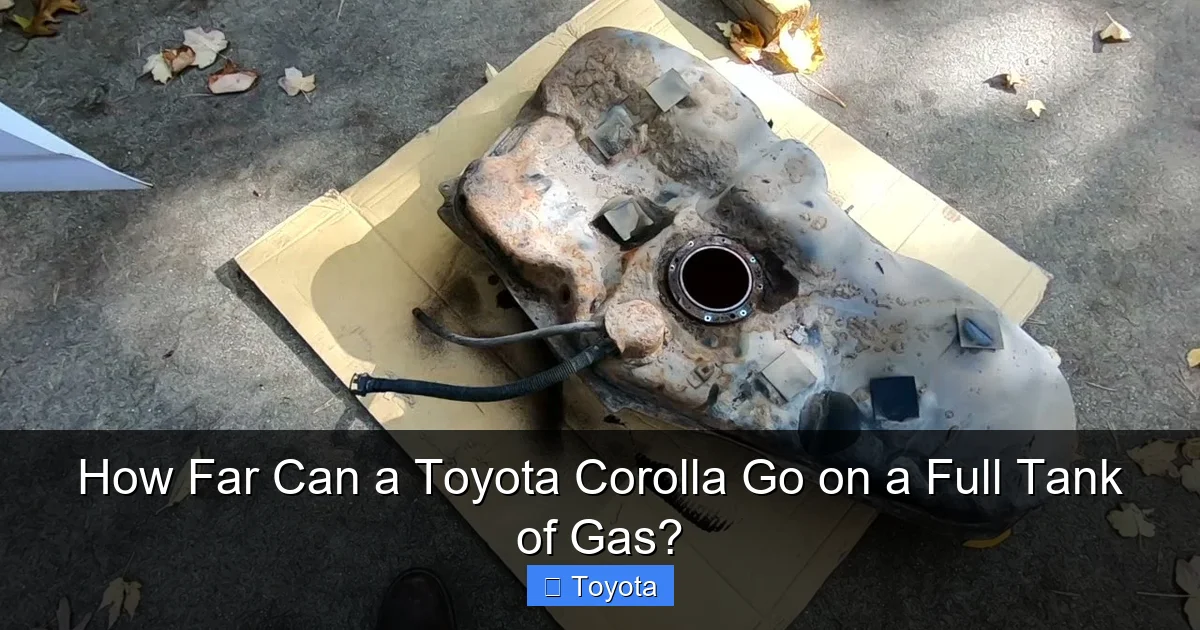
Visual guide about How Far Can a Toyota Corolla Go on a Full Tank of Gas?
Image source: i.ytimg.com
The Official Reserve: 30-50 Miles
When your Corolla’s gas light illuminates, the vehicle’s computer is estimating you have approximately 30 to 50 miles of driving distance remaining. This “reserve” is intentionally designed to be enough to safely find a gas station without leaving you stranded. The exact mileage varies by model year and driving conditions.
Why You Shouldn’t Push It
While 30-50 miles sounds like a reasonable buffer, routinely driving with the gas light on is bad practice for several reasons:
- Fuel Pump Health: The fuel pump is submerged in gasoline, which keeps it cool and lubricated. Running consistently low can cause the pump to overheat and fail prematurely. Replacing a fuel pump is an expensive repair.
- Sediment & Debris: Over time, tiny particles and sediment settle at the bottom of the tank. When you run it nearly empty, you risk sucking this debris into the fuel system, clogging filters and potentially damaging injectors.
- Stranded Risk: Estimates are just that. A sudden detour, unexpected traffic, or a misjudged distance to the station can leave you helpless on the side of the road.
Our article on how many miles you can drive after the gas light comes on in a Toyota Corolla provides more specific details for your model. The rule of thumb is simple: when the light comes on, find a station within the next 20-30 miles and fill up. Don’t test your luck.
Maximizing Your Corolla’s Range: Practical Tips & Tricks
Want to consistently hit the higher end of that 350-480 mile spectrum? It’s less about magic and more about mindful habits. Here’s your actionable plan to become a fuel-efficiency ninja in your Corolla.
1. Master the Art of “Hypermiling” (Safely)
This term refers to driving techniques that maximize MPG. You don’t need to go to extremes. Just adopt these core principles:
- Drive Smoothly: Anticipate traffic flow. Accelerate gently and brake gradually. The most fuel is burned during acceleration. Coast when possible.
- Observe Speed Limits: Aerodynamic drag increases exponentially with speed. Driving 65 mph instead of 75 mph can save you 10-15% in fuel.
- Use Cruise Control on Flat Highways: It maintains a steady speed, which is more efficient than constant minor throttle adjustments.
- Minimize Idling: Modern engines use very little fuel at idle. If you’re stopped for more than 60 seconds (except in heavy traffic), turn the engine off.
2. Rigorous Maintenance is Non-Negotiable
A well-maintained Corolla is an efficient Corolla. Stick to your service schedule:
- Regular Oil Changes: Use the manufacturer-recommended grade. Clean, proper viscosity oil reduces internal engine friction.
- Air Filter: A clogged air filter starves the engine of air, forcing it to work harder and burn more fuel. Check it at every oil change.
- Spark Plugs & Fuel System: Worn spark plugs or dirty fuel injectors cause incomplete combustion, killing MPG.
- Alignment & Brakes: Misaligned wheels drag, and dragging brakes create constant resistance. Both are silent MPG thieves.
3. Smart Use of Accessories
Every electrical draw taxes the alternator, which taxes the engine.
- Air Conditioning: At low speeds, open windows. At high speeds (above 50 mph), use AC with windows up—the aerodynamic drag of open windows outweighs the AC compressor load.
- Heater/Defroster: These are significant draws. Use them only as needed.
- Remove Roof Racks: If you’re not using them, take them off. They create massive aerodynamic drag even when empty.
4. Plan Your Trips and Your Weight
Combine errands into one trip. A warm engine is more efficient than a cold start. Also, don’t carry unnecessary weight. An extra 100 pounds in the trunk can reduce MPG by about 1-2%. Clean out your car regularly!
For more model-specific tips on optimizing your driving experience, from activating sport mode for a more responsive drive to maintaining clear visibility, our library has you covered.
Conclusion: Your Corolla’s Range is What You Make It
So, how far can a Toyota Corolla go on a full tank of gas? The definitive answer lives in a range: 350 to 480 miles for gasoline models, and up to 570 miles for the Hybrid. The 13.2-gallon tank provides the potential, but it’s your driving behavior, your car’s maintenance, and your route that unlock the reality. The EPA numbers give you a solid baseline, but your personal “corolla-ometer” is the true measure.
Don’t fear the gas light; respect it as a useful warning system. By understanding your tank size, monitoring your real-world MPG, and adopting efficient habits, you can consistently achieve impressive range and keep your fuel costs low. The Toyota Corolla’s reputation for reliability and efficiency is well-earned, and with a little knowledge and care, you can squeeze every last mile out of that full tank, making your little sedan not just a point-A-to-point-B car, but a master of the long haul.
Frequently Asked Questions
Does the Toyota Corolla have a reserve fuel tank beyond the “empty” line?
No, there is no separate “reserve tank.” The fuel light comes on when the computer estimates you have about 1-2 gallons (or 30-50 miles) of fuel remaining in the main tank. This is your safety buffer.
How often should I fill my Corolla’s tank to maintain fuel efficiency?
There’s no ideal frequency. It’s best to refuel when your gauge shows about 1/4 tank remaining. This helps avoid sediment pickup from the tank bottom and ensures you have a sufficient buffer for detours or traffic, without the weight of a constantly full tank affecting efficiency slightly.
Does using premium gas increase my Corolla’s range?
Almost certainly not. The standard Toyota Corolla is designed for regular unleaded gasoline (87 octane). Using a higher octane premium fuel provides no benefit in terms of power or efficiency unless your specific model’s manual explicitly states it is required (which most base Corollas do not). Save your money.
How much does the AC really affect my Corolla’s MPG and range?
The impact varies. In city driving, using the AC can reduce MPG by 1-3 MPG. At highway speeds, the effect is often less noticeable because the aerodynamic drag from open windows is worse than the AC compressor load. The best practice is to use the recirculate setting, which cools already-cooled cabin air more efficiently.
Is the hybrid Corolla’s range significantly better than the gasoline model’s?
Yes, in practice. While the hybrid has a slightly smaller tank (~11.4 gal vs. 13.2 gal), its dramatically higher efficiency (50+ MPG vs. 33-35 MPG) gives it a clear advantage. A hybrid can easily achieve 500+ miles on a single fill-up, compared to a gasoline model’s 400-450 mile typical range.
What’s the single biggest thing I can do to improve my Corolla’s gas mileage?
Modify your driving style. Gentle acceleration, early coasting to stops, and maintaining steady highway speeds are the most powerful tools. This one change can improve your real-world MPG by 15-20% compared to aggressive, stop-and-go driving, directly translating to many more miles per tank.
