
How Many Miles Can a Toyota Corolla Go on a Full Tank?

A Toyota Corolla typically travels between 400 to 500 miles on a full tank of gas. This range is primarily determined by your specific model year’s combined fuel economy and its fuel tank capacity, which usually holds between 13.2 and 14.5 gallons. Real-world driving habits, terrain, and vehicle maintenance can significantly increase or decrease this estimated range. Understanding your Corolla’s actual miles per gallon (MPG) is the most accurate way to calculate your personal driving distance per tank.
You’re cruising down the highway in your trusty Toyota Corolla, the fuel gauge is hovering just above the empty line, and a thought pops into your head: “Just how many more miles can I actually go?” It’s one of the most practical and common questions for any Corolla owner. The answer isn’t a single number, but a range influenced by your specific car, how you drive, and where you drive. This guide will break down everything you need to know about your Corolla’s fuel range, from factory specs to real-world tips for maximizing every drop of gasoline.
Key Takeaways
- Tank Size & MPG are Key: Your Corolla’s range is a simple calculation: Fuel Tank Capacity (gallons) x Your Real-World MPG = Total Miles per Tank.
- Model Year Matters: Newer Corollas (2014+) with the 1.8L or 2.0L engine and CVT generally achieve the highest EPA ratings (up to 40 MPG highway), maximizing range.
- “Full Tank” is an Estimate: The pump’s “auto shut-off” isn’t perfect. You’re rarely getting 100% of the tank’s stated capacity, which slightly reduces theoretical range.
- Driving Style is Everything: Aggressive acceleration, high speeds, and excessive idling can lower your MPG by 15-30%, drastically cutting your miles per tank.
- The Gas Light is Your Safety Net: When your Corolla’s low fuel light illuminates, you typically have 30-50 miles remaining, not “empty.” Learn exactly how far you can go after it comes on.
- Maintenance Directly Impacts Efficiency: Under-inflated tires, dirty air filters, and old spark plugs force your engine to work harder, burning more fuel per mile.
- Use Your Own Data: For the most accurate range, track your own fuel fill-ups over several tanks to calculate your true average MPG.
📑 Table of Contents
Understanding the Core Formula: Tank Size x MPG
At its heart, calculating how far your Toyota Corolla can go on a full tank is a straightforward math problem. The formula is:
Total Driving Range (miles) = Fuel Tank Capacity (gallons) x Average Miles Per Gallon (MPG)
To solve it, we need two key pieces of data: how much gas your tank holds, and how efficiently your specific Corolla uses that gas. Let’s dive into each variable.
Decoding Your Corolla’s Fuel Tank Capacity
The Toyota Corolla’s fuel tank capacity has been remarkably consistent over its modern generations. For most models from the late 1990s to the present day, you’re looking at a tank that holds between 13.2 and 14.5 gallons. Here’s a quick breakdown by recent generation:
- E110 Generation (1998-2002): Typically 13.2 gallons.
- E120 Generation (2003-2007): Usually 13.2 gallons.
- E140 Generation (2008-2013): Increased to 13.6 or 14.5 gallons depending on trim.
- E210 Generation (2014-Present): Standardized at 13.2 gallons for most trims, though some hybrid models differ.
Important Note: The “rated” capacity is a laboratory figure. In reality, when the pump clicks off, you’re not getting every last drop. There’s always a small amount of unusable fuel at the bottom and vapor space at the top. So, if your owner’s manual says 13.2 gallons, a typical fill-up from “empty” (gas light on) might only yield 12.5-12.8 gallons. This small variance is part of why real-world range differs slightly from pure math.
Finding Your Corolla’s True MPG
This is the most critical and variable number. The EPA provides official estimates, but your personal “real-world MPG” is what truly determines your range. EPA ratings for recent non-hybrid Corollas look like this:
- 2014-2019 Models (1.8L + CVT): Up to 30 MPG city / 40 MPG highway / 33 MPG combined.
- 2020-Present Models (2.0L + CVT): Up to 31 MPG city / 40 MPG highway / 34 MPG combined.
- Corolla Hybrid (2020-Present): Up to 53 MPG city / 52 MPG highway / 52 MPG combined.
However, these are best-case scenarios under controlled testing. Your actual MPG depends on:
- Driving Environment: Stop-and-go city traffic is the biggest MPG killer. Steady highway cruising is where Corollas shine and hit those 40 MPG numbers.
- Driving Style: Are you a gentle accelerator who coasts to stops? Or do you drive with a lead foot? Aggressive driving can slash your MPG by 20% or more.
- Climate & Accessories: Using the A/C compressor places a significant load on the engine, reducing MPG. Cold winter weather also makes engines work harder and tires less efficient.
- Vehicle Load & Roof Racks: Carrying heavy cargo or a roof rack creates aerodynamic drag and weight, lowering efficiency.
- Vehicle Health: This is huge. Worn spark plugs, a clogged engine air filter, under-inflated tires (by even 5 PSI), and old, viscous oil all force your engine to consume more fuel to produce the same power.
The best way to know your MPG is to calculate it yourself. Next time you fill up, reset your trip odometer to zero. Drive normally until you need to fill up again. Note the number of gallons it takes to fill the tank and the miles on your trip odometer. Divide miles by gallons. Do this 3-4 times and average the results for your true, real-world MPG.
Real-World Range Estimates by Model Era
Now, let’s plug some numbers into our formula using common tank sizes and realistic MPG ranges to give you a practical idea of what to expect.

Visual guide about How Many Miles Can a Toyota Corolla Go on a Full Tank?
Image source: vehiclebright.com
For the Modern Corolla (2014-Present, Non-Hybrid)
Using a 13.2-gallon tank:
- Best-Case Scenario (40 MPG highway): 13.2 gal x 40 MPG = 528 miles. This is achievable on a long, steady highway trip with minimal traffic, gentle driving, and no A/C.
- Mixed Driving (33 MPG combined): 13.2 gal x 33 MPG = 435 miles. This is a very realistic average for many drivers combining city and highway miles.
- City-Heavy Driving (27 MPG): 13.2 gal x 27 MPG = 356 miles. If your commute is mostly in heavy urban traffic with A/C on, this is a more likely figure.
Practical Takeaway: Plan for 400-450 miles as a reliable, comfortable range for most modern Corolla drivers under normal mixed conditions. You might squeeze out 500 miles on a pure highway run, but it’s not a daily expectation.
For the Older Corolla (2003-2013)
These models often have slightly larger tanks (13.6-14.5 gal) but less efficient engines (typically 26-30 MPG combined). The math works out similarly:
- 14.5 gal tank x 28 MPG (realistic mixed): = 406 miles.
- 13.6 gal tank x 30 MPG (good highway): = 408 miles.
The range remains consistent because the drop in fuel efficiency is somewhat offset by a larger fuel tank in some models. You can still comfortably expect 350-420 miles per tank.
The Corolla Hybrid Game-Changer
If you own a Corolla Hybrid, the numbers jump dramatically. With a similar-sized tank (around 13.2 gallons) and a 52 MPG combined rating:
- 13.2 gal x 52 MPG = 686 miles. Real-world owners consistently report 600-700+ mile ranges. This is one of the best in its class. For those interested in maximizing fuel savings across Toyota’s lineup, understanding the Toyota Venza’s MPG shows how hybrid technology transforms range.
Factors That Can Increase or Decrease Your Range
Now we get to the “why” behind the variance. Your Corolla’s range is a living number, not a fixed one. Here’s what pushes it up or down.
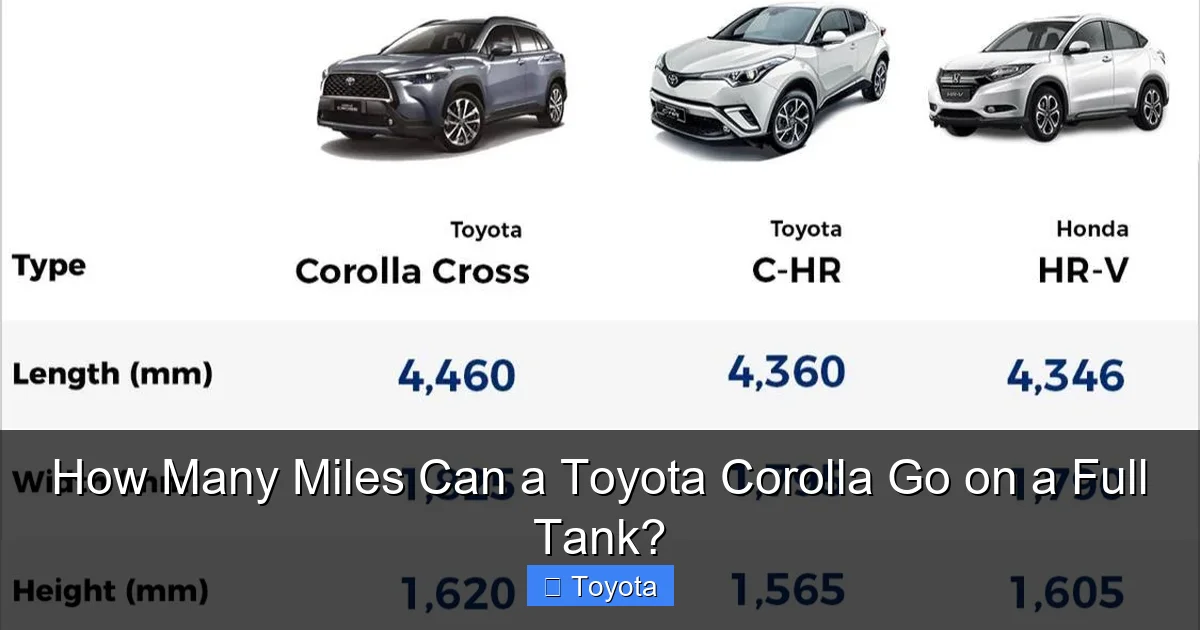
Visual guide about How Many Miles Can a Toyota Corolla Go on a Full Tank?
Image source: fcache1.pakwheels.com
The Big Five Range Killers
- Speed: Aerodynamic drag increases exponentially with speed. Driving 75 mph vs. 65 mph can increase fuel consumption by 10-15%.
- City Traffic: Constant acceleration and braking are incredibly inefficient. An MPG drop from 35 to 22 in heavy traffic is common.
- Winter Weather: Cold engines run richer until warm. Winter gasoline blends have less energy content. Thicker oil and rolling resistance in cold tires all hurt MPG. You might see a 3-5 MPG drop.
- Roof Cargo: A roof rack alone adds drag. With a cargo box, you can lose 5-10 MPG on the highway. Remove it when not in use.
- Poor Maintenance: This is the silent killer. A dirty air filter can reduce MPG by 10%. Under-inflated tires increase rolling resistance. Worn spark plugs cause incomplete combustion. Staying on top of your maintenance schedule is non-negotiable for peak range.
Surprising Factors That Can Help
- Hypermiling Techniques: Gentle, early acceleration, anticipating traffic to avoid braking, and using cruise control on flat highways can push your MPG beyond the EPA estimates.
- Premium Fuel (in some models): While most Corollas are designed for regular 87 octane, some higher-compression engines (like the 2.0L in 2020+) can see a slight efficiency gain with premium due to reduced engine knock, though it’s often not cost-effective.
- Correct Tire Pressure: Inflate tires to the maximum PSI listed on the door jamb sticker (not the tire sidewall) for optimal rolling resistance and range, accepting a slightly firmer ride.
- Weight Reduction: Clean out your trunk! Every 100 lbs of extra cargo reduces MPG by about 1-2%.
How to Calculate Your Personal, Accurate Range
Forget the brochure numbers. Here’s your step-by-step plan to know exactly how many miles your Corolla can go.

Visual guide about How Many Miles Can a Toyota Corolla Go on a Full Tank?
Image source: vehiclebright.com
Step 1: Determine Your True Average MPG
As mentioned, this is the golden data point. For 3-5 consecutive fill-ups:
- Fill the tank completely until the pump clicks off.
- Reset your trip odometer to 0.
- Drive normally until it’s time to fill up again.
- Record the miles driven (trip A) and the gallons used (from the receipt).
- Calculate: MPG = Miles Driven / Gallons Added.
- Average all your results. This is your baseline.
Step 2: Know Your Usable Fuel
You don’t run the tank completely dry. The gas light comes on with a reserve. To find your true usable fuel:
- When the gas light first comes on, immediately drive to a station and note the trip mileage (let’s say 350 miles).
- Fill the tank completely. Record the gallons added (let’s say 12.0 gallons).
- Your usable fuel from “gas light on” to full is ~12.0 gallons.
- To find your total usable tank capacity, add the miles you drove after the light came on to your previous fill-up point. This is more advanced, but the simpler method is to use your manual’s rated capacity (e.g., 13.2 gal) and subtract 0.8-1.0 gal as the typical “unusable” reserve at the bottom. So, ~12.2-12.4 gallons is your practical “full to empty” volume.
Step 3: Do the Final Math
Your Personal Range = Your Usable Gallons (from Step 2) x Your Average MPG (from Step 1)
Example: Usable fuel = 12.3 gallons. Average MPG = 34. Range = 12.3 x 34 = 418 miles. This is a much more accurate figure for you than any generic estimate.
Practical Tips to Maximize Your Corolla’s Range
Armed with knowledge, here’s how to stretch those miles.
Driving Habits That Pay Off
- Use Cruise Control on Highways: Maintaining a constant speed is far more efficient than fluctuating your throttle.
- Slow Down: The difference between 65 mph and 75 mph is massive for fuel economy. Find your Corolla’s “sweet spot” on the tachometer, usually around 2000-2500 RPM for the CVT.
- Drive Smoothly: Look far ahead. If you see a red light, start coasting early instead of racing to it and braking hard.
- Minimize Idling: If you’re stopped for more than 60 seconds (not in traffic), turn the engine off. Modern engines use negligible fuel on restart.
Maintenance Must-Dos for Efficiency
- Tire Pressure: Check monthly. Inflate to the door jamb spec.
- Air Filter: Inspect and replace as needed (often every 15k-30k miles). A clogged filter chokes your engine.
- Spark Plugs: Use the recommended iridium or platinum plugs and replace on schedule (typically 60k-120k miles). Worn plugs cause misfires and wasted fuel.
- Oil Changes: Use the correct viscosity (e.g., 0W-16 for newer models). Old, thick oil creates internal drag.
- Wheel Alignment: Misalignment causes tire scrub, increasing resistance.
Smart Trip Planning
Combine errands. A warm engine is more efficient than a cold start. If you have multiple stops, do the longest one first. Use navigation apps that offer “eco-friendly” routes that avoid heavy traffic and stop-and-go, even if they’re slightly longer in distance.
Conclusion: Your Corolla’s Range is Reliable and Predictable
The Toyota Corolla has earned its reputation for reliability and efficiency for a reason. While the exact number on the sticker might say “up to 40 MPG,” your real-world experience will land you in a very predictable and respectable range of 400 to 450 miles per full tank for the vast majority of drivers with a standard gasoline model. The hybrid variant stretches that to an impressive 600+ miles. The key to knowing your number is simple: calculate your own MPG, understand your tank’s usable capacity, and practice efficient driving habits. By doing so, you turn a vague question into a precise, personal answer. And remember, when that low fuel light does finally come on, you have a comfortable buffer—typically 30-50 miles—to find a gas station safely, so there’s no need for undue panic. Your Corolla is designed to be an economical, hassle-free companion for the long haul.
Frequently Asked Questions
How far can a Toyota Corolla go on a full tank of gas?
Most modern, non-hybrid Toyota Corollas can travel between 400 and 450 miles on a full tank under normal mixed driving conditions. Models optimized for highway driving can sometimes reach 500 miles, while heavy city traffic may reduce the range to around 350 miles.
How many gallons of gas does a Toyota Corolla hold?
The fuel tank capacity for most Toyota Corollas from the late 1990s to today is between 13.2 and 14.5 gallons. The most common capacity for the 2014-Present models is 13.2 gallons. Always check your owner’s manual for the exact specification for your specific model year and trim.
What is the real-world MPG of a Toyota Corolla?
While EPA ratings are up to 34 MPG combined for recent models, real-world MPG varies. A realistic average for mixed driving is 32-36 MPG. Highway-only driving can achieve 38-42 MPG, while heavy city traffic with A/C can drop it to 25-28 MPG. The Corolla Hybrid consistently delivers 50+ MPG in real-world use.
When the gas light comes on in a Corolla, how many miles are left?
When the low fuel warning light illuminates in a Toyota Corolla, you typically have between 30 and 50 miles remaining before you run out of fuel. This is a safety reserve, not an indication to keep driving indefinitely. It’s wise to find a gas station within the next 20-30 miles. You can find the exact estimate for your specific model year here.
Does using the A/C significantly reduce my Corolla’s range?
Yes, the A/C compressor places a notable load on the engine. In city driving, using the A/C can reduce your MPG by 3-5 MPG (a 10-15% loss). On the highway, the penalty is less severe, around 1-3 MPG. For maximum range on long trips, consider using the vent system or recirculate mode once the cabin is cooled.
How can I improve my Corolla’s miles per gallon?
Focus on three areas: 1) Driving Style: Accelerate gently, maintain steady highway speeds, and anticipate traffic to avoid braking. 2) Maintenance: Keep tires properly inflated, replace air filters and spark plugs on schedule, and use the correct oil. 3) Reduce Drag: Remove roof racks when not in use and clear unnecessary weight from the vehicle. These steps can easily improve your MPG by 5-15%.
