
How Many Gallons Does It Take to Fill a Toyota Sienna?

The Toyota Sienna typically holds between 18.5 and 20 gallons of fuel, depending on the model year and drivetrain. The standard gasoline models have a 20-gallon tank, while the hybrid models have an 18.5-gallon tank. This capacity directly impacts your driving range and fueling frequency, making it a key spec for owners to know.
Key Takeaways
- Standard Tank Size: Most gasoline-powered Toyota Sienna models (2021+) feature a 20-gallon fuel tank.
- Hybrid Variation: The Toyota Sienna Hybrid has a slightly smaller 18.5-gallon tank to accommodate its battery system.
- Model Year Matters: Older Sienna generations (pre-2021) may have different capacities, so always verify for your specific year.
- “Gallons to Fill” vs. “Tank Capacity”: You rarely fill from absolute empty; “gallons to fill” is usually less than total capacity due to reserve fuel.
- Check Your Manual: The definitive source for your vehicle’s exact fuel tank capacity is the owner’s manual or driver’s door jamb sticker.
- Comparison Context: The Sienna’s 20-gallon tank is competitive for minivans, similar to rivals like the Honda Odyssey, but larger than many crossovers like the Toyota RAV4.
- Practical Impact: Knowing your tank size helps plan trips, budget for fuel, and understand your vehicle’s maximum range.
📑 Table of Contents
- Why Knowing Your Sienna’s Fuel Capacity is a Big Deal
- The Official Answer: Toyota Sienna Fuel Tank Capacity by Generation & Trim
- So, How Many Gallons Does It *Actually* Take to Fill It?
- How to Find the Exact Capacity for *Your* Sienna
- Putting the Sienna in Context: Comparison with Other Toyota Models
- Practical Tips: Getting the Most from Your Sienna’s Fuel
- Conclusion: More Than Just a Number
Why Knowing Your Sienna’s Fuel Capacity is a Big Deal
So, you’re standing at the pump, nozzle in hand, watching the numbers climb. You’re in your trusty Toyota Sienna, the family hauler, the road trip king. A simple question pops into your head: “How many gallons does it take to fill this thing?” It’s not just idle curiosity. Knowing your minivan’s precise fuel tank capacity is a cornerstone of smart vehicle ownership. It transforms you from a passive consumer at the gas station into an informed manager of your family’s transportation budget and schedule.
For a vehicle like the Sienna, designed for practicality and long-haul comfort, fuel capacity is directly tied to its core promise: effortless family mobility. A larger tank means fewer stops on a cross-country adventure with antsy kids in the back. It means better planning for weekly errands or a month’s worth of school runs. It also helps you understand your true fuel costs and efficiency. You can’t accurately calculate miles per gallon if you don’t know the full volume of the tank you’re refilling. Whether you’re a meticulous planner or someone who just wants to avoid that gut-wrenching “low fuel” light on a deserted highway, this number is your friend. Let’s dive deep into the specifics of the Toyota Sienna, from its current hybrid-only lineup to the generations before it.
The Official Answer: Toyota Sienna Fuel Tank Capacity by Generation & Trim
Let’s cut to the chase. The answer isn’t a single number because it has evolved. The modern, hybrid-only Toyota Sienna (introduced for the 2021 model year) has a different capacity than its gasoline predecessor. Here’s the breakdown, straight from Toyota’s specifications.

Visual guide about How Many Gallons Does It Take to Fill a Toyota Sienna?
Image source: i.ytimg.com
2021-Present Hybrid-Only Sienna
Starting in 2021, the Sienna made a monumental shift to a hybrid powertrain. This engineering change influenced the vehicle’s packaging, including the fuel tank. For all trims of the current-generation (XL40) Sienna Hybrid—LE, XLE, XSE, Limited, and Woodland Edition—the fuel tank capacity is 18.5 gallons.
This might seem like a step down from the previous generation’s 20-gallon tank, but it’s a necessary compromise. The hybrid system requires space for its battery pack, which is often situated in the underfloor area where a traditional fuel tank might be extended. Engineers designed an 18.5-gallon tank that fits within the new architecture while still providing excellent range. The hybrid’s superior fuel economy (an EPA-estimated 36 mpg combined) largely compensates for the slightly smaller tank, often delivering a greater total driving range than the older V6 models.
- 2021, 2022, 2023, 2024, 2025 Toyota Sienna Hybrid (All Trims): 18.5 U.S. gallons
2011-2020 Gasoline Sienna (Pre-Hybrid)
The long-running previous generation (the XL30 series, and before that the XL20) was powered by a 3.5-liter V6 engine. These models were not fuel-sippers by today’s standards, so they were equipped with a larger tank to provide a reasonable driving range. For nearly all model years and trims from 2011 through 2020, the fuel tank capacity was 20 gallons.
There were rare, subtle variations based on specific model years or fleet packages, but 20 gallons was the standard for consumer models. If you own a 2020 Sienna or earlier, you are almost certainly looking at a 20-gallon tank. This is a crucial distinction if you’re comparing your older Sienna to a new hybrid model at the pump.
- 2011-2020 Toyota Sienna (V6, All Trims): 20 U.S. gallons
Older Generations (2004-2010)
For completeness, the generation before that (2004-2010, model code SL20) also featured a V6 engine and typically had a 20-gallon fuel tank. The very first Sienna for 1998-2003 had a 20-gallon tank as well. The consistency across the pre-hybrid era makes it easy for owners of older models.
So, How Many Gallons Does It *Actually* Take to Fill It?
This is the most important practical distinction. Your fuel tank’s capacity is the total volume it can hold when filled to the brim from completely empty. The number of gallons it takes to fill it from your typical “empty” warning is almost always less than the total capacity.
Visual guide about How Many Gallons Does It Take to Fill a Toyota Sienna?
Image source: musclepound.com
The Mysterious “Reserve” Fuel
Every vehicle has a reserve. This is a small volume of fuel (often 1-2 gallons) that remains in the tank even after the fuel gauge reads “E” and the low fuel warning light illuminates. This is a safety feature. It prevents you from being instantly stranded the moment the gauge hits empty and gives you a buffer to find a gas station. The fuel pump, which is submerged in the tank, also needs to stay cool and lubricated by fuel, so running it completely dry is damaging.
Therefore, when your Sienna’s light comes on, you likely have 1.5 to 2.5 gallons left, depending on driving conditions and your specific vehicle’s calibration. If you immediately pull into a station, you might only pump 16-17 gallons into a 20-gallon tank, or 15-16 gallons into an 18.5-gallon hybrid tank. The “fill-up” number is variable.
Factors That Change Your Fill-Up Volume
- Temperature & Fuel Density: Gasoline expands as it gets warm. Gas stations store fuel in underground tanks at a relatively stable temperature. When you pump it on a hot day, the fuel is warmer and less dense than the “standard” temperature (60°F) used for regulatory measurements. You get slightly fewer actual BTUs of energy per gallon, but the pump meter measures volume, not energy content. This means you’re physically putting more liquid volume into your tank on a hot day than on a cold morning for the same monetary amount.
- Pump Calibration: Gas pumps are calibrated devices. While they are regularly inspected, minor variances exist. You might get 18.0 gallons one time and 18.3 gallons the next for what feels like the same “full” tank.
- How You Pump: Using the “slow” or “fast” setting on the nozzle can slightly affect the final amount due to splash-back and automatic shut-off sensitivity. Pumping on “slow” and allowing the nozzle to automatically click off multiple times (as it settles) is the most accurate way to get a consistent “full” reading.
- Vehicle Angle: Parking on a significant incline can affect how the fuel sloshes in the tank and when the pump’s automatic shut-off triggers, potentially leading to a slightly different fill volume.
The takeaway? Don’t stress over a 0.2-gallon difference between fill-ups. Focus on the long-term average when calculating your MPG.
How to Find the Exact Capacity for *Your* Sienna
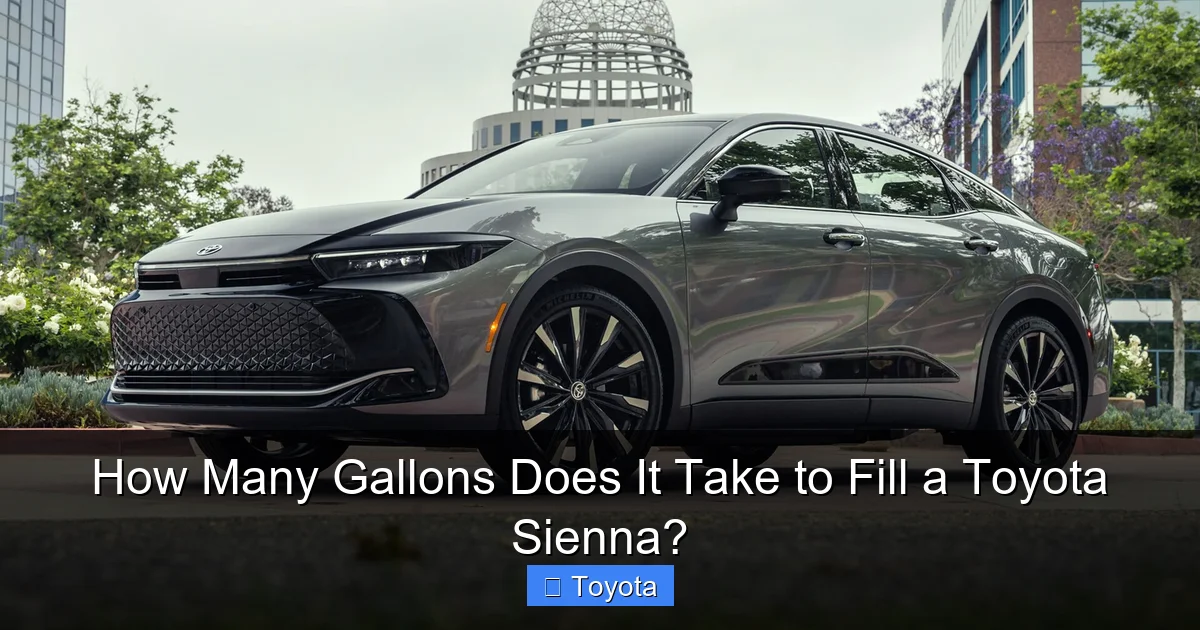
While the specs above are accurate for the vast majority of models, the only way to be 100% certain for your specific vehicle is to consult its official documentation.
Visual guide about How Many Gallons Does It Take to Fill a Toyota Sienna?
Image source: motortrend.com
1. The Owner’s Manual (Your Bible)
Open the glovebox. The physical owner’s manual that came with your Sienna has a specifications section, usually near the beginning or end. Look for “Fuel Tank Capacity” or “Capacities and Specifications.” It will list the exact figure in gallons (and often liters). This is the most authoritative source.
2. The Driver’s Door Jamb Sticker
Open the driver’s door and look at the B-pillar or the door edge itself. There’s a sticker (the tire placard) that lists tire pressures, GVWR, and often the fuel tank capacity. This is a quick, reliable reference without needing the manual.
3. Toyota’s Official Resources
You can often find specifications on the Toyota USA website by building a model or looking up brochures for your specific model year. Additionally, your local Toyota dealership’s parts or service department can look up the exact spec for your VIN (Vehicle Identification Number).
4. A Careful Manual Calculation (The “Scientific” Method)
This is the most accurate way to determine your *usable* capacity. It requires patience and consistency.
- Fill Up: When your low fuel light comes on, drive to a station. Park level, set the pump to “slow,” and fill until the nozzle automatically shuts off. Do NOT top off (pump more after the first shut-off). Record the gallons pumped (e.g., 17.2 gal). This is your “usable” reserve-to-full volume.
- Reset: Immediately reset your trip odometer to zero.
- Drive: Drive normally until the low fuel light comes on again. Try to be consistent with driving conditions.
- Calculate: The miles you drove (trip odometer) divided by your average MPG (from your car’s display or past calculations) should give you an estimate of the gallons used. This should closely match the gallons you pumped. For a more precise figure, repeat this process several times and average the “gallons pumped” numbers. This method accounts for your specific vehicle’s actual usable reserve.
Important: Never intentionally run your tank completely dry. This can damage the fuel pump, which relies on gasoline for cooling and lubrication.
Putting the Sienna in Context: Comparison with Other Toyota Models
Understanding the Sienna’s tank size is more meaningful when compared to its siblings. Is it a sipper or a guzzler? How does it stack up against Toyota’s popular SUVs?
Sienna vs. Toyota RAV4
The Toyota RAV4, America’s best-selling SUV, has a fuel tank capacity of 14.5 gallons for most gasoline models and 14.1 gallons for the RAV4 Hybrid. This is significantly smaller than even the hybrid Sienna’s 18.5-gallon tank. Why? The RAV4 is a smaller, more efficient crossover, and its packaging prioritizes cabin and cargo space over an enormous tank. The Sienna, as a dedicated family minivan, has the physical length to accommodate a larger tank, translating to much longer range between fill-ups despite similar or better MPG ratings. A hybrid Sienna (36 mpg, 18.5 gal) has a potential range of ~666 miles, while a hybrid RAV4 (40 mpg, 14.1 gal) has a potential range of ~564 miles. The minivan wins on raw distance.
Sienna vs. Toyota Highlander
The three-row Toyota Highlander is the Sienna’s closest sibling in terms of passenger capacity. The gasoline-only Highlander has a 17.1-gallon tank, while the Highlander Hybrid has a 14.3-gallon tank. Here, the Sienna’s 18.5-gallon hybrid tank gives it a clear advantage in total driving range over its SUV counterpart, even though the Highlander Hybrid is slightly more fuel-efficient. This makes the Sienna uniquely positioned as the long-range, three-row Toyota family hauler.
Sienna vs. Toyota Camry & Tacoma
For comparison, a Toyota Camry sedan has a 15.8-gallon tank. The midsize Toyota Tacoma pickup’s tank varies by cab and bed configuration but is typically around 18.5 gallons for the Access Cab and 21.1 gallons for the Double Cab long-bed. The Sienna’s tank size sits comfortably between these, optimized for its specific duty cycle of heavy loads (people and cargo) and highway cruising.
Practical Tips: Getting the Most from Your Sienna’s Fuel
Knowing your tank capacity is step one. Using that knowledge to save money and time is step two.
Plan Your Trips with Range in Mind
Do the math: Maximum Range = Tank Capacity (gal) x EPA Combined MPG. For a 2024 Sienna Hybrid XLE (18.5 gal x 36 mpg), that’s about 666 miles. On a family road trip, you can comfortably plan fuel stops every 500-550 miles to maintain a safe buffer. This reduces stress and allows you to seek out cheaper fuel stations along your route rather than being forced to take whatever is nearest when the light comes on.
Don’t Obsess Over “Topping Off”
After the pump clicks off automatically, adding more fuel by slowly squeezing the handle (known as “topping off”) is not recommended. This can force liquid fuel into the evaporative emission (evap) system’s charcoal canister, which is designed to handle only vapor. This can damage the system, trigger the “Check Engine” light, and lead to costly repairs. The small amount of extra fuel you get (maybe 0.5-1 gallon) isn’t worth the risk. Trust the automatic shut-off.
Use the Right Fuel and Maintain Your Engine
The Sienna is designed for regular 87-octane unleaded gasoline. Using premium is unnecessary and a waste of money unless your manual specifically calls for it (it doesn’t). A well-maintained engine with clean air filters, properly inflated tires, and the correct oil will achieve its rated MPG and maximize the distance you get from each tank. A clogged fuel filter or failing oxygen sensor can drastically reduce efficiency, meaning you’ll be filling up more often regardless of tank size.
Understand the “Low Fuel” Light is a Warning, Not a Suggestion
When that amber light illuminates, your Sienna has its reserve fuel left. Use it to get to a station, not to continue your normal routine for another 50 miles. Consistently driving with a very low tank can cause the fuel pump to overheat and fail prematurely, as it relies on being submerged in fuel for cooling. It can also stir up sediment from the bottom of the tank, potentially clogging your fuel filter.
Conclusion: More Than Just a Number
So, how many gallons does it take to fill a Toyota Sienna? For the modern hybrid, you’ll typically pump between 16 and 18.5 gallons. For the older V6 models, it’s between 17 and 20 gallons. But this number is a gateway to smarter ownership. It’s the key to calculating your true cost per mile, planning worry-free family adventures, and understanding your vehicle’s capabilities. It connects you to the mechanical reality of your minivan, transforming a routine chore into an act of informed management. Whether you’re comparing it to the fuel capacity of a Toyota RAV4 or simply budgeting for the month, knowing your Sienna’s 18.5 or 20-gallon capacity is a small piece of knowledge that pays big dividends in confidence and convenience on the road.
Frequently Asked Questions
Does the Toyota Sienna Hybrid have a smaller fuel tank than the old V6 model?
Yes. The current hybrid-only Sienna has an 18.5-gallon tank, while the previous gasoline V6 models (2011-2020) had a 20-gallon tank. This is due to packaging needs for the hybrid battery system.
Why doesn’t my Sienna take exactly 18.5 or 20 gallons when I fill up from empty?
Because your “empty” gauge isn’t truly empty. The low fuel light comes on with 1.5-2.5 gallons of reserve fuel remaining. You’re filling from that reserve to “full,” not from absolute zero. Pump calibration and temperature also cause minor variations.
Is it bad to fill my Sienna’s tank all the way to the top?
It’s best to stop at the first automatic shut-off. “Topping off” by manually adding more fuel can damage the evaporative emission system and lead to costly repairs. The small extra volume isn’t worth the risk.
Does the Sienna’s fuel tank capacity change if I have a different trim level like XLE or Limited?
No. For a given generation, the fuel tank capacity is identical across all trims. A 2024 Sienna LE and a 2024 Sienna Limited both have the same 18.5-gallon tank.
How can I find the exact fuel tank capacity for my specific model year Sienna?
The most reliable methods are: 1) Check your owner’s manual in the specifications section. 2) Look at the tire placard sticker on the driver’s door jamb. 3) Contact a Toyota dealership with your VIN.
Does using regular vs. premium gas affect how much I can put in the tank?
No. The fuel tank’s physical volume is fixed. The pump dispenses the same volume (gallons) regardless of the fuel grade. The only difference is the energy content and price per gallon. Your Sienna is designed for regular 87-octane fuel.
