
How Many Miles Does a Toyota Rav4 Last on a Full Tank?

The Toyota RAV4 typically delivers between 350 and 450 miles on a full tank, but your actual range depends heavily on the model year, drivetrain (gas vs. hybrid), and driving conditions. A vehicle’s estimated MPG is a laboratory figure, while real-world mileage is influenced by your personal driving habits, terrain, weather, and cargo load. By understanding these variables and adopting efficient driving techniques, you can consistently get closer to the upper end of your RAV4’s potential range and enjoy its renowned reliability for the long haul.
You’re cruising along, the fuel gauge is creeping toward that ominous “E,” and a familiar question pops into your head: “Just how many more miles can I squeeze out of this tank?” For the millions of Toyota RAV4 owners out there, this isn’t just idle curiosity—it’s a practical concern that ties into the vehicle’s legendary reputation for reliability and efficiency. The short answer is that a Toyota RAV4 can last anywhere from about 350 to over 500 miles on a full tank of gas. But that’s a huge range, and the “why” behind it is where the real story lies. Your specific RAV4’s range isn’t a magic number from a brochure; it’s a living, breathing figure that dances to the tune of your driving habits, your local geography, and the precise model you have parked in your driveway.
Think of your RAV4’s fuel range as a personal budget. The “income” is the amount of gasoline you pump in, measured in gallons. The “spending rate” is your miles per gallon (MPG), which tells you how efficiently you’re using that fuel. The “total miles until broke” is your range. To truly understand how far your RAV4 will go, we need to unpack both sides of this equation: the fixed hardware (the gas tank size) and the variable performance (your real-world MPG). We’ll dive deep into the differences between the gas and hybrid powertrains, explore the sneaky factors that drain your tank faster than you’d expect, and give you a toolkit of practical, actionable strategies to stretch every last drop of fuel. By the end, you won’t just have an estimate—you’ll have a clear, personalized understanding of your vehicle’s capabilities and how to make the most of them.
Key Takeaways
- Tank Size & MPG Dictate Range: Your RAV4’s maximum distance on a full tank is a simple calculation: Fuel Tank Capacity (gallons) x Average MPG (miles per gallon). The 2023-2024 RAV4 has a 14.5-gallon tank, with EPA ratings from 27-40 MPG depending on the model.
- Hybrids Significantly Out-Distance Gas Models: The RAV4 Hybrid’s superior fuel efficiency (up to 40 MPG combined) gives it a major advantage, often exceeding 500 miles per tank, while most gas models target 350-420 miles.
- Real-World MPG is Almost Always Lower: EPA estimates are achieved under optimal conditions. Aggressive driving, city traffic, harsh winter weather, and mountainous terrain can reduce your actual MPG by 15-30% compared to the sticker.
- Driving Style is Your Most Powerful Tool: Smooth acceleration, gentle braking, using cruise control on highways, and avoiding excessive idling are the single biggest factors you control to maximize miles per tank.
- Proper Maintenance is Non-Negotiable: Under-inflated tires, dirty air filters, old spark plugs, and neglected oil changes directly harm fuel economy. A well-maintained RAV4 will consistently perform closer to its rated MPG.
- Know Your “Reserve” Fuel: The gas light typically illuminates with 1-2 gallons remaining, offering a final 30-50 miles. However, regularly driving on empty can damage the fuel pump and is not recommended.
- Longevity and Fuel Efficiency are Linked: A RAV4 that is well-cared-for and driven efficiently will not only go farther on a tank but also have a dramatically longer overall lifespan, often surpassing 200,000 miles.
📑 Table of Contents
- The Foundation: Tank Capacity and Official MPG Ratings
- Real-World vs. EPA: Why Your Actual Mileage Varies
- Gas vs. Hybrid: The Divide in Range
- Factors That Secretly Suck Your Fuel Dry
- Proactive Strategies to Maximize Your Miles Per Tank
- Longevity: The Million-Dollar Question and Fuel’s Role
- Conclusion: Your Personal RAV4 Range Formula
The Foundation: Tank Capacity and Official MPG Ratings
Before we talk about the open road, we need to look at the spec sheet. The starting point for any “miles per tank” calculation is two hard numbers: the size of your RAV4’s fuel tank and its Environmental Protection Agency (EPA) estimated fuel economy. These are the fixed boundaries within which your actual range will operate.
Fuel Tank Capacity: How Much Gas Do You Actually Get?
The Toyota RAV4’s fuel tank capacity has been remarkably consistent across recent model years. For the current fifth-generation model (2019-present), the vast majority of trims—both gas and hybrid—feature a 14.5-gallon tank. This includes popular models like the LE, XLE, Limited, and the Adventure-grade. There are a few minor exceptions; some early 2019 models and certain specific market trims might have a 14.8-gallon tank, but for practical purposes, you can safely assume 14.5 gallons as your full-tank volume. This consistency is great news because it means the primary variable in your range calculation isn’t the container size, but what you do with the contents.
For historical context, the previous fourth-generation RAV4 (2006-2018) also generally used a 14.5-gallon tank. So, whether you have a 2012 or a 2024, the “full” part of “full tank” means essentially the same amount of gasoline. If you want the exact figure for your specific VIN, your owner’s manual or a quick look at the fuel filler door (which often lists the capacity) will confirm it. For a deeper dive into tank specs across the Toyota lineup, you can explore resources that detail how many gallons a Toyota RAV4 holds.
EPA MPG Estimates: The Starting Point, Not the Finish Line
The EPA puts every new vehicle through a standardized laboratory test to determine its city, highway, and combined MPG ratings. These numbers are your baseline. But it’s critical to understand what they represent. The “combined” number is a weighted average of city and highway driving. Here’s a snapshot of recent RAV4 ratings:
- Gasoline-Only Models (AWD): Typically 27 MPG city / 34 MPG highway / 29-30 MPG combined.
- Gasoline-Only Models (FWD): Slightly higher, around 28 MPG city / 35 MPG highway / 30-31 MPG combined.
- RAV4 Hybrid (AWD): 40 MPG city / 38 MPG highway / 40 MPG combined.
Using these official numbers and the 14.5-gallon tank, we can get our theoretical maximum ranges:
- Gas AWD (30 MPG combined): 14.5 gallons x 30 MPG = 435 miles.
- Gas FWD (31 MPG combined): 14.5 x 31 = 449.5 miles.
- Hybrid (40 MPG combined): 14.5 x 40 = 580 miles.
These are the “best-case scenario” numbers you’ll see advertised. They assume ideal conditions: gentle acceleration, steady highway speeds, level terrain, and perfect weather. In the real world, hitting these exact figures is rare. That’s why your personal range will almost always be less than these calculations. The gap between EPA estimate and real-world MPG is the most important concept to grasp.
Real-World vs. EPA: Why Your Actual Mileage Varies
Let’s be honest: if every driver got the EPA-rated MPG, gas stations would be a lot less busy. The laboratory tests are designed to be repeatable and fair for comparison shopping, but they can’t replicate the chaos of real driving. Your personal RAV4’s fuel efficiency is a unique fingerprint shaped by dozens of variables. Understanding these is the key to managing your expectations and, more importantly, improving your results.

Visual guide about How Many Miles Does a Toyota Rav4 Last on a Full Tank?
Image source: autocarresource.com
The Big Three: Driving Environment
Three primary environmental factors have the largest impact on your fuel gauge:
- City vs. Highway Driving: This is the single biggest drain. Stop-and-go city traffic is a fuel economy killer. You’re constantly accelerating from a dead stop, which uses immense energy, only to brake and waste that momentum as heat. The RAV4’s EPA city rating (27-40 MPG) is much lower than its highway rating (34-38 MPG). If your commute is 80% city, your real-world combined MPG could easily be 3-5 MPG lower than the sticker. Conversely, a long, steady highway cruise will often yield MPG numbers that meet or even slightly exceed the EPA highway estimate.
- Terrain: Hills and mountains are the stealth fuel thieves. Driving uphill requires significantly more power (and fuel) than driving on flat ground. While you regain some energy on the downhill via engine braking, it’s never a 1:1 recovery. If you live in a hilly or mountainous area, subtract 2-4 MPG from your expectations. This is a key reason why someone living in Denver might get 32 MPG combined, while someone in flat central Kansas with the same driving habits might see 35 MPG.
- Weather: Temperature has a profound effect. Cold weather (below 60°F) is particularly harsh. Your engine runs less efficiently until it warms up, and it stays in a richer fuel mixture longer. You might use the heater and defroster more, adding electrical load. In winter, a 15-20% drop in MPG is common. Hot weather isn’t as severe but can reduce efficiency due to the energy draw of the air conditioning compressor and increased aerodynamic drag from open windows at high speeds.
Vehicle Load and Driving Habits
The other major category is all about you and your cargo:
- Weight: The RAV4 is a crossover, not a lightweight sports car. Every extra 100 pounds of cargo or passengers can reduce MPG by about 1-2%. That roof rack you left on all summer? It adds significant aerodynamic drag, hurting highway MPG by 5% or more. A fully loaded RAV4 for a road trip with the family, luggage, and a rooftop carrier could see a 10-15% drop in range compared to a solo driver with an empty vehicle.
- Driving Style: Are you a “jack-rabbit” starter? Do you tailgate, forcing constant braking and re-acceleration? This is the one factor you have total control over. Aggressive driving can lower your MPG by 15-30% in city conditions. Smooth, predictable driving—accelerating gradually, maintaining a steady speed, and anticipating traffic lights—is the single most effective way to claw back those lost miles. Using cruise control on flat highways is one of the best ways to maximize efficiency.
- Fuel Quality: While the difference isn’t night-and-day, using top-tier gasoline with the recommended octane (usually regular 87 for most RAV4s) and higher detergent levels can help keep your engine and fuel system clean, preserving optimal performance over time. Don’t fall for “premium” gas unless your owner’s manual specifically requires it for your engine code; it won’t improve MPG and is a waste of money.
Gas vs. Hybrid: The Divide in Range
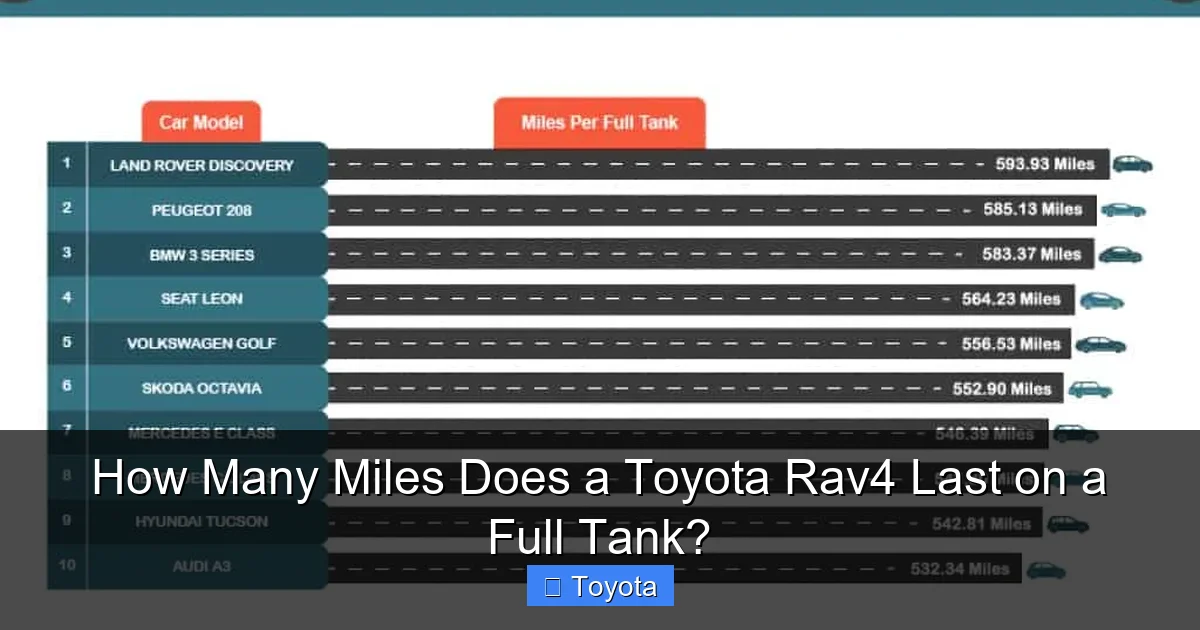
When you’re talking about “how many miles on a full tank,” the choice between the standard gasoline engine and the hybrid powertrain is the most significant fork in the road. It’s not just a slight efficiency bump; it’s a fundamental re-engineering of how the vehicle uses energy.
Visual guide about How Many Miles Does a Toyota Rav4 Last on a Full Tank?
Image source: choosemycar.com
How the RAV4 Hybrid Works Its Magic
The RAV4 Hybrid doesn’t just have a more efficient gasoline engine; it has a second power source—an electric motor—and a sophisticated system that seamlessly blends them. In city driving, it can run on electric power alone for short distances, using zero gasoline. The gasoline engine only kicks on when needed for higher speeds or hard acceleration. Furthermore, the hybrid system captures energy during braking and coasting (regenerative braking) to recharge the battery, energy that would otherwise be lost as heat. This is why the hybrid’s city MPG rating (40 MPG) is astronomically higher than the gas model’s (27 MPG). On the highway, the system is less dominant but still optimizes power delivery.
The Real-World Hybrid Advantage: In practical terms, this means a RAV4 Hybrid driver who does a mix of city and highway driving will consistently see combined MPG in the high 30s to low 40s. Let’s do the math: 14.5 gallons x 38 MPG (a realistic real-world hybrid average) = 551 miles. That’s a potential 100+ mile advantage over a similarly driven gas model. For someone with a long commute or who frequently makes road trips, that’s the difference between stopping for gas every week and a half versus every two weeks. The hybrid’s advantage is most pronounced in stop-and-go traffic, where the gas model suffers the most.
When the Gas Model Makes Sense
The standard gas RAV4 is no slouch. Its 203 horsepower 2.5L 4-cylinder engine is smooth, reliable, and more than adequate for daily duties. Its range, while lower, is still very respectable for the class. A gas AWD model getting a real-world 28 MPG combined would still deliver about 406 miles per tank. For drivers who primarily do highway driving, the MPG gap narrows significantly. The gas model also has a slightly lower initial purchase price and a long, proven track record for durability. If your driving is 70%+ highway and you prioritize upfront cost or don’t want to think about battery longevity (though Toyota’s hybrid battery warranty is excellent), the gas RAV4 is a fantastic, efficient choice. You can also compare longevity trends across Toyota’s lineup; for instance, the Toyota Avalon is another model known for exceptional long-term reliability, showcasing the brand’s overall engineering philosophy.
Factors That Secretly Suck Your Fuel Dry
Beyond the big categories of driving environment and powertrain, a constellation of smaller factors nibbles away at your fuel economy. Being aware of these can help you diagnose why your range might be lower than expected.

Visual guide about How Many Miles Does a Toyota Rav4 Last on a Full Tank?
Image source: i.ytimg.com
Accessory Load: The Invisible Drain
Every electrical component in your RAV4 is ultimately powered by the engine (via the alternator), which burns fuel. The biggest offender is the air conditioning compressor. In hot weather, running the A/C can increase fuel consumption by 5-25%, depending on the outside temperature and your fan speed. Heated seats and a heated steering wheel also draw power. On the highway, running with the windows down creates aerodynamic drag, which is another fuel drain. The most efficient way to cool the cabin at high speed is to use the A/C with windows up. At low city speeds, the drag penalty is lower, so rolling down windows can sometimes be more efficient than running the A/C compressor.
Tire Pressure and Condition
This is a massive, often-overlooked factor. Under-inflated tires increase rolling resistance, forcing the engine to work harder. The RAV4’s recommended tire pressure is listed on a sticker inside the driver’s door jamb. It’s typically around 32-33 PSI for all four tires, but it can vary by trim and load. Check your tires monthly. A drop of just 5 PSI below the recommended level can reduce fuel economy by 2-3%. Worn, uneven, or low-quality tires can also increase rolling resistance. Ensuring your tires are properly inflated and in good condition is one of the easiest, cheapest ways to maximize MPG.
Fuel and Oxygen Sensor Health
Your RAV4’s engine computer (ECU) relies on a network of sensors to calculate the perfect air-fuel mixture. A faulty oxygen (O2) sensor can tell the ECU the mixture is too rich (too much fuel), causing it to inject more gasoline than necessary. A clogged air intake sensor or a failing fuel pressure sensor can have similar effects. These issues often trigger a “Check Engine” light, but not always. If you notice a sudden, unexplained drop in MPG of 10% or more, a diagnostic scan at a reputable shop is a wise investment. Catching a failing sensor early saves fuel and prevents potential damage to the catalytic converter.
Proactive Strategies to Maximize Your Miles Per Tank
Now for the fun part: what you can *do* about it. You can’t move mountains or control the weather, but you have immense control over your driving behavior and vehicle care. Implementing these strategies will directly translate to more miles between fill-ups.
Master the Art of Efficient Driving
This is your most powerful lever. Imagine there’s an egg under your foot on the accelerator and brake pedals.
- Accelerate Smoothly and Gradually: Aim to reach your cruising speed over 8-10 seconds instead of 3-4. This keeps the engine in a lower, more efficient RPM range.
- Maintain Steady Speeds: Use cruise control on flat, open highways. Constant speed is far more efficient than constant tiny throttle adjustments.
- Anticipate and Coast: Look far ahead at traffic. If you see a red light or slowing cars ahead, take your foot off the gas early and coast. This uses zero fuel. The RAV4’s fuel-injected engine cuts fuel entirely during deceleration when your foot is off the pedal and the RPMs are above idle.
- Reduce Idling: If you’re stopped for more than 60 seconds (except in traffic), turn the engine off. Modern engines use very little fuel to restart. Idling gets 0 MPG.
- Observe Speed Limits: Aerodynamic drag increases exponentially with speed. Driving 65 MPH vs. 75 MPH can save 10-15% in fuel consumption on the highway.
Rigorous, Consistent Maintenance
A neglected RAV4 is an inefficient RAV4. Stick to your maintenance schedule religiously.
- Oil Changes: Use the correct oil grade (0W-16 or 0W-20 for most modern RAV4s). Old, dirty oil increases internal engine friction.
- Air Filter: A clogged air filter starves the engine of air, forcing it to use more fuel. Check it at every oil change; replace it if it’s dirty.
- Spark Plugs: Worn spark plugs cause incomplete combustion, wasting fuel. Replace them at the manufacturer’s interval (often 120,000 miles on platinum/iridium plugs).
- Wheel Alignment: Misalignment causes the tires to drag, increasing rolling resistance. Get it checked annually or if you hit a pothole.
Smart Trip Planning and Load Management
Combine errands into one trip. A warm engine is more efficient than a cold start. Remove unnecessary weight from the vehicle—every 50 pounds matters. Take the roof rack off when not in use. Plan routes that avoid heavy traffic and stop-and-go situations when possible, even if it means a slightly longer distance. The time saved in constant acceleration/braking will pay off in fuel.
Another practical tip is understanding your RAV4’s fuel door mechanism. Knowing exactly how to open the gas tank on a Toyota RAV4 smoothly can save you a moment of frustration at the pump, but more importantly, it ensures you’re refueling correctly and safely, without damaging the filler neck—a small but part of overall ownership care.
Longevity: The Million-Dollar Question and Fuel’s Role
The question of “how many miles does it last” often extends beyond a single tank to the entire lifespan of the vehicle. The Toyota RAV4 is famous for its durability, with many examples on the road well past 200,000 and even 300,000 miles. How you manage fuel and maintenance plays a direct role in achieving that mileage.
Running your RAV4 consistently with a very low fuel level (relying on the reserve) is not a recommended practice. The fuel pump, which is located inside the gas tank, is cooled and lubricated by the gasoline surrounding it. Frequently driving with less than a quarter-tank can cause the pump to overheat and wear out prematurely. Additionally, sediment that settles at the bottom of the tank can be sucked into the fuel system when the level is very low, potentially clogging filters or injectors. For long-term health, try to refuel when you reach the 1/4 tank mark. This also gives you a safety buffer and prevents the stress of hunting for a gas station with the low-fuel light glaring.
The synergy between fuel efficiency and engine longevity is clear. A well-maintained engine that operates at peak efficiency is under less strain, produces less harmful carbon buildup, and runs at optimal temperatures. This translates directly to a longer, healthier life for pistons, rings, valves, and the catalytic converter. The habits that give you 40 MPG—smooth driving, clean filters, proper tire pressure—are the exact same habits that will help your RAV4’s odometer climb to formidable heights. This philosophy of building durable, efficient vehicles is a Toyota hallmark, evident in everything from the compact RAV4 to the full-size Toyota Sienna minivan.
Conclusion: Your Personal RAV4 Range Formula
So, how many miles does a Toyota RAV4 last on a full tank? The definitive answer is: it depends. The theoretical ceiling for a hybrid is around 580 miles, and for a gas model, about 450 miles. But your real, reliable, day-to-day range will be 10-25% lower than that, landing most drivers in the 350-500 mile sweet spot depending on their model and lifestyle.
The power is in your hands. By choosing the hybrid model for maximum efficiency, adopting smooth driving habits, keeping your vehicle meticulously maintained, and managing your loads and trips wisely, you can consistently hit the higher end of your RAV4’s potential. Don’t just view the fuel gauge as a simple indicator; see it as a feedback loop for your driving behavior and vehicle health. The next time you fill up, reset your trip odometer. Drive normally for a few tanks, calculate your actual MPG, and then implement one or two of the tips from this article. You’ll likely see the number of miles you can extract from that 14.5-gallon tank start to creep upward. That’s the true beauty of owning a RAV4: it’s not just a capable, reliable SUV—it’s a highly tunable machine where your choices behind the wheel and under the hood have a direct, measurable impact on your fuel budget and your vehicle’s long-term vitality.
Frequently Asked Questions
What is the realistic range of a Toyota RAV4 on a full tank?
For most recent gas-powered RAV4 models, a realistic range is between 350 and 420 miles per tank. For the RAV4 Hybrid, a realistic range is typically between 450 and 550 miles, with some highway-centric drives potentially exceeding 550 miles. This assumes normal mixed driving and properly inflated tires.
How does the RAV4 Hybrid’s range compare to the gas model?
The RAV4 Hybrid has a significantly longer range, often by 100 miles or more per tank. This is due to its superior EPA rating of 40 MPG combined versus the gas model’s 29-31 MPG combined. The hybrid’s advantage is most dramatic in city driving where its electric motor is used frequently.
Does using AWD reduce the RAV4’s range?
Yes, but the reduction is relatively small on the RAV4. The AWD system is primarily rear-biased and only engages the rear wheels when needed for traction. Compared to the FWD model, the AWD version typically has an EPA rating that is 1-2 MPG lower, translating to about a 10-20 mile reduction in total range per tank under similar conditions.
How many miles can I drive after the gas light comes on?
When the low-fuel light illuminates, you typically have 1-2 gallons of fuel remaining, giving you a safe reserve of approximately 30-50 miles. It’s not advisable to regularly test this limit, as consistently driving with very low fuel can overheat and damage the in-tank fuel pump.
What is the single best thing I can do to improve my RAV4’s MPG?
The most impactful change is modifying your driving style. Practicing smooth, gradual acceleration and gentle braking, using cruise control on highways, and anticipating traffic to coast more often can improve your real-world MPG by 15% or more. This is a free, immediate upgrade with no mechanical work required.
How often should I check my tire pressure to maintain optimal range?
You should check your tire pressure at least once a month and before long trips. Temperature changes cause air in tires to expand and contract, so checking during seasonal swings is especially important. Always refer to the recommended PSI on the driver’s door jamb sticker, not the number on the tire sidewall.
