
What Is the Most Common Problem with a Toyota 4runner?

While the Toyota 4Runner is celebrated for its rugged reliability and off-road prowess, it is not without its faults. The most prevalent issues typically revolve around the 4.0L V6 engine’s head gaskets, extensive frame rust on older models, and wear on suspension and electrical components. Understanding these common problems is crucial for prospective buyers and current owners to ensure proper maintenance and avoid costly repairs.
Let’s be honest. When you think of a Toyota 4Runner, words like “indestructible,” “go-anywhere,” and “lifelong companion” probably come to mind. And for the most part, that reputation is earned. These SUVs are famously tough, often racking up hundreds of thousands of miles with basic care. But “reliable” doesn’t mean “perfect.” Like any complex machine, especially one built over decades with multiple generations, the 4Runner has its Achilles’ heels. Knowing what they are isn’t about fear-mongering; it’s about being a smart owner or buyer. It’s about separating myth from reality and knowing where to look, what to listen for, and how to stay ahead of the curve. So, what is the most common problem with a Toyota 4Runner? The answer isn’t a single, simple thing. It’s a handful of well-documented weak points that, with awareness, are completely manageable.
Key Takeaways
- Head Gasket Failure in the 4.0L V6: This is the single most common and costly issue, particularly in 2003-2009 models. Look for coolant loss, white smoke, or milky oil.
- Frame Rust is a Major Concern: Severe corrosion on the rear frame section, especially around the spare tire mount, was so widespread it led to a recall and extended warranty coverage for specific years.
- Suspension & Steering Wear: Ball joints, control arm bushings, and tie rod ends wear out faster than expected, leading to clunks, poor alignment, and uneven tire wear.
- Electrical Gremlins: Faulty multifunction switches (turn signals/wipers), starter motor failures, and dashboard light problems are frequent annoyances.
- 4WD System Issues: Transfer case bearing failures and problems with the DAC (Downhill Assist Control) system can occur, affecting off-road functionality.
- Transmission Longevity: While generally robust, automatic transmissions in high-mileage or heavily loaded 4Runners can experience solenoid or shift issues.
- Proactive Maintenance is Key: Regular inspections, addressing minor leaks immediately, and rust prevention treatments can dramatically extend the life of a 4Runner.
📑 Table of Contents
- The Engine Elephant in the Room: The 4.0L V6 Head Gasket
- The Rust Scourge: Frame Corrosion and the Recall
- Wear and Tear: Suspension and Steering Components
- The Annoying Little Things: Electrical System Gremlins
- 4WD and Transfer Case Concerns
- The Transmission: Generally Tough, But Not Invincible
- Conclusion: Knowledge is Power (and Savings)
The Engine Elephant in the Room: The 4.0L V6 Head Gasket
If we had to crown one issue as the “most common” and most financially significant, it would be head gasket failure in the 4.0-liter V6 engine. This engine powered the 4Runner from its introduction in the 2003 model year (for the fourth generation) all the way through the 2024 model year in various forms. It’s a generally torquey, simple, and durable engine, but it has one critical flaw.
Why Do These Head Gaskets Fail?
The 4.0L V6 uses a multi-layer steel (MLS) head gasket. In theory, that’s a good, robust design. The problem often stems from the engine’s design and operating conditions. The 4Runner is frequently used for towing, off-roading, and general heavy-duty work. This leads to higher sustained under-hood temperatures and greater thermal cycling (heating up and cooling down). Over time, this stress can cause the MLS gasket to develop a leak, most commonly between the cylinder and the coolant passage. This is not a quick, sudden failure like a blown radiator hose. It’s a slow, insidious leak that can go unnoticed for thousands of miles until symptoms become severe.
- Coolant Disappearance: You’ll find yourself needing to top off the coolant reservoir more often than usual, with no visible leaks on the ground.
- White Smoke from the Exhaust: This is the classic sign. Sweet-smelling white smoke (steam) billowing from the tailpipe, especially when the engine is warmed up, means coolant is being burned in the combustion chamber.
- Milky or Frothy Oil: Check the dipstick and the oil filler cap. If the oil looks like a chocolate milkshake, coolant is contaminating the lubrication system. This is catastrophic if not addressed immediately.
- Overheating: The engine may run hot or overheat, not necessarily because the cooling system is low, but because combustion gases are pressurizing the cooling system.
- Poor Performance and Misfires: Loss of compression in one or more cylinders can cause rough running, lack of power, and check engine lights.
The Fix: This is not a simple gasket job. It’s an engine-out repair. The cylinder heads must be removed, the surfaces machined perfectly flat (often necessary), and new head gaskets, head bolts, and other related seals installed. The cost can range from $2,500 to $4,000+ at a reputable shop. For this reason, a pre-purchase inspection by a mechanic familiar with this engine is non-negotiable for any used 4Runner. They will perform a block test (chemical test for exhaust gases in the coolant) and a thorough inspection.
It’s worth noting that the later 4.0L V6 in the fifth generation (2014+) and the 4.6L V8 in some limited models are considered more robust in this regard. If you’re looking at a 4Runner with the 4.0L V6, the model year is less important than the maintenance history. A well-maintained, never-overheated engine can go 300,000 miles. A neglected one can fail at 150,000. For those considering the V8 option, researching the reliability of the 4.6L V8 is a smart comparison point.
The Rust Scourge: Frame Corrosion and the Recall
For many years, the second biggest knock against the 4Runner was the alarming rate of rust on its frame. This wasn’t just surface rust. We’re talking about severe, structural corrosion that could compromise the integrity of the vehicle. The problem was so severe and widespread, particularly on fourth-generation (2003-2009) models built at the Tahara, Japan plant, that Toyota had to act.
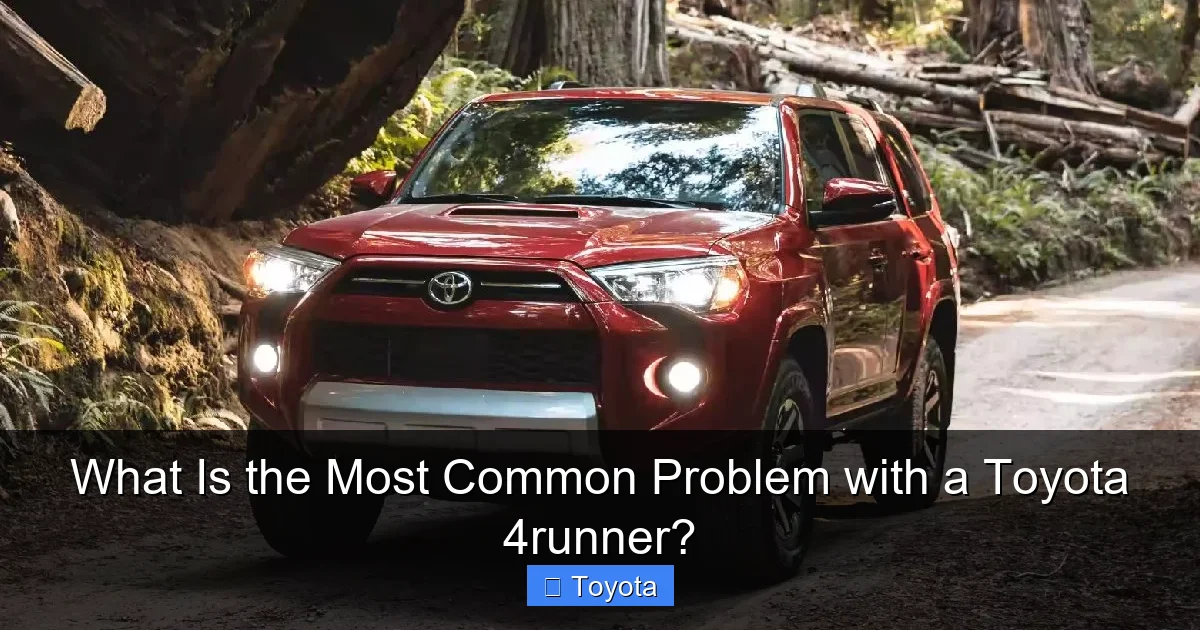
Visual guide about What Is the Most Common Problem with a Toyota 4runner?
Image source: motorbiscuit.com
The “Frame Recall” and Extended Warranty
In 2016, the National Highway Traffic Safety Administration (NHTSA) investigated and Toyota issued a recall. For specific 2003-2009 4Runners, Toyota offered an extended warranty for frame corrosion perforation for 15 years from the date of first use, with no mileage limit. The warranty covered the repair or replacement of the frame if it developed a hole due to corrosion. This was a massive admission of a problem. The corrosion was typically worst on the rear section of the frame, around the spare tire carrier mount and the rear leaf spring/axle mounts. Road salt, moisture, and possibly a coating issue during manufacturing combined to create a perfect storm.
What to Look For: When inspecting a used 4Runner, get underneath and poke at the frame with a screwdriver or awl, especially in those rear sections. Healthy frame metal will be solid. Rusted-through metal will feel soft and crumble easily. Look for large bubbles, flaking, or holes. If the frame is severely corroded, the vehicle is unsafe and often considered a total loss by insurance companies. Even if it’s not yet holed, heavy scaling rust is a red flag for future expensive repairs.
The Good News: Fifth-generation (2014+) 4Runners, built in the USA, have shown dramatically improved resistance to frame rust due to changes in manufacturing processes and coatings. If you’re buying today, a 2014 or newer model is far less likely to have this issue. For owners of older, affected models, the extended warranty is a lifesaver if the problem surfaces. Always check the vehicle’s service history for any frame-related repairs performed under this special warranty.
Wear and Tear: Suspension and Steering Components
The 4Runner is a heavy, body-on-frame SUV designed to tackle rough terrain. This puts immense stress on its suspension and steering linkage. While the core components like axles and leaf springs are very tough, the smaller, wearable parts tend to have a shorter lifespan than you might expect from a Toyota.

Visual guide about What Is the Most Common Problem with a Toyota 4runner?
Image source: autozonic.com
The Usual Suspects: Ball Joints, Bushings, and Tie Rods
As mileage climbs, listen for noises. A clunk, pop, or creak over bumps or when turning is the first symptom. Visually, inspect for:
- Lower Ball Joints: These wear out and can have excessive play. Failure means the wheel could potentially separate from the steering knuckle—a serious safety hazard. They are a common replacement item on high-mileage 4Runners.
- Control Arm Bushings: The rubber or polyurethane bushings that isolate the control arms from the frame deteriorate. This leads to poor alignment, a vague steering feel, and thumping noises.
- Tie Rod Ends: Inner and outer tie rod ends wear, causing steering wheel play and uneven tire wear. A “shimmy” or vibration in the steering wheel at certain speeds can be a sign.
- Sway Bar Links and Bushings: These are relatively cheap and easy to replace but often make annoying clunking noises over small bumps.
Practical Tip: During a pre-purchase inspection, have the mechanic perform a “shake test” on the front wheels. They will grab the tire at 9 and 3 o’clock and try to wiggle it laterally, checking for play in the tie rods and ball joints. They’ll also check for up/down play in the ball joints. Don’t skip this. Repairing a full set of front suspension components can easily cost $1,000-$2,000.
The Annoying Little Things: Electrical System Gremlins
For a vehicle known for its simplicity, the 4Runner has a surprising number of documented electrical quirks. These rarely leave you stranded but can drive you bonkers and point to larger component failures.
Visual guide about What Is the Most Common Problem with a Toyota 4runner?
Image source: i.pinimg.com
The Multifunction Switch and Other Common Failures
The most infamous is the multifunction switch, which controls the turn signals, high beams, and wiper/washer functions. In many models (especially 2003-2009), the contacts wear out. Symptoms include:
- Turn signals working intermittently or not at all.
- High beams sticking on or not engaging.
- Wipers working only on certain speeds.
- The infamous “three-blink” lane change feature failing.
The fix is replacing the entire switch assembly, which is relatively inexpensive but can be a bit of a dash-disassembly job. Another common failure is the starter motor, particularly on the 4.0L V6. The symptom is a slow, labored crank or a complete “click” with no turnover. The starter itself is a known wear item and is straightforward to replace. Other issues include dashboard light failures (especially the “4L” or “4H” indicators in the 4WD cluster) and occasional problems with the power window regulators and door lock actuators.
The Takeaway: These electrical issues are mostly nuisances. They are well-known, parts are readily available, and repairs are generally not bank-breaking. They are, however, a key reason to always test every single switch, light, and motor on a used 4Runner before buying.
4WD and Transfer Case Concerns
A non-4WD 4Runner is a rare bird. The part-time 4WD system is a core feature. While the electronic shift-on-the-fly systems in the fourth and fifth generations are generally reliable, there are two areas of concern.
Transfer Case Bearings and DAC System
First, some transfer cases (particularly in the 2003-2009 range with the 4.0L) can develop a noisy bearing. You might hear a whine, hum, or grinding noise from the center of the vehicle that changes with vehicle speed and sometimes with 2WD vs. 4WD mode. This is an internal bearing failure and requires a transfer case rebuild or replacement—a costly job.
Second, the Downhill Assist Control (DAC) system, which automatically controls speed on steep descents, has its own set of potential faults. The DAC button might illuminate but the system won’t engage, or it might engage erratically. This is often caused by a faulty wheel speed sensor, a problem with the ABS module, or a dedicated DAC hydraulic unit failure. Diagnosing it can be tricky. Understanding what the DAC button is supposed to do and testing its function is part of a thorough 4WD inspection. Always test the 4WD system! Engage 4High and 4Low on a loose surface or in a safe parking lot. Listen for grinding (which can indicate a worn transfer case) and ensure the vehicle actually locks in and moves smoothly.
The Transmission: Generally Tough, But Not Invincible
The automatic transmissions in the 4Runner—the A750F series in the fourth gen and the A760F in the fifth—are workhorses. They are not the weak link that plagues some other SUVs. However, no transmission is bulletproof forever, especially one mated to a heavy SUV that tows and off-roads.
What to Expect at High Mileage
The most common transmission-related issues are not catastrophic failures but rather:
- Shift Solenoid Failures: These small electro-hydraulic valves control gear changes. A failed solenoid can cause harsh shifts, slippage, or the transmission getting “stuck” in one gear (like Limp Mode). Diagnosis with a scan tool is key, and replacing the solenoid is often a transmission-pan-drop repair.
- Delayed Engagement: Feeling a pronounced pause between “Park” and “Drive” or “Reverse” when cold can indicate worn clutch packs or a failing valve body. It’s a sign of general wear.
- Fluid Condition: This is paramount. The factory fill is “lifetime,” but smart owners and mechanics agree this is a myth. At 100,000 miles, a full drain and refill (not just a pan drop) with the correct Toyota WS fluid is essential prophylaxis. Dark, burnt-smelling fluid is a red flag for internal wear.
Preventive maintenance is your best defense here. Avoid excessive heat by ensuring your cooling system is in top shape (see the head gasket section). Don’t use the transmission as a “brake” on long descents; use the engine and proper gearing. If buying high-mileage, a thorough transmission service history is a huge plus.
Conclusion: Knowledge is Power (and Savings)
So, what is the most common problem with a Toyota 4Runner? It’s a combination of a few key areas: the ever-present threat of head gasket failure in the 4.0L V6, the historic but largely resolved frame rust issue, predictable suspension wear, and assorted electrical gremlins. The 4WD and transmission systems are robust but require attention at very high mileages.
The beautiful thing about the 4Runner is that these are known, documented issues. They are not mysterious, sudden death traps. They are engineering realities that have been discussed on forums for years. This means a savvy buyer can inspect for them. A meticulous owner can prevent or catch them early. The 4Runner’s legendary reliability comes from its simple, overbuilt core—its solid axles, its body-on-frame construction, its lack of complicated unibody designs. The problems arise in the peripherals and in the specific weaknesses of its most common engine.
If you’re considering a 4Runner, your due diligence is clear: get a pre-purchase inspection from a specialist. Check for coolant in the oil and exhaust. Get underneath and probe the frame. Listen for suspension clunks. Test every switch and 4WD mode. Review the maintenance history with a critical eye. A clean bill of health on these fronts means you likely have one of the most capable and dependable used SUVs on the market.
And if you already own one? Stay on top of scheduled maintenance. Address minor coolant leaks immediately. Have the suspension inspected annually. Treat the frame with an undercoating if you live in a rust belt. These steps transform a good 4Runner into an immortal one. The 4Runner’s reputation is hard-earned, and with a little knowledge about its quirks, you can be confident your specific example will live up to the legend. For more details on the manufacturing quality and origins of these vehicles, you can read where the Toyota 4Runner is built, which also speaks to the changes in corrosion protection over the years.
Frequently Asked Questions
What years of Toyota 4Runner have the most problems?
The 2003-2009 fourth-generation models are the most problematic due to the combination of the prone-to-failure 4.0L V6 head gaskets and severe frame rust issues. The 2010-2013 “refresh” models improved the frame but still have the 4.0L engine. The 2014+ fifth-generation models are significantly better, with a more rust-resistant frame and a revised 4.0L V6 that is more durable.
Are Toyota 4Runners reliable overall?
Yes, overwhelmingly so. Despite the common problems listed, the 4Runner consistently ranks at or near the top of reliability surveys like those from J.D. Power and Consumer Reports. Its core mechanical components (axles, transfer case, transmission when maintained) are exceptionally tough. The “problems” are mostly specific, known, and often preventable with proper care and inspection.
How much does it cost to fix a head gasket on a 4Runner?
Because it’s an engine-out job, the cost is high. Expect to pay between $2,500 and $4,000 at an independent repair shop. Dealership prices can be higher. This cost underscores why a block test during a pre-purchase inspection is worth every penny. Sometimes, a neglected head gasket leak can lead to further damage (like a warped head), increasing the cost.
Can frame rust on a 4Runner be repaired?
Yes, but it is extremely expensive and labor-intensive. For minor surface rust, grinding and coating can suffice. For the severe, perforating rust that the recall addressed, the frame section often needs to be cut out and welded with new metal. This is a major structural repair that can cost several thousand dollars. For the affected 2003-2009 models, check if the repair was done under Toyota’s extended warranty.
Should I avoid buying a 4Runner with over 200,000 miles?
Not necessarily. A 4Runner with 200,000+ miles can be an excellent buy if it has a complete, verifiable service history. The key is evidence of consistent maintenance: transmission services, coolant flushes, timing belt/chain checks (if applicable to that engine), and suspension inspections. A neglected high-mileage 4Runner is a risk, but a well-cared-for one is likely just getting broken in.
What is the most expensive common repair on a 4Runner?
Unaddressed head gasket failure leading to engine damage is the most expensive. A catastrophic engine failure can require a used or remanufactured engine, costing $5,000-$8,000 installed. Following that, a major transfer case rebuild/replacement (for the bearing issue) and a complete frame rust repair can each cost $3,000-$5,000. Proactive inspection and maintenance are always cheaper than these major failures.
