
What It’s Like to Drive a Ford F150

Driving a Ford F150 is a study in confident capability mixed with surprising refinement. You feel its immense power and solid-road presence immediately, yet the modern cabins are quiet and comfortable enough for family road trips. It’s a versatile tool that transitions from a capable workhorse to a luxurious daily driver with ease, though its size and fuel costs require real-world consideration.
So, you’re thinking about buying a Ford F150. Maybe you need a true work truck. Maybe you just like the idea of sitting up high and feeling utterly confident on the road. Or perhaps you’ve heard it’s the best-selling vehicle in America for over four decades straight and you’re curious what all the fuss is about. I’ve spent considerable time behind the wheel of various F150s, from base XLs to loaded Lariats and even a Raptor. Let’s cut through the hype and marketing and talk about what it’s actually like to drive one every single day.
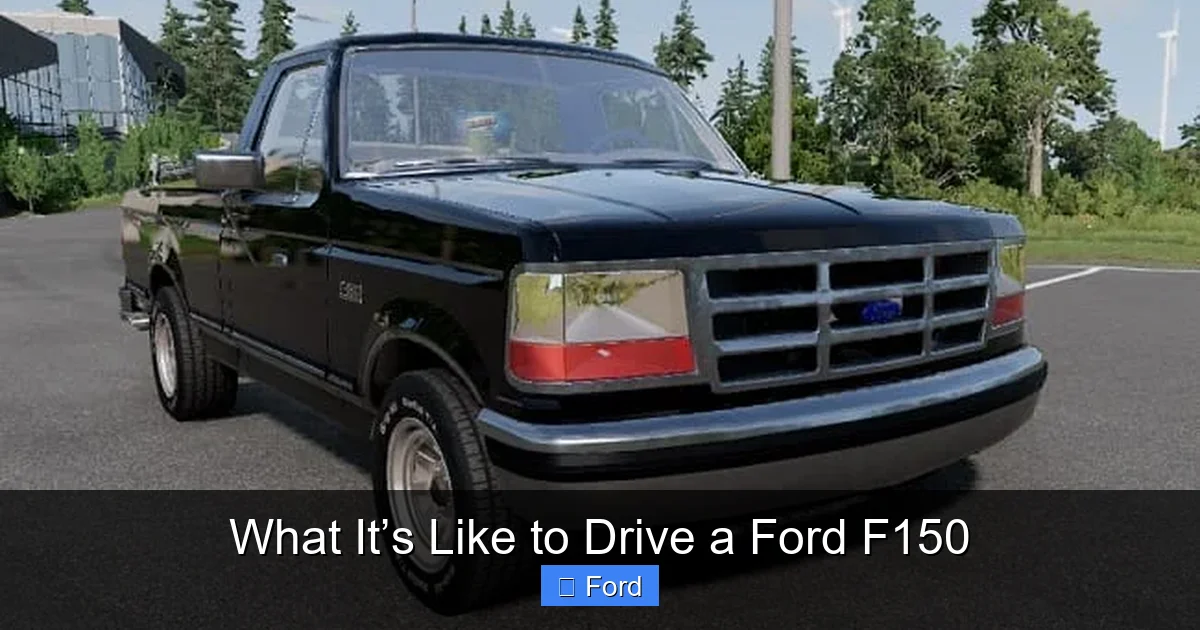
First, the sensation. You don’t so much get into an F150 as you mount it. The step up is substantial, and once you’re in the driver’s seat, you’re perched. The hood stretches out before you like a small landing strip. This commanding view is a huge part of the F150’s appeal—you see over most cars, and the feeling of being surrounded by steel is undeniably secure. The doors shut with a heavy, satisfying THUNK. This isn’t a lightweight, rattly feeling; it’s substantial. That solidity translates directly to the driving experience.
Key Takeaways
- Commanding Presence: The F150’s seating position and solid build quality create a feeling of authority and safety on the road, making you feel in control.
- Surprising Refinement: Modern F150s, especially with the available independent rear suspension, offer a smooth, quiet ride that defies traditional truck stereotypes.
- Unmatched Versatility: From a basic work truck to a plush King Ranch or high-performance Raptor, the F150’s vast configuration range means there’s one for virtually every need and budget.
- Capable, But Costly: Towing and hauling are effortless with the right powertrain, but you must factor in significant fuel costs and potential maintenance expenses for heavy use.
- Tech-Forward Cabin: The SYNC 4 system and available digital gauge cluster provide modern connectivity and a car-like interface, though some may prefer simpler controls.
- Size Matters: Its massive footprint is an advantage for cargo and towing but requires careful parking and maneuvering in tight urban spaces.
- Strong Resale Value: The F150 consistently holds its value exceptionally well, making it a smarter long-term financial investment than many vehicles.
📑 Table of Contents
The Driving Experience: Power, Poise, and Presence
Turn the key (or press the button), and the engine wakes up. Depending on your choice of powertrain—the potent 3.5L EcoBoost V6, the torquey 5.0L V8, or the hybrid PowerBoost—the character changes dramatically. But across the board, there’s one constant: low-end grunt. Even the base 3.3L V6 has enough torque to get the truck moving with authority. The EcoBoost, with its twin turbos, delivers a rush of power that feels almost European in its linear delivery, while the V8 provides a more traditional, burbling American rumble. The PowerBoost is a revelation, offering electric motor torque instantly and sipping fuel far more efficiently than you’d expect for such a heavy vehicle. Shifts from the 10-speed automatic are smooth and decisive, though they can be busy under light throttle as it hunts for the perfect gear.
On-Road Manners: A Surprising Transformation
This is where the modern F150 truly shocks first-time drivers. The old stereotype of a bouncy, truck-like ride is largely dead. For the 2021 model year, Ford introduced an independent rear suspension (IRS) on most models (the heavy-duty XL 4×4 retained the solid axle). The difference is night and day. The IRS soaks up bumps and road imperfections with a composure that rivals many SUVs. The cabin is impressively quiet at highway speeds, with only a distant wind roar and a muted thrum from the engine under acceleration. It cruises effortlessly, making long drives less fatiguing than you’d ever imagine. Steering is appropriately weighted—heavy enough to feel connected but light enough for easy parking. This is a truck that doesn’t punish you for daily driving.
Towing and Hauling: Where It Truly Shines
This is the F150’s core competency. Hooking up a trailer, you engage the trailer brake controller (a must-have feature) and select your drive mode. The available “Towing” mode adjusts the transmission shift points, throttle response, and even the steering feel for better control. The backup camera with dynamic guide lines makes lining up a hitch a one-person job. Once moving, the truck feels utterly unbothered. The torque is constant, and the transmission holds gears to maintain power on grades. The integrated trailer brake controller provides smooth, adjustable stopping power. It’s an incredibly confidence-inspiring experience. For maximum payload, the available Max Trailer Tow and Max Payload packages are engineered with heavy-duty frames, upgraded axles, and enhanced cooling. If you plan to tow regularly, getting the correct axle ratio and package from the start is critical; it makes all the difference in performance and component wear. For those needing maximum capability, understanding how to engage 4-wheel drive on a heavy-duty truck is similar knowledge, though the F150’s system is typically more user-friendly.
Cabin Comfort and Technology: A Car-Like Sanctuary
Step inside, and the story continues. The F150’s interior has evolved from utilitarian to genuinely upscale in higher trims. The materials vary wildly by trim—the base XL is functional and durable, while the Platinum and Limited are borderline luxurious with leather, real wood, and soft-touch surfaces. The front seats are spacious and comfortable, with excellent support for long drives. The rear seat in SuperCrew models is genuinely roomy, a true full-size back seat that adults won’t complain about.
Visual guide about What It’s Like to Drive a Ford F150
Image source: gtmods.ru
The tech story is dominated by the SYNC 4 system. The large, vertical touchscreen (or available 12-inch horizontal screen) is responsive and bright. Apple CarPlay and Android Auto are standard. The digital instrument cluster is clear and configurable, showing vital truck data like trailer brake output and gear selection. The system works well, though some users prefer physical buttons for critical functions like HVAC and audio volume, which are still present but minimized. The available Bang & Olufsen premium sound system is excellent, helping to drown out the road noise that, while reduced, is never fully eliminated in a big box on wheels.
Trim Levels: Finding Your Perfect F150
The F150’s genius is in its staggering range. This isn’t one truck; it’s a family.
- XL/XLT: The workhorses. Functional, durable, and the best value for pure capability. Missing many comfort features but built to last.
- Lariat: The sweet spot for most. Adds leather, heated/cooled seats, a premium audio system, and more tech. Balances comfort and capability perfectly.
- King Ranch/Platinum: The luxury cruisers. Premium leather, unique styling, and almost every available feature. For those who want a truck that feels like a limousine.
- Raptor: The desert-racing beast. Completely different suspension, massive tires, and a high-output engine. It’s a thrill machine off-road but compromises on-road comfort and fuel economy.
- Limited: The top of the line, loaded with every conceivable option and a focus on ultimate luxury and presence.
Choosing a trim is the first and most important step. Your budget and primary use will dictate this choice more than anything else. For those looking to personalize their truck, exploring the best accessories for a truck is a fun and practical next step after purchase.
Visual guide about What It’s Like to Drive a Ford F150
Image source: i.ytimg.com
The Realities of Ownership: Costs and Considerations
Let’s be real. Driving an F150 comes with compromises you must accept.
Fuel Economy: The Elephant in the Room
Even the most efficient PowerBoost model will struggle to see 25 MPG on the highway in real-world driving with a mix of loads. The V8 and EcoBoost trucks, especially when towing or in city traffic, can easily dip into the 12-16 MPG range. This is the price of moving nearly three tons of metal. You are not buying this truck for fuel efficiency; you are buying it for capability, and you will pay at the pump. Budget accordingly. The cost of ownership extends beyond fuel.
Visual guide about What It’s Like to Drive a Ford F150
Image source: cimg8.ibsrv.net
Size and Maneuverability
At 19+ feet long, the F150 is a parking challenge. Narrow city streets, tight parking garages, and crowded lots require patience and practice. The blind spots are significant, especially over the tall hood and rear corners. The excellent camera systems help immensely, but you must remain aware of the truck’s footprint. It’s not a vehicle for squeezing into tiny spaces.
Maintenance and Long-Term Care
Modern trucks are complex. The turbocharged engines and 10-speed transmissions require specific, often more expensive, maintenance. Oil changes are larger (often 7-8 quarts) and may require specific oil specs. Heavy towing puts extra strain on the transmission, differentials, and brakes. Following the severe service schedule is wise if you use your truck hard. A well-maintained F150 is famously durable, but cutting corners on service will lead to costly repairs. For potential owners, understanding the true cost to own and drive your car is essential, and a full-size truck is one of the more expensive common vehicles to operate.
Who Is the F150 For? (And Who Should Look Elsewhere?)
It’s PERFECT for you if: You regularly tow a boat, trailer, or RV; you carry heavy gear or equipment; you need a massive, secure cargo bed; you value a high driving position and a sense of security; you want a single vehicle that can do almost everything; you plan to keep it for 10+ years and value strong resale.
You should probably LOOK ELSEWHERE if: Your primary concern is fuel economy or low running costs; you rarely carry more than 2-3 people or any cargo; you live in a dense urban area with tight parking; you prioritize driving dynamics and handling over sheer capability; you want a sporty, nimble feel.
The Verdict: More Than Just a Truck
Driving a Ford F150 is an experience in confidence. It’s the feeling that you can handle almost any task or road condition thrown your way. The modern versions have shattered the old compromises, offering a cabin that is quiet, comfortable, and tech-rich. The powertrain options provide a spectrum from efficient to wildly powerful. It is, without question, the most versatile full-size truck on the market.
But it’s not for everyone. Its size is a burden in the city. Its thirst for fuel is a constant companion. You are paying for a tremendous amount of capability, whether you use it all or not. Yet, for its intended purpose, it’s exceptionally good at its job. The reason it’s been America’s best-seller for so long is that it delivers on its promises of capability, durability, and versatility better than any competitor. It feels substantial, built to last, and ready for adventure. If your lifestyle—or your dreams—align with what a full-size truck represents, the Ford F150 remains the undisputed benchmark. It’s more than a vehicle; it’s a tool, a sanctuary, and a statement, all rolled into one.
Frequently Asked Questions
Is the Ford F150 comfortable for daily driving and long road trips?
Absolutely. Especially in trims from Lariat upward with the independent rear suspension, the ride is smooth and quiet. The seats are comfortable, and the cabin is spacious, making it an excellent highway cruiser. The main drawback is the difficulty of parking its large size in tight urban spots.
Which F150 engine is the best for most people?
The 3.5L EcoBoost V6 is the best all-around engine for most buyers. It offers strong power and torque for towing, decent fuel economy, and is a proven, reliable powertrain. The hybrid PowerBoost is the efficiency champion if you want maximum MPGs, while the 5.0L V8 is ideal for those who prefer the sound and feel of a traditional American V8.
How much can an F150 actually tow and haul?
It depends entirely on the configuration. Maximum conventional towing ranges from about 5,000 lbs on base models to over 14,000 lbs on properly equipped trucks with the 3.5L EcoBoost and Max Trailer Tow package. Maximum payload ranges from around 1,500 lbs to over 4,000 lbs. It’s crucial to check the specific yellow sticker on your door jamb for your truck’s exact ratings.
What’s the biggest downside of owning an F150?
For most, it’s fuel economy. Even the most efficient models struggle to match the MPG of a typical SUV or car. The second biggest issue is its sheer size, which makes parking and navigating narrow roads a regular challenge. Maintenance costs for complex turbo engines and transmissions can also be higher than for simpler, smaller vehicles.
Does the F150 hold its value well?
Yes, exceptionally well. Full-size trucks, and the F150 in particular, have some of the highest resale values in the automotive market. A well-maintained F150 will retain a large percentage of its original value after 5 or even 10 years, making it a financially smarter choice than many depreciating vehicles.
Is the Raptor a good daily driver?
It depends on your priorities. The Raptor’s high-off-road suspension and massive all-terrain tires make its ride noticeably rougher and noisier than a standard F150. Fuel economy is also very poor. For someone who primarily drives on pavement, a Lariat or Platinum is a far better daily-use truck. The Raptor is a dedicated performance vehicle for off-road enthusiasts who can accept its on-road compromises.
