
Can Bmw Rotors Be Resurfaced?

Yes, BMW rotors can often be resurfaced, but with strict conditions. The primary rule is the rotor must remain above BMW’s minimum thickness specification after machining. Resurfacing is a cost-effective option for early-stage wear but is not advisable for thin, cracked, or severely warped rotors. Always prioritize safety and consult your owner’s manual or a BMW specialist to make the right call for your specific model and driving habits.
You’re driving your BMW, and you notice a subtle vibration through the steering pedal when you brake. Or maybe you hear a high-pitched squeal that wasn’t there before. Your mind immediately goes to the brake pads, but what about the rotors? Those big, shiny discs behind your wheels are just as critical. The question then pops up: can BMW rotors be resurfaced? It’s a common query for BMW owners looking to balance performance, safety, and cost. The answer isn’t a simple yes or no—it’s a firm “it depends.” Let’s pop the hood and dive deep into the world of BMW brake rotors, resurfacing (also called turning or machining), and what you really need to know to keep your Ultimate Driving Machine stopping as powerfully as it goes.
Key Takeaways
- Thickness is Everything: A rotor can only be resurfaced if it stays above the manufacturer’s minimum thickness (often stamped on the rotor). Removing too much metal compromises heat dissipation and structural integrity.
- Safety Trumps Savings: Resurfacing is not for rotors with cracks, severe rust, or hot spots. Using compromised rotors risks brake failure and is a serious safety hazard.
- Cost-Benefit Analysis: Resurfacing is typically 30-50% cheaper than new rotors, but if the rotor is near its minimum thickness, replacement is the only safe and economical long-term choice.
- BMW’s Official Stance: BMW generally does not recommend resurfacing rotors on newer models, favoring complete replacement with OEM or high-quality aftermarket parts to ensure optimal performance and warranty compliance.
- Inspection is Non-Negotiable: A proper rotor inspection includes measuring thickness at multiple points, checking for runout (warping), and examining the surface for uneven wear or damage before any decision is made.
- One Resurface is the Usual Limit: Due to material removal, rotors are typically only resurfaced once. A second machining often pushes the part below safe thickness limits.
- Professional Assessment is Key: The condition of your BMW’s rotors should be evaluated by a technician familiar with BMW’s engineering standards, as generic shop practices may not meet the brand’s specific requirements.
📑 Table of Contents
- Understanding Your BMW’s Brake Rotors: More Than Just Metal Discs
- The Resurfacing Process: What Actually Happens on the Lathe
- BMW’s Official Stance and Model-Specific Considerations
- When Resurfacing Makes Sense: The Cost-Benefit Analysis
- Risks and Limitations: Why Resurfacing Isn’t Always the Answer
- The Replacement Alternative: Embracing New Technology
- The DIY Question: Can You Resurface BMW Rotors Yourself?
- Conclusion: The Smart, Safe Path for Your BMW’s Brakes
Understanding Your BMW’s Brake Rotors: More Than Just Metal Discs
Before we talk about machining them, we need to understand what brake rotors do and why BMW engineers them so precisely. In a disc brake system, when you press the pedal, calipers squeeze brake pads against the spinning rotor. This friction converts the vehicle’s kinetic energy into heat, slowing the car down. It’s a brutal process. A rotor can easily exceed 500°F (260°C) during hard braking and even more on a track. BMW’s performance-oriented models—from the agile 3 Series to the powerful X5 M—generate immense stopping forces, placing extraordinary demands on these components.
BMW’s Engineering Philosophy and Rotor Design
BMW doesn’t just slap any disc on a car. Rotors are designed with specific characteristics for each model and engine variant. You’ll find different designs:
- Solid Rotors: Common on many non-M models. They are a single piece of cast iron.
- Vented Rotors: Have internal vanes between two friction surfaces. These vanes pump air through the rotor to cool it more effectively. Almost all modern BMWs use vented rotors.
- Drilled and Slotted Rotors: Often found on M Performance and M models. The holes (drilled) and grooves (slots) help evacuate gases and water, improve pad bite, and enhance cooling. However, they can create stress points that may lead to cracking under extreme use.
This precision engineering means the rotor’s thickness, diameter, and surface finish are all calculated for optimal heat capacity, warping resistance, and pad interaction. Altering that thickness through resurfacing changes these carefully balanced characteristics.
The Critical Concept of Minimum Thickness
This is the golden rule of rotor service. Every rotor has a “discard thickness” or “minimum thickness” specified by BMW. This value is not arbitrary; it’s the point at which the rotor can no longer safely dissipate heat or maintain structural rigidity. It’s typically stamped on the rotor’s edge or hat (the center mounting section) in millimeters (e.g., “MIN TH 22.0”). Once a rotor is machined down to this mark, it must be replaced. Machining beyond it is not just poor practice—it’s dangerous. The rotor will overheat, warp quickly, and could potentially crack or fail under braking loads.
The Resurfacing Process: What Actually Happens on the Lathe
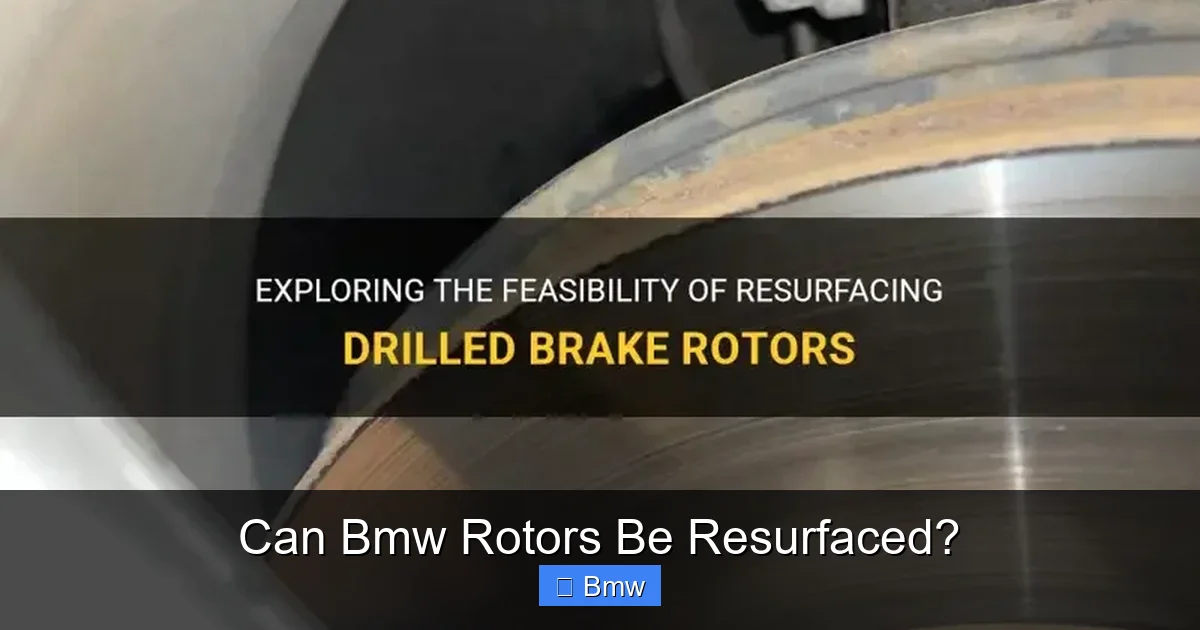
Resurfacing isn’t just a fancy word for sanding. It’s a precise machining process performed on a brake lathe. The rotor is mounted on the machine, and a cutting tool removes a thin layer of material from both friction surfaces. The goal is to create a perfectly flat, smooth, and parallel surface, free from the uneven wear, grooves, or minor warping that causes brake pulsation or noise.
Visual guide about Can Bmw Rotors Be Resurfaced?
Image source: shuntool.com
Steps in a Professional Resurfacing Job
A reputable shop follows a strict procedure. First, the rotor is thoroughly cleaned. Then, it’s mounted on the lathe. The machine spins the rotor while a single-point cutter removes material. A good technician will take a very light cut—often just 0.002 to 0.010 inches (0.05 to 0.25 mm) per pass—to avoid inducing new stress. The total material removed is measured in thousandths of an inch. After machining, the rotor is often cross-hatched with a slight abrasive brush to help new brake pads bed in properly. Finally, it’s measured again at multiple points to confirm even thickness and that the minimum thickness hasn’t been breached.
Tools of the Trade: Lathes and Measurement
You need the right tools. A precision brake lathe is essential. For BMWs, especially those with complex hat designs or wheel speed sensor rings, proper fixturing is key to avoid damaging these components. Measurement is done with micrometers or calipers at the inner and outer edges of the rotor’s braking surface. A “taper” or “thickness variation” beyond a few thousandths of an inch indicates the rotor is too far gone. For the DIY enthusiast, buying a personal brake lathe is a massive, impractical expense. This is almost always a professional job. Speaking of professional tools, when diagnosing the cause of brake issues, technicians often rely on advanced diagnostic scanners. For BMW-specific systems, having access to the best scan tool for BMW and Mercedes is crucial to check for ABS, DSC, or other electronic brake system faults that might mimic or contribute to rotor problems.
BMW’s Official Stance and Model-Specific Considerations
Here’s where things get interesting. BMW’s own technical documentation and recommendations have evolved. For many years, resurfacing rotors was a standard shop practice. Today, the official recommendation from BMW AG for most newer models is to replace, not resurface, the rotors. Why this shift?
Visual guide about Can Bmw Rotors Be Resurfaced?
Image source: vehq.com
Why BMW Leans Toward Replacement
Several factors drive this change. First, modern BMWs are lighter. To reduce unsprung weight, rotors are often made with less initial material. This leaves less “margin” for machining before hitting the minimum thickness. Second, the performance expectations are higher. M cars and even standard models are driven more aggressively. A resurfaced rotor, with its reduced mass, is more susceptible to heat-induced warping (brake pulsation) than a new, full-thickness rotor. Third, warranty and liability concerns. If a resurfaced rotor fails and causes an accident, the liability argument becomes messy. Sticking to new parts is a cleaner, safer policy for the manufacturer.
What About Older BMWs and Non-M Models?
For older BMWs (think E36, E46, early E90 generations), resurfacing is still a very viable and common practice. The rotors were generally thicker from the factory, providing ample material for at least one machining. For non-M models like a 328i or 530i that are used primarily for daily commuting and spirited (but not track) driving, a single resurface within the thickness spec is often perfectly acceptable and a smart economic choice. The key is always the measured thickness. A 2005 BMW 325i with 120,000 miles might have rotors that are 2mm above minimum—perfect for a resurface. A 2020 BMW M340i with 40,000 miles might already be at or below spec due to higher initial wear from more aggressive pad compounds and driving styles.
When Resurfacing Makes Sense: The Cost-Benefit Analysis
Let’s talk numbers, because that’s a huge part of the decision. Assume you need a brake job (pads and rotors) on a standard BMW sedan.
Visual guide about Can Bmw Rotors Be Resurfaced?
Image source: vehq.com
- Option A (Resurface + New Pads): Rotor resurfacing costs ~$40-$80 per rotor at a shop. A set of four is $160-$320. Plus quality brake pads ($150-$300 for a set). Total: ~$310-$620 in parts/labor.
- Option B (New Rotors + New Pads): Economy aftermarket rotors: $60-$100 each. Premium aftermarket or OEM: $120-$250+ each. Set of four: $240-$1000+. Pads: same as above. Total: ~$390-$1300+.
Resurfacing can save you a few hundred dollars. But that savings evaporates if the rotor is too thin. The real benefit is for a rotor that is, say, 1.5mm above minimum thickness. Machining it to a fresh surface gives you a perfectly functional part for a fraction of the cost of new. It’s also a more environmentally friendly choice, reusing existing metal.
The “It Depends” Checklist for Your Specific BMW
Before you decide, you must get answers to these questions:
- What is the actual, measured thickness? This is non-negotiable. You must measure at 4-5 points around the rotor. If any point is at or below minimum, it’s trash.
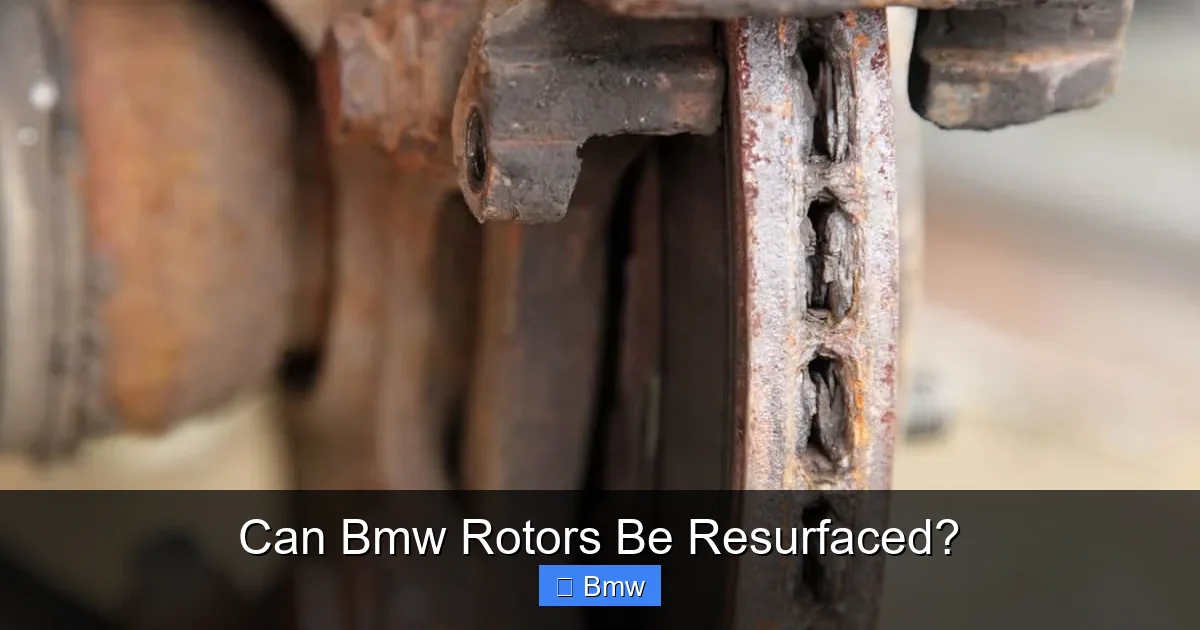
- What is the condition of the surface? Is it just a little grooved and blue from heat? That’s resurfaceable. Are there deep grooves, cracks (especially between drilled holes), significant rust on the braking surface, or hard spots (blue spots that won’t machine evenly)? That’s replacement territory.
- What is the rotor’s history? Has it been resurfaced before? Check for a “turned” stamp or a scribed line on the hat. If it has, it’s likely at or near its limit.
- What is the car’s use case? A daily-driven BMW 320i used for school runs and grocery shopping is a better candidate for resurfacing than an M4 used for occasional track days. Track use generates extreme heat cycles that can leave latent stress in the metal, making a resurfaced rotor more prone to cracking.
- What does BMW say? Always check your owner’s manual or factory service information for your specific chassis code (e.g., F30, G20, G01). For many post-2015 models, BMW explicitly states “replace rotor” in the brake service procedure.
Risks and Limitations: Why Resurfacing Isn’t Always the Answer
Choosing resurfacing when replacement is the correct answer is a recipe for disaster. The risks are real and directly impact your safety.
The Thin Rotor Problem: Heat and Warping
A rotor’s mass is its heat sink. Less metal means it heats up faster and can’t hold as much heat. This leads to “hot spots”—areas of extreme localized heat that cause the brake fluid to boil (leading to spongy pedal) and the rotor to warp dramatically. You’ll get a pulsating brake pedal and shuddering steering wheel. A thin, resurfaced rotor is a warp waiting to happen. This is especially true on heavier BMW SUVs like the X5 or X7, where the braking effort required is greater.
Cracks and Structural Failure
Drilled rotors, common on M models, are prone to developing hairline cracks from the stress of drilling and thermal cycling. These cracks often start at the edge of a hole. Machining the rotor does not remove these cracks; it may even expose them or make them worse. A rotor with a visible crack must be replaced immediately. Continuing to use it risks catastrophic failure where the rotor breaks apart under braking load. This kind of mechanical failure is not just a car problem—it’s a major safety incident. In severe cases, a failure due to neglected critical components like brakes could even be a factor if a car is totaled due to mechanical failure. It’s a risk you cannot take.
The Law of Diminishing Returns
As you machine a rotor, you remove not just the worn surface but also some of the original casting’s dense, stable microstructure. The newly cut surface is fresh, but the remaining metal has been through multiple heating/cooling cycles and now has less mass. Its ability to resist future warping is permanently reduced. A rotor that has been turned once is fine. A rotor that has been turned twice is on borrowed time. Most shops have a policy of only resurfacing once, and many will refuse to machine a rotor that is within 1mm of its minimum spec, anticipating it will be back soon.
The Replacement Alternative: Embracing New Technology
Sometimes, spending the money on new rotors is the wisest, safest, and ultimately most economical choice. Let’s look at why you might choose replacement over resurfacing for your BMW.
When Replacement is the Only Safe Choice
You must replace the rotor if:
- Thickness is at or below the “MIN TH” stamp.
- There are any visible cracks.
- There is severe rust on the braking surface (light surface rust is normal; pitted, flaky rust is not).
- The rotor has a blue, discolored “heat tint” that is uneven or widespread, indicating overheating and potential metallurgical changes.
- The rotor is excessively warped (high runout) that exceeds what can be machined off within the thickness limit.
- Your BMW is a newer model where the factory service bulletin mandates replacement.
- You are performing a track day or high-performance driving. New, thicker rotors are a must for endurance and safety.
OEM vs. Aftermarket: What’s Best for Your BMW?
If you decide to replace, you have choices.
- OEM (Original Equipment Manufacturer): This is the exact rotor BMW put on the car when it was built. It guarantees perfect fitment, material quality, and performance. It’s the gold standard, especially for M models and newer cars. The downside is cost—it’s usually the most expensive option.
- Premium Aftermarket (e.g., Brembo, Akebono, StopTech): These companies often use superior materials and designs. Some even exceed OEM specifications (e.g., better metallurgy, improved venting). You can get excellent performance and sometimes better value. Research is key; stick with reputable brands known for BMW applications.
- Standard Aftermarket: The budget option. Quality can vary wildly. For a daily driver with low stress, a good quality standard rotor can be fine, but it may not dissipate heat as well or last as long as OEM or premium brands.
For a BMW, my general advice is: if the car is under warranty or is a recent model, go OEM. If it’s an older daily driver, a premium aftermarket rotor from a brand like Brembo is an excellent, often more affordable, high-performance alternative. Never cheap out on brakes.
The DIY Question: Can You Resurface BMW Rotors Yourself?
Technically, yes, if you have the space, the $2,000+ for a dedicated on-car brake lathe, and the skill to use it. Practically, for 99.9% of people, no. The tools are expensive, the process is messy (grinding metal creates fine dust), and the risk of ruining a rotor or doing an uneven job is high. A poorly resurfaced rotor is worse than a worn one because it introduces new vibration and uneven wear. The value of a professional’s time and precision equipment is worth every penny for this job. Your safety is not the place to save a few bucks on tool rental.
Conclusion: The Smart, Safe Path for Your BMW’s Brakes
So, can BMW rotors be resurfaced? The definitive answer is: only if they pass a rigorous thickness and condition inspection and your specific model/year’s guidelines allow for it. For older, non-M BMWs with ample rotor material, a single resurfacing paired with new pads is a perfectly sensible, cost-effective maintenance procedure. For newer BMWs, M models, or any rotor that is thin, cracked, or severely damaged, replacement is the only correct answer.
The process is simple in theory but critical in practice. Get the rotors measured by a qualified technician—preferably one familiar with BMWs. Ask to see the measurements. Ask to see the old rotors. If they suggest replacement because of thickness or damage, trust them. Brakes are your primary safety system. The few hundred dollars you might save by resurfacing a borderline rotor is not worth the risk of brake fade, pulsation, or, worst-case, failure. Invest in fresh, quality rotors and pads, and your BMW will continue to deliver that legendary driving confidence—and stopping power—for miles to come. Remember, maintaining your car’s health extends beyond just the brakes; regular checks on everything from where your car might be leaking oil from to tire wear are all part of being a responsible owner. When in doubt, replace.
Frequently Asked Questions
How thin is too thin for a BMW rotor to be resurfaced?
Too thin is any measurement at or below the “MIN TH” (minimum thickness) stamp on the rotor’s edge. This specification is unique to each BMW model and year. Machining a rotor below this limit is unsafe and illegal in many jurisdictions, as it compromises heat dissipation and structural strength.
Is resurfacing BMW rotors really cheaper than replacing them?
Yes, typically. Resurfacing a set of four rotors usually costs between $160 and $320 in labor. A set of new economy aftermarket rotors starts around $240, while OEM rotors can be $800-$1200+. So resurfacing saves money, but only if the rotor is thick enough to be safely machined. If it’s too thin, you’re paying for a temporary fix that requires immediate replacement anyway.
Can I resurface my BMW rotors myself at home?
While possible with an expensive on-car brake lathe and mechanical skill, it is not recommended for DIY. The process requires precision to avoid creating a tapered or uneven surface, which will cause worse brake pulsation. The cost of proper tools and the high risk of error make professional service the only practical and safe choice for virtually all owners.
How often can BMW rotors be resurfaced?
Generally, only once. Each machining removes a finite amount of material (typically 0.020″ to 0.040″). After one resurface, the rotor is significantly closer to its minimum thickness. A second machining almost always pushes it below the safe limit, making replacement mandatory. Some shops will refuse to machine a rotor that has already been turned.
What are the clear signs my BMW rotors need attention, not just new pads?
Key signs include: a pulsating brake pedal or shuddering steering wheel when braking (indicating warping); a high-pitched squeal or grinding noise (could be worn pads or rotor grooves); visible deep grooves or scoring on the rotor surface; blue discoloration from overheating; and a brake pedal that feels soft or sinks to the floor (could indicate severely overheated rotors boiling the brake fluid).
Will resurfacing my BMW rotors void my warranty?
It potentially can, especially on a newer car under a factory or extended warranty. BMW’s warranty requires the use of genuine or approved parts and adherence to factory maintenance procedures. If a warranty claim arises related to the braking system and non-OEM, resurfaced rotors are found, the claim could be denied. Always check your warranty booklet and discuss with your dealer before modifying critical safety components.
