
Arkansas Window Tint Law Guide

Arkansas window tint law sets specific Visible Light Transmission (VLT) limits for different windows, with stricter rules for the front windshield and front sides. Non-compliance can lead to fines, mandatory tint removal, and even traffic stops. Understanding these regulations is crucial for all vehicle owners, including BMW drivers who often opt for factory or aftermarket tint for style and comfort.
Let’s talk about something practically every Arkansan thinks about when the summer heat and humidity hit: window tint. That deep, dark shade on a sedan or SUV feels like a miracle for keeping the cabin cool, protecting your skin from harsh UV rays, and adding a touch of sleek, private style. But before you hand over your keys—or your BMW—to the first tint shop you find, you need to know the rules. The Arkansas window tint law isn’t just a suggestion; it’s a legal framework with specific measurements and serious consequences for breaking it. This guide will walk you through everything, from the exact percentage of light your windows must let in to what happens if you’re caught with tint that’s too dark. We’ll even touch on special considerations for luxury brands like BMW, where factory tint and owner preferences often collide with state regulations.
Key Takeaways
- VLT Limits Are Strict: Arkansas law mandates a minimum of 25% VLT (allowing 25% of light in) for the front side windows and windshield, while rear and back side windows must allow over 10% of light.
- Front Windshield Rules Are Unique: Only a non-reflective tint strip at the very top (above the AS-1 line) is permitted on the front windshield; the rest must remain clear.
- Medical Exemptions Exist: A physician’s statement can exempt a vehicle from standard VLT limits for documented medical conditions like photosensitivity.
- Penalties Are Enforced: Violations are typically a primary offense, resulting in fines (often $100-$250) and a court-ordered order to remove illegal tint.
- Factory Tint Is Regulated: Even your vehicle’s original factory tint must meet Arkansas’s minimum 25% VLT requirement for front windows; many European imports like BMWs may need adjustment.
- Professional Installation Is Key: To ensure compliance and avoid costly fixes, always have tint installed by a certified professional who understands Arkansas state law.
- Enforcement Is Active: Law enforcement uses tint meters during routine traffic stops, so assume your vehicle will be checked if pulled over for any reason.
📑 Table of Contents
- Understanding the Core of Arkansas Tint Law: VLT Percentages
- Medical Exemptions: When the Law Makes an Exception
- Enforcement, Penalties, and What to Expect During a Traffic Stop
- Professional Installation vs. DIY: Why Expertise Matters
- Special Considerations for BMW Owners and Factory Tint
- Comparing Arkansas to Neighboring States: A Quick Glance
- Conclusion: A Clear View on Compliance
Understanding the Core of Arkansas Tint Law: VLT Percentages
At the heart of every state’s window tint regulation is VLT, or Visible Light Transmission. Simply put, VLT is the percentage of visible light that passes through your car’s glass. A 100% VLT means completely clear glass. A 5% VLT means only 5% of light gets through, making it extremely dark from the outside. The Arkansas window tint law sets different VLT thresholds for different windows on your vehicle. It’s critical to understand these distinctions because a percentage that’s perfectly legal for your back window can get you a ticket on your front driver and passenger windows.
Front Side Windows and Windshield: The Strictest Rules
For the front side windows (the driver and front passenger windows) and the windshield, Arkansas maintains the most conservative standards. The law states that these windows must allow a minimum of 25% of visible light to pass through. This means the tint on these windows cannot be darker than a 25% VLT. In practical terms, a 25% tint is quite dark—it significantly reduces glare and heat but still allows for reasonable visibility from inside the car at night and for law enforcement to see inside during a stop. Many tint shops will recommend a 35% or even 50% tint for the front to stay comfortably within the legal limit and avoid any meter-reading errors.
The windshield has an even more specific rule. Tinting the entire windshield to a 25% VLT is not allowed. Instead, you are permitted a non-reflective tint strip along the very top of the windshield. This strip must be located above the manufacturer’s AS-1 line (a marking etched into the glass, usually near the sun visor). This strip is designed to block glare from the sun for the driver without obstructing the view through the main portion of the windshield. Anything beyond that narrow top band on the windshield is illegal.
Rear Side Windows and Back Windshield: More Flexibility
Here’s where you have more freedom. The Arkansas window tint law requires that the rear side windows (behind the driver and front passenger) and the back windshield must allow a minimum of 10% of visible light to pass through. This is significantly darker than the front side requirement. A 10% VLT is very dark, often called “limo tint.” It provides maximum privacy, heat rejection, and UV protection. For many SUV, truck, and minivan owners, this is the preferred level for the rear passenger and cargo areas. For a sedan like a BMW 3 Series or 5 Series, applying a 10% tint to the rear window and back glass is completely legal and a popular choice.
The Critical Role of the AS-1 Line
You’ll hear this term a lot when discussing windshield tint. The AS-1 line is a permanent marking, usually a series of letters and numbers, etched into the corner of your windshield by the manufacturer. It indicates the maximum height for a visor and, by extension, the highest point where any non-reflective tint strip is legally allowed. Your tint installer must know where this line is and install the top strip accordingly. A strip that extends below the AS-1 line, even by an inch, is a violation of the Arkansas window tint law and is one of the most common reasons for a fix-it ticket.
Medical Exemptions: When the Law Makes an Exception
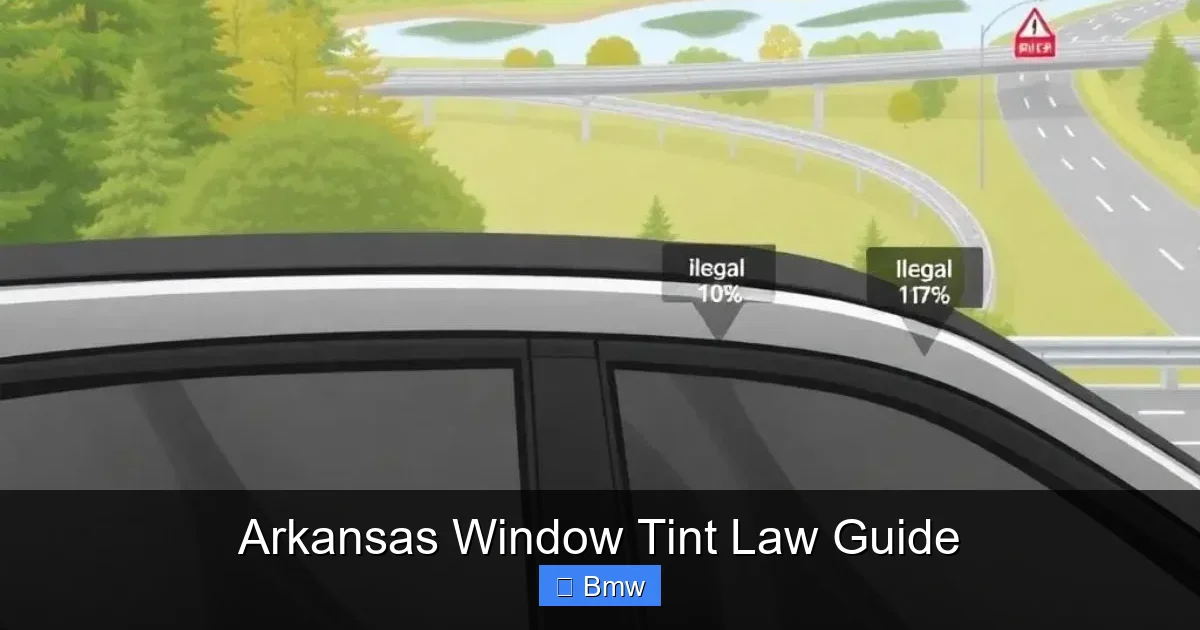
The Arkansas window tint law recognizes that certain medical conditions can make exposure to sunlight dangerous. Conditions like lupus, porphyria, xeroderma pigmentosum, and severe photosensitivity reactions can qualify a vehicle owner for an exemption from the standard VLT limits. This is not a free pass for darker tint; it’s a formal process.
Visual guide about Arkansas Window Tint Law Guide
Image source: thepracticlelaw.com
How to Qualify for a Medical Exemption
To obtain a medical exemption, you must provide a notarized statement from a licensed physician (MD or DO) practicing in Arkansas. The statement must clearly diagnose your condition and explicitly state that the use of a motor vehicle with window tint darker than the legal limit is medically necessary for your health and safety. There is no specific state-issued “permit” or sticker for the windshield. Instead, you must carry this physician’s statement with you in the vehicle at all times. If stopped, you are required to present it to the law enforcement officer. The burden of proof is on you, the driver. It’s important to note that this exemption applies to the vehicle you primarily use and is not transferable to other vehicles you might drive.
Enforcement, Penalties, and What to Expect During a Traffic Stop
Knowing the law is one thing; understanding how it’s enforced is another. In Arkansas, window tint violations are generally considered a “primary offense.” This means a police officer can pull you over solely if they suspect your tint is too dark. They don’t need another reason, like a broken taillight. This is a key point—your tint is a visible, easily checked compliance issue.
Visual guide about Arkansas Window Tint Law Guide
Image source: windowtintlaws.us
The Tint Meter: The Final Authority
When an officer suspects illegal tint, they will use a handheld device called a tint meter or photometer. This device is placed on the inside of your window and emits a light beam, measuring exactly how much light passes through the glass and the tint film. The reading it gives is the VLT percentage. This meter reading is considered objective evidence. If your front window reads 20% VLT in a state that requires 25%, that’s a violation, regardless of what the tint shop told you or what the film’s roll labeled. Professional shops use these same meters to ensure their work is legal before you drive off.
Consequences of a Violation
The typical penalty for a first-time Arkansas window tint law violation is a fine, which can vary by county and municipality but often falls in the $100 to $250 range. More importantly, the court will issue an “Order to Correct Violation” or a “Fix-It Ticket.” This is not something you can just pay and forget. You must have the illegal tint removed or replaced with a compliant film and then have a law enforcement officer or a licensed inspection station sign off that the correction has been made. You must then present that proof to the court. Failure to correct the violation can lead to additional fines, a suspended driver’s license, or a warrant for your arrest. For commercial vehicles, the penalties can be more severe, affecting company licensing.
Professional Installation vs. DIY: Why Expertise Matters
The allure of saving money with a do-it-yourself (DIY) window tint kit is strong. You can find precut kits online for a fraction of professional installation costs. However, when it comes to complying with the Arkansas window tint law, DIY is a high-risk gamble. Here’s why hiring a certified professional is almost always the smarter, more economical long-term choice.
Visual guide about Arkansas Window Tint Law Guide
Image source: windowtintlaws.us
The Precision of Measurement and Application
A professional installer doesn’t just slap film on glass. They meticulously measure each window, often using computer-cut patterns for perfect fitment. They understand the nuances of different vehicle curves—the complex arch of a BMW i4’s rear window, the slight dip in a Ford F-150’s front glass. A poor DIY application leads to bubbles, creases, peeling edges, and improper sealing. Not only does this look terrible, but it can also impair visibility and cause the film to fail prematurely. Furthermore, reputable shops own calibrated tint meters and will test their work on your car before you leave to guarantee it meets the 25% or 10% thresholds required by Arkansas law.
Warranty and Legality
Professional installations come with warranties—often 5 years to lifetime—against bubbling, fading, and peeling. A DIY kit offers no such guarantee; if it fails, you’re on your own. More critically, a professional shop assumes liability for the legality of their work. If you get a ticket for tint they installed incorrectly, a reputable business will often correct it at no charge to protect their reputation. A DIY error means you pay twice: once for the kit and again for the removal, a professional re-tint, and the ticket fine. For a luxury brand like BMW, where resale value and pristine condition are paramount, a flawless, legal professional installation is an investment in your vehicle’s future.
Special Considerations for BMW Owners and Factory Tint
This is a crucial section for anyone driving a BMW in Arkansas. Many modern BMWs, especially models from the 3 Series, 5 Series, X3, X5, and above, come from the factory with what’s called “privacy glass” or “factory tint.” This is not a film applied on top of the glass; the glass itself is manufactured with a slight tint, usually around 20% VLT for the rear windows and sometimes a bit darker. It’s permanent and integrated.
Is Factory Tint Legal in Arkansas?
Here’s the critical distinction: factory tint is still subject to Arkansas state law. If your BMW’s factory-installed rear glass measures 15% VLT, that’s perfectly legal under the 10% minimum rule. However, if your BMW model year has factory front side windows tinted to 20% VLT (some European-market models do), that is illegal in Arkansas, which requires a minimum of 25% VLT for the front. You cannot “remove” factory tint; it’s the glass. This creates a compliance issue for the owner. The solution is to replace the front side glass with clear glass (a costly process) or, more commonly, to apply a clear or very light (e.g., 70% VLT) ceramic film over the factory tint. This clear film does not significantly change the appearance but adds UV protection and heat rejection. It does not, however, make the illegal 20% VLT legal; it remains a violation. Therefore, BMW owners must first verify the actual VLT of their factory glass using a tint meter before assuming they are compliant.
Aftermarket Tint on a BMW
When adding aftermarket tint to a BMW, the same Arkansas rules apply. You must ensure the combined VLT of factory glass plus aftermarket film meets the 25% front / 10% rear minimums. A reputable tint shop will measure your BMW’s factory glass first and recommend a film percentage that results in a legal final VLT. For example, if your 2023 BMW X5’s factory rear glass is 15% VLT, you could legally apply a 35% VLT film over it (resulting in a combined VLT darker than 10%, but the law measures the final light transmission, so the shop must calculate the combined effect). This is complex math best left to professionals.
Comparing Arkansas to Neighboring States: A Quick Glance
Laws change when you cross state lines. If you frequently drive your tinted vehicle to Texas, Tennessee, Mississippi, Louisiana, Missouri, or Oklahoma, you must be aware that their tint laws differ. For instance, Texas also has a 25% front VLT rule but requires only 25% for the rear on passenger cars (Arkansas is 10%). Tennessee is 35% front and 30% rear. Oklahoma is 25% front and 25% rear. This means your legally tinted Arkansas car could be illegal in Oklahoma if your rear windows are at 10%. While you are primarily subject to Arkansas law while registered and garaged there, if you are stopped in another state, you are subject to that state’s laws. You could receive a ticket there. This is a major reason many drivers in border regions opt for a more conservative tint (like 35% all around) to remain legal across multiple jurisdictions. For a complete comparison, you can reference our comprehensive Window Tint Laws By State Updated 2026 guide.
Conclusion: A Clear View on Compliance
The Arkansas window tint law is straightforward in its percentages but carries real weight in its enforcement. The core message is simple: 25% minimum VLT for front side windows and windshield (with a top strip only), and 10% minimum for the rear. Medical exemptions are available but require documented proof. Penalties for non-compliance are not just a slap on the wrist; they involve fines, mandatory correction, and the hassle of court. For BMW owners and all drivers, the path to enjoying tint’s benefits without legal trouble is clear: know your vehicle’s factory VLT, hire a certified professional installer who uses a tint meter, and get written confirmation that your final installation meets Arkansas’s specific legal limits. Don’t guess, don’t rely on a shop’s word alone. Verify it. A small investment in professional, legal tint saves you from significant cost, inconvenience, and a permanent mark on your driving record. Stay cool, stay private, and most importantly, stay legal on Arkansas roads.
Frequently Asked Questions
Can I have 5% limo tint on my front windows in Arkansas?
No. Arkansas law explicitly requires front side windows to allow at least 25% of light in. A 5% tint is far darker than the legal limit and will result in a ticket if measured by law enforcement.
What is the fine for a window tint ticket in Arkansas?
Fines vary by city and county but typically range from $100 to $250 for a first offense. More significantly, you will receive a court order to remove or replace the illegal tint, which adds cost and inconvenience.
Are medical exemptions for window tint permanent?
The exemption is tied to your medical condition and the physician’s statement. There is no set expiration, but the statement should be current. You must carry the notarized physician’s document with you in the vehicle at all times when driving with illegal tint levels.
Does the tint law apply to the front windshield?
Yes, but very specifically. You may apply a non-reflective tint strip at the very top, above the AS-1 line. Tinting any other part of the front windshield, or using a reflective/metallic tint on the strip, is illegal.
I bought a used car with dark tint. Am I responsible?
Yes. As the registered owner and driver, you are responsible for ensuring your vehicle complies with Arkansas law. You will be cited for illegal tint regardless of who installed it. You should have the tint measured and corrected immediately.
How long does a professional window tint installation take?
A full-car installation by a professional typically takes 1 to 3 hours, depending on the vehicle’s size and window complexity. The film then needs 24-72 hours to cure fully before windows should be rolled down.
