
What Kind of Oil Does a 2007 Toyota Tacoma 4.0 Take?

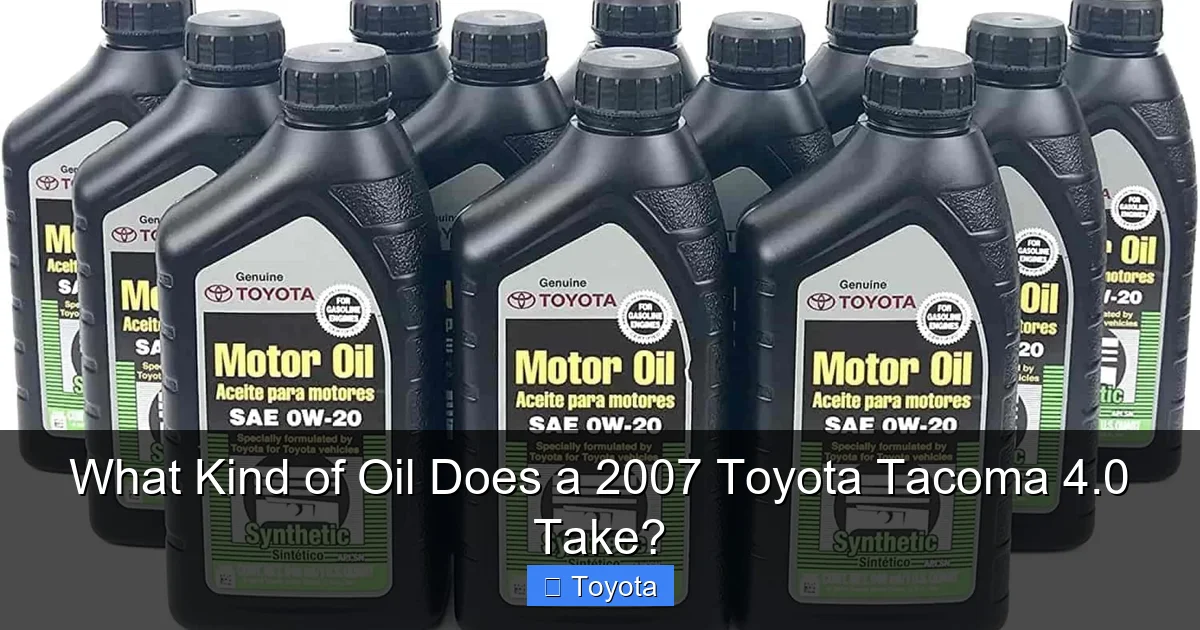
Your 2007 Toyota Tacoma with the 4.0-liter V6 engine requires 0W-20 synthetic oil meeting Toyota’s specification and the ILSAC GF-5 standard. The total capacity is approximately 6.1 quarts (5.8 liters) with a filter change. Using the correct oil is critical for the VVT-i system, fuel economy, and engine longevity. Always check your owner’s manual for the most precise information and adhere to the recommended service intervals.
So, you’re the proud owner of a 2007 Toyota Tacoma with the legendary 4.0-liter V6 engine. You know it’s a workhorse, a truck built to last that can tackle both daily commutes and off-road adventures with ease. But to keep that robust engine purring for another 200,000 miles, you’ve got to feed it the right stuff. And by “stuff,” we mean the lifeblood of your engine: oil. The question “What kind of oil does a 2007 Toyota Tacoma 4.0 take?” isn’t just trivia—it’s the single most important piece of maintenance knowledge you can have. Get it wrong, and you’re risking expensive repairs. Get it right, and your Tacoma’s 1GR-FE V6 will reward you with unwavering reliability. Let’s break down everything you need to know, in plain English.
Key Takeaways
- Mandatory Oil Type: The 2007 Tacoma 4.0L V6 requires 0W-20 full synthetic oil that meets Toyota’s specification (often labeled as “Toyota Genuine Motor Oil” or meeting ILSAC GF-5).
- Viscosity is Non-Negotiable: The “0W-20” rating is specifically engineered for the engine’s VVT-i (Variable Valve Timing with intelligence) system; using a different weight can cause performance and damage issues.
- Synthetic is Required: Unlike older models, the 2007 4.0L is designed for synthetic oil from the start. Conventional oils will not provide the required protection and can void warranty coverage.
- Exact Capacity: The engine holds about 6.1 quarts (5.8 liters) of oil when replacing the filter. Always fill to the “Full” mark on the dipstick, not by a fixed quart count.
- Filter Matters: Use a high-quality filter compatible with the 0W-20 oil. A poorly made filter can allow contaminants to bypass, negating the benefits of synthetic oil.
- Service Interval: Under normal driving conditions, change the oil and filter every 5,000 miles or 6 months. Severe conditions (towing, dusty environments, extreme temps) may require more frequent changes.
- What to Avoid: Never use 5W-30, 10W-30, or “high mileage” 0W-20 oils not specifically approved by Toyota. Stick to API SN or newer and ILSAC GF-5 certified oils.
📑 Table of Contents
The Official Word: What Toyota Says
First things first, let’s go straight to the source. Your 2007 Tacoma’s owner’s manual is the bible for this information. For the 4.0-liter V6 (engine code 1GR-FE), Toyota specifies:
- Oil Type: Toyota Genuine Motor Oil or an equivalent meeting Toyota’s specification.
- Viscosity Grade: 0W-20.
- API & ILSAC Certification: Must meet the latest API service classification (at the time, SN; today, SP is the current standard and is backward compatible) and the ILSAC GF-5 standard.
That “0W-20” is the magic number. The “0W” refers to the oil’s winter viscosity—how easily it flows in cold starts. A “0W” oil flows faster at startup than a “5W” or “10W,” meaning it reaches critical engine components quicker, reducing wear during the most damaging period of an engine’s life: cold start. The “20” is the high-temperature viscosity, indicating the oil’s thickness at operating temperature. For the 2007 Tacoma 4.0L, this specific thin-at-hot blend is engineered for its advanced variable valve timing system and to help meet federal fuel economy standards.
It’s crucial to understand that this isn’t a suggestion. The 4.0L V6 in your 2007 Tacoma is not the same as the 2.7L I4, and it’s certainly not the same as a Tacoma from 1995. The 2007 model year was part of the second generation (2005-2015), and for the V6, Toyota made a significant switch to 0W-20. If you’re coming from an older Tacoma or a different Toyota model, you cannot assume the oil is the same. For a broader look at Tacoma oil specifications across years, you can explore resources that detail what kind of oil does a Toyota Tacoma take in general.
Why 0W-20? The Engineering Behind the Spec
You might be thinking, “Thinner oil? Isn’t that less protective?” In modern engines, the opposite is often true. The 4.0L V6 in your Tacoma features Toyota’s VVT-i (Variable Valve Timing with intelligence) system. This system uses hydraulic pressure, regulated by engine oil, to continuously adjust camshaft timing. The passages and actuators in this system are incredibly precise and tight.
A thicker oil, like 5W-30, is too viscous at cold temperatures and can flow too slowly into these tiny passages. This can cause delayed or inconsistent VVT-i operation, leading to poor performance, reduced fuel economy, and potentially triggering check engine lights (like P0010, P0011, P0012 codes). Over time, it can cause excessive wear on the VVT-i components. The 0W-20 flows like a “0W” oil should in the cold but maintains the perfect “20” weight film strength at high temperatures to protect bearings and piston rings. It’s a carefully balanced formula designed specifically for the engine’s tolerances and the emissions/fuel economy targets of its era.
Synthetic vs. Conventional: There Is No Debate
When the 2007 Tacoma 4.0L was designed, Toyota’s engineers specified full synthetic oil. This is not a case where conventional oil is “okay.” The reasons are multifaceted:
Visual guide about What Kind of Oil Does a 2007 Toyota Tacoma 4.0 Take?
Image source: automotivian.com
- Better Temperature Range: Synthetic base oils have a naturally wider operating temperature range. They resist thinning out (shearing) at high heat better and flow more freely at extreme cold.
- Superior Deposit Control: Synthetics are more resistant to thermal breakdown and sludge formation, keeping the intricate VVT-i passages and oil galleries cleaner.
- Longer Drain Intervals: While we still recommend sticking to the 5,000-mile/6-month interval for a truck that might see mixed use, synthetics are inherently more stable and could, in theory, last longer. The additive packages in high-quality synthetics also last longer.
- Additive Package: The ILSAC GF-5 specification, which 0W-20 oils must meet, mandates specific friction-reducing additives (like molybdenum) to improve fuel economy. These additives are formulated into a synthetic base oil.
Using conventional oil in this engine is a significant step down in protection. It may meet the 0W-20 viscosity rating when new, but it will break down faster, form more sludge, and offer less wear protection, especially under the high-stress conditions a Tacoma often endures (towing, idling, off-road). For optimal engine health and longevity, full synthetic is the only correct choice.
Understanding Oil Certifications: API SN/SP and ILSAC GF-5
You’ll see these labels on every reputable oil bottle. They aren’t just marketing fluff; they are standardized performance tests.
API (American Petroleum Institute) sets the baseline for engine oil performance. “SN” was the standard for 2010-2020 vehicles. The newer “SP” is the current standard and is backward compatible, meaning an SP oil is perfectly suitable and superior for your 2007 Tacoma. Look for the API “donut” symbol.
ILSAC (International Lubricants Standardization and Approval Committee) is a joint effort of U.S. and Japanese automakers. The “GF-5” standard is specifically for modern gasoline engines requiring fuel economy oils. It includes rigorous tests for sludge prevention, fuel economy retention, and compatibility with emission systems. For your 2007 Tacoma 4.0L, an oil that meets both API SN/SP and ILSAC GF-5 is the gold standard. Toyota’s own genuine motor oil is formulated to exceed these standards.
Oil Capacity and the All-Important Filter
Knowing the right oil is only half the battle. You also need to know how much to put in and what filter to use.
Visual guide about What Kind of Oil Does a 2007 Toyota Tacoma 4.0 Take?
Image source: tailoredtrucks.com
Exact Capacity: It’s Approximate
The 2007 Tacoma 4.0L V6 has a total oil capacity of approximately 6.1 quarts (5.8 liters) when replacing the oil filter. If you’re just doing a top-off, obviously you add less. But for a full change, start with 5.5 quarts, replace the filter, then slowly add more oil while checking the dipstick. The dipstick has a “Full” and “Add” mark. You want the oil level to be at the very bottom of the “Full” mark when the engine is warm and level. Never overfill. Overfilling by even a quart can cause aeration (foaming), leading to loss of oil pressure and potential catastrophic damage.
Choosing the Right Oil Filter
The filter is your engine’s kidney. A cheap, poorly constructed filter can allow particles larger than 20 microns to circulate, causing abrasive wear. For a 2007 Tacoma, you have excellent original equipment (OE) and aftermarket options.
- OEM (Toyota Genuine): Part number 90915-YZZF1. This is what the dealership installs. It’s designed specifically for the engine and uses high-quality filter media.
- Top-Tier Aftermarket: Brands like Mobil 1 (M1-110A), WIX XP (51056), Purolator PureOne (PL14610), and Fram Titanium (XT1145) are all excellent choices that meet or exceed OEM specs. Ensure the filter is rated for use with 0W-20 synthetic oils.
When in doubt, consult a parts professional at an auto store or dealership, referencing your 2007 Tacoma 4.0L. Using the wrong filter (e.g., one with a different anti-drain back valve or incorrect thread) can be just as bad as using the wrong oil.
Maintenance Schedule: When to Change
Your 2007 Tacoma’s maintenance minder system will alert you, but it’s based on a complex algorithm of mileage, engine runtime, and driving conditions. As a rule of thumb:

Visual guide about What Kind of Oil Does a 2007 Toyota Tacoma 4.0 Take?
Image source: tailoredtrucks.com
- Normal Driving: Every 5,000 miles or 6 months, whichever comes first. “Normal” means mostly highway driving, moderate temperatures, and no severe loads.
- Severe Driving: Every 3,000-4,000 miles or 4 months. Toyota defines “severe” as: frequent short trips (under 10 minutes), driving in extremely cold or hot climates, extensive idling, driving in dusty conditions, towing a trailer, or aggressive driving.
Given the Tacoma’s reputation as a rugged truck, many owners use it for towing, hauling, or off-roading. If that’s you, err on the side of caution and change the oil more frequently. The cost of an extra oil change is trivial compared to an engine rebuild. Also, always replace the oil filter with every oil change. It’s cheap insurance.
If you’re unsure about your driving conditions or want a more precise guide for your specific model year, looking at maintenance schedules for similar Toyotas, like the Toyota Camry, can provide a good benchmark for Toyota’s general recommendations, though always defer to your Tacoma’s manual first.
Resetting the Maintenance Minder
After changing the oil yourself, you must reset the maintenance minder system. Here’s the simple procedure:
- Turn the ignition to “ON” (do not start the engine).
- Ensure the odometer is displaying the regular mileage (not trip A or B).
- Turn the ignition “OFF.”
- Press and hold the trip/odometer reset button.
- While holding the button, turn the ignition back to “ON.”
- Continue holding the button until the display blinks and then shows “000000” or the maintenance light goes off. This may take 5-10 seconds.
- Release the button. The system is reset.
Common Mistakes and Misconceptions
Even with the specs in hand, Tacoma owners can make some classic errors. Let’s clear them up.
“Can I Use 5W-30? It’s What I’ve Always Used.”
This is the most frequent and potentially damaging mistake. The 2007 4.0L V6 was not designed for 5W-30. While it might “run,” you are compromising VVT-i performance, fuel economy, and long-term durability. The engine’s tolerances and hydraulic circuits are calibrated for 0W-20. Stick to the spec. This is not a matter of opinion; it’s engineering.
“What About High-Mileage 0W-20?”
High-mileage oils contain seal conditioners and additives designed for engines with significant wear (typically over 75,000 miles). If your 2007 Tacoma has over 150,000 miles and is beginning to consume a small amount of oil (say, a quart every 1,500-2,000 miles), a high-mileage 0W-20 that meets Toyota’s specs could help. However, for a well-maintained engine with no consumption issues, standard 0W-20 is perfectly fine. The key is that any oil you use must still be 0W-20 and meet the required certifications.
“Does It Matter What Brand?”
As long as the brand’s 0W-20 product is certified to API SP/SN and ILSAC GF-5 (or Toyota’s own specification), you are safe. Major brands like Mobil 1, Castrol EDGE, Pennzoil Platinum, Valvoline SynPower, and Toyota Genuine all meet these standards. Choose based on price, availability, and personal preference. For a truck that might see harsh conditions, a reputable brand with a strong reputation in the synthetic market is a good bet.
Mixing Oils and Topping Off
In a pinch, topping off with a different brand of 0W-20 synthetic that meets the same specs is acceptable. However, try to avoid mixing different viscosities (e.g., 0W-20 with 5W-30). For a full change, always drain and refill completely. If you accidentally add a quart of the wrong oil, don’t panic. Change it at the next oil change, but do not continue to drive on a mixture for extended periods.
Practical Tips for DIYers and Shop Visits
Whether you’re changing the oil yourself or talking to a technician at a quick-lube shop, knowledge is power.
For the DIY Enthusiast
You’ll need: 6.1 quarts of your chosen 0W-20 synthetic, a new oil filter (correct part number), a new drain plug washer (crush washer), a drain pan, wrenches (usually 14mm for the drain plug, special socket for filter), and gloves. Warm the engine slightly (2-3 minutes) to thin the oil for better drainage, but be careful—oil will be hot! Drain the oil, replace the drain plug with a new washer, remove the old filter (catch the spill), prime the new filter with a little fresh oil, install it hand-tight plus 3/4 turn, and then fill with oil. Check for leaks after starting. This process is similar for many Toyota models; for instance, the procedure for a 2010 Toyota Corolla involves the same principles of using the correct viscosity and capacity, though the engine is vastly different.
Talking to a Technician or Quick-Lube Shop
Be explicit. Say: “I need 6.1 quarts of 0W-20 full synthetic oil that meets API SP and ILSAC GF-5 specifications. Please use a filter that is appropriate for this engine, like a Toyota 90915-YZZF1 or a WIX 51056.” Do not say, “Just do the usual Tacoma oil change.” Many generic lists at quick-lube shops incorrectly list 5W-30 for all Tacomas. Verify the oil viscosity on the receipt before they start the work. It’s your truck; you are responsible for specifying the correct lubricant.
Conclusion: Protecting Your Investment
Your 2007 Toyota Tacoma 4.0L is more than a vehicle; it’s an investment in capability and reliability. The simple act of using the correct 0W-20 full synthetic oil is one of the most effective, cost-efficient things you can do to protect that investment. It ensures the sophisticated VVT-i system functions perfectly, maximizes your fuel economy, prevents sludge, and provides the best possible wear protection for the 1GR-FE engine’s bearings and cylinders. Ignoring this specification is a false economy that can lead to thousands in repairs. By following the guidelines in your owner’s manual—using the right oil, in the right amount, with the right filter, at the right intervals—you are giving your Tacoma the best chance to reach and surpass 300,000 miles of faithful service. It’s a small price to pay for monumental peace of mind.
Frequently Asked Questions
Can I use 5W-30 oil in my 2007 Toyota Tacoma 4.0L if I can’t find 0W-20?
No, you should not. The 4.0L V6 engine is specifically engineered for 0W-20. Using 5W-30 can cause improper VVT-i operation, reduce fuel economy, and potentially cause long-term engine wear. Always use the specified 0W-20.
Is Toyota Genuine Motor Oil really better than brands like Mobil 1 or Castrol?
Toyota Genuine Oil is an excellent, high-quality oil formulated to meet or exceed the specific demands of Toyota engines. However, major brands like Mobil 1, Castrol, and Pennzoil also produce top-tier 0W-20 synthetics that meet the same API SP and ILSAC GF-5 certifications. You can confidently use any major brand that meets these specifications.
How do I reset the oil maintenance light after changing the oil myself?
Turn the ignition to “ON” (do not start). Ensure the odometer displays total miles. Turn the ignition “OFF,” then press and hold the trip/odometer reset button. While holding it, turn the ignition back to “ON.” Continue holding until the display blinks and resets to “000000” or the light goes off (about 5-10 seconds). Release the button.
My Tacoma has 180,000 miles. Should I switch to a high-mileage 0W-20 oil?
If your engine is not burning or leaking oil excessively, standard 0W-20 is still appropriate. High-mileage oils with seal conditioners are beneficial if you notice a small, consistent oil consumption (like a quart per 1,500-2,000 miles) or if seals are drying out. They can help reduce minor leaks and consumption.
Is this the same oil for the 4.0L Tacoma as for a 4-cylinder or a different year?
No. The 2.7L 4-cylinder in the same year often takes 5W-30. The oil specification changed for the 4.0L V6 starting with the 2006 model year. Always check your specific model year and engine size. For example, the oil for a 2008 Toyota Camry is different, as that platform uses different engines with different requirements.
Can I add oil additives to the 0W-20 for extra protection?
Generally, no. Modern synthetic oils like 0W-20 contain a highly sophisticated and balanced additive package. Adding aftermarket additives can disrupt this chemistry, potentially harming emission systems (like the catalytic converter) or causing other issues. The best additive is a high-quality oil changed on schedule.
