
Can You Use Regular Gas in Infiniti Qx80

No, you should not regularly use regular 87-octane gasoline in an Infiniti QX80. Infiniti specifically recommends premium fuel (91-octane or higher) for this luxury SUV’s powerful 5.6L V8 engine. Using lower-octane regular gas can cause engine knock, reduce performance and fuel economy, and potentially lead to long-term engine damage. While the vehicle’s computer can temporarily adjust to prevent severe damage, consistently using regular gas voids your warranty and compromises the QX80’s smooth, powerful driving experience. Always consult your owner’s manual and use the fuel grade specified by the manufacturer.
Key Takeaways
- Premium Fuel is Mandatory: Infiniti explicitly states that the QX80’s 5.6L V8 engine requires premium unleaded gasoline (91-octane AKI or higher) for proper operation and to meet warranty requirements.
- Risk of Engine Knock: Using 87-octane regular gas can cause damaging “engine knock” or “detonation,” especially under load (like accelerating or climbing hills). The engine control unit will try to compensate by retarding timing, which hurts performance.
- Performance and Economy Suffer: You will notice a significant drop in power, throttle response, and fuel efficiency when using regular gas. The smooth, quiet ride expected from a luxury SUV will be compromised.
- Long-Term Damage is Possible: Chronic pre-ignition from low-octane fuel can overheat pistons, damage spark plugs, and harm catalytic converters, leading to very costly repairs.
- Warranty May Be Voided: If engine damage is traced back to the use of fuel below the recommended octane rating, Infiniti/Nissan may deny warranty coverage for those specific repairs.
- Temporary vs. Chronic Use: An occasional, emergency fill-up with regular gas is unlikely to cause immediate catastrophic harm due to the knock sensor’s protection, but it should never become a habit.
- Octane Rating is About Knock Resistance: The octane number measures a fuel’s ability to resist igniting under pressure. High-compression engines like the QX80’s need high-octane fuel to prevent uncontrolled, early combustion.
📑 Table of Contents
- Understanding Fuel Octane: It’s Not Just a Number
- The Infiniti QX80: A Powerhouse That Demands Premium
- What Actually Happens If You Use Regular Gas (87-Octane)?
- Debunking Myths and “Workarounds”
- Best Practices for QX80 Owners and Fuel Choices
- The Bottom Line: Performance, Protection, and Peace of Mind
Understanding Fuel Octane: It’s Not Just a Number
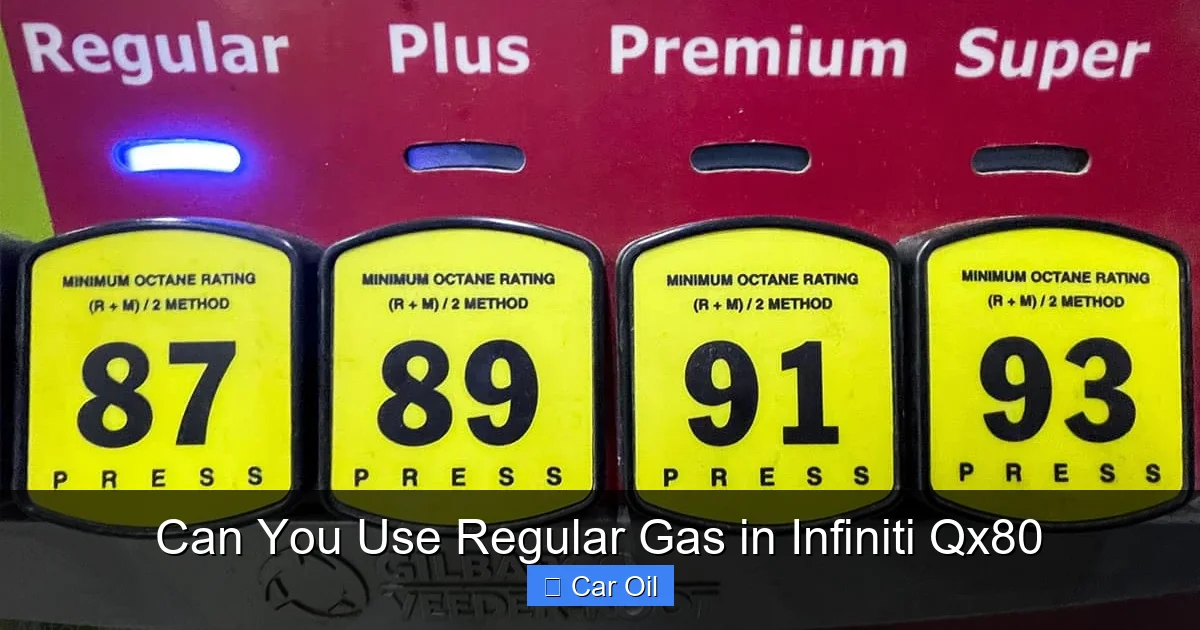
Before we dive into the Infiniti QX80 specifically, let’s clear up a common point of confusion: what octane actually means. You see the numbers 87, 89, and 91 (or 93) at the pump, but what do they signify? Octane rating is a standard measure of a fuel’s ability to withstand “knocking” or “pinging” during combustion in a spark-ignition engine. Knocking is the undesirable, uncontrolled, and explosive combustion of the air-fuel mixture. It’s not the smooth, controlled burn that pushes the piston down; it’s a secondary explosion that creates a sharp knocking sound and immense pressure spikes that can hammer engine components.
Modern engines are designed with specific compression ratios. A higher compression ratio squeezes the air-fuel mixture more tightly before ignition, which is more thermally efficient and produces more power. However, this also makes the mixture more prone to spontaneously igniting from heat and pressure alone, rather than waiting for the spark plug. High-octane fuel has a higher knock resistance, allowing it to withstand this intense compression without pre-igniting. Think of it like a pressure cooker: a recipe for a tough stew (high compression) needs a more robust lid (high-octane fuel) to hold everything in until the right moment.
The Role of the Knock Sensor
Every modern car, including the Infiniti QX80, is equipped with a knock sensor. This is a clever piece of technology that listens for the metallic pinging sound of engine knock. When it detects it, the engine control unit (ECU) will automatically retard the ignition timing—meaning it sparks the plug slightly later in the cycle. This reduces pressure and eliminates the knock, but it also significantly reduces power and efficiency. The knock sensor is a safety net, not a permission slip to use low-quality fuel. Its primary job is to protect the engine from immediate, severe damage if you accidentally use bad fuel or encounter extreme conditions, not to compensate for consistently subpar fuel in a high-performance engine.
The Infiniti QX80: A Powerhouse That Demands Premium
The Infiniti QX80 is the flagship luxury SUV from Nissan’s premium division. It’s a full-size, body-on-frame behemoth designed for comfort, space, and effortless towing. Under its hood resides a legendary powerplant: the 5.6-liter V8 engine, codenamed VK56VD. This is not a small, efficient four-cylinder; it’s a large-displacement, high-compression workhorse. For the 2024 model year, this engine produces 400 horsepower and 413 lb-ft of torque. To achieve these numbers from a naturally aspirated (non-turbo) V8, Nissan/Infiniti engineers utilized a high compression ratio (around 10.8:1 for this generation). This high compression is the direct reason premium fuel is non-negotiable.

Visual guide about Can You Use Regular Gas in Infiniti Qx80
Image source: blogmedia.dealerfire.com
Infiniti’s official stance, repeated in every owner’s manual and on their website, is unequivocal: “Premium unleaded gasoline with an octane rating of 91 AKI (Anti-Knock Index) or higher is recommended for the best performance and fuel economy.” The language is strong—”recommended” in luxury and performance vehicle contexts almost always means “required for optimal operation and warranty compliance.” It’s the same philosophy behind brands like Mercedes-Benz, BMW, and Lexus for their larger engines. The QX80 is built to a standard, and using regular gas means you are operating that finely tuned machine outside its designed parameters.
What Actually Happens If You Use Regular Gas (87-Octane)?
So, you’re at the pump, and the price of premium makes you wince. What’s the real-world impact of putting 87-octane regular unleaded into your QX80? It’s not an immediate, apocalyptic event, but it’s a cascade of negative effects that add up quickly.
Visual guide about Can You Use Regular Gas in Infiniti Qx80
Image source: partsofacarengine.com
Immediate Sensations: Loss of Power and Smoothness
The first thing you’ll notice, often within the first few drive cycles, is that the QX80 feels sluggish. The V8, which should deliver power with a quiet, authoritative surge, now feels hesitant and labored. You’ll press the accelerator, and instead of an immediate response, there’s a delay as the ECU’s safety protocols kick in. That’s the retarded ignition timing at work. The engine is literally running on a less aggressive spark schedule to prevent knock. You might also hear or feel a slight pinging or knocking under hard acceleration, like when merging onto a highway or climbing a steep hill. This is the sound of combustion instability—the very thing the knock sensor is fighting against.
Fuel economy will also take a hit. The retarded timing makes the combustion process less efficient. The engine has to work harder to produce the same amount of power, burning more fuel in the process. You could see a drop of 1-3 MPG or more, depending on your driving style, which quickly erodes any savings from skipping the premium grade. The smooth, quiet, and refined character that justifies the QX80’s luxury price tag is gone, replaced by a coarse, strained feeling.
The Long-Term Danger: Cumulative Engine Stress
This is the most critical part. The occasional ping under heavy load isn’t just an annoyance; it’s a form of violent mechanical stress. Repeated pre-ignition events create shockwaves that can:
- Damage Pistons and Rings: The edges of pistons can develop hotspots, cracks, or erosion. Piston rings can wear prematurely.
- Harm Bearings: The increased pressure spikes can stress main and rod bearings, accelerating wear.
- Destroy Spark Plugs:
- Overheat the Catalytic Converter: Unburned or erratically burned fuel can ignite inside the exhaust system, overheating and destroying the expensive catalytic converter.
Excessive heat from pre-ignition can melt spark plug electrodes or crack insulators, leading to misfires.
While the knock sensor does a good job of preventing *immediate* catastrophic failure, it cannot eliminate all the harmful pressure spikes during its rapid correction cycles. Over thousands of miles, this chronic low-level abuse takes a toll. An engine repair or replacement on a V8 SUV is a five-figure expense.
Debunking Myths and “Workarounds”
The internet is full of anecdotes and so-called “solutions” for people who want to ignore manufacturer recommendations. Let’s address the most common ones related to the QX80.
Visual guide about Can You Use Regular Gas in Infiniti Qx80
Image source: autochimps.com
“My Friend Uses Regular Gas and His QX80 is Fine!”
This is the most dangerous myth. “Fine” is subjective. The engine might not have blown up yet, but it is almost certainly operating under duress. The long-term wear is invisible until it’s too late. The “fine” vehicle might also be suffering from poor performance, bad fuel economy, and a pending check-engine light related to ignition timing or oxygen sensor data. Additionally, if a warranty claim arises, Nissan/Infiniti can often detect engine operating history (via onboard diagnostic data) that points to chronic low-octane use, giving them grounds to deny coverage.
“I Just Add an Octane Booster.”
Octane boosters are available at auto parts stores. While some can raise the effective octane rating of a tank of gas by a point or two, they are an imperfect and expensive solution. You must add the correct amount consistently to every tank. It’s messy, adds cost and hassle, and doesn’t change the fact that you’re starting with a sub-base fuel. It’s far better and simpler to just buy the premium fuel the engine was engineered for. This is a band-aid on a fundamental design mismatch.
“The Knock Sensor Protects It, So It’s Safe.”
As explained, the knock sensor is a protective emergency measure, not a tuning feature. Relying on it constantly is like relying on your car’s crumple zones to protect you in every single minor fender-bender. The system works by reducing performance and efficiency. You are paying for a 400-horsepower V8 and then electronically neutering it to run on cheaper gas. You get neither the performance nor the potential long-term reliability. The sensor’s constant intervention is a sign of improper operation.
Best Practices for QX80 Owners and Fuel Choices
Given that premium fuel is a requirement, not a suggestion, what’s the best way to manage this?
- Always Use 91-Octane or Higher: Make this your non-negotiable rule. Top Tier™ certified premium fuels (found at most major brands like Shell, Chevron, Exxon) are even better, as they contain superior detergent additives that help keep your engine’s intake valves and fuel injectors clean. This is especially important for direct-injected engines like the VK56VD, which are more prone to intake valve deposits.
- Stick to Reputable Brands: Avoid off-brand or discount station gasoline for your QX80. While all gasoline must meet minimum standards, the additive packages vary widely. Premium Tier fuels have a proven track record for maintaining engine cleanliness and performance.
- Don’t Mix Grades Habitually: If you accidentally put regular in one time, fill up with premium as soon as possible. Do not adopt a strategy of mixing 50/50 to save money. The overall octane of the tank will still be below the safe, recommended threshold.
- Consider Your Driving Conditions: If you are regularly towing a heavy trailer, driving in very hot climates, or consistently using the QX80 for its intended heavy-duty purpose, the demand on the engine is higher, making the correct fuel even more critical. The margin for error disappears.
- Use the Correct Fuel Cap: Ensure you are using the proper, sealed fuel cap. A loose or missing cap can allow contaminants into the system and also trigger the check-engine light, which is another unnecessary headache.
If cost is a primary concern, it’s worth considering if a full-size, V8-powered luxury SUV is the most economical vehicle choice for your lifestyle. The fuel cost is part of the ownership package. However, by using the correct fuel, you are protecting your significant investment, ensuring it performs as intended, and maintaining its resale value. A well-maintained QX80 with a complete service history using premium fuel will fetch a higher price on the used market.
The Bottom Line: Performance, Protection, and Peace of Mind
Let’s bring it all home. The Infiniti QX80 is a masterpiece of engineering designed to provide a serene, powerful, and luxurious driving experience for up to eight people and their cargo. Its heart is a sophisticated high-compression V8 engine. This engine’s design philosophy is predicated on the consistent use of high-octane premium fuel. Using regular gasoline is fundamentally incompatible with that design.
You are not just choosing a number at the pump; you are choosing how your vehicle operates. Premium fuel allows the engine management computer to run its most aggressive, efficient, and powerful ignition timing map. It ensures smooth operation, maximum horsepower and torque, the best possible fuel economy for a vehicle of this size, and, most importantly, long-term engine health. Regular gas forces the computer into a protective, power-sapping limp mode, subjects the engine to harmful stress, risks voiding your warranty, and degrades the ownership experience you paid for.
Think of it this way: you wouldn’t put low-grade oil in your QX80 just because it’s cheaper, knowing it would eventually destroy the engine. The same principle applies to fuel. The fuel is just as much a lubricant and coolant for the combustion chamber as the oil is for the moving parts. Give your Infiniti QX80 what it was built for: premium unleaded gasoline. Your engine, your wallet (in the long run), and your driving enjoyment will thank you. For more on how different fluids affect your vehicle’s performance, check out our guide on using high-mileage oil in a new car, which explores another common “can I use this instead?” question.
Frequently Asked Questions
Can I put regular gas in my Infiniti QX80 just once?
An occasional, accidental fill-up with regular gas is unlikely to cause immediate, catastrophic damage due to the knock sensor’s protection. However, you should refill with premium gasoline as soon as possible and avoid hard acceleration until you do. Making a habit of it is what causes long-term harm.
Will using regular gas void my Infiniti QX80’s warranty?
Yes, it potentially can. If an engine component fails and the investigation by Infiniti/Nissan determines that the failure was caused by using fuel below the recommended 91-octane rating, they can deny warranty coverage for that repair. Your owner’s manual states the fuel requirement as a condition of the warranty.
Is there any benefit at all to using regular gas in the QX80?
The only perceived benefit is a lower price per gallon at the pump. However, this is immediately offset by a measurable drop in fuel economy (1-3 MPG or more) and a significant loss of power and drivability. You end up with a slower, less refined vehicle that may cost more to run per mile.
What about mid-grade fuel (89-octane)? Is that a safe compromise?
No. Infiniti’s specification is a minimum of 91-octane AKI. Mid-grade (89-octane) is still below that threshold. While it’s better than regular 87-octane, it does not meet the manufacturer’s requirement and can still cause knock, reduced performance, and long-term wear under load. It is not an acceptable substitute for premium.
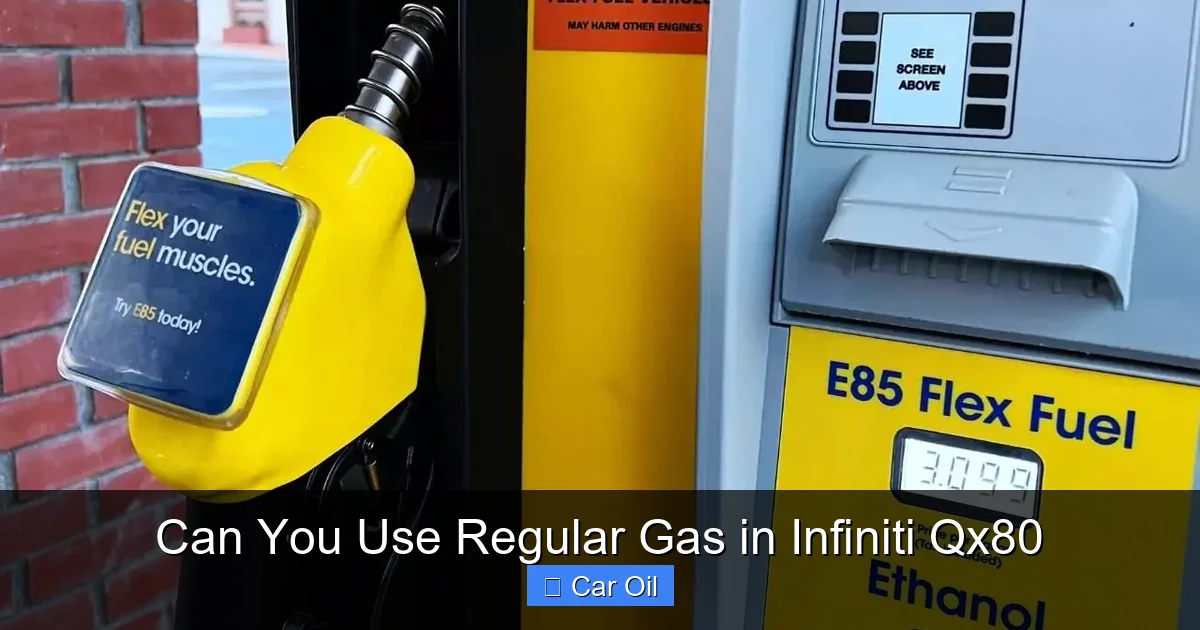
Does the QX80 have a flex-fuel engine that can use E85?
No. The standard 5.6L V8 in the QX80 is not a flex-fuel vehicle (FFV). It is calibrated for standard unleaded gasoline only. Using E85 (which has a lower energy content and different properties) in a non-FFV engine can cause severe fuel system and engine damage and is strictly prohibited. If you’re interested in flex-fuel capabilities, you might read about whether flex-fuel cars can use regular gas, but that does not apply to the QX80.
Is the premium requirement different for different model years of the QX80?
The requirement has been consistent for many model years. Both the previous generation and the current (from 2024) QX80 with the 5.6L V8 engine explicitly require premium unleaded fuel with an octane rating of 91 or higher. Always double-check your specific vehicle’s owner’s manual, but you can confidently expect this to be the rule for any recent QX80.
