
Why Are Porsche Oil Changes So Expensive?

Porsche oil changes are expensive because they require high-specification synthetic oil, meticulous factory-trained labor, and genuine OEM parts to protect their high-performance engines. The cost reflects the engineering precision and quality materials needed to maintain the car’s performance, longevity, and warranty. While pricey, it’s a critical investment to avoid catastrophic engine damage. Understanding these factors helps owners see past the sticker shock and make informed maintenance decisions.
Key Takeaways
- Specialized Oil Requirements: Porsche engines demand specific, high-grade synthetic oils (like Mobil 1) that meet strict manufacturer approvals, costing significantly more than standard motor oil.
- Labor Intensity & Expertise: The procedures are complex, often requiring specialized tools and training for technicians who understand Porsche’s unique engineering, leading to higher labor rates.
- Genuine OEM Parts Premium: Using genuine Porsche oil filters and crush washers is often mandatory for warranty compliance, and these parts carry a brand premium compared to aftermarket alternatives.
- Dealership vs. Independent Shop Markup: Dealer pricing includes overhead, brand assurance, and warranty documentation, while reputable independents can offer savings but must still use correct parts and procedures.
- Engine Design Justifies the Care: High-revving, tightly-tuned flat-six and V8 engines have minimal tolerance for error; proper oil maintenance is non-negotiable for performance and reliability.
- It’s Preventive, Not Just Routine: The high cost is an insurance policy against expensive repairs; skipping or cutting corners on a Porsche oil change can lead to engine failure costing tens of thousands.
- Long-Term Value Preservation: Consistent, correct oil changes are a top factor in maintaining a Porsche’s exceptional resale value and operational integrity over decades.
📑 Table of Contents
- The Sticker Shock: Why a Simple Service Costs a Fortune
- Factor 1: The Liquid Gold – Premium, Specified Synthetic Oil
- Factor 2: The Specialist’s Touch – Labor Costs and Complexity
- Factor 3: The Genuine Article – OEM Parts Premium
- Factor 4: The Ecosystem – Dealer vs. Independent Shop Economics
- Factor 5: The Real Cost of Skipping or Scrimping
- Smart Strategies for the Porsche Owner
The Sticker Shock: Why a Simple Service Costs a Fortune
You pull into the dealership or your trusted independent shop for what you assume is a routine oil change on your Porsche. The quote comes back, and your eyes widen. $400. $550. Even $700+ for some models. Your friend with a Honda Civic gets the same service for $60. What gives? Is this pure markup? Are they taking advantage of Porsche owners?
The short answer is no. While there is certainly a premium for brand and specialized service, the core reasons behind the high cost of a Porsche oil change are deeply rooted in engineering, material science, and risk management. It’s not just about draining and refilling oil; it’s a precise, multi-point procedure designed to protect one of the most sophisticated and performance-oriented engines on the planet. To understand the price, you must first understand the machine it’s meant to serve.
Porsche engines are not commuter units. They are high-revving, often air-cooled (in older models) or complex water-cooled masterpieces with incredibly tight tolerances. They are designed to operate at extreme temperatures and RPMs, pushing the boundaries of what a piston engine can do. In such an environment, engine oil isn’t just a lubricant; it’s a critical coolant, a hydraulic fluid for variable valve timing systems, a sealant for piston rings, and a protector against wear under immense stress. The quality and specification of that oil, and the care taken during its replacement, are absolutely paramount.
Factor 1: The Liquid Gold – Premium, Specified Synthetic Oil
Not All Synthetic is Created Equal
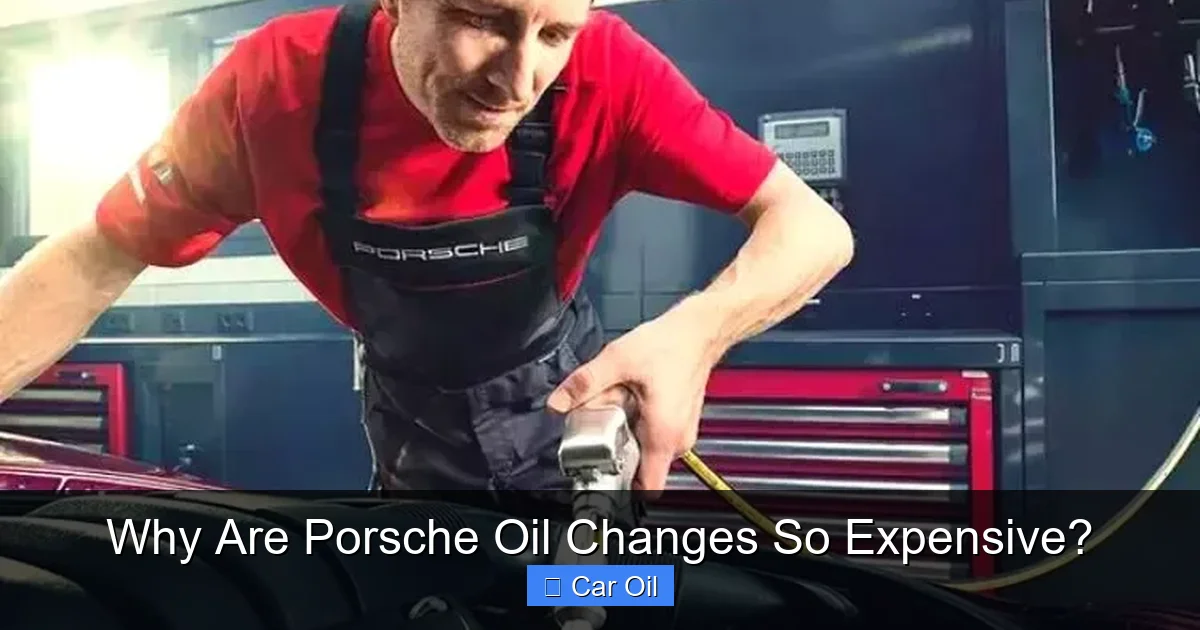
Your standard “full synthetic” oil from a big-box store is not going to cut it in a Porsche. Porsche engineers, particularly for modern models like the 911, Cayman, Boxster, Panamera, and Cayenne, specify oils that meet their own rigorous approvals, most famously Porsche A40 and increasingly Porsche C30 for certain diesel and newer models. These approvals are far more stringent than the API (American Petroleum Institute) or ACEA (European Automobile Manufacturers Association) standards most consumer oils meet.
Visual guide about Why Are Porsche Oil Changes So Expensive?
Image source: carwrenching.com
An oil with a Porsche A40 approval has been rigorously tested by Porsche itself—or by an authorized lab—to ensure it provides the exact shear stability, high-temperature/high-shear (HTHS) viscosity, friction reduction, and deposit control required for their engines. It must protect the engine during cold starts, sustain protection at track-day temperatures, and work seamlessly with complex systems like VarioCam Plus (Porsche’s variable valve timing). This often means it has a higher concentration of advanced, expensive esters and additives.
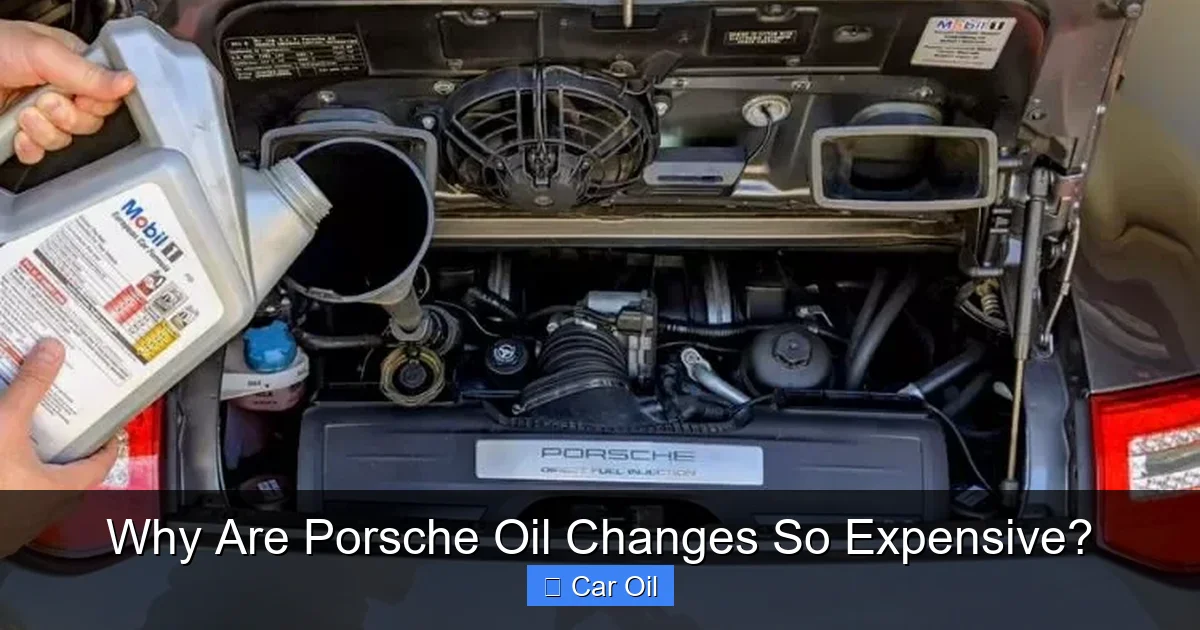
Practical Example: A 5-quart jug of a high-quality generic full synthetic might cost $30-$40. A 5-quart jug of Mobil 1 ESP 0W-40, which carries the Porsche A40/BMW Long-Life-01 approval, costs $50-$65. For a Porsche that requires 8-10 quarts, that oil cost alone is $80-$130 before you even touch a filter or labor. For a V8-powered Panamera or Cayenne Turbo requiring 9-10 quarts of specific 0W-20 or 5W-40, the oil bill can easily exceed $150.
Factor 2: The Specialist’s Touch – Labor Costs and Complexity
It’s More Than Just a Drain Plug
The “labor rate” at a Porsche dealership or a top-tier independent specialist is high—often $150-$200+ per hour. This isn’t arbitrary. The technician performing the service has undergone specific training on Porsche systems. The procedure itself is often more involved than on a standard car.
Visual guide about Why Are Porsche Oil Changes So Expensive?
Image source: carwrenching.com
- Access Challenges: On mid-engine Boxsters and Caymans, the oil filter and drain plug can be buried, requiring removal of underbody panels or working in tight spaces. For rear-engine 911s, while access is better, the design still requires care to avoid heat shields and exhaust components.
- Multiple Filters: Many modern Porsches have both an external oil filter and an internal “suction filter” or strainer in the oil pan. Replacing the internal filter requires dropping the oil pan, which is a several-hour job on its own. Some models (like certain 996/997 911s) also have a separate “sump filter” that needs attention.
- Critical Torque Specs: The oil drain plug must be torqued to an exact specification (often 22-30 Nm) with a new crush washer. Overtightening strips the threads; undertightening causes a catastrophic leak. The oil filter housing cap on many models also has a specific torque.
- Diagnostic Protocol: A proper Porsche oil change often includes a multi-point inspection that checks for any stored engine codes, monitors oil level and quality via the car’s computer, and resets the service interval reminder using proprietary diagnostic tools (Porsche PIWIS or equivalent). This diagnostic step is crucial and requires expensive equipment.
A simple drain-and-fill on a straightforward model might take 1.5-2 hours of billed time. A full service with internal filter replacement on a 911 can easily be 3-4 hours. At $180/hour, that’s $540-$720 in labor alone before parts. This is why the total cost for a Porsche oil change can vary so wildly based on the specific model and year.
Factor 3: The Genuine Article – OEM Parts Premium
Why “Just Any Filter” Won’t Do
Porsche, like many premium European marques, strongly advocates for the use of genuine OEM (Original Equipment Manufacturer) parts for critical service items. The Porsche oil filter is a prime example. These filters are manufactured to Porsche’s exacting specifications by top-tier suppliers (often Mahle or Mann). They feature specific filter media designed for the extended drain intervals (often 10,000-15,000 miles) recommended by Porsche, precise pressure relief valves, and anti-drain back valves that perform correctly in the engine’s high-G environment.
Visual guide about Why Are Porsche Oil Changes So Expensive?
Image source: mindofmechanic.com
Using a low-quality aftermarket filter is a genuine risk. A filter with poor construction can shed particles, have a faulty valve that causes oil starvation on startup, or simply not flow enough oil for a high-performance engine. For warranty purposes, especially on newer cars, using genuine Porsche parts (or a high-quality OEM-equivalent like a Mann or Mahle filter *with the correct part number*) is often required to prove due diligence in case of a future engine claim.
Additionally, you’re paying for the Porsche name on the box. The genuine Porsche-branded filter, crush washer for the drain plug, and sometimes even the specific oil (if purchased from the dealer) carry a significant premium. A genuine Porsche oil filter might cost $25-$40, while a top-tier aftermarket equivalent might be $12-$18. Multiply that by the cost of a crush washer, and the parts bill climbs quickly.
Factor 4: The Ecosystem – Dealer vs. Independent Shop Economics
Where You Get It Done Matters
The price you pay is heavily influenced by where you have the service performed.
- Porsche Dealership: This is the highest-cost option. You’re paying for the brand prestige, the comprehensive warranty-compliant service history, the state-of-the-art facility, the factory-trained technicians, and the proprietary diagnostic software subscriptions that cost the dealer tens of thousands of dollars annually. The labor rate is the highest, and parts are sold at full MSRP. The upside is absolute peace of mind, perfect record-keeping, and no questions about warranty coverage.
- Specialized Independent Porsche Shop: This is often the “sweet spot” for value. These shops focus exclusively on Porsches (and often other German performance cars). Their technicians are experts, sometimes with more hands-on experience than dealer techs. They use the correct parts (genuine or high-quality OEM-equivalent) and procedures. Their labor rates are typically 15-30% lower than the dealer. They may not have the latest factory diagnostic software for every new model, but for an oil change, their expertise and tools are usually more than sufficient. This is where you can save $100-$300 without compromising quality.
- General European Import Shop / “Fast Lube” (NOT Recommended): A general mechanic might offer a lower rate, but the risk is immense. Do they have the specific torque specs for your drain plug? Do they know which internal filter your 997.2 911 requires? Will they use the correct oil? Will they reset the service interval properly? The potential for a mistake that causes a $15,000 engine rebuild far outweighs the $100 you might save. This is not the place to economize on a Porsche.
It’s instructive to compare this to another premium brand facing similar questions. Why Subaru oil changes are expensive also involves specialized oil (Subaru’s own 0W-20 for many models) and boxer engine considerations, but the labor and parts cost structure is different. Porsche’s cost is on another tier due to its overall engineering complexity and brand positioning.
Factor 5: The Real Cost of Skipping or Scrimping
An Expensive False Economy
Understanding why the service is expensive is only half the story. The true cost comes from neglecting it. Porsche engines are designed for longevity, but they are utterly dependent on clean, high-quality oil at the correct level.
- Oil Sludge & Carbon Buildup: Extending drain intervals beyond Porsche’s recommendations (or using subpar oil) can lead to oil thickening, sludge formation, and carbon deposits on piston rings and valves. This increases wear, reduces power, and can lead to expensive decarbonization procedures or even engine failure.
- Premature Bearing Wear: The main and rod bearings in a high-revving Porsche engine are a marvel of engineering but have little margin for error. Poor oil quality or low oil level can cause metal-on-metal contact, leading to bearing scoring and a catastrophic “bearing knock” that requires a complete engine rebuild or replacement—a $20,000+ proposition.
- VarioCam & Other System Failure: Porsche’s variable valve timing systems are hydraulically actuated and sensitive to oil pressure and cleanliness. Contaminated oil can clog narrow passages, causing camshaft timing issues, poor performance, check engine lights, and ultimately, mechanical damage.
- Warranty Voidance: If you have an extended warranty or are still under the factory warranty, failing to follow the exact maintenance schedule using specified fluids and parts can void coverage for related engine repairs. The service record from a Porsche dealer or reputable specialist is your best defense.
The $500 oil change is not an expense; it’s a $500 insurance policy protecting a $30,000+ asset (the engine). When viewed through that lens, the cost is not only justified but essential. For another perspective on maintenance importance, you can read about why Toyota is so reliable, where consistent, correct maintenance is also a cornerstone of their legendary durability, albeit at a much lower cost of entry.
Smart Strategies for the Porsche Owner
How to Manage the Cost Without Compromising
So, what’s a Porsche owner to do? You can’t change the engineering, but you can be a savvy consumer.
- Find a Reputable Independent Specialist: This is the single most effective way to save 20-40%. Look for shops with Porsche-specific certifications, memberships in Porsche Clubs of America, and glowing reviews from fellow owners. Ask them specifically if they use the correct internal filter for your model year and if they reset the service interval via the proper diagnostic method.
- Buy Your Own Oil and Filters: If you find a shop with a fair labor rate, you can often supply your own parts. Purchase the exact Mobil 1 (or other approved brand) in the correct quantity and the precise OEM or OEM-equivalent filter. This eliminates the shop’s parts markup. Just ensure the shop is comfortable installing customer-supplied parts.
- Understand Your Model’s True Needs: Not all Porsches are the same. A 1998 911 Carrera with a basic M96 engine has different (and often less expensive) requirements than a 2021 911 Turbo S with a twin-turbo flat-six and multiple internal filters. Get a specific quote for your VIN. Some older air-cooled models actually have simpler requirements and can be less costly.
- Consider the “Major Service” Interval: Porsche’s maintenance schedules are mileage-based but also time-based. A “major service” at 20k/40k/60k miles includes the oil change plus dozens of other inspections and replacements (spark plugs, filters, etc.). Budgeting for this larger, less frequent expense can feel more manageable than thinking about the oil change in isolation.
- Learn to Check Your Own Oil: Porsche’s oil level indicators are excellent, but it’s still a critical skill. Check the level (with the car on level ground, engine warm) at least once a month. Catching a slow leak or consumption issue early can prevent a disaster. For other common oil-related issues, reading about why cars burn oil can help you spot problems.
Ultimately, the high cost of a Porsche oil change is a direct reflection of the car’s capabilities and the consequences of neglect. It’s a fee for admission to the world of high-performance, precision engineering. By understanding what you’re paying for and choosing your service provider wisely, you ensure your Porsche delivers the driving thrill it was built for, for years to come.
Frequently Asked Questions
Can I change the oil in my Porsche myself to save money?
Technically, yes, if you have the expertise, tools, and a safe workspace. However, it’s not recommended for most owners. You must use the exact Porsche-approved oil and filter, have the correct torque wrenches, know how to access the filter (which may require underbody panel removal), and most importantly, have a way to reset the service interval via the car’s diagnostic port. A mistake can lead to leaks, damage, or a failed inspection. The potential savings are often not worth the risk and lost time.
Is it okay to use a high-quality aftermarket oil filter instead of a genuine Porsche one?
This is a gray area. For many Porsche models, high-quality filters from brands like Mann, Mahle, or Bosch (with the correct part number) are considered OEM-equivalent and are widely used by reputable independent shops. They are often made by the same manufacturers as the genuine part. However, you must verify the filter is explicitly approved for your specific engine code and model year. Cheap, unknown-brand filters are a definite no. When in doubt, use the genuine Porsche filter for critical models or if your car is under warranty.
Why do some Porsche models require an internal oil filter change, and how much does that add?
Many water-cooled Porsche engines (like the M96, M97, and newer 9A1, 9A2) have a secondary suction filter inside the oil pan. Its purpose is to catch larger debris before the oil reaches the main pump. It is considered a “lifetime” part by some, but Porsche’s own maintenance schedules for “major services” often include its replacement. Dropping the oil pan to access it is labor-intensive, adding 2-4 hours of labor to the job. This is a primary reason an oil change on a 911 can cost double that of a simpler front-engine car. Always ask if your quote includes this internal filter.
What happens if I accidentally put the wrong oil in my Porsche?
Using oil that does not meet the specified approval (e.g., using a generic 5W-30 instead of required 0W-40) can have serious consequences. The oil may not have the correct shear stability, leading to premature wear; it might not protect adequately at high temperatures; or it could cause issues with VarioCam and other hydraulic systems. If you realize the mistake immediately, do not start the engine. Have it drained and refilled correctly. If the engine has been run, have it inspected by a Porsche specialist immediately. Continued operation with incorrect oil can void your warranty and destroy the engine.
Are Porsche oil changes at an independent shop covered under warranty?
Yes, but with conditions. The Magnuson-Moss Warranty Act in the U.S. prevents manufacturers from requiring that maintenance be performed only at a dealership, provided you use the correct parts and fluids and follow the exact procedures and intervals outlined in the owner’s manual. The key is documentation. You must keep detailed receipts showing the date, mileage, oil type and specification (e.g., Mobil 1 ESP 0W-40), and the exact filter part number used. The shop should also note the procedure in your service book or provide a digital record. Poor documentation can give a dealer grounds to deny a warranty claim.
Why is the oil change interval on my Porsche so long (e.g., 10,000-15,000 miles)?
Modern Porsche engines, paired with high-quality full synthetic oils meeting approvals like A40, are designed for extended drain intervals. This is due to advancements in base oils and additive packages that resist oxidation, thermal breakdown, and sludge formation much better than oils of the past. Porsche’s engineering tolerances are also tighter, leading to less fuel dilution and contamination. However, this long interval is predicated on using the *exact specified oil*. Using a lesser oil and following a long interval is a recipe for disaster. Always follow the manual for your specific model and driving conditions (severe service may require shorter intervals).
