
Difference Between Mazda Cx-5 and Cx-30

The Mazda CX-5 and CX-30 are both excellent compact SUVs from Mazda, but they serve different needs. The CX-5 is a larger, more traditional midsize SUV offering more passenger and cargo space, while the CX-30 is a taller, sportier subcompact crossover based on the Mazda3 sedan. Your choice hinges on prioritizing space and power (CX-5) versus agility, value, and urban maneuverability (CX-30).
So, you’re in the market for a Mazda SUV, and you’ve naturally zeroed in on two fantastic contenders: the ever-popular CX-5 and the sleek, newer CX-30. It’s a great problem to have, as both vehicles embody Mazda’s “car-like” driving ethos, premium interiors, and stunning Kodo design. But they are not the same car in different clothing. The difference between the Mazda CX-5 and CX-30 is fundamental, rooted in their different vehicle classes, intended purposes, and engineering priorities. Let’s break it down, plain and simple, to help you find your perfect match.
Key Takeaways
- Size & Class: The CX-5 is a midsize SUV competing with the Honda CR-V, while the CX-30 is a subcompact crossover rivaling the Hyundai Kona.
- Space Priority: The CX-5 provides significantly more rear legroom and cargo capacity for families and frequent travelers.
- Performance Focus: The CX-5 offers a more powerful standard engine and an optional turbo, whereas the CX-30 is tuned for nimble, car-like handling.
- Price Point: The CX-30 starts lower, making it the more accessible entry into the Mazda SUV lineup.
- Interior Ambiance: Both share Mazda’s premium cabin philosophy, but the CX-5’s larger scale makes its interior feel more spacious and luxurious.
- Towing & Capability: The CX-5 has a higher maximum towing capacity, making it better for light trailer or boat duties.
- Target Driver: Choose the CX-30 for city-centric, stylish driving; choose the CX-5 for growing families needing all-around versatility.
📑 Table of Contents
Design & Styling: Two Different Personalities
At first glance, you see Mazda’s signature design language in both. The flowing lines, minimalist fronts, and elegant profiles are unmistakable. But look closer, and their personalities diverge.
The CX-5: Established SUV Presence
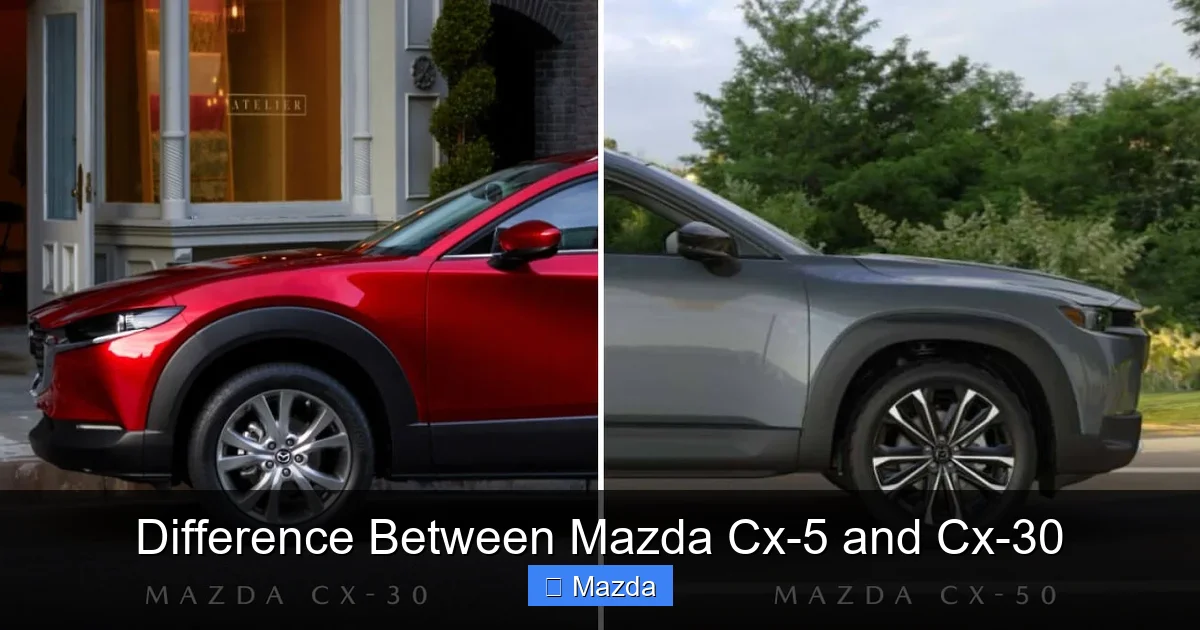
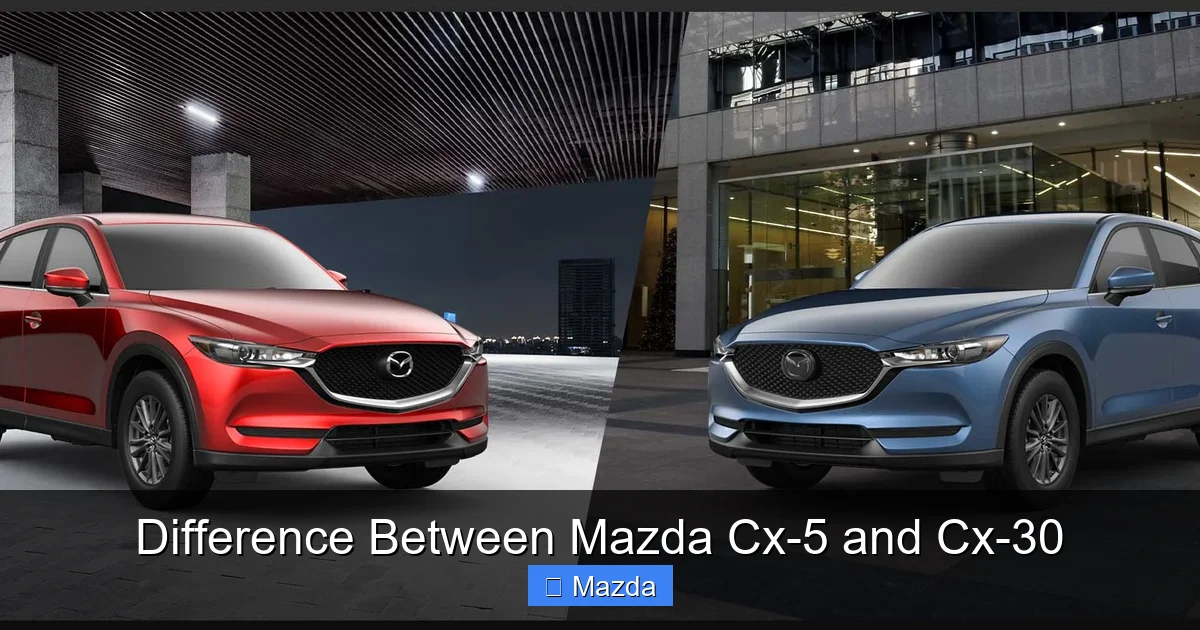
The 2026 CX-5 carries forward its confident, upright SUV stance. It’s wider, taller, and longer than the CX-30, presenting a more traditional and substantial on-road presence. The design emphasizes strength and capability, with a pronounced hood line and a higher beltline. It looks like a vehicle built for adventure, even if that’s just a trip to the grocery store with the kids. The rear end is broad and robust, emphasizing its cargo-hauling intent.
The CX-30: Sporty, Hatchback-Inspired Agility
The CX-30’s design tells a different story. It’s essentially a Mazda3 with a higher ride height and some crossover cladding. The profile is sleeker, with a faster-sloping roofline that gives it a coupe-like, sporty silhouette. It feels more like a tall hatchback or a “crossover” in the purest sense—a car raised up for better visibility and light off-pavement ability. The shorter overhangs and compact dimensions make it look nimble and urban-ready. It’s the stylish, athletic sibling.
Size, Space & Practicality: The Clear Divide
This is the most significant and immediate difference you’ll notice. The CX-5 is in a different league when it comes to space.
Visual guide about Difference Between Mazda Cx-5 and Cx-30
Image source: pictures.dealer.com
Exterior Dimensions & Parking
The CX-30 is about 10 inches shorter in length than the CX-5. This makes a huge difference in tight city parking, narrow streets, and crowded garages. The CX-30 is the clear winner for urban dwellers who value a smaller footprint. The CX-5, while not a massive truck, requires more room to maneuver and park. Its extra length translates directly to interior space.
Passenger Cabin & Rear Seat Comfort
Here, the CX-5 dominates. The rear seat in the CX-5 offers several inches more legroom. For adults, this means the difference between a comfortable cross-country trip and a knees-up, cramped journey. The CX-30’s rear seat is adequate for children and occasional adult use on shorter trips, but it’s tight for anyone over 5’10”. The CX-5’s wider body also contributes to a less claustrophobic feeling for rear passengers.
Cargo Capacity: Groceries vs. Gear
The cargo area difference is stark. The CX-5 boasts approximately 39 cubic feet behind the rear seats (varying by model year), swelling to over 75 cubic feet with seats folded. The CX-30 offers about 20 cubic feet behind the rear seats, expanding to around 45 cubic feet total. For perspective, that’s roughly the difference between being able to comfortably fit a week’s worth of family groceries and large suitcases (CX-5) versus a couple of weekend bags and smaller items (CX-30). If you regularly haul gear, sports equipment, or luggage for four, the CX-5’s space is non-negotiable.
Performance & Driving Experience: Power vs. Precision
Both are fun to drive, but they channel that fun in distinct ways.
Visual guide about Difference Between Mazda Cx-5 and Cx-30
Image source: cdn.dlron.us
Engine Options & Power Output
The 2026 CX-5 comes standard with a 2.5-liter naturally aspirated four-cylinder engine (187 hp, 186 lb-ft). The big news is the available 2.5-liter turbocharged engine (256 hp, 320 lb-ft on premium fuel), which transforms the CX-5 into a genuine performer. The CX-30, for 2026, is expected to continue with its sole powertrain: a 2.5-liter naturally aspirated engine (191 hp, 186 lb-ft). While the power figures are similar on paper, the CX-5 feels more substantial and muscular, especially with the turbo. The CX-30 feels peppy and responsive but never powerful. Its lighter weight (about 300-400 lbs less) helps it feel agile with its standard engine.
Handling & Ride Quality
This is where Mazda’s engineering shines in both. The CX-5 offers a balanced, compliant ride that soaks up bumps well while maintaining sharp steering and minimal body roll. It feels planted and confident. The CX-30, with its lower center of gravity and car-based platform, feels even more nimble and playful. The steering is incredibly direct, making it feel like you’re driving a sophisticated hot hatch. The trade-off is that the CX-30’s ride can be slightly firmer, especially on larger wheels, as it prioritizes road-holding comfort over absolute plushness.
Towing Capacity
If you have even a light trailer, kayak rack, or small jet ski, the CX-5 is your only choice between these two. The CX-5 with the turbo engine is rated to tow up to 3,500 pounds. The CX-30 is not rated for toching by Mazda. For a clear comparison on numbers, you should consult the official towing capacity guide for the Mazda CX-5 and the corresponding guide for the Mazda CX-30, which confirms the CX-30’s 0-lb rating.
Interior Quality, Features & Technology
Welcome to Mazda’s great equalizer. Both cabins are showcases of thoughtful design, high-quality materials (soft-touch plastics, available leather, metal accents), and driver-focused layouts. The difference here is scale.
Cabin Ambiance & Layout
The CX-30’s interior feels incredibly well-built for its class, with a clean, minimalist dashboard and a logical infotainment screen mounted high on the dash. The CX-5’s interior benefits from its larger footprint; everything feels more spread out and substantial. The center console is wider, the door panels offer more storage, and the overall atmosphere is more spacious and serene. Both use the excellent Mazda Connect infotainment system with a rotary knob and 8.8-inch display (in most trims), which is intuitive but not a touchscreen.
Standard & Available Features
Feature parity is high. Both come standard with a suite of advanced safety features via Mazda’s i-Smart Sense (adaptive cruise, lane-keep assist, automatic emergency braking, etc.). Both offer available features like a power sunroof, Bose premium audio, navigation, and a driver’s seat memory. However, the CX-5, especially in higher trims like the Premium or Turbo, often gets more luxurious touches as standard, such as heated rear seats, a heated steering wheel, and more elaborate leather upholstery, simply because it’s positioned as a more premium, family-oriented model.
Pricing, Value & Trims
Here, the CX-30 asserts its value proposition.
Starting MSRP
The CX-30 consistently starts at a lower price point than the CX-5. For the 2026 model year, expect the CX-30’s base trim to begin in the low-$20,000s, while the CX-5 will likely start closer to the mid-$20,000s. This makes the CX-30 the more accessible gateway into the Mazda brand.
Value Proposition
The CX-30 offers a tremendous amount of style, a premium cabin, and engaging driving dynamics for its starting price. You’re getting a lot of “car” for your money. The CX-5’s higher starting cost buys you that crucial extra space, more powerful engine options, and a more comprehensive list of standard comfort features on base trims. You’re paying for the added versatility and family-friendly size.
Trim Walk
Both follow a similar trim ladder: Sport, Carbon Edition, Preferred, Premium, and a performance-oriented top trim (CX-30 Premium/ CX-5 Turbo). The CX-5’s top trim is explicitly the “Turbo” model, highlighting its performance edge. The CX-30’s top trim focuses more on loaded comfort and tech. Understanding which trim offers the features you need at the best price is key, and sometimes a higher-trim CX-30 can approach the price of a base CX-5 Turbo, forcing a choice between space and power.
Which One Should You Choose? The Final Verdict
The choice boils down to your life situation and what you value most in a daily driver.
Choose the Mazda CX-30 if:
- You are single, a couple, or have very young children in car seats.
- Your primary driving environment is city or suburban streets.
- Parking is tight and you value a smaller, more agile footprint.
- You prioritize sporty, engaging handling and a stylish, unique design.
- You want the lowest possible entry price into a premium-feeling Mazda SUV.
- You rarely carry more than 2-3 people or significant cargo.
Choose the Mazda CX-5 if:
- You have a family with school-age children or teenagers.
- You frequently carry 4-5 adults or need generous rear legroom.
- Cargo space is a weekly necessity—for trips, sports gear, or shopping.
- You want more power, especially with the turbocharged engine option.
- You need a higher towing capacity for light recreational equipment.
- You prefer the traditional, spacious feel of a midsize SUV over a tall hatchback.
Both are superb vehicles. The CX-30 is the clever, athletic city slicker. The CX-5 is the versatile, spacious, and more powerful family stalwart. Test drive both back-to-back. Sit in the back seats. Try to fit your stroller or golf clubs. The right answer will become immediately clear once you experience the difference in size and space.
Frequently Asked Questions
Which is more reliable, the CX-5 or CX-30?
Both models share many mechanical components and have excellent reliability reputations. Long-term data suggests they are very close, with minor variations by model year. Regular maintenance is key for both.
Does the CX-30 or CX-5 have better fuel economy?
The lighter CX-30 with its sole 2.5L engine typically achieves slightly better EPA fuel economy estimates than the base CX-5 with the same engine, due to its lower weight. However, the CX-5’s turbo engine, while more powerful, will have lower fuel economy.
Is the CX-30 just a smaller CX-5?
No. While they share design language and technology, the CX-30 is built on the Mazda3 platform (a compact car), making it a subcompact crossover. The CX-5 is a dedicated midsize SUV platform. This fundamental difference defines their size, driving character, and target use.
Which has a more comfortable ride for long trips?
The CX-5 generally offers a more comfortable, compliant ride on long highway journeys due to its longer wheelbase and greater mass, which better absorbs bumps. The CX-30 is very capable but can feel slightly busier on rough pavement because of its firmer tuning and shorter wheelbase.
Can I install a roof rack on both?
Yes, both vehicles offer factory or aftermarket roof rails and crossbars. However, the CX-5’s larger size and higher weight capacity (when properly equipped) may allow for a greater load capacity. Always check the specific owner’s manual for your model’s dynamic roof load limits.
I’m deciding between a base CX-5 and a top-trim CX-30. What should I consider?
This is the classic space vs. features dilemma. The top-trim CX-30 will have more premium interior materials, advanced tech, and comfort features than a base CX-5. Ask yourself: do you absolutely need the extra space and power of the CX-5? If not, the loaded CX-30 might deliver a more luxurious and engaging daily experience. If space is a must, even a base CX-5 will feel more roomy than a loaded CX-30.
