
How to Start a Buick Century Without a Key

Being locked out of your Buick Century is a stressful situation, but understanding your options is key. This guide explains that while older models (1997-2005) have a traditional key ignition, modern security still poses challenges. We cover legal emergency entry methods, the realities of “hot-wiring,” and why professional help is often the safest, smartest choice. Never attempt illegal or damaging methods; focus on prevention with spare keys and trusted services.
So, you’re standing next to your Buick Century, the sun is beating down (or it’s pouring rain), and you realize your key is nowhere to be found. Maybe it’s in the couch cushions at home. Maybe it fell out of your pocket at the store. That sinking feeling is universal. Your mind races. “How do I start a Buick Century without a key?” It’s a question no owner wants to ask, but it’s vital to have a clear, safe answer. This guide is your roadmap through that stressful moment, specifically for the Buick Century—a reliable sedan built from 1997 to 2005. We’ll cut through the Hollywood myths, focus on practical reality for a 2026 owner (yes, these cars are still on the road!), and give you the steps to get back on the road, legally and safely.
First, a crucial disclaimer: this information is for educational purposes for owners of their own vehicles. Unauthorized entry or starting of a vehicle is illegal. The Buick Century, especially from its later model years, features security measures designed to prevent exactly what we’re discussing. Your primary goal should always be to regain entry and start the car without causing damage. In most cases, that means calling for professional help. But knowledge is power, and understanding your car’s systems helps you make smart decisions when panic sets in.
Key Takeaways
- Know Your Model Year: Buick Centuries (1997-2005) typically have a traditional metal key ignition, but later models may include a transponder chip that complicates starting without the correct key.
- Entry is the First Hurdle: You must gain physical access to the car’s interior before attempting any ignition manipulation. Methods like using a spare key or calling a locksmith are the first steps.
- “Hot-Wiring” is Obsolete & Risky: Modern wiring and steering locks make the classic movie-style hot-wiring ineffective and likely to cause expensive damage to your Century’s wiring harness.
- Push-Starting Only Works for Manuals: A Buick Century with an automatic transmission cannot be push-started. This method is exclusively for rare manual transmission models.
- Professional Help is the Best Investment: A certified locksmith or GM dealership can create a new key using your Vehicle Identification Number (VIN), ensuring a perfect, non-destructive solution.
- Prevention is Cheaper Than Cure: Investing in a quality hidden spare key or a key fob with a backup physical key is the most reliable way to avoid a lockout situation entirely.
- Legality is Paramount: Any method you attempt must be on a vehicle you legally own. Unauthorized entry or starting is a crime.
📑 Table of Contents
- Understanding Your Buick Century’s Ignition System
- Emergency Methods: Gaining Entry to Your Century
- Starting the Engine Once You’re Inside
- Alternative Methods: Towing and Push-Starting
- Professional Solutions: The Smart, Safe Path
- Prevention: Never Get Locked Out Again
- Conclusion: Knowledge and Preparedness Are Your Best Tools
Understanding Your Buick Century’s Ignition System
Before you can start it, you need to understand what you’re dealing with. The Buick Century’s ignition system evolved slightly over its production run. Knowing your specific model year is the first step in solving this problem.
The Traditional Key Ignition (1997-2002)
The vast majority of Buick Centuries on the road use a standard, cut metal key that fits into a lock cylinder on the steering column. This is the system many of us are familiar with. You insert the key, turn it to “ON” to power the accessories and fuel pump, and then further to “START” to engage the starter motor. There is no electronic chip in the key itself for these early models. The security is purely mechanical—the lock cylinder itself. If you have a duplicate key made at a hardware store that matches the cuts, it will start the car. This simplicity means that if you can get into the car and have a key that turns the lock, you’re in business.
The Transponder Key Era (2003-2005)
For the final model years, General Motors implemented a passive anti-theft system (PATS). This system uses a tiny electronic chip (transponder) embedded in the plastic head of the key. When you insert the key and turn it, the ignition lock cylinder reads the chip’s unique code. If the code matches what the car’s computer (ECM) has stored, the car is allowed to start. If the code is missing or incorrect, the fuel system is disabled, and the engine will crank but not fire. This is the single most important factor for a 2003-2005 Century owner. A copied key that only matches the mechanical cuts will not start the engine. You need a key that is “programmed” to the car’s system. This programming typically requires a special tool and access to the car’s OBD-II port, which is why dealerships and professional locksmiths are essential for these models.
How can you tell which system you have? Look at your key. If it’s a simple metal key with a plastic head that likely has a GM logo or “Buick” written on it, and there’s no remote lock/unlock buttons on the fob, it’s probably the traditional system. If the key has a prominent plastic head with a chip and no remote functions, it’s likely a PATS key. If it has remote buttons, it’s a separate system but still uses the transponder chip for starting. For a definitive answer, your VIN will tell you, which is why having it handy is critical when seeking professional help.
Emergency Methods: Gaining Entry to Your Century
You cannot start the car if you cannot get inside it. All strategies hinge on this first, critical step. The goal here is non-destructive entry. Let’s review the options from simplest to most complex.
Visual guide about How to Start a Buick Century Without a Key
Image source: i.ytimg.com
1. The Spare Key: Your First and Best Call
Do you have a spare? Where is it? Before you do anything else, retrace your steps, call your home, office, or a family member who might have it. A spare key is the ultimate lockout solution. If your spare is a simple metal key for an older Century, you can use it to unlock the driver’s door and start the car immediately. If it’s a key fob for a later model, pressing the unlock button should work if the fob’s battery is good. If the spare fob’s battery is dead, you may need to use the hidden physical key inside the fob to unlock the door manually (more on that below). Always know where your spare is. Many people keep one in a magnetic box attached to the underside of the car (in a secure, hidden spot) or with a trusted neighbor.
2. The Hidden Emergency Key Inside the Fob
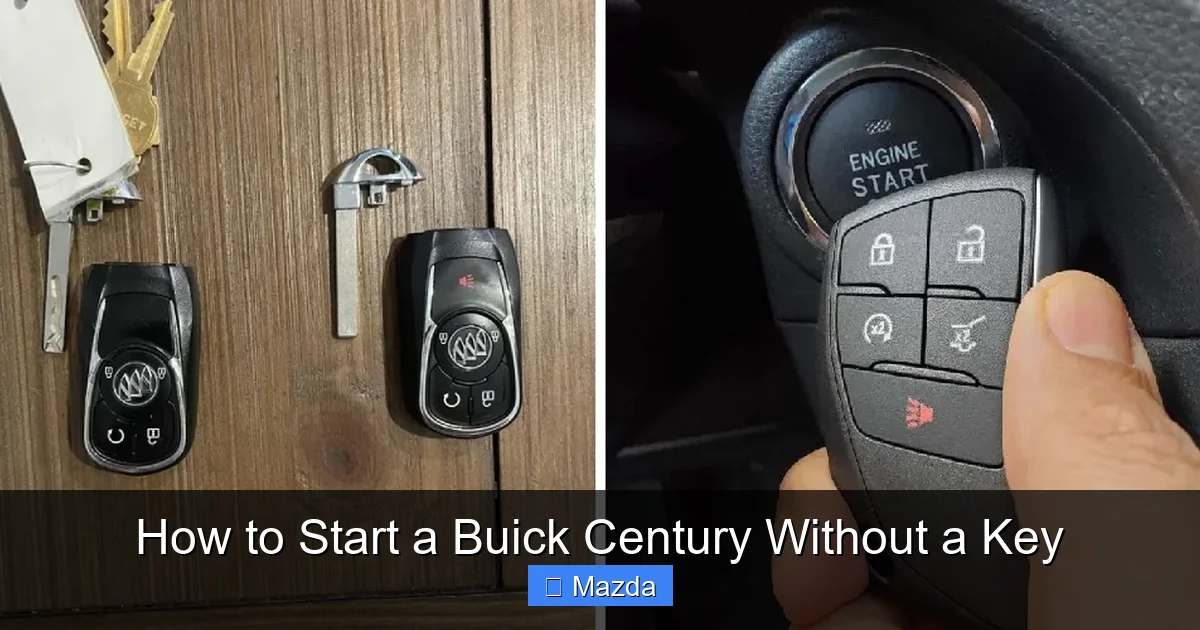
If your Century (likely 2003-2005) has a key fob with remote buttons, there is almost certainly a small, traditional metal key hidden inside it. There’s usually a tiny release button or slide mechanism on the fob. Press it, and the key will pop out. This key is designed to unlock the driver’s door in an emergency like a dead fob battery. Here’s the critical catch for a PATS-equipped Century: this emergency key will unlock the door, but it is almost certainly not programmed to the car’s security system. You will be able to get inside, but when you insert it into the ignition, the car’s security light will likely blink rapidly, and the engine will not start because the chip is not recognized. This key gets you in the car, but you’re still stuck. However, being inside the car is a prerequisite for any other method, like calling a mobile locksmith who can come to you.
3. Calling a Professional Locksmith
This is the most reliable and damage-free method for gaining entry. A professional automotive locksmith has tools designed to pick the lock cylinder of a Buick Century without damaging it. They use slim jims, lock picks, or specialized air wedges and long-reach tools to manipulate the door lock mechanism from a tiny gap in the window or door seal. It’s quick, usually takes 5-15 minutes, and leaves no trace. They can also, in many cases, cut and program a new key on the spot if they have the right equipment for your model year. This is your best bet if you have no spare and the hidden key is useless for starting. You can find reputable local locksmiths by searching “automotive locksmith near me.” Look for ones with good reviews and who specify they work on GM vehicles.
4. The “Slim Jim” or Coat Hanger Method (Not Recommended)
You’ve seen this in movies. A thin, flat piece of metal (a “slim jim”) is slid between the window and the weather stripping to hook the door lock rod. While theoretically possible on very old cars with simple lock mechanisms, this method is strongly discouraged on a Buick Century. Modern door designs, airbags in the door panel, and complex linkage make this extremely risky. You can easily damage the window regulator, the wiring for the door, or the lock mechanism itself, leading to a repair bill that far exceeds the cost of a locksmith. It requires significant skill and knowledge of your specific car’s internals. For the vast majority of people, attempting this will cause more harm than good. It’s better to pay for a professional than to create a thousand-dollar problem.
Starting the Engine Once You’re Inside
Okay, you’re in the driver’s seat. The key is missing. Now what? The path forward splits sharply based on your model year’s security system.
Visual guide about How to Start a Buick Century Without a Key
Image source: tffn.net
Scenario A: For Traditional Key Models (1997-2002) – The Mechanical Solution
If your Century does not have a transponder chip, the path is straightforward. You need a key that fits the ignition lock cylinder. How do you get one?
- Use a Spare: If you have a spare metal key, simply insert it and start the car.
- Have a Key Made: If you have no spare but have gained entry (via a locksmith or hidden key), you can call a locksmith or a hardware store (like Home Depot or Lowe’s) to cut a new key by code. They can look up the key code for your VIN and cut a new mechanical key. This new key will turn the ignition and start the car because there is no electronic barrier.
There is no “hot-wiring” bypass needed for these models. The ignition switch is a direct connection to the starter solenoid when turned to “START.” As long as the key turns the cylinder, the car will start. The only potential issue is if the ignition lock cylinder itself is worn or damaged, which is a separate mechanical failure.
Scenario B: For Transponder Key Models (2003-2005) – The Electronic Barrier
Here’s where it gets complicated and why professional help is usually mandatory. You are inside the car with a door key that does not have the correct transponder chip. You insert it into the ignition. You turn it to “ON.” You see the security light on the dashboard—often a small icon of a car with a key—blink rapidly or stay solid. You turn it to “START.” The engine cranks normally but refuses to fire. This is the PATS system doing its job. It has disabled the fuel injectors and/or the ignition coil. The engine is not “broken”; it’s being electronically prevented from starting.
To bypass this, you need a key with a chip that is “paired” or “programmed” to your car’s computer. This programming is not something you can do with a simple key from a locksmith unless they have the proprietary GM software and a connection to your car’s OBD-II port. There are a few theoretical paths, but all have major caveats:
- Using a “Master” Key: Some sources mention a “master key” that can program new keys. This is largely a myth for the PATS system used here. Programming requires the car to be in a specific “learn” mode, which is initiated by having at least one already-programmed key present. If you have lost all programmed keys, the process becomes more involved and almost always requires a dealer or advanced locksmith with a module that can bypass the system temporarily to add a new key.
- The “10-Minute” Learn Cycle: For some GM vehicles, if you have one working key, you can use it to program a new key by inserting it, turning it to “ON” for a set time (e.g., 10 minutes until the security light changes), then inserting the new key. But if you have zero working keys, this cycle cannot be initiated. You are locked out of the programming process.
- Aftermarket Immobilizer Bypass Modules: These are devices that can be installed to trick the car into thinking the correct chip is present. This is a permanent modification, should only be done by professionals, and will likely void any remaining insurance coverage for theft. It is not a solution for a one-time lockout.
Conclusion for 2003-2005 Models: If you have lost all programmed keys, your options are: 1) Find one of your original keys, 2) Call a locksmith or dealership who can use their scan tool to program a new key to your VIN (they often need proof of ownership), or 3) Have the car towed to the dealer. There is no safe, DIY method to start the engine without a properly programmed transponder key.
Alternative Methods: Towing and Push-Starting
What if you just need to move the car a short distance, like out of a parking spot or to a safer location, without starting the engine?
Visual guide about How to Start a Buick Century Without a Key
Image source: safetyfic.com
Towing with the Wheels on the Ground
For an automatic transmission Buick Century (which is virtually all of them), the car must be on a flatbed tow truck. Towing with the drive wheels on the ground can cause severe damage to the transmission, as it is not designed to be turned over while in “Park” with the engine off. The only exception is for very short distances at very low speed (like a few feet) on a flat surface, but this is still not recommended. Your safest bet is a professional tow truck with a flatbed. This is the correct way to move a disabled or locked-out automatic vehicle.
Push-Starting (Bump Starting)
This classic technique only works on manual transmission vehicles. You put the car in neutral, have someone push it to get it rolling (or go down a hill), then quickly pop the clutch into second gear. The moving wheels engage the transmission, which spins the engine, hopefully allowing it to fire. This is irrelevant for a Buick Century. GM did not offer a manual transmission in the Century during its production. Therefore, push-starting is not an option. Do not attempt it; you will just roll the car without starting the engine.
Professional Solutions: The Smart, Safe Path
Given the complexities, especially for post-2002 models, calling a professional is rarely a last resort and often the first and best choice. It saves time, prevents damage, and is ultimately more cost-effective.
Automotive Locksmiths: Your Mobile Solution
A reputable automotive locksmith is your hero in this scenario. They come to you. Their services typically include:
- Lockout Service: Gaining entry using non-destructive tools.
- Key Cutting: Creating a new mechanical key by code.
- Key Programming: For transponder keys (2003-2005), they can often program a new key on the spot if they have the necessary equipment (a T-Code or similar programmer) and can access your car’s OBD-II port. Always ask if they can program for a Buick Century before they come out. Not all locksmiths have this capability for every GM model.
- Key Fob Programming: For the remote fob functions (lock/unlock, trunk), they can often program those as well, though sometimes a separate procedure.
Cost varies by region and service complexity. Expect $80-$150 for a simple lockout on an older car, and $150-$300+ for a new transponder key cut and programmed. It’s an investment in your time and your car’s integrity.
The Dealership: The Official Source
Your local Buick/GM dealership is the ultimate authority. They can cut and program a new key using your VIN. The process is very secure—they will require proof of ownership (title, registration, ID) to prevent fraud. This is the most expensive route, often $200-$400 or more, but it guarantees a factory-compliant key that will work perfectly. The downside? You’ll likely need to have the car towed to the dealership if you cannot start it, adding towing costs. For a locked-out 2003-2005 Century with a lost transponder key, the dealership is the most certain solution.
Using Your VIN: The Key to a New Key
Whether you use a locksmith or a dealer, your Vehicle Identification Number is the golden ticket. The VIN (usually found on the driver’s side dashboard, door jamb, or insurance card) contains a code that allows a locksmith or dealer to cut a key that matches your car’s specific lock cylinder. For transponder keys, the VIN also allows them to access the code needed to program a new chip to your car’s computer. Have your VIN ready when you call for service. It streamlines the process and proves you are the owner.
Prevention: Never Get Locked Out Again
The best strategy for “how to start a Buick Century without a key” is to ensure you never need to know. Prevention is simple and inexpensive.
Invest in Quality Spare Keys
Do not rely on a single key. Have at least two working keys. For a traditional key model, get a spare cut at a reputable locksmith or hardware store. For a transponder key model (2003-2005), the spare must be a full, programmed key, not just a mechanical copy. Budget for this. The cost of a spare transponder key and programming is far less than the stress and cost of a lockout.
Strategic Spare Key Placement
Where do you keep your spare? Don’t keep it in the glove box—that’s inside the locked car. Don’t keep it on the same keyring as your main keys. Good options include:
- With a trusted neighbor or family member who lives nearby.
- In a secure, magnetic lock box attached to a hidden part of the car’s undercarriage (e.g., behind the rear bumper, inside the frame rail). Make sure it’s truly hidden and corrosion-proof.
- At your workplace, if secure.
Maintain Your Key Fob
For key fob models, the battery will die. It’s a fact of life. The typical CR2032 battery lasts 1-2 years. When the range starts to diminish, replace the battery immediately. You can find tutorials online for your specific fob, but it usually involves prying open the fob with a small flat screwdriver. A dead fob means you must use the hidden emergency key, which, as we discussed, may not start a PATS-equipped car, but at least it gets you in to call for help.
Consider a Key Tracker
In 2026, Bluetooth key trackers like Tile or Apple AirTag are ubiquitous. Slip a small tracker onto your keyring. If you lose your keys, you can use your phone to see their last known location or make the tracker beep. It’s a low-cost, high-tech insurance policy against misplacement.
Conclusion: Knowledge and Preparedness Are Your Best Tools
Facing a Buick Century lockout is a test of patience and preparation. For the older, pre-2003 models with a simple key, the solution is often straightforward if you have a spare or can get a new key cut. For the 2003-2005 models with the PATS transponder system, the problem shifts from mechanical to electronic, making professional intervention not just helpful but almost always necessary. Never resort to destructive entry methods like breaking a window—the cost of glass replacement and potential interior damage will dwarf any locksmith fee. Remember the core principle: your first goal is safe, legal entry. Your second is starting the engine, which for modern cars requires the correct electronic credentials. The most successful outcome is the one you prevent by having a spare key strategy in place. Bookmark this guide, save your local locksmith’s number in your phone, and take a moment to locate your spare key today. That peace of mind is worth more than any quick-fix scheme.
Frequently Asked Questions
Is it legal to start my own Buick Century without the key if I’m the owner?
Yes, it is legal to use alternative methods to start a vehicle you legally own. However, many methods that involve bypassing security systems may violate terms of service or warranties, and some techniques (like certain lock-picking tools) may be regulated in your area. The safest and most universally legal method is to use a spare key or call a professional locksmith.
Will trying to “hot-wire” my Buick Century damage it?
Almost certainly, yes. The Buick Century, even from the late 90s, has a complex wiring harness under the dash. Attempting to hot-wire it involves cutting and splicing wires randomly. This can short circuits, blow fuses, damage the ignition switch, destroy the steering column lock, and trigger the security system to lock out the ECU. The repair costs will be significant. Hot-wiring is a Hollywood myth for cars of this era.
Can I push-start an automatic Buick Century?
No. Push-starting (or bump starting) only works on vehicles with a manual transmission. It relies on the physical connection between the wheels and the engine through the transmission. An automatic transmission has a fluid coupling (torque converter) that slips, so the engine cannot be spun by the wheels. All Buick Centuries were sold with automatic transmissions, making this method impossible.
Where is the hidden emergency key on my Buick Century key fob?
For 2003-2005 models with a remote fob, the emergency key is hidden inside the fob itself. Look for a small slider or release button on the side or back of the fob. Pressing or sliding this will eject a small, traditional metal key. This key is used to manually unlock the driver’s door when the fob battery is dead. Remember, it will likely not start the engine on transponder-equipped models.
My key fob battery is dead. Can I still start my 2005 Buick Century?
A dead key fob battery only affects the remote lock/unlock/trunk functions. It does not affect the transponder chip inside the key that is used for starting. If your 2005 Century has a transponder key, you can still insert the key into the ignition and start the car normally, provided the chip is programmed to the car. The dead battery just means you’ll need to use the hidden emergency key to unlock the door first.
When should I call a professional instead of trying myself?
You should call a professional automotive locksmith immediately if: 1) You have a 2003-2005 model and have lost all programmed keys, 2) You are uncomfortable with any DIY method, 3) Simple entry methods (spare key, hidden key) have failed, or 4) You suspect any damage to the lock or ignition. For traditional key models, a locksmith is still the best call for non-destructive entry if you have no spare. The cost of a service call is almost always less than the cost of repairing damage from a failed DIY attempt.
