
How Much Does a Toyota Tacoma Catalytic Converter Cost?

Replacing a Toyota Tacoma catalytic converter can cost between $1,200 and $3,500 for parts alone, depending on whether you choose OEM or aftermarket. Labor adds $200 to $800, bringing the total to $1,400-$4,300. The exact price depends on your Tacoma’s model year, engine type, and location. Understanding these variables helps you prepare financially and avoid unexpected expenses.
Key Takeaways
- Catalytic converters are essential emissions components that can be costly to replace when they fail.
- The number of catalytic converters in a Toyota Tacoma varies by model year and engine, with most having one or two.
- OEM parts are more expensive but offer guaranteed compatibility and warranty; aftermarket parts can save 30-50% but quality varies.
- Labor costs are high due to the converter’s location and the need for welding or exhaust work.
- Additional expenses may include oxygen sensors, gaskets, and exhaust system components.
- Regular maintenance, like timely oil changes with the correct oil capacity for your Tacoma, can help prevent premature converter failure.
- Common signs of a failing converter include a check engine light, poor acceleration, and failed emissions tests.
📑 Table of Contents
- Catalytic Converter Basics: What It Is and Why It Matters
- How Many Catalytic Converters Does a Toyota Tacoma Have?
- Toyota Tacoma Catalytic Converter Replacement Cost: Parts and Labor
- Factors That Influence the Total Price
- Smart Ways to Save Money on Catalytic Converter Replacement
- Warning Signs of a Failing Catalytic Converter
Catalytic Converter Basics: What It Is and Why It Matters
Your Toyota Tacoma’s catalytic converter is a metal canister located in the exhaust system. It’s a critical part of your truck’s emissions control. Its job is to convert harmful gases—like carbon monoxide, hydrocarbons, and nitrogen oxides—into less harmful substances before they exit the tailpipe. Without it, your Tacoma would pollute far more and likely fail emissions tests.
The converter contains precious metals like platinum, palladium, and rhodium. These metals act as catalysts, meaning they speed up chemical reactions without being consumed. When exhaust gases pass through, these metals help transform toxins into carbon dioxide, nitrogen, and water vapor. It’s a clever piece of engineering that keeps our air cleaner.
Because it handles extremely hot exhaust gases, the catalytic converter operates at high temperatures. Over time, it can become contaminated, clogged, or damaged. When that happens, your Tacoma’s performance suffers, and you’ll eventually need a replacement. That’s where the cost comes in.
How Does a Catalytic Converter Work?
Think of the catalytic converter as a chemical processing plant for your exhaust. Inside, a honeycomb structure coated with catalysts gives gases a large surface area to interact with. As exhaust flows through, two main reactions happen:
- Reduction reaction: Nitrogen oxides (NOx) are split into nitrogen and oxygen.
- Oxidation reaction: Carbon monoxide (CO) and hydrocarbons (HC) are burned, turning into carbon dioxide (CO2) and water (H2O).
These reactions require precise temperature control. That’s why the converter is placed close to the engine—to heat up quickly. But that heat also makes it vulnerable to damage from engine problems or fuel additives.
Why Is It Critical for Your Tacoma?
A failing catalytic converter doesn’t just harm the environment; it harms your truck. It can cause:
- Reduced engine performance: A clogged converter restricts exhaust flow, making your Tacoma feel sluggish.
- Poor fuel economy: The engine works harder, burning more gas.
- Check engine light: Oxygen sensors monitor converter efficiency and will trigger a warning.
- Failed emissions tests: Most states require passing emissions to register your vehicle.
- Potential engine damage: In severe cases, backpressure can harm the engine.
Because it’s such a vital component, replacing a bad catalytic converter isn’t optional—it’s necessary for your Tacoma’s health and legal operation.
How Many Catalytic Converters Does a Toyota Tacoma Have?
The number of catalytic converters in your Tacoma isn’t the same for every model. It depends on the engine type and model year. Knowing how many you have is the first step in estimating replacement cost. More converters mean higher parts and labor costs.
Visual guide about How Much Does a Toyota Tacoma Catalytic Converter Cost?
Image source: tacotunes.com
Generally:
- 4-cylinder engines (most pre-2016 models): Typically have one catalytic converter.
- V6 engines (most models from 2005 onward): Usually have two catalytic converters—one for each cylinder bank.
- Some newer models (2020+): May have additional converters or advanced systems like a “four-way” catalyst, but still often two main units.
For a precise breakdown by year and engine, check out our detailed guide on how many catalytic converters a Toyota Tacoma has. It’s essential to know your exact configuration before getting quotes.
Model Year and Engine Differences
Let’s look at some examples:
- 2005-2015 Tacoma with 4-cylinder (2.7L): One converter.
- 2005-2015 Tacoma with V6 (4.0L): Two converters (front and rear).
- 2016-2023 Tacoma with 4-cylinder (2.7L): Still one converter, but design may vary.
- 2016-2023 Tacoma with V6 (3.5L): Two converters, often with a combined unit or separate.
The V6’s two converters are typically more expensive individually than a single 4-cylinder unit. So if you have a V6, expect to pay roughly double for parts (though not exactly, as labor might be slightly less per unit).
Why the Number of Converters Affects Cost
Each converter costs money. If your Tacoma has two, you’re buying two parts. Labor also increases because the mechanic must remove and install both. However, sometimes both are replaced at once even if only one fails, because they often wear at similar rates. That’s a decision you’ll make with your mechanic based on mileage and condition.
Additionally, some models have a “pre-catalyst” or “under-floor” converter. These can be cheaper or more expensive depending on accessibility. Knowing your setup prevents surprise quotes.
Toyota Tacoma Catalytic Converter Replacement Cost: Parts and Labor
Now, the big question: how much will it actually cost? The total price is split into parts and labor. Let’s break it down.
Visual guide about How Much Does a Toyota Tacoma Catalytic Converter Cost?
Image source: m.media-amazon.com
For a typical Toyota Tacoma, here are the price ranges (as of 2024):
- Parts only (one converter): $600 – $1,800 for aftermarket; $1,200 – $3,500 for OEM.
- Parts only (two converters): $1,200 – $3,600 for aftermarket; $2,400 – $7,000 for OEM.
- Labor: $200 – $800 total, depending on shop rates and difficulty.
- Total estimate (one converter): $800 – $2,600.
- Total estimate (two converters): $1,400 – $4,300+.
These are broad ranges. Your specific cost will fall somewhere inside based on several factors we’ll discuss next.
OEM vs Aftermarket: Price Comparison
OEM (Original Equipment Manufacturer) parts are made by Toyota or its partners. They match the original exactly and come with a warranty (usually 12 months/12,000 miles). Prices are high because you’re paying for brand assurance.
Aftermarket parts are made by third-party companies. They can be direct replacements or performance upgrades. Prices are often 30-50% lower than OEM. Quality varies widely—some are excellent, others are poor. Look for reputable brands with EPA compliance and good reviews.
Example: A 2015 Tacoma V6 might have an OEM rear converter priced at $2,200. An aftermarket equivalent from a trusted brand might be $1,100. That’s a $1,100 saving before labor.
Tip: Ask your mechanic if they offer a warranty on aftermarket parts. Many shops provide a 2-year/24,000-mile warranty on parts and labor, which can give peace of mind.
Labor Costs: What to Expect
Replacing a catalytic converter isn’t a quick job. It often requires:
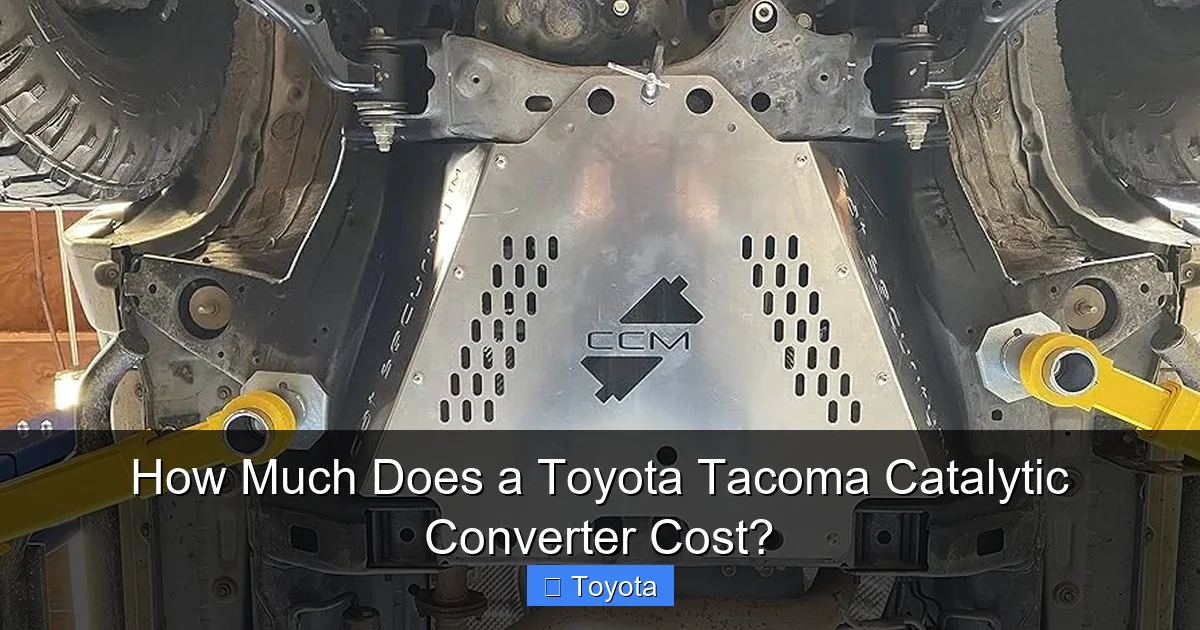
- Lifting the truck and removing skid plates.
- Unbolting or cutting out the old converter (old ones are often welded or rusted).
- Installing the new converter, sometimes with new gaskets and hardware.
- Welding or clamping it in place.
- Clearing any error codes and testing.
Labor time ranges from 2 to 4 hours per converter. At $100-$200 per hour shop rate, that’s $200-$800 total. Some shops charge a flat rate based on estimated time. Always ask for a labor estimate upfront.
Note: If your Tacoma has a dual exhaust system, both sides may need work, increasing labor. Also, if the converter is severely rusted, cutting it out takes extra time, raising the cost.
Additional Parts and Fees
Don’t forget these extras that can add to the bill:
- Oxygen sensors: Often replaced at the same time ($100-$300 each).
- Gaskets and seals: $20-$50.
- Exhaust hardware: Bolts, nuts, clamps ($30-$100).
- Welding: If welding is required, some shops charge extra ($50-$150).
- Shop supplies and disposal: Small fees for fluids, rags, and recycling the old converter ($20-$50).
- Taxes: Sales tax on parts and labor (varies by state).
Ask for a full itemized quote that includes these potential add-ons. That way, there are no surprises when you pick up your Tacoma.
Factors That Influence the Total Price
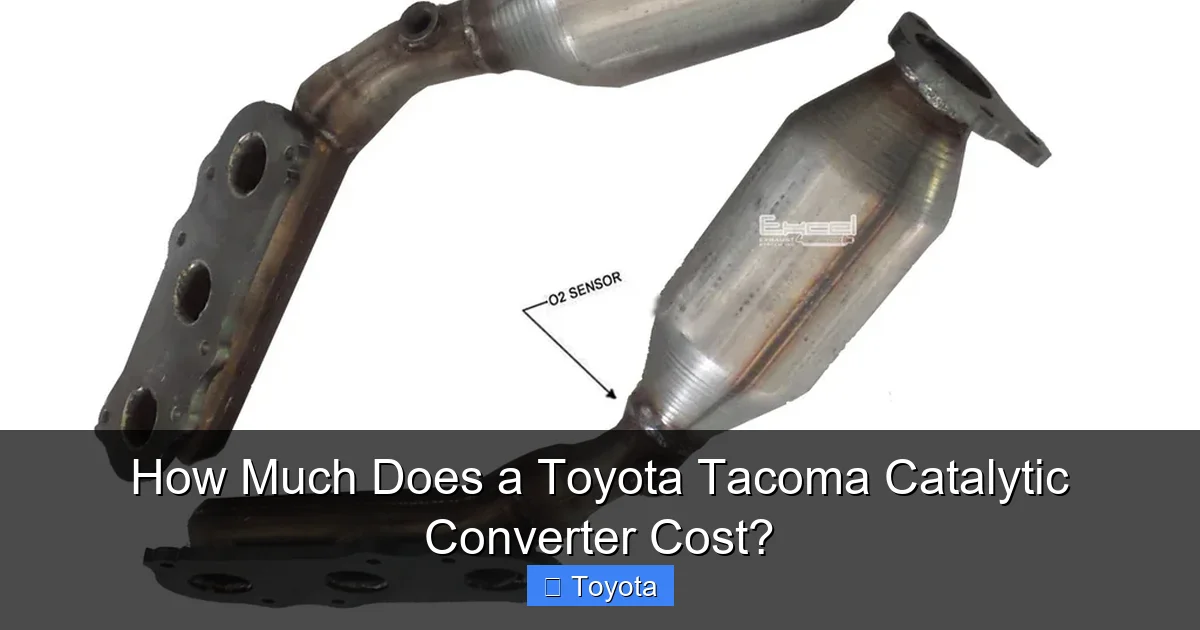
Even with the same parts, two Tacoma owners might pay different prices. Why? Several variables affect the final number.
Visual guide about How Much Does a Toyota Tacoma Catalytic Converter Cost?
Image source: excelexhaust.com
Model Year and Engine Type
As mentioned, newer models often have more complex emissions systems. A 2023 Tacoma’s converter might be more expensive than a 2005’s due to stricter regulations and advanced materials. Also, V6 engines typically cost more than 4-cylinders because they have two converters and sometimes larger, more sophisticated units.
Example: Replacing the single converter on a 2010 Tacoma 4-cylinder might cost $1,500 total. The same job on a 2022 Tacoma V6 could hit $4,000 because of two converters and higher part prices.
Geographic Location and Shop Rates
Labor rates vary wildly by region. In major cities like Los Angeles or New York, shops may charge $150-$200 per hour. In rural areas, $80-$120 is common. That difference can add hundreds to your bill.
Also, some states have higher costs for emissions-related parts due to regulations. California, for example, often requires converters that meet stricter standards, which can be pricier.
Tip: Get quotes from multiple shops in your area. Consider dealerships, independent mechanics, and exhaust specialists. Sometimes a mobile mechanic can offer lower rates.
Condition of the Exhaust System
If your Tacoma’s exhaust is rusty or damaged, the converter might be welded in place and impossible to remove without cutting. That means extra labor and possibly the need to replace sections of pipe or mufflers. A quick visual inspection can reveal this. If your truck is from a snowy region with road salt, expect higher labor costs due to corrosion.
Additionally, if other exhaust components are failing (like the muffler or pipes), it might be wise to replace them now to avoid future problems. That adds parts and labor but could save money long-term.
Smart Ways to Save Money on Catalytic Converter Replacement
Replacing a catalytic converter is a big expense, but you can reduce the sting. Here are proven strategies.
Shop Around for Quotes
Don’t just call one shop. Get at least three written estimates. Ask each to break down parts, labor, and additional fees. Compare apples to apples—OEM vs aftermarket, warranty length, and what’s included. Sometimes a slightly higher labor rate with a lower parts cost wins.
Pro tip: Call local parts stores (AutoZone, O’Reilly, Advance). They often sell converters and can recommend installers. Some even offer installation services themselves at discounted rates.
Consider Aftermarket or Refurbished Options
As noted, aftermarket parts can save 30-50%. But not all aftermarket is equal. Stick to brands with EPA certification and positive reviews. Look for “direct fit” or “OEM replacement” listings.
Refurbished or “remanufactured” converters are another option. These are used units that have been cleaned, tested, and sometimes have new catalyst material. They’re cheaper than new but may have shorter lifespans. Ask about the warranty—often 1 year vs 2+ for new aftermarket.
Warning: Avoid extremely cheap converters from unknown online sellers. They may not meet emissions standards, causing you to fail tests or even damage the engine.
DIY vs Professional Installation
If you’re handy with tools, you can save labor by doing it yourself. But this job is tough. It requires:
- Jack stands or a lift.
- Reciprocating saw or angle grinder if the old converter is welded.
- Wrenches, sockets, and possibly a torch.
- Welding skills if new welding is needed.
For most people, professional installation is wise. Mistakes can lead to exhaust leaks, failed inspections, or damage to oxygen sensors. If you DIY, ensure you have the right tools and knowledge. Watch tutorial videos for your specific Tacoma year.
Preventive Maintenance to Avoid Early Failure
The best way to save on a catalytic converter is to make it last as long as possible. Here’s how:
- Fix engine problems promptly: Misfires, rich fuel mixtures, or oil burning can poison the catalyst. If your check engine light is on, get it diagnosed immediately.
- Use high-quality fuel: Cheap gas with additives can leave deposits. Stick to top-tier brands when possible.
- Don’t ignore oxygen sensor codes: A bad O2 sensor can cause improper fuel mixture, overheating the converter.
- Regular oil changes: Clean oil prevents engine wear and oil consumption. Use the correct oil capacity for your Tacoma and change intervals.
- Avoid short trips: The converter needs to reach optimal temperature to burn off deposits. If you only drive short distances, consider occasional highway drives.
By maintaining your Tacoma’s engine, you protect the catalytic converter and extend its life, potentially avoiding replacement for 100,000+ miles.
Warning Signs of a Failing Catalytic Converter
Catching a problem early can sometimes save the converter. Watch for these symptoms:
- Check engine light: Common codes include P0420 (catalyst system efficiency below threshold) or P0430.
- Poor acceleration or “lugging”: The engine feels weak, especially when pressing the gas.
- Reduced fuel economy: You’re filling up more often.
- Dark or smelly exhaust: A sulfur-like “rotten egg” odor or black smoke.
- Failed emissions test: Your Tacoma won’t pass state inspection.
- Rattling noise: A broken catalyst substrate can rattle inside the canister.
If you notice any of these, get a diagnosis ASAP. Sometimes a clogged converter can be cleaned with additives, but often replacement is the only fix.
Common Symptoms to Watch For
Let’s dive deeper into a few key signs:
Check Engine Light: This is the most common indicator. Your Tacoma’s computer monitors oxygen sensor readings before and after the converter. If the downstream sensor sees too many pollutants, it sets a code. A simple scan at an auto parts store (often free) can confirm.
Performance Issues: A clogged converter acts like a kinked hose—exhaust can’t flow freely. You might notice the Tacoma struggles to gain speed, especially on inclines. It may feel like it’s “choking.”
Rattling Noise: If the internal ceramic honeycomb breaks apart (from age or impact), you’ll hear a metallic rattle from under the truck, especially when idling or revving.
When to Get a Diagnosis
Don’t wait. If the check engine light is flashing (not just steady), stop driving and get help. A flashing light indicates a severe misfire that can quickly overheat and destroy the converter. Even a steady light should be checked within a week.
Also, if you’re up for an emissions test, get the issue fixed beforehand. A failing converter will fail the test, and you’ll have to repair it anyway to renew your registration.
Replacing a catalytic converter on your Toyota Tacoma is a significant but manageable expense. By understanding the factors that influence cost—such as the number of converters, choice of parts, and labor rates—you can budget effectively and avoid surprises. Remember, regular maintenance is your best defense against premature failure. Keep your engine tuned, address problems quickly, and follow service intervals. If you do need a replacement, shop around, consider aftermarket options, and get a clear, itemized quote. With the right approach, you can get your Tacoma back on the road without breaking the bank.
While catalytic converter replacement is a major repair, it’s not the only cost associated with owning a Tacoma. You might also face expenses like painting your Tacoma if you want to restore its appearance after rust or damage. Being prepared for all potential costs helps you keep your truck running and looking great for years to come.
Frequently Asked Questions
How much does it cost to replace a Toyota Tacoma catalytic converter?
The total cost typically ranges from $1,400 to $4,300, depending on whether you have one or two converters and your choice of OEM or aftermarket parts. Labor adds $200-$800 to the parts cost.
How many catalytic converters does a Toyota Tacoma have?
Most Tacomas with a 4-cylinder engine have one catalytic converter, while V6 models usually have two. The exact number depends on the model year and engine type. Check your specific configuration for accurate information.
Can I drive my Tacoma with a bad catalytic converter?
You can drive short distances, but it’s not recommended long-term. A severely clogged converter can cause engine damage, poor performance, and failed emissions. If the check engine light is flashing, stop driving immediately.
What are the signs of a failing catalytic converter?
Common signs include a check engine light (often with codes P0420/P0430), poor acceleration, reduced fuel economy, a sulfur smell from the exhaust, rattling noises, and failed emissions tests.
Does insurance cover catalytic converter theft or damage?
Comprehensive auto insurance may cover catalytic converter theft if you have that coverage. Damage from hitting an object or rust is typically not covered. Check your policy for specifics and deductibles.
How long should a catalytic converter last on a Tacoma?
With proper maintenance, a catalytic converter can last 100,000 miles or more. However, engine problems, poor fuel quality, or short trips can shorten its life. Regular service helps maximize longevity.
