
How Many Miles Can a Toyota Camry Last on a Full Tank

The distance a Toyota Camry can travel on a full tank isn’t a single number—it varies significantly by model year, engine type, and driving conditions. Typically, a modern Camry with a 15.8-gallon tank and combined EPA rating of 28-32 MPG can cover roughly 440 to 500 miles. However, aggressive driving, heavy loads, and city traffic can reduce this by 20% or more, while highway cruising can push it higher. Understanding your specific Camry’s specs and habits is key to estimating your true range.
So, you’re planning a road trip or just wondering about your daily commute. The big question pops up: “How many miles can my Toyota Camry actually go on a full tank of gas?” It’s one of the most common questions for Camry owners, and for good reason. The answer isn’t as simple as looking at the gauge and doing quick math. A Toyota Camry’s range on a full tank is a dynamic number, a dance between its mechanical specifications and your real-world driving life. In this comprehensive guide, we’ll pop the hood on that question, breaking down every factor that influences your miles-per-tank. We’ll look at tank sizes across generations, the dramatic difference between a gas and hybrid model, how your foot on the pedal changes everything, and practical tips to squeeze every last drop of distance from your fill-up. By the end, you’ll have a clear, personalized estimate for your specific Camry and the knowledge to maximize it.
Key Takeaways
- Tank Size Matters: Camry gas tanks range from about 14.5 to 15.8 gallons depending on the model year and trim, directly impacting maximum possible distance.
- MPG is the Biggest Variable: Fuel efficiency, from 22 MPG in older V6 models to 52 MPG in hybrids, is the primary factor determining miles per tank.
- Real-World vs. EPA Estimates: Actual mileage often differs from EPA window sticker numbers due to driving style, terrain, weather, and vehicle maintenance.
- The “Reserve” is Key: When your gas light comes on, you typically have 1-2 gallons left, giving you a crucial buffer of 30-60 miles before empty.
- Driving Habits Have Massive Impact: Smooth acceleration, maintaining highway speeds around 65 mph, and proper tire inflation can add 50+ miles to your range per tank.
- Hybrid Models Offer Dramatically More Range: The Toyota Camry Hybrid’s superior MPG (up to 52 MPG combined) means it can often exceed 600 miles on a single tank.
- Know Your Specific Camry: The model year, engine (2.5L 4-cylinder, 3.5L V6, or hybrid), and drivetrain (FWD/AWD) define your baseline range potential.
📑 Table of Contents
- The Foundation: Fuel Tank Capacity Across Camry Generations
- The Heart of the Matter: Miles Per Gallon (MPG) by Model and Year
- The Real World: Why Your Mileage Will (Probably) Differ
- Maximizing Your Miles Per Tank: Practical, Actionable Tips
- Model Year and Powertrain Comparisons: What Gives the Best Range?
- Putting It All Together: How to Calculate *Your* Number
The Foundation: Fuel Tank Capacity Across Camry Generations
Before we can calculate potential distance, we must know the starting point: how much fuel the tank holds. This is your maximum raw material. The Toyota Camry’s fuel tank capacity has evolved slightly over its long production run, generally settling into a range that balances range with packaging space. For most model years from the mid-2000s onward, you’re looking at a capacity between 14.5 and 15.8 gallons.
Modern Camry (2012-Present)
The current and recent generations (XV50, XV70) are fairly consistent. The vast majority of gasoline-powered models (LE, SE, XLE, XSE trims) are equipped with a 15.8-gallon tank. This is the standard you’ll most commonly encounter. The high-performance TRD model, with its sport-tuned suspension and sometimes different underbody shielding, also uses this 15.8-gallon tank. For the hybrid models (LE and XLE trims), Toyota uses a slightly smaller, but still substantial, 14.5-gallon tank. The hybrid’s superior fuel efficiency more than compensates for the 1.3-gallon deficit, as we’ll see later. If you own a 2012 or newer Camry, your tank is almost certainly one of these two sizes. For precise confirmation, your owner’s manual is the ultimate authority, but these figures are reliable for planning.
Previous Generations (2002-2011)
The previous generation (XV40) also primarily used a 15.8-gallon tank for most 4-cylinder and V6 models. Some very early base-model variants from the early 2000s might have a 15.1-gallon tank, but the difference is negligible for our overall range calculations. The key takeaway here is stability: for about the last 15 years, Toyota has standardized on a large, single tank size for the vast majority of its Camry lineup, simplifying our math. If you need the exact capacity for your specific year and trim, a quick check of your manual or a reputable source like this detailed guide on Camry gas tank sizes will give you the definitive number.
The Heart of the Matter: Miles Per Gallon (MPG) by Model and Year
Tank size sets the upper limit, but miles per gallon (MPG) is the engine that determines how far you actually go. This is where the story splits dramatically. The Toyota Camry is offered with three primary powertrain options: a fuel-efficient 4-cylinder, a more powerful V6, and the ultra-efficient hybrid system. Each has a vastly different MPG profile, and EPA estimates have improved over time thanks to engine technology and transmission refinements.
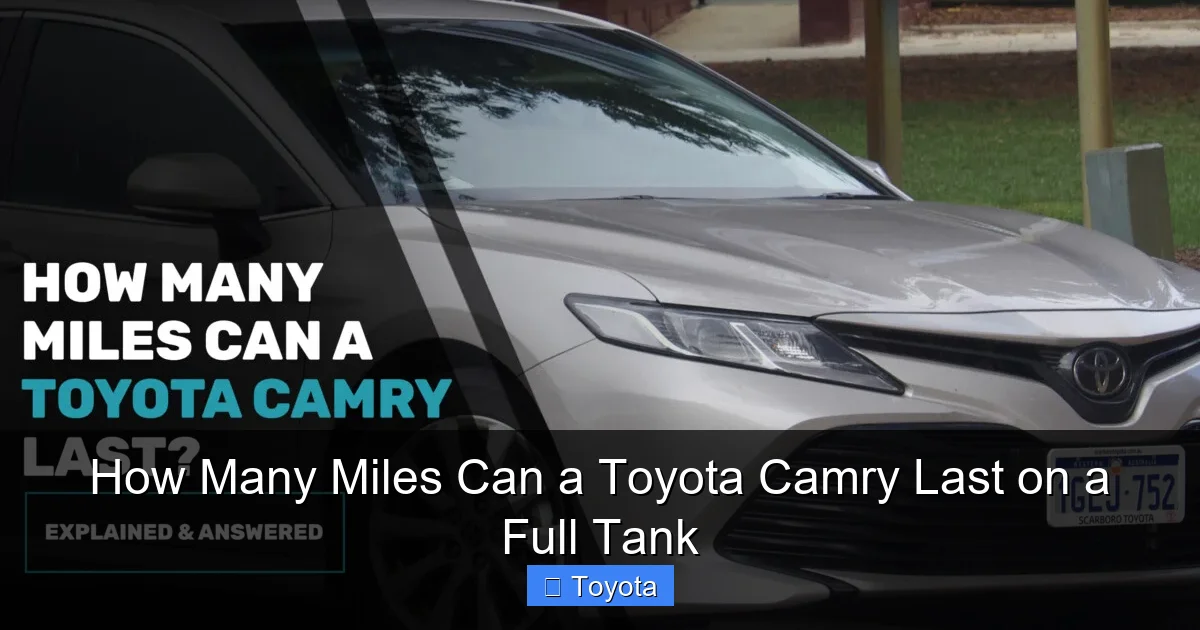
Visual guide about How Many Miles Can a Toyota Camry Last on a Full Tank
Image source: drivecanvas.com
Gasoline 4-Cylinder Models (The Volume Seller)
The 2.5-liter 4-cylinder engine is the workhorse of the Camry lineup. For the current 2023-2024 models, the EPA estimates are impressive:
- City/Highway/Combined: 28 MPG city / 39 MPG highway / 32 MPG combined for most FWD models.
- With AWD (available on some trims): Slightly lower, typically 25 city / 34 highway / 28 combined.
Older 4-cylinder models from, say, 2012-2017 were less efficient, often rating around 24-25 city / 35 highway. To calculate a realistic full-tank range for a typical modern FWD 4-cylinder Camry, we use the combined MPG and the 15.8-gallon tank: 32 MPG combined * 15.8 gallons = approximately 506 miles. That’s the theoretical maximum under mixed driving conditions. On a pure, steady-state highway trip, you could realistically approach the 39 MPG highway rating, yielding 39 * 15.8 = 616 miles—a significant jump.
V6 Models (Power and a Penalty)
The 3.5-liter V6 offers a satisfying power boost but consumes more fuel. Current V6 Camrys (XSE V6, XLE V6) are rated at 22 city / 33 highway / 26 combined MPG. Using the same 15.8-gallon tank: 26 MPG combined * 15.8 gallons = about 411 miles. The highway-focused potential is 33 * 15.8 = 521 miles. You see the trade-off: roughly 100 fewer miles on a full tank compared to the efficient 4-cylinder for the added 100+ horsepower. For performance-oriented drivers, this is the calculated compromise.
The Hybrid Champion: Unmatched Range
This is where the numbers get staggering. The Camry Hybrid uses a 2.5-liter 4-cylinder engine paired with electric motors. Its EPA ratings for recent models are: 44 city / 47 highway / 44 combined MPG (for LE trim) and 44/44/44 for the slightly heavier XLE trim. Remember, it has a smaller 14.5-gallon tank. The math: 44 MPG combined * 14.5 gallons = 638 miles. That’s a number most gasoline models can’t touch, even on their best highway runs. On a long highway cruise, the hybrid’s system is exceptionally efficient, and many owners report real-world averages of 45-48 MPG, pushing that range to 650+ miles on a single tank. The hybrid isn’t just about saving gas stations; it’s about fundamentally redefining what “a full tank” means in terms of distance. You can see how this compares to other Toyota hybrids by exploring models like the Avalon Hybrid, which shares similar powertrain philosophy in a larger package.
The Real World: Why Your Mileage Will (Probably) Differ
Here’s the crucial part. EPA numbers are achieved in controlled laboratory conditions. Your actual miles per tank are a story written by your driving habits, your environment, and your car’s health. Let’s break down the major variables that can swing your range by 50, 100, or even 200 miles.
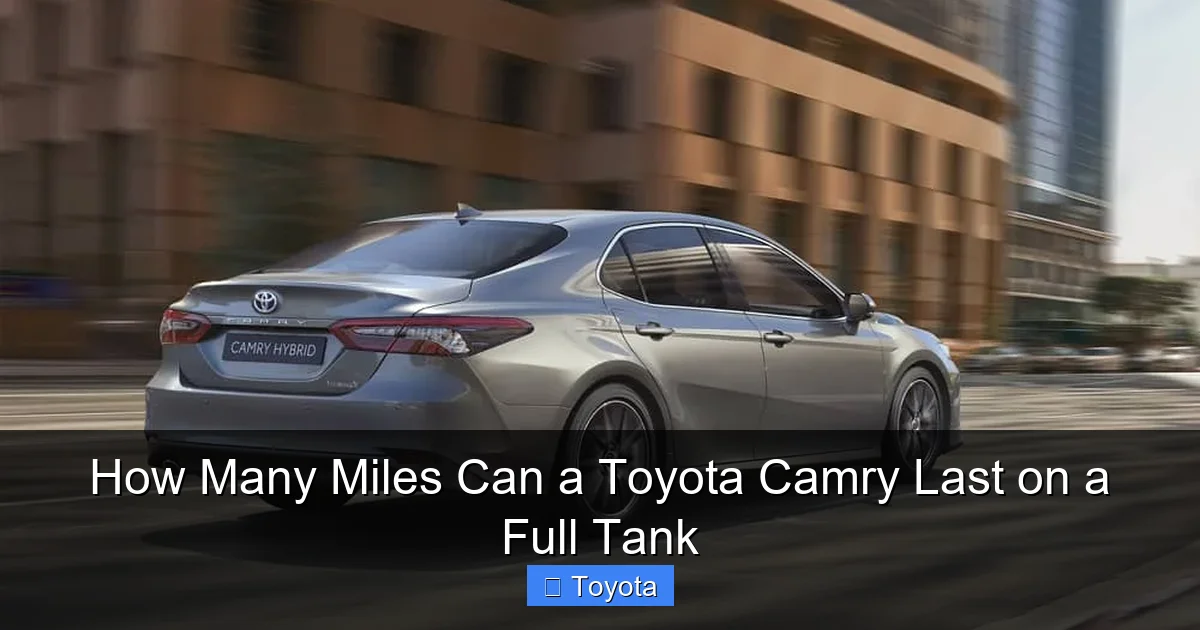
Visual guide about How Many Miles Can a Toyota Camry Last on a Full Tank
Image source: drivingonroad.com
Driving Style: The Lead Foot vs. The Zen Master
This is the single largest controllable factor. Aggressive acceleration, hard braking, and speeding are the enemies of efficiency. Rapid acceleration from a stop might feel fun, but it forces your engine to work in its least efficient power band and wastes the kinetic energy you just built up when you brake. Conversely, a smooth, anticipatory driving style—gentle acceleration, coasting to stops, and maintaining a steady speed—can dramatically improve your real-world MPG. A driver who practices this “hypermiling” technique can often achieve 5-10 MPG better than the EPA combined rating in mixed driving. On the highway, speed is the killer. Aerodynamic drag increases exponentially with speed. Driving at 75 mph versus 65 mph can reduce fuel economy by 10-15% or more. For a Camry getting 32 MPG at 65 mph, that drop could mean only 27-28 MPG at 75 mph, costing you 50+ miles on a full tank.
Environment and Terrain: Hills, Weather, and Traffic
You cannot control the weather or the road, but you must account for them. Hilly terrain is a major range reducer. Climbing grades requires significant extra power, and descending them rarely recovers all that energy (unless you’re in a hybrid, which can sometimes regenerate a small amount). Constant stop-and-go city traffic in a gasoline Camry is the worst-case scenario for MPG, as your engine is idling and working hard from low speeds. Cold weather is another hidden enemy. Engines run less efficiently when cold, taking longer to reach optimal temperature. Winter blend gasoline has less energy content. You’re also more likely to use the heater and defroster, which place a load on the engine (in gas models) or battery (in hybrids). A 20-30% drop in MPG during a harsh winter month is not uncommon. Conversely, warm weather with gentle breezes is ideal for highway efficiency.
Vehicle Health and Maintenance
A well-maintained Camry is an efficient Camry. Proper tire inflation is critical. Under-inflated tires create more rolling resistance. A drop of just 5 PSI below the recommended pressure (found on the driver’s door jamb sticker) can reduce fuel economy by 2-3%. Engine oil viscosity matters. Using the correct grade of oil, as specified in your manual, ensures minimal internal friction. Air filter cleanliness is another factor; a clogged filter starves the engine of air, forcing it to work harder. Wheel alignment and brake caliper drag (from seized pins) also create parasitic drag that sips fuel. Regular maintenance isn’t just about longevity; it’s directly tied to your miles per tank. Following the recommended service schedule, especially for things like spark plugs and oxygen sensors, keeps your engine running at its designed efficiency peak.
Maximizing Your Miles Per Tank: Practical, Actionable Tips
Armed with the knowledge of what affects range, you can become a proactive manager of your fuel. The goal is to turn your Camry’s potential range into a consistent, reliable reality. Here are the highest-impact strategies.
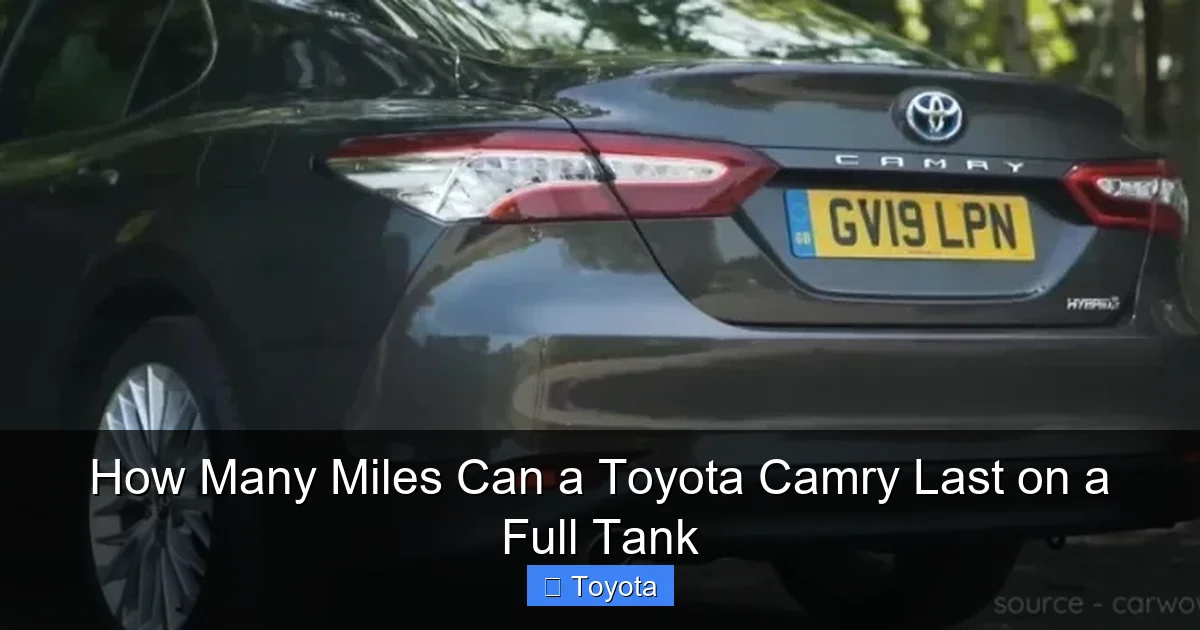
Visual guide about How Many Miles Can a Toyota Camry Last on a Full Tank
Image source: vehicleic.com
Drive with a Purpose (and Patience)
This is the golden rule. Practice smooth, predictable driving. Look far ahead at traffic lights and signs. If you see a red light ahead, start coasting early instead of racing to it and braking hard. Use cruise control on flat, open highways to maintain a constant, efficient speed (typically between 55-65 mph). Avoid excessive idling; if you’re stopped for more than 60 seconds, turning the engine off (in non-hybrids) saves fuel. These habits don’t require special equipment—just a change in mindset—and can yield immediate improvements in your fuel log.
Optimize Your Camry’s Physical State
Get in the habit of checking your tire pressure monthly with a good gauge, and inflate to the manufacturer’s recommended PSI (not the max on the tire sidewall). Remove unnecessary weight from the car. Every 100 pounds of extra cargo reduces MPG by about 1%. That set of golf clubs or bags of sand in the trunk is literally costing you miles. If you have a roof rack or cargo carrier, remove it when not in use, as it creates significant aerodynamic drag. Use the recommended motor oil. Consider switching to a low-rolling-resistance tire when it’s time for replacements—they are designed specifically to improve fuel economy.
Plan Your Trips and Know Your Reserve
Combine errands into one trip. A warm engine is far more efficient than a cold one, so doing all your stops in one go after the car has warmed up is better than multiple short trips with cold starts. Use your navigation system to check for traffic and choose routes with fewer stops and lower speed limits when possible. Finally, know your reserve. The gas light isn’t a immediate “empty” warning. For most Camrys, when the low fuel light illuminates, you still have roughly 1.5 to 2 gallons of fuel remaining, giving you a safe buffer of 30-60 miles (depending on your MPG) to find a station. This knowledge reduces anxiety and helps you plan refueling stops strategically on long trips, avoiding last-minute scrambles for gas. For a precise figure on your model, you can research how many miles you can typically drive after the gas light comes on in a Camry.
Model Year and Powertrain Comparisons: What Gives the Best Range?
Let’s synthesize the data. If maximizing distance on a single tank is your top priority, the choice is clear. The table below illustrates the approximate maximum and typical real-world ranges for the most common Camry configurations, assuming a 15.8-gallon tank for gas models and 14.5 for hybrid.
Approximate Camry Range Comparison (Full Tank)
- 2023-2024 Camry Hybrid (FWD): EPA Combined: ~638 miles. Real-world mixed driving: 550-650+ miles. Highway-focused: 650-700+ miles. (The undisputed range king.)
- 2023-2024 Camry 4-Cylinder (FWD): EPA Combined: ~506 miles. Real-world mixed driving: 400-480 miles. Highway-focused: 550-600 miles.
- 2023-2024 Camry 4-Cylinder (AWD): EPA Combined: ~442 miles. Real-world mixed driving: 350-420 miles. Highway-focused: 480-530 miles.
- 2023-2024 Camry V6: EPA Combined: ~411 miles. Real-world mixed driving: 330-390 miles. Highway-focused: 450-500 miles.
- 2012-2017 Camry 4-Cylinder: EPA Combined: ~450 miles (with 15.8-gal tank). Real-world mixed driving: 350-420 miles.
The hybrid’s advantage is overwhelming. For the gasoline models, the difference between a conservative driver and an aggressive one in the same car can be as wide as the gap between the 4-cylinder and V6. An important note on AWD: All-Wheel Drive, while great for traction, adds weight, drivetrain friction, and sometimes requires a different transmission tuning, which inevitably reduces fuel economy—and thus range—compared to the identical FWD model. If your priority is maximum range and you don’t need AWD, the FWD 4-cylinder is your best gasoline choice.
Putting It All Together: How to Calculate *Your* Number
So, how do you get a personalized, accurate estimate for your specific Toyota Camry? Follow this three-step process.
Step 1: Identify Your Exact Powertrain and Tank Size
Look at your window sticker (or Monroney label) for the “EPA Fuel Economy” section. It lists the official MPG city/highway/combined for your exact model year, engine, and drivetrain. Also, confirm your fuel tank capacity from your owner’s manual or a trusted online source. For example: “2020 Camry SE 4-cylinder FWD, 15.8-gallon tank, 29 city / 41 highway / 34 combined MPG.”
Step 2: Assess Your Real-World MPG
The EPA number is a benchmark, not your prophecy. The most accurate method is to do a manual calculation. Next time you fill up, reset your trip meter to zero. Drive normally until you need to refuel again. At the pump, note how many gallons it takes to fill the tank. Your real MPG is: Miles driven on that tank (trip meter reading) ÷ Gallons added. Do this a few times to get a solid average that reflects *your* driving, routes, and conditions. If you don’t want to wait, use your car’s trip computer average MPG reading, but know it can be slightly optimistic.
Step 3: Do the Math and Add a Safety Margin
Take your real-world average MPG and multiply it by your tank’s *usable* capacity. But don’t use 100% of the tank. It’s bad for the fuel pump (which is liquid-cooled and lubricated by gas) and risky. A safe practice is to consider only about 90-95% of the tank as usable for regular driving. So, for a 15.8-gallon tank, use 15.0 gallons. Formula: Real-World MPG x 0.95 x Total Tank Capacity = Reliable Full-Tank Range.
Example: Your 2020 Camry SE shows a real-world average of 32 MPG. Calculation: 32 MPG x 0.95 x 15.8 gal = 32 x 14.51 = 464 miles. This is a realistic, conservative number you can plan around. You’ll notice your car’s range indicator (if equipped) will likely show a number close to this when you fill up. For hybrid owners, the same formula applies with their higher MPG and smaller tank.
Frequently Asked Questions
Does the Toyota Camry have a reserve fuel tank?
No, the Camry does not have a separate, physical reserve tank. The “reserve” is simply the fuel remaining in the main tank after the fuel gauge reads empty and the low fuel warning light illuminates. This typically amounts to about 1.5 to 2 gallons of fuel, providing a 30-60 mile buffer depending on your model’s efficiency.
How does cold weather affect my Camry’s miles per tank?
Cold weather can reduce your Camry’s fuel economy by 15-30%. Engines take longer to warm up to their efficient operating temperature, winter gasoline has less energy density, and using the heater and defroster adds engine load. For a 4-cylinder Camry normally getting 32 MPG, you might see real-world averages drop to 26-28 MPG in very cold conditions, significantly reducing your full-tank range.
Will using premium gas increase my Camry’s range?
For the vast majority of Toyota Camry models, no. Toyota explicitly states that regular 87-octane gasoline is the recommended and sufficient fuel for all non-turbocharged engines (the standard 2.5L 4-cylinder and 3.5L V6). Using premium will not improve fuel economy or power and is an unnecessary expense. Only if your specific, rare high-performance or turbocharged variant (not standard in US Camrys) requires premium should you use it.
What is the absolute maximum range I could get from a Camry Hybrid on the highway?
Under ideal, hyper-miling conditions—flat terrain, no wind, steady 55-60 mph speed, perfectly maintained tires, and a single driver—a Camry Hybrid can approach or even slightly exceed its EPA highway rating of 47 MPG. With its 14.5-gallon tank, that potential is 47 x 14.5 = 681 miles. Most real-world highway drives with normal traffic and speeds (65-70 mph) will yield 44-46 MPG, for a very comfortable 640-670 miles on a full tank.
How many miles can I expect to drive after the gas light comes on in my Camry?
When the low fuel light (a yellow gas pump icon) illuminates on your dashboard, you generally have between 30 and 60 miles of driving range remaining. This varies by model year and your current MPG. A fuel-efficient 4-cylinder might be at the higher end of that range, while a V6 might be at the lower end. It’s a warning to refuel soon, not an exact countdown to zero. You can find model-specific estimates by researching how many miles you can drive when the gas light comes on in your specific Toyota Camry.
Is the range of a Camry similar to other midsize sedans like the Honda Accord or Nissan Altima?
Yes, the Camry is highly competitive. Modern, efficient 4-cylinder versions of the Honda Accord and Nissan Altima have very similar EPA ratings and real-world ranges to the Camry 4-cylinder, typically offering 450-500 miles of combined range. The Camry Hybrid, however, often holds a slight edge in combined MPG over its direct hybrid competitors, giving it a potential range advantage. For comparison, you can look at the range of other reliable sedans like the Nissan Maxima, which is a more powerful V6 option, to see the trade-offs between power and efficiency.
=== STRONG CONCLUSION ===
Ultimately, the question “how many miles can a Toyota Camry last on a full tank?” has a personalized answer written in the intersection of your car’s specifications and your driving reality. The hardware provides the potential—a 15.8-gallon tank paired with 26-52 MPG creates a baseline range from the high 300s to the mid-600s. But the final number is authored by you. Your gentle acceleration on the highway, your properly inflated tires, and your commitment to routine maintenance are the variables that unlock the higher end of that spectrum. The hybrid model offers a monumental leap in range for those who prioritize it, turning the act of refueling into a quarterly event rather than a monthly chore. By understanding these dynamics and applying the practical tips outlined, you transform your Camry from a simple point-A-to-point-B device into a finely-tuned instrument of efficiency, squeezing every possible mile from every precious gallon. The next time you fill up, you’ll know exactly what your tank is truly capable of.
