
How Many Gallons of Gas Can Fit in a Toyota Corolla?

The Toyota Corolla’s gas tank capacity typically ranges from 13.2 to 13.9 gallons depending on the model year and trim level. The most common size for recent models is 13.2 gallons. Knowing your specific tank capacity is crucial for calculating driving range, planning trips, and understanding your vehicle’s fuel efficiency limits. Always consult your owner’s manual for the precise figure for your particular Corolla.
Ever found yourself staring at the gas pump, wondering if you can squeeze in that last gallon? Or maybe you’re planning a long road trip and need to know exactly how far your Toyota Corolla can go before needing a pit stop. The simple question, “How many gallons of gas can fit in a Toyota Corolla?” has a more nuanced answer than you might think. It’s not just a single number; it’s a specification that varies slightly across generations and holds the key to understanding your car’s true range. This guide will dive deep into the fuel tank capacity of every Toyota Corolla, from the latest models to the classics, and explain what that number really means for you as a driver.
Key Takeaways
- Standard Capacity: Most modern Toyota Corollas (2014-Present) have a fuel tank capacity of 13.2 gallons (50 liters).
- Historical Variation: Older models (pre-2014) and some specific trims may have slightly different capacities, often around 13.9 gallons (52.6 liters).
- Design Factors: The tank’s physical size is fixed, but design elements like the fuel pump module and evaporative emission system occupy internal volume.
- Not “Full” at Pump Click: The rated capacity is the *maximum safe fill*. Pump nozzles have anti-spill devices, so you rarely achieve 100% of the rated volume.
- Range Calculation: Your real-world driving range is tank capacity multiplied by your average MPG, not the theoretical maximum.
- Critical for Trip Planning: Knowing your tank’s capacity helps you calculate safe refueling intervals and avoid running out of gas.
- Consult Your Manual: The definitive source for your Corolla’s exact fuel tank capacity is the manufacturer’s specifications in your owner’s manual.
📑 Table of Contents
- Understanding Fuel Tank Capacity: It’s More Than Just a Number
- A Model-by-Model Breakdown: Corolla Fuel Tank Sizes Through the Years
- The Hidden Variables: What Truly Affects Your Usable Fuel
- Real-World Range: Capacity Meets Efficiency
- Practical Tips for Maximizing Your Corolla’s Fuel Potential
- Maintenance and Your Fuel System: Protecting the Tank’s Integrity
- Conclusion: Your Corolla’s Tank in a Nutshell
Understanding Fuel Tank Capacity: It’s More Than Just a Number
When we talk about a car’s fuel tank capacity, we’re referring to the total internal volume designed to hold liquid fuel. This is a fixed measurement determined during the vehicle’s engineering and manufacturing process. For the Toyota Corolla, a car celebrated for its efficiency and reliability, this number is a core part of its identity. However, it’s crucial to understand that the “rated” or “nominal” capacity listed in your owner’s manual is a maximum safe fill volume. It accounts for something called “ullage”—the space left at the top of the tank to allow for fuel expansion as temperatures rise. Overfilling beyond this point can damage your evaporative emission (EVAP) system and is simply unsafe.
The Rated Capacity vs. What You Actually Pump
You might have experienced this: the pump clicks off, the display shows you’ve pumped 12.8 gallons, but your manual says the tank holds 13.2 gallons. Where did the missing 0.4 gallons go? It’s a combination of factors. First, modern gas pumps are equipped with a “stop-flow” sensor that triggers when fuel reaches the filler neck, preventing liquid from spilling out. Second, there is always a small amount of vapor space (ullage) at the very top of the tank that cannot be filled with liquid. Third, the fuel you’re pumping might be slightly warmer or cooler than the standard temperature used for volume measurement (usually 60°F/15°C), causing minor expansion or contraction. So, seeing a few tenths of a gallon less than the rated capacity at the pump is perfectly normal and indicates the system is working correctly.
Why This Number Matters to You
Knowing your Corolla’s exact fuel tank capacity isn’t just trivia. It’s a practical tool for:
- Trip Planning: Calculating how often you need to stop on long journeys.
- Fuel Economy Verification: You can accurately calculate your real-world miles per gallon (MPG) by dividing miles driven by gallons used between full tanks.
- Understanding Warning Lights: Knowing your tank size helps you estimate how many miles you have left when the low fuel light illuminates. While this varies with driving conditions, a common rule of thumb is 30-50 miles remaining. For a deeper dive into your specific model’s warning range, you can read our detailed article on how many miles you can drive after the gas light comes on in a Toyota Corolla.
- Avoiding Damage: Understanding why you shouldn’t constantly drive with the tank near empty helps protect your fuel pump, which is cooled by being submerged in gasoline.
A Model-by-Model Breakdown: Corolla Fuel Tank Sizes Through the Years
The Toyota Corolla has been in continuous production since 1966, evolving through numerous generations. The fuel tank design has been optimized for packaging (fitting within the vehicle’s chassis), weight distribution, and safety over the decades. Let’s break down the capacities for the most relevant modern generations.
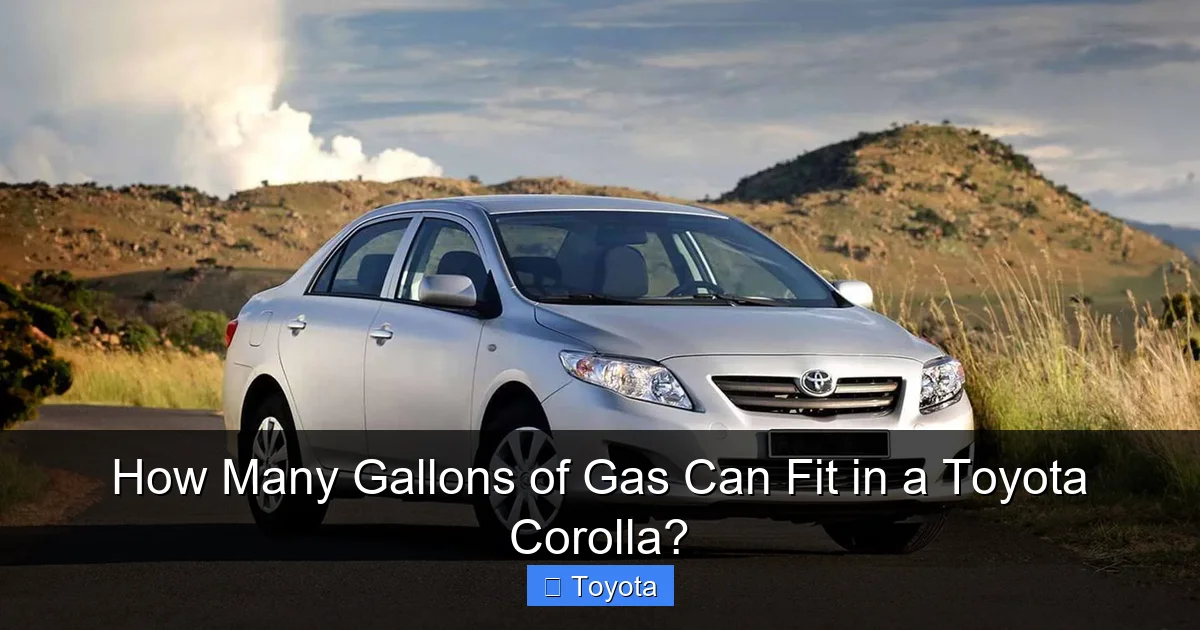
Visual guide about How Many Gallons of Gas Can Fit in a Toyota Corolla?
Image source: lionharttires.com
The Current Generation (E210: 2018-Present)
The current, eleventh-generation Corolla (introduced for the 2018 model year in some markets, 2019 in North America) features a sleek new design but retains the practical efficiency of its predecessors. For this generation:
- All Sedan and Hatchback Models: The fuel tank capacity is consistently 13.2 gallons (50.0 liters). This includes the base L, mid-grade LE, sporty SE, and top-tier XLE trims for sedans, and the SE and XSE trims for the hatchback.
- Engine Variants: This capacity is shared across the entire range, whether you have the efficient 1.8L 4-cylinder (L/LE) or the more powerful 2.0L Dynamic Force engine (SE/XLE/XSE). The tank is the same physical unit; the engine does not change its size.
This standardization simplifies manufacturing and ownership. Whether you’re in a basic commuter Corolla or a slightly peppier model, your maximum fuel hold is identical.
The Previous Generation (E170/E180: 2014-2019)
The tenth-generation Corolla, produced from the 2014 through 2019 model years, was a massive seller and is still incredibly common on roads today. Its fuel tank capacity is also very consistent:
- Standard Capacity: 13.2 gallons (50.0 liters) for nearly all trims (L, LE, S, SE, XLE).
- Notable Exception: The Corolla iM (the compact hatchback model offered from 2017-2018) had a slightly smaller tank of 12.4 gallons (47.0 liters). This was due to different rear suspension and cargo area packaging requirements.
For the vast majority of buyers shopping for a used Corolla from this era, the 13.2-gallon figure is what they will encounter. This generation cemented the 13.2-gallon standard for the mainstream Corolla sedan.
Older Generations (Pre-2014)
Going further back, we see a slight increase in some models. For example:
- Ninth Generation (E120/E130: 2009-2013): The sedan and matrix variants typically held 13.2 gallons. However, some specific market and early production models were rated for 13.9 gallons (52.6 liters).
- Eighth Generation (E110: 2003-2008): The standard sedan capacity was often 13.2 gallons, but again, some trims and model years list 13.9 gallons.
The variance in older models can be due to minor changes in tank molding, filler neck design, or even regional specifications. If you own a Corolla from before 2010, your best bet is to check the driver’s side door jamb sticker or your owner’s manual for the definitive “Cap” or “Fuel Tank Capacity” number.
Comparison with Other Popular Toyotas
To put the Corolla’s tank size in perspective, it’s helpful to compare it with other vehicles in Toyota’s lineup. The Corolla is a compact sedan/hatchback, so its tank is designed for efficiency over long-haul capacity. For instance, the midsize Toyota Camry typically holds 15.8 gallons, while the compact crossover Toyota RAV4 holds about 14.5 gallons. The full-size Toyota Highlander SUV’s tank is significantly larger, often around 17.2 gallons, to accommodate its lower fuel economy and family-hauling purpose. The Corolla’s 13.2-gallon tank is a perfect balance for its class, offering a competitive range without adding unnecessary weight or compromising interior space.
The Hidden Variables: What Truly Affects Your Usable Fuel
So you know your Corolla’s manual says 13.2 gallons. But why can you sometimes only fit 12.5 after the pump clicks off? Several engineering and environmental factors play a role in the actual volume of gasoline you can introduce into your tank.
Visual guide about How Many Gallons of Gas Can Fit in a Toyota Corolla?
Image source: m.media-amazon.com
Manufacturing Tolerances and “Book” Capacity
The stamped metal or high-density polyethylene tank shell has a designed volume. However, no two tanks are exactly identical due to manufacturing tolerances. The “rated capacity” is an average or minimum guarantee. Your specific tank might have a very slightly different internal volume. Furthermore, components inside the tank—the fuel pump module, the fuel level sensor, the baffles that prevent fuel sloshing—all take up physical space. This “occupied volume” is factored into the rated capacity calculation, but minor assembly variations can change it infinitesimally.
The Role of the Evaporative Emission (EVAP) System
This is a major reason you can’t fill a tank to 100%. The EVAP system is designed to capture gasoline vapors from the tank and route them to the engine to be burned, preventing them from escaping into the atmosphere. A key part of this system is the “canister” and the “purge valve,” but critically, the system requires a dedicated vapor space at the top of the tank. This space allows for fuel expansion as it gets hot (gasoline expands significantly with temperature) and provides a chamber for vapors to collect before they are purged. If you overfill and liquid gasoline enters the EVAP canister, it can saturate it, leading to a diagnostic trouble code, poor engine performance, and costly repairs. The pump’s auto-shutoff is primarily there to protect this system.
Temperature and Fuel Density
Gasoline, like most liquids, expands when it gets warm and contracts when it gets cold. The rated capacity is based on a standardized temperature (usually 60°F or 15.6°C). If you fill up on a very hot day, the fuel is warmer and less dense. You are physically putting more *molecules* into the tank to reach the same liquid level, but the pump’s meter measures volume, not mass. Conversely, filling in very cold weather means denser fuel. This temperature variation can cause a difference of 1-2% in the actual volume you can pump compared to the rated capacity. This is why you might get more “gallons” in the winter for the same money if the price is per gallon (volume), but the energy content (mass) is similar.
Real-World Range: Capacity Meets Efficiency
Knowing your tank holds 13.2 gallons is only half the equation. The magic number for road trips is your driving range. This is calculated as: Tank Capacity (gallons) x Average MPG = Total Miles on a Full Tank.
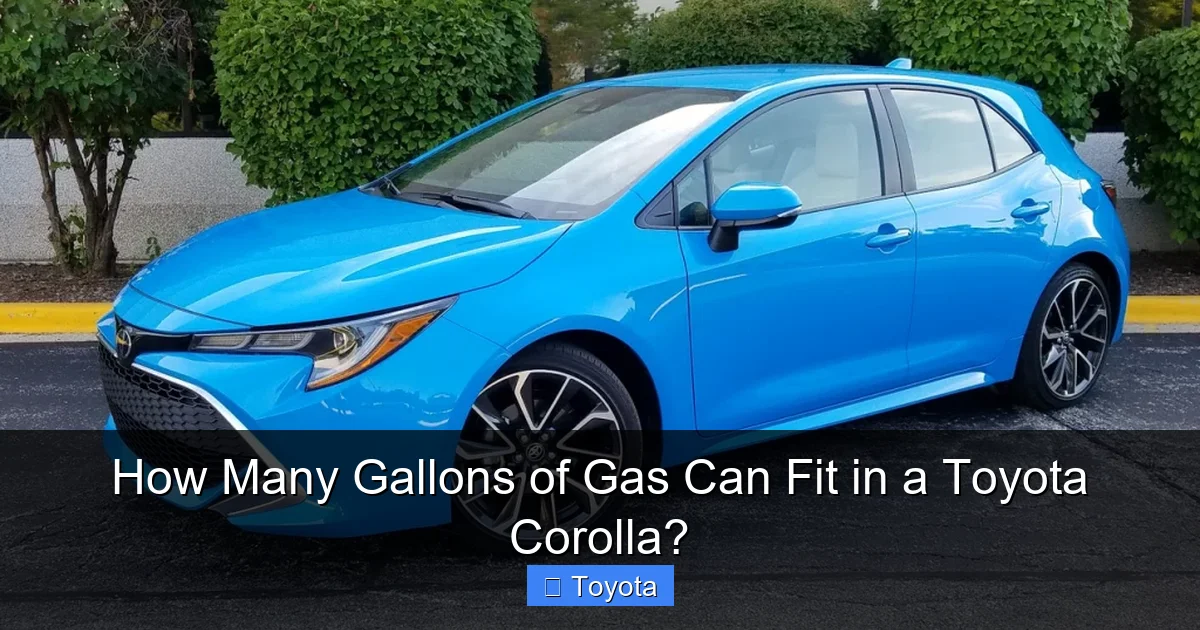
Visual guide about How Many Gallons of Gas Can Fit in a Toyota Corolla?
Image source: blog.consumerguide.com
Estimating Your Corolla’s Range
The Toyota Corolla is famous for its fuel efficiency. EPA ratings for recent models (2019+) with the standard 1.8L engine and CVT are:
- City: ~30 MPG
- Highway: ~38 MPG
- Combined: ~33 MPG
Using the conservative combined figure and the 13.2-gallon tank:
13.2 gallons x 33 MPG = 435.6 miles (theoretical maximum range).
Of course, this is an ideal estimate. Real-world range depends heavily on driving style, terrain, traffic, weather (cold reduces efficiency), and vehicle maintenance. Aggressive driving, mountainous roads, and using the AC constantly can reduce your actual range by 15-25%. A more realistic “daily driver” expectation might be 350-400 miles per tank for mixed driving.
The Gas Light: Your Critical Warning System
When that low fuel warning light (usually a yellow gas pump icon) illuminates on your dashboard, it’s not an exact “0 miles remaining” indicator. It’s a pre-programmed warning that your fuel level has dropped below a certain threshold, typically when about 1.0 to 2.0 gallons remain. This reserve is a safety buffer. How far you can go after it comes on depends entirely on your driving conditions at that moment. At a steady 60 mph on a flat highway, you might squeeze out 40-50 miles. In stop-and-go city traffic with the AC blasting, you might only get 20-25 miles. It is never advisable to routinely test this limit. Consistently driving with a very low tank can cause the fuel pump to overheat (as it relies on gasoline for cooling and lubrication) and can also stir up sediment from the bottom of the tank, potentially clogging your fuel filter or injectors. For specifics on your model’s estimated reserve, our article on miles after the gas light comes on in a Toyota Corolla provides model-specific insights and crucial safety advice.
Practical Tips for Maximizing Your Corolla’s Fuel Potential
Now that you understand the “what” and “why” of your fuel tank, let’s talk about the “how”—how to use this knowledge to your advantage.
Don’t Game the “Click”
It can be tempting to keep slowly pumping after the nozzle clicks off to get every last drop. Resist this urge. That click is your friend and your EVAP system’s protector. Trying to “top off” by jiggling the nozzle or holding it manually can force liquid fuel into the vapor recovery system. This can lead to a check engine light, failed emissions tests, and expensive repairs. The few cents you might save are not worth the risk. Accept that the pump’s auto-shutoff volume is your practical, safe maximum.
Plan Refueling Based on Trip, Not Just the Light
Don’t wait for the gas light to become your primary refueling trigger. A better habit is to refuel when your tank reaches about 1/4 full. This gives you a comfortable buffer for unexpected detours or traffic delays, reduces stress on the fuel pump by ensuring it’s regularly submerged, and often allows you to find a gas station at a more convenient time and location. For long highway trips, plan your stops around your calculated range (e.g., every 350-400 miles), even if the light hasn’t come on.
Use Your Odometer for Accurate Tracking
Want to calculate your true, real-world MPG? Here’s the simple method: 1) Fill your tank completely until the pump clicks off. 2) Reset your trip odometer to zero. 3) Drive normally until you need to refuel again. 4) Fill the tank completely again and note the number of gallons pumped. 5) Divide the miles on your trip odometer by the gallons pumped. This gives you your actual MPG. Doing this a few times will give you a solid baseline for your driving habits and conditions, allowing you to accurately predict your range from your 13.2-gallon tank.
Maintenance and Your Fuel System: Protecting the Tank’s Integrity
Your fuel tank is more than just a plastic or metal box. It’s part of a complex, sealed system. Proper maintenance ensures it functions safely and efficiently for the life of the vehicle.
The Importance of a Tightly Sealed Gas Cap
The gas cap is the primary seal for the entire fuel system. A loose, damaged, or missing cap will trigger the “Check Engine” light (for an EVAP system leak) and can cause fuel to evaporate into the atmosphere instead of being captured and burned. It also allows contaminants to enter the tank. Always ensure your cap is tightened until it clicks at least once after refueling. If the cap’s seal is cracked or the cap itself is damaged, replace it immediately. This is one of the simplest and cheapest pieces of maintenance you can do.
Fuel Pump Longevity and Tank Level
The electric fuel pump is located inside the fuel tank. Submersion in gasoline helps keep it cool and lubricated. While modern pumps are designed to function even with low fuel levels, constantly running the tank down to the last gallon can shorten the pump’s life due to increased heat and potential for drawing in air or sediment. Keeping your fuel level above 1/4 tank is a good practice for long-term pump health. If you ever experience sputtering or loss of power, especially on inclines, it could be a sign of a failing pump struggling to draw fuel from a low level.
When to Worry About Tank Damage
The fuel tank itself is very robust. Physical damage is rare but can occur from severe underside impacts (like hitting a deep pothole or debris). Signs of a potential tank issue include a persistent strong smell of gasoline (inside or outside the car), visible damage or corrosion on the underside, or a sudden, unexplained drop in fuel economy accompanied by a check engine light for an EVAP leak. If you suspect tank damage, have it inspected by a professional immediately, as fuel leaks are a serious fire hazard.
Conclusion: Your Corolla’s Tank in a Nutshell
So, how many gallons of gas can fit in a Toyota Corolla? For the overwhelming majority of models you’ll encounter on the road today—from the 2014 model year onward—the answer is a reliable and practical 13.2 gallons (50 liters). This capacity, combined with the Corolla’s class-leading fuel efficiency, yields a stellar driving range often exceeding 400 miles on a single fill-up, making it an exceptional choice for commuting and road trips alike.
Remember, the rated capacity is a maximum safe limit, not a guaranteed pump volume. Factors like pump design, temperature, and the essential vapor space mean you’ll almost never pump the full 13.2 gallons. This is normal and intentional. Use this knowledge to plan smarter: refuel before the gas light comes on, track your actual MPG to know your real range, and never overfill. Your owner’s manual is your final authority for your specific vehicle’s capacity. By understanding your Toyota Corolla’s fuel tank, you move from guessing at the pump to confidently managing your vehicle’s range, efficiency, and long-term health.
Frequently Asked Questions
Can I fit more than 13.2 gallons in my Corolla if I keep pumping after the nozzle clicks?
No, and you should not try. The pump’s automatic shut-off is designed to prevent liquid fuel from entering the vapor recovery system. Overfilling can cause serious damage to your EVAP system, trigger check engine lights, and create a safety hazard. The small amount of extra fuel you might force in is not worth the risk and cost of repairs.
Does the tank size change if I have a hybrid Toyota Corolla?
Yes, but not by much. The Toyota Corolla Hybrid uses a slightly smaller fuel tank to accommodate its hybrid battery pack. The hybrid model typically has a capacity of 11.4 gallons (43.2 liters). This is because the hybrid’s superior fuel economy (often 50+ MPG) means it doesn’t need as large a tank to achieve a similar or greater total driving range.
Why does my friend’s 2012 Corolla say 13.9 gallons on the sticker, but my 2018 says 13.2?
This is due to minor design changes between generations. Some older Corolla models (like certain 2009-2013 trims) were engineered with a 13.9-gallon tank. The switch to the 13.2-gallon tank in later generations was likely due to packaging changes, updates to the internal tank structure (baffles, pump module), or refinements to the EVAP system. Both capacities are correct for their respective model years.
If my tank is 13.2 gallons and I get 35 MPG, is my range exactly 462 miles?
That is your theoretical maximum range under ideal, constant-speed conditions. In real-world driving, your range will be less due to city driving, traffic, AC use, terrain, and driving style. A more realistic estimate for mixed driving would be 10-15% lower, so around 390-415 miles. Always use your own calculated MPG from trip data for the most accurate prediction.
Is it bad to let my Corolla’s tank run completely empty?
Yes, it is very bad. Running the tank completely dry forces the fuel pump, which is cooled by gasoline, to run hot and potentially fail. It also sucks in air and any sediment or debris that has settled at the bottom of the tank, which can clog the fuel filter or damage the injectors. The low fuel light is your warning to refuel soon; do not ignore it.
How can I find the exact fuel tank capacity for my specific VIN?
The most reliable sources are: 1) Your owner’s manual, which lists specifications. 2) The yellow fuel filler door sticker or the driver’s side door jamb sticker, which often lists tire pressure and sometimes fuel capacity. 3) A Toyota dealership parts department can look up the specification by VIN. 4) Reputable automotive databases or your vehicle’s maintenance guide. Avoid relying on generic internet forums for precise specifications.
